Skip to content

Tag: random house

Midweek Miscellany

Reading a Book is Reading a Book — Peter Ginna has another thoughtful post on about the Random House e-book rights controversy (which better articulates some of what I was trying to get at here).

A Decade of Fear — David Ulin, book editor of The LA Times, looks back at the last 10 years (and forward to the next).

Book Lovers Never Go To Bed Alone — a Tumblr collection of  bookshelves (via index//mb)

Hello, I’m Robot! — A somewhat surreal — but definitely awesome — Soviet kids’ book at A Journey Round My Skull

And…

Russian Artists and The Children’s Book 1890-1992 — 512 pages, full color with over 1100 images. Written and privately published by Albert Lemmens and Serge Stommels in The Netherlands. Yours for only $195 plus shipping (seen at The Daily Heller).

And…

Three Designers from Moscow — MyFonts interviews Russian type designers Vera Evstafieva, Alexandra Korolkova and Elena Novoselova.

And… Thinking of MyFonts…

…They’ve just released the rather lovely exljbris slab serif Museo Slab. Regular Museo Slab and Museo Slab Italic are free downloads.

The Book Design Review‘s Favourite Covers of 2009 — All good choices. Go vote. Now.

And… Have I mentioned just how incredible Peter Mendelsund’s new Foucault covers are…? I did? OK. Just want to make sure…

RUSSIAN ARTISTS AND THE CHILDREN’S BOOK 1890-1992.
1 Comment

A Question

I’ve been staying clear of the publishing shit-storm du jour — Random House’s claim to backlist e-book rights and Stephen Covey’s decision to sell exclusive digital rights to two of his bestselling books to Amazon rather than his traditional publisher Simon & Schuster — because I simply don’t know enough about rights. But, Peter Ginna, publisher and editorial director of Bloomsbury Press, (who should know a thing or two) has a couple of interesting related posts, ‘The E-Book Wars Have Really Begun’ Part 1 and 2, on the issues.

Leaving the specifics of Covey aside (because I just don’t think you can generalize from his position), Peter Ginna doesn’t seem to think Random House has much of a leg to stand on. Nor, for that matter, does Richard Curtis, or the Author’s Guild. And agents are understandably unhappy…

But my question (to someone who does know something about rights) is if e-books remain essentially shovelware and aren’t substantially transforming the original book as edited and designed by the publisher, don’t Random House kind of have a point?

[Before you yell at me — I’m just curious!]

5 Comments

Missed Things: Friday

Floating — Toronto illustrator Michael Cho on his cover art and interior illustrations for The Amazing Absorbing Boy by Rabindranath Maharaj (published by Random House Canada).

The Ideal Studio Library — It’s Nice That interviews designer Jason Godfrey about his beautiful new book Bibiographic: 100 Classic Graphic Design Books, published by Laurence King,  (and yes, full disclosure, LK are distributed in Canada by my employer Raincoast Books):

My aim was to create the ideal studio library of graphic design books and put this into a book format. I had always felt that there was a need for a visual reference to that could give flesh to many reading lists that have been published… The really tricky choices were the more recent books as it is difficult to know whether they will become classic points of reference, time will tell if I made the right choices on these books.

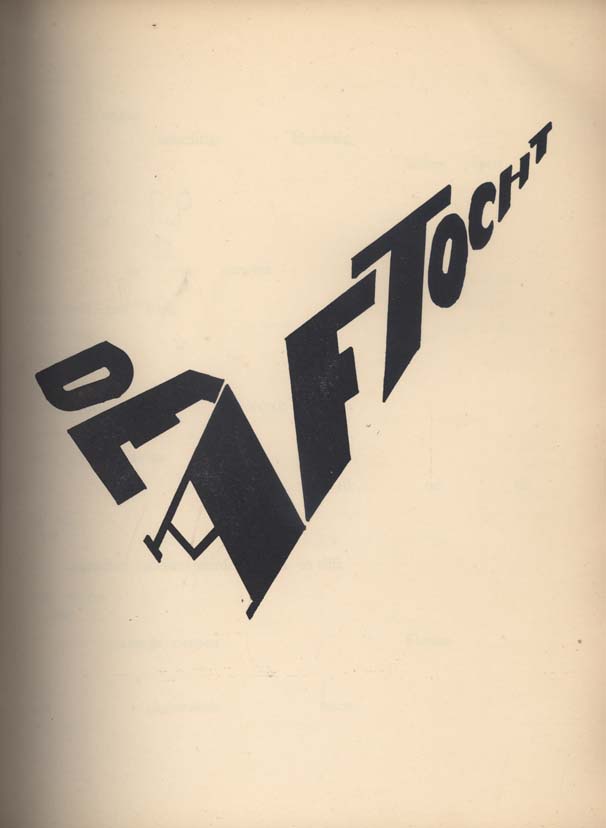
Bezette Stad —  A book of poems by Paul van Ostaijen, illustrated with woodcuts by Oskar Jespers, available in full at the University of Iowa Libraries’ astonishing International Dada Archive (via the lovely Aqua-Velvet).

And finally…

ENOUGH! — The hilariously on the money Editorial Anonymous:

I REALLY NEED A FRICKING BREAK FROM THE “FUTURE OF PUBLISHING” TALK… I don’t need to read any more of these articles, and neither do you.

A quick overview:

1. Publishing is a somewhat crappy business. Which makes it PRETTY MUCH LIKE EVERY OTHER BUSINESS.
2. Publishing has a future. NO ONE KNOWS WHAT IT WILL BE.

So everyone can stop
a. COMPLAINING
and
b. COMPLAINING.

Thank you.

No, no, Thank YOU.

3 Comments

Sunnyside

I just picked up  copy of Glen David Gold’s most recent novel Sunnyside.

Book Covers Anonymous gave the British cover — with a whimsical illustration by Adam Simpson — some love back in July, but I think I prefer this lovely elegant, and understated cover by Megan Wilson for the US edition published by Knopf:

You can see more of Megan Wilson’s work at her website, including these rather lovely covers for Vintage’s Richard Yates reissues:

Young Hearts Crying: Photograph by Richard Rutledge

A Special Providence: Photograph by John Rawlings

Comments closed

Midweek Miscellany, May 13th, 2009

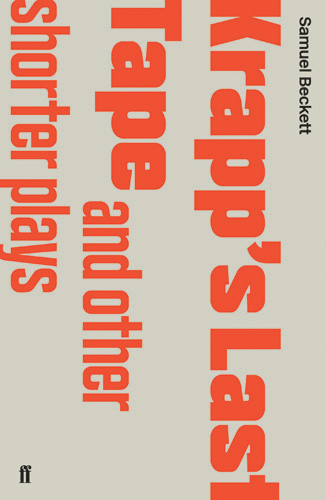
Any colour, so long as it’s grey” — New typographic covers for the Faber editions of Samuel Beckett,  designed by London-based studio A2/SW/HK. You can see more from the series at Faber’s Flickr photostream.

The Publishers’ Dilemma — Tobias Schirmer on publishing’s digital future:

[D]igitalization is not about a product moving from its analogue to a digital form. It is a revolution that changes everything. The old business models don’t work the way they used to. Inevitably, publishing needs to think about how it can still inject value somewhere in between the creation of content and its distribution. Not transition but change management is needed.  Acknowledging this is the first step in getting out of the publishers dilemma.

Now is the Winter of our Discontent — Peter Olson, the former chairman and CEO of Random House, is feeling gloomy in Publishers Weekly. I wonder how much of this only applies to bloated multinationals?:

With the recession accelerating changes that are already taking place in the market, the world after 2009 will likely begin to look very different for book publishers, and a likely return to the relative security of the last decade may be wishful thinking.

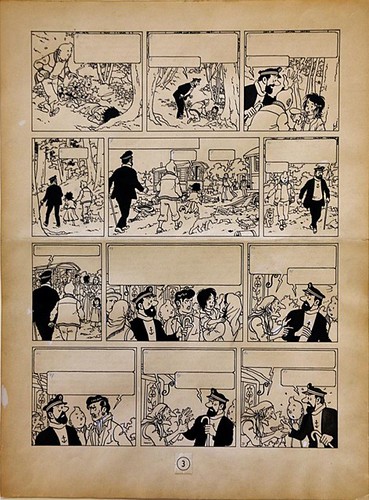
Tintin and the Broken Records600 lots associated with the cartoonist Hergé were sold at auction at the weekend:

The sale in Namur, southern Belgium, dominated by five large hand-drawn pages of original cartoon strips, raised 1,172,000 euros (1.57 million dollars), including charges, — a world record for Herge-associated items and a cartoon strip book record in Belgium, said Thibaut Van Houtte, an expert on hand for the Rops auction house sale.

Titles Designed by Saul Bass — A collection of Bass’ incredible film credit sequences at Not Coming To A Theater Near You (via Grain Edit on Twitter):

One is pressed to cite an example of an active, self-contained, and characteristic credits sequence in film prior to the work of Saul Bass. And…  in regard to innovation, renown, and influence, Bass’ impact in credits design remains virtually unparalleled, even to this day.

Comments closed

C.S. Richardson on Book Design

BookLounge have posted three really interesting videos of  C.S. Richardson, VP, Creative Director at Random House of Canada, discussing the history and practice of book design (clip 1 above).

Link

2 Comments

The e-book Revolution Favours the Agile (But Deep Pockets Help)

The publishing industry is finally turning toward “mass digitization”, Matthew Shaer reports in The Christian Science Monitor .

But “it’s not the bigger houses, such as Macmillan or HarperCollins, that are moving the fastest” he says. It is agile independent presses — who can make decisions quickly  and are “more open-minded when it comes to distribution and marketing” — that are “making the most extensive restructuring efforts” according to Schaer.

Independent presses are undoubtedly innovating — necessity is the mother of invention after all — and I would really love to believe that they can steal a march on the big publishers in the “e-book revolution”. Unfortunately I just don’t think it’s true. Or, at least, that simple.

Even if you ignore the Schaer’s assertion that the “typical” independent press can make quick decisions “without much internal friction” (in theory yes, in practice I’m not so sure), the ability to adapt is not just about a “fast and light ethos”, it is also about resources. It actually takes a great deal of time and expertise — often in short supply at small presses — to put a digital program in place. And although the cost of creating, marketing, and selling e-books may be low once the infrastructure is there, getting to that point requires a lot investment.

Soft Skull’s ambitious aim to have its entire list available digitally by the end of the year is a huge step for an independent publisher. But the two publishers Schaer specifically identifies as being behind the times are, in fact, already on this track. In November last year, Pan Macmillan made books available for the Stanza e-book reader for iPhones, and they currently offer a large, large number of downloads in different formats from their  web site, as do  HarperCollins .

In fact, ALL of the other major publishers — Random House, Penguin, and Simon & Schuster — offer e-books to download from their web sites in the US. Not that you would know from Schaer’s article.

And HarperCollins has been trailblazing with creative online initiatives in the past year. They set up Authonomy, a community site for writers, and are launching BookArmy, which Victoria Barnsley, chief executive of HarperCollins UK, describes as a “social networking site organised around books and authors.” . They’ve collaborated with if:book London and Apt to create an online, annotated version of Doris Lessing’s The Golden Notebook , and in December they released a charming online video, This Is Where We Live, to celebrate the 25th anniversary of their 4th Estate imprint, that quickly went viral.

In April 2008, HarperCollins also acquired The Friday Project — originally set up to find  web based material and turn it into books — as an “incubator for fostering new talent, and finding new markets.”

And let us not forget HarperStudio who may not be offering e-books yet, but have firmly established themselves on online.

Penguin have not been idle either. In December, Penguin US launched Penguin 2.0 to boost their web presence with an iPhone app and other downloads. Penguin in the UK — who sponsored in the recent BookCamp on technology and the future of the book — not only offer over 1,000 e-books on their website, they have an online dating service (no, really), and have created SpineBreakers, a web site with teenage contributors. And there is, of course, the ever-popular Penguin Blog.

The same day as Penguin 2.0 was announced, PW also reported that Random House would be partnering with Stanza and making select titles available for iPhones, and in January, Simon & Schuster relaunched their website with all the whistles-and-bells — such as blogs and author videos (outlined by PW here) — that one would expect from a publisher who knows their audience is online.

Of course none of  these strategies is perfect and the major publishers still have work to do on their e-books programs (there have been complaints about the  pricing in particular), but this is a period of experimentation and, with the best will in the world, it’s simply absurd to suggest, that the big publishers are “dinosaurs” who “think people are just sitting down in leather chairs and reading hardcopy books.”

Independent publishers may have “the most to gain from electronic publishing” as Richard Nash of Soft Skull says, and I genuinely hope that e-books usher in a renaissance of independent publishing. But the big publishers are not blind to the possibilities that technology is opening up and they have the resources to move quickly and boldly, and, in some cases at least, they are doing so. Let’s just give credit where it is due.

1 Comment

BEC DOA

Book Expo Canada is in trouble.

The Canadian publishing trade show has been dogged by industry apathy and persistent complaints about high costs, low attendance, and a lack of paying customers for years. But the immediate need to cut costs in the face of the economic downturn — or, at least, see some kind of measurable return on investment —  has been the final straw for dissatisfied publishers.

Random House, Canada’s largest trade publisher, unilaterally withdrew from the event in November, and last week HarperCollins and Penguin — closely followed by  Scholastic Canada and H.B. Fenn & Co.  — announced that they would not be attending BEC in 2009 either.

Scheduled for June 19th-22nd at the Metro Toronto Convention Centre, organizers Reed Exhibitions initially said that it was still their intention to hold the annual convention even though Simon & Schuster was the only one of the “Big Four” multinational publishers committed to the ailing event.

Now it seems Reed may be reconsidering that decision after Random House’s recent announcement that they would be launching a new Toronto “literary and cultural” festival with the Globe and Mail in May —  one month before BEC.

With a high-profile media sponsor, and including events with crowd-pleasing luminaries such as Naomi Klein, Margaret MacMillan, Richard Florida, Pulitzer Prize nominee Ha Jin, and New Yorker columnist Adam Gopnik, the two day “Open House Festival” is clearly aimed at doing precisely what BEC has seemed so incapable of – bringing in paying customers and driving book sales.

More troubling for Reed is that the new festival means their latest initiative, the Toronto Book Fair, planned for the first weekend in October, will almost certainly be stillborn.

Details of the fair were unveiled earlier this month by John McGeary, Reed’s general manager for Canada.

Hoping to win over critics of Book Expo, McGeary outlined an “inclusive celebration of reading and literacy” akin to Salon du Livre. But hampered by a venue (the Direct Energy Centre) on the fringes of public transit, and scheduled for one of the busiest months in the publishing calendar, Reed’s plans disappointed the vast majority of the invited audience of independent booksellers and industry-types.

McGeary, relying heavily on his PowerPoint slides, struggled to articulate a coherent vision for a fair that nobody seemed to want, and was unable to substantially differentiate it from Word on the Street, the popular not-for-profit book festival taking place in downtown Toronto one week before the Reed event.

“We consider ourselves extremely different” was about the best McGeary could manage. “Yes”, a wag in the audience said, “Word on the Street is free and in Queen’s Park!” Touché .

The poor timing and location, combined with a breath-taking dearth of both imagination and logistical detail, makes it unsurprising that Random House and Penguin have already announced they will not be attending the new fair. And more publishers are sure to follow suit.

Reed — who are now, according to PW, reviewing all their dealings with the book industry in Canada — will no doubt blame the combined failure of BEC and the Toronto Book Fair on the crumbling economy and the mixed messages sent by fickle, selfish and duplicitous book industry players.

But Reed cannot entirely escape responsibility for their situation. They have consistently put the cart before the horse, planning events before they have identified a real need or purpose. This ‘build it and they will come’ attitude may have worked in the past, or perhaps elsewhere. Unfortunately Reed’s abortive attempt to make BEC more inclusive two years ago, the now infamous the Booked!, and the shortcomings of the trade show itself have seriously damaged their credibility in Toronto.

And Reed is guilty of simply trying too hard. Their efforts to be inclusive are laudable, and yet in trying please everyone, they inevitably please no one.

The book community in Toronto consists of authors, publishers, distributors, bookstores, libraries, readers, publicists, journalists, bloggers and more. Their interests conflict at least as often as they overlap, and one only needs to look at the finger-pointing and handbag-swinging caused by the high Canadian dollar last year to see that relations between publishers and booksellers, and booksellers and their customers, (not to mention the industry and the media), are fragile at best. People get upset. And they get over it. Reed has never quite seemed to grasp that to organise an effective event they will need to risk offending some people.

It is simply not fair to expect Reed to organise an event like BookCamp, or even Word on the Street. It would be impossible. But Reed could – and probably should – have organised an event like the Open House Festival. It should’ve been possible to work, initially at least, with one or all of the Big Four and a single retailer to kickstart something bigger and more inclusive. Random House’s understandable impatience has slammed that door  in Reed’s face, and, to be honest, it is hard now to see where they have left to turn.

Comments closed

Midweek Miscellany, Jan 21st, 2009

The Books are alright — Montreal’s Hugh McGuire (of LibriVox and Book Oven) on the Penguin-sponsored BookCamp in London:

If the amount of thought and enthusiasm generated that day — and evening — is any indication, I think we’re going to be OK. The book is alive and well, even if defining “book” is becoming more complicated; and the publishing business, bracing itself for the biggest shake-up since the paperback, will come out the other end, transformed certainly, but alive nonetheless.

Cuts Were Necessary — The New York Observer on Marcus Dohle the new CEO of Random House (previously described as “dapper, but mildly off-putting”):

Now, the feeling among both literary agents and executives who used to work at Random House seems to be that Mr. Dohle inherited a rotten, bloated thing when he took over last May, and though one can wish it hadn’t gone the way it did, there simply was no reversing the damage done by his predecessor, Peter Olson, without forcing the publishers who’d survived his thoughtless 10-year reign to make some hard calls.

Rotten and bloated. Nice.

How to Publish in a Recession — a wide-ranging interview with Declan Spring, senior editor at New Directions, at Conversational Reading (via Ready Steady Blog):

We’re not beholden to stock owners, our overhead is pretty small, and we always count on just a pretty small profit every year anyway. Our staff has worked here for many years, mostly the same folks for twenty years, who are devoting much of their lives to the mission of ND. We see it as a profit-making business, but we are also realistic and dedicated to the cause. That makes it easier in this climate.

And speaking of New Directions… Any excuse (really) to post another book jacket by Alvin Lustig (pictured).

Comments closed

Cautious Optimism

Books a better buy in Canada? After all the problems caused by the high Canadian dollar in 2007, Canadian publishers and booksellers are “cautiously optimistic” at the start of this year’s holidays according to Vit Wagner in the Toronto Star:

“The climate is much better this year,” says [Nancy] Frater, proprietor of the Orangeville store BookLore. “My reason for optimism is that in challenging economic times, people do turn to books. As gifts, books have long-lasting value and they’re reasonably priced.”

It’s all relative though:

“I can’t look into the future and say everything’s going to be sanguine,” says Random House of Canada’s [Brad] Martin. “We’re doing a lot of cost cutting, but it’s more discretionary, like cutting the number of sales conferences from two to one. But we believe that the organization that we have now is what we need to successfully publish books in this country at the level that we have been publishing them.

“What I can’t tell you is what is going to happen to the market over the first six months of next year. It’s concerning for all of us. But certainly right now we seem to be performing better in a difficult market than the two other major English-language markets.”

And I’m not sure how this all sits with the recently reported “belt-tightening” in Canadian publishing — including staff changes at KidsCan Press and Thomas Allen postponing most of  their spring 2009 list — and all the grim news coming out of the US.

Is there worse to come? Any Thoughts?

1 Comment

“A hint of optimism”

Publishers Weekly is reporting that following “one of publishing’s bleakest weeks” in living memory, there’s a reason for us to keep on living in the form of two recent digital announcements from Penguin and Random House.

Penguin have launched Penguin 2.0 which includes more online content, e-books and POD, as well as an app imaginatively called ‘Penguin Mobile’ which makes the features from Penguin’s website available on the iPhone.

In the meantime, Random House have announced a partnership with Stanza “the popular iPhone e-book reader from Lexcycle” that will make e-books by several RH authors available for free on the platform. According to the press release, the books available “will be drawn from each author’s backlist and will include excerpts for any new hardcovers coming in 2009.”

I have to say I was really surprised how much I like e-books on the iPhone. But what does this mean for single-purpose devices like Sony’s e-Reader and Amazon’s Kindle?

Comments closed

Whiskey Tango Foxtrot?*

There has been relentless torrent of grim publishing news coming out of New York the last few days.

It has, at times, been hard to keep up with it all, and I don’t know the people involved well enough or understand the machinations sufficiently to offer much in the way of trenchant analysis. I hope that a summary of ‘Black Wednesday’ and the rest of this week’s events — with appropriate links — will, at least, offer some kind of context.

The details are sketchy, but Houghton Mifflin Harcourt acknowledged that there would be further changes at the company, including job-cuts. According to Publishers Weekly, at least eight people have been let go including executive editor Ann Patty, senior editor Anjali Singh and legendary editor Drenka Willen. GalleyCat has spokesman Josef Blumenfeld’s full statement about the changes.

Personally I’m stunned that the recipient of the 2007 Maxwell E. Perkins Award Drenka Willen, the US editor of Günter Grass, José Saramago and Umberto Eco, has been let go by HMH. PW profiled Willen in 2002, and, after pointing out that she has edited four Nobel Prize winners, MobyLives asked, pertinently, “do the proprietors of Houghton Mifflin Harcourt really know what they’re doing?”

I think my favourite quote, however, came from an unnamed ‘publishing veteran’ who told GalleyCat:

“Those fuckers have destroyed two venerable publishing houses in less than a fucking year.”

Elsewhere things are not much better.

Earlier in the week, Christian publisher Thomas Nelson announced it would be laying off 54 employees, or about 10% of its workforce. CEO Michael Hyatt said in a statement on his corporate blog From Where I Sit :

This was the second round of reductions this year. Unfortunately, this one was no less painful. We did the first round after significantly cutting our SKU count. However, this second round was purely a result of the slowdown in the economy.

According to GalleyCat , Hyatt apparently first made the announcement by Twitter. Stay classy Michael, stay classy…

After Doubleday cut 16 jobs in October, the “long anticipated” restructuring of Random House was announced on Wednesday. Maud Newton offered some bleak analysis and reprinted the full memo from Random House CEO Markus Dohle. Sarah Weinman has questions. Kassia Krozser at BookSquare thinks it’s all irrelevant:

“Who really cares if Crown or Knopf or Ballantine or Bantam Dell survives? I’m serious. Who. Cares… Focusing on imprints is focusing on the wrong problem.

The hyperbole-prone New York Observer called it “The End of an Era”.

In addition to the upheaval at Random House, Simon & Schuster announced it was eliminating 35 positions on Wednesday. Publishers Weekly reported that the Rick Richter, the president of the company’s children’s book division, and Rubin Pfeffer, senior v-p and publisher of the children’s group, would also be leaving.

On Thursday, Penguin Group chairman and CEO John Makinson announced the company will not give pay raises to anyone earning more than $50,000 in the new year. PW quoted Makinson as saying: “I cannot of course guarantee that there will be no job losses in Penguin in 2009. In this financial climate that would be plain foolhardy.”

And, according to a recent wire story from the AP on this week’s events in publishing, pay raises at HarperCollins have been delayed until next July. Spokeswoman Erin Crum says that “no decisions had been made” on job cuts, whatever that means…

All in all, it’s been quite a week. Thursday’s New York Times had a thorough summary and postmortem, and Andrew Wheeler has been keeping a running tab of the changes on his blog if you want more details.

Do I see a silver lining? Well, my hope is that all the talented, smart people who got unceremously dumped this week will stay in publishing (but who could blame them if they don’t?) and take their brilliance and vast experience to smaller more flexible companies and deliver a resurgence of creativity in New York. That would be nice wouldn’t it?

UPDATE:

Ron Hogan has posted some that trenchant analysis that I was talking about over at GalleyCat.

Also, what are the implications of all this, if any, for Canadian publishers? Anyone…?

*Thanks to Pete for the best blog post title ever.

Comments closed