Skip to content

Tag: poetry

Poets with Cellphones

Stephen Collins for The Guardian

Comments closed

Let’s Not Play Frisbee With That Poet Anymore

frisbee Stephen Collins

Stephen Collins for The Guardian (and newly available as limited edition Giclee print from his shop).

Comments closed

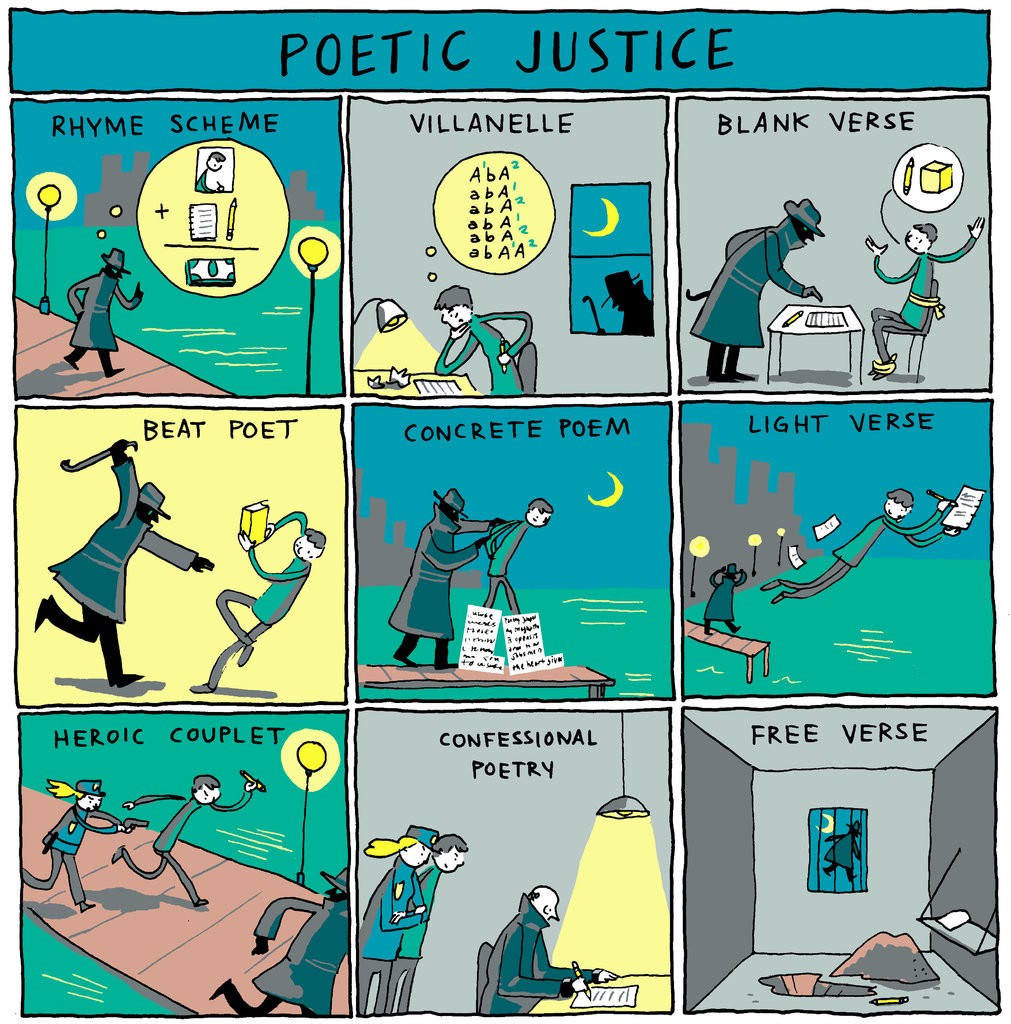
Poetic Justice

03snider-jumbo

Grant Snider marks National Poetry Month for the New York Times.

Comments closed

Jeff Shotts: Artful and Enduring Experiences

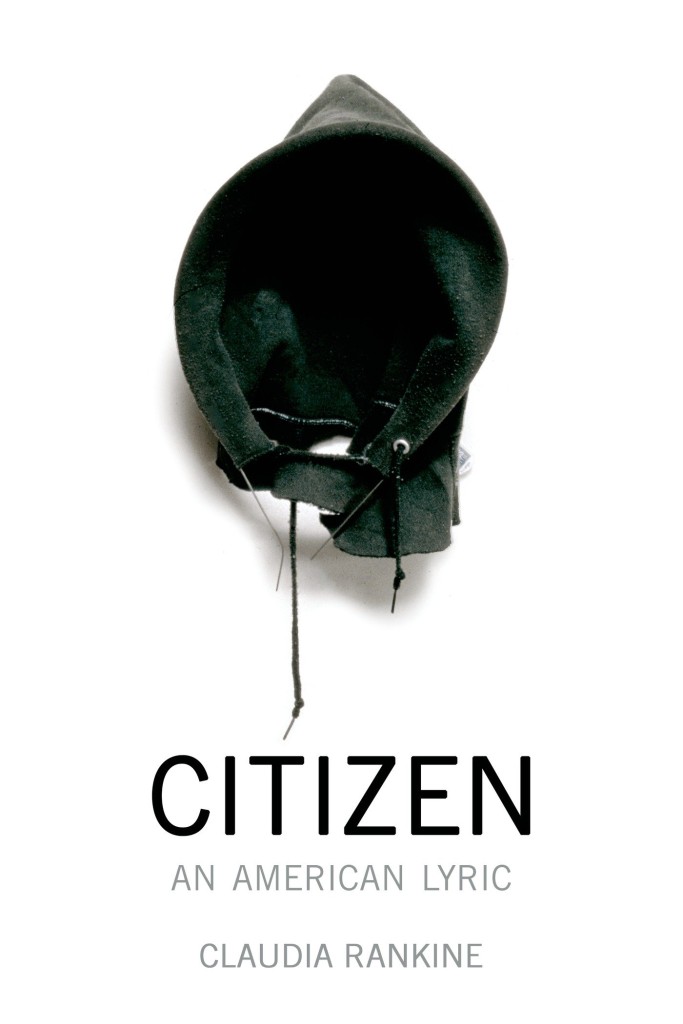
citizen

At Literary Hub,  Jeff Shotts discusses his work an editor at Minneapolis-based publisher Graywolf Press with Kerri Arsenault:

At Graywolf, we choose what we choose because these books deal with uncomfortable issues. Sometimes we need comfort, but what comforts us as readers, when so much of the rest of the world is hard at work to comfort us? I am made more uncomfortable by passivity, invisibility, and perfection. And readers want books like Citizen, which directly confronts race, or’On Immunity, which takes on vaccination and cultural fear, or D. A. Powell’s exquisite, lyrical trilogy collected in Repast, on illness and HIV, or Solmaz Sharif’s upcoming Look, which describes the casualties of war, one of which is our language.

All of these books we choose because of the issues they confront, yes, and also because of how they confront them. The language, style, and form of the books Graywolf publishes are meant to challenge you, provoke you, keep you reading, immerse you in experiences that you can’t shake off after you look up from their pages. Not all these experiences are loud or ugly, and many of them are also subtle, internal, joyous, and beautiful. But we hope all these experiences are artful and enduring…

…It’s a risk in this climate to publish the kinds of books we do—poetry and translations, essays and short stories, works of social justice and artful language. But we continue to recognize that many, many people are excited by these kinds of books: they want to read them, share them, hand-sell them, download them, review them, teach them, study them, engage with them, maybe throw them across the room. As an independent, nonprofit, mission-driven publisher, Graywolf and our titles exist in the same marketplace as countless, more commercial publishers and their titles, and these books have to compete for attention, review coverage, bookstore placement, online positioning, distribution, sales, awards, event listings, and on and on and on. It’s a risk in most every way, but given the extraordinary success many titles have had in these last few years, I think more and more people inside and outside the industry are giving Graywolf books an extra look and an additional boost.

Comments closed

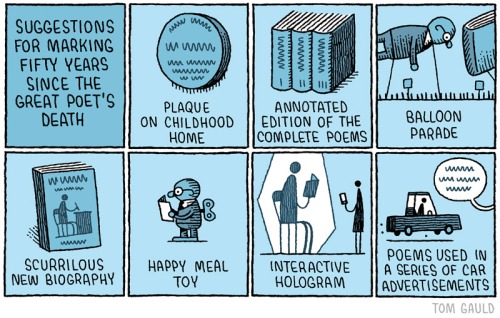
50 Years Since the Great Poet’s Death

50-years

Tom Gauld‘s weekly strip is back in The Guardian.

Comments closed

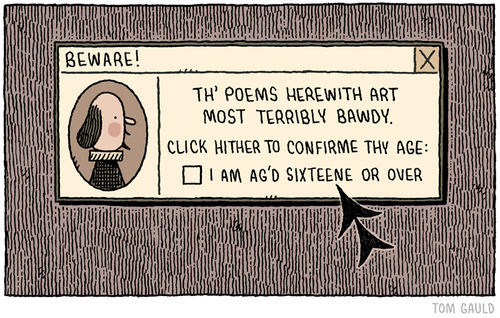
Beware!

beware

Tom Gauld

Comments closed

Graywolf and the Art of Independent Publishing

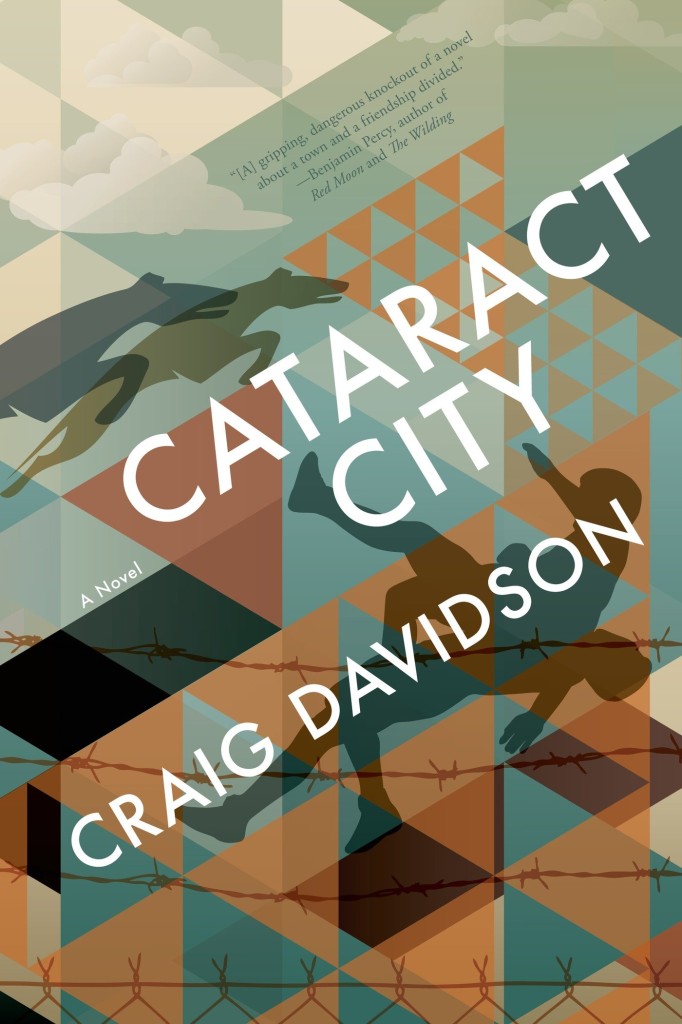
cataract-city

At Guernica Magazine, Jonathan Lee interviews Fiona McCrae, the publisher at American independent press Graywolf:

Any day of the week you can see that the big publishers are publishing some great books… But I think sometimes the context they’re working in involves the wrong kind of economic stress—or at least, a focus on economics and commerce that is not always conducive to interesting literary dialogue, or finding the new things that are happening at the edges of the literary culture. A very big publisher is unlikely to publish poetry unless the poets have already proven themselves—made it. And they are unlikely to go anywhere near essays, or hybrid books that fall between genres or play with conventions. Translation. Short stories. Criticism. We’re able to publish all these things, but someone who is required to hit X financial target each year is unlikely to go anywhere near those areas of literature…

There are dozens of obstacles to any given book succeeding. If a book succeeds it always does so against the odds. The odds in one generation might relate to the fact that people would rather be watching television than reading your book. The odds in the next generation might be that they’d rather be on their computer than reading your book. Once it was that people would rather be riding a bicycle than reading your book. It doesn’t do any good to be talking, as an author or publisher, about the obstacles. There are better uses of energy, I think. Yes, we can all feel helpless and wary in this industry sometimes, but it’s better, as a publisher, to look at the ways in which e-books and Twitter and so on can help us reach new readers, rather than treating social media as an enemy to literature.

Just last Friday, Publishers Weekly ran a short piece about the surprise success of Leslie Jamison’s The Empathy Exams, winner of the Graywolf Press Nonfiction Prize:

The Empathy Exams has already gone through five print runs, and a sixth print run of 10,000 copies has been scheduled, bringing the total number of copies in print to 25,500.

Graywolf, the small literary press in Minneapolis that published The Empathy Exams, is no stranger to media attention, having published books that have won National Book Awards and Pulitzer Prizes. While the publisher expected that the collection, which won the 2011 Graywolf Nonfiction Prize on the basis of a partial manuscript, would receive positive media attention, it is still a bit taken aback at the degree of acclaim. The buzz began months ago, when the key independent booksellers who received early galleys started talking it up on social media and recommending it to their colleagues. The bookseller chatter picked up steam at Winter Institute, which Jamison attended. It has continued through this past month, when Jamison launched her book tour at Yale University in New Haven, where she is pursuing a Ph.D in literature, followed by a more formal launch at Common Good Books in St. Paul, Minn. She has been speaking before standing-room-only crowds at indies around the country since then.

Well played.

(Disclosure: Graywolf Press are distributed in Canada by my employer Raincoast Books)

Comments closed

Skydweller: A Portrait of London

skydweller
Skydweller combines over 5,000 photographs of London taken from the top of Cromwell Tower, one of the three residential towers in the city’s Barbican Estate. The short film is accompanied by music specially composed by Tom Rosenthal and poetry by Paul Haworth:

(via ArchDaily)

Comments closed

Day Jobs of Poets by Grant Snider


The new comic from Grant Snider, ‘The Day Jobs of Poets’, comes with the following disclaimer:

“there’s no evidence that Emily Dickinson liked cats, but her sister Lavinia was cat-obsessed. So Emily must have been forced to cat-sit occasionally.”

The comic is available as a poster from Grant’s shop.

Comments closed

Meeting John Berger

A beautifully shot portrait of English art critic, writer, artist and philosopher John Berger by filmmaker Jos de Putter:

Berger is probably best known for his BBC TV series and book, Ways of Seeing.

3 Comments

Midweek Miscellany

A.S. Byatt by reviews Peter Carey’s latest novel The Chemistry of Tears for the Financial Times.

Also at the FT: Jennie Erdal, author of The Missing Shade of Blue, on philosophical novels:

The more novels I read at university, the more I felt that fiction was where truth was to be discovered. I seemed to experience Melville’s “shock of recognition”; which is to say re-cognition, for it was there already, waiting to be reawakened – the knowledge that some things, not least what it is that makes us human, can never be adequately expressed in conventional philosophical prose.

Scheduling Time to Stare Out of the Window — Clay Shirky on boredom (via Nicholas Carr):

It was only later that I realized the value of being bored was actually pretty high. Being bored is a kind of diagnostic for the gap between what you might be interested in and your current environment. But now it is an act of significant discipline to say, “I’m going to stare out the window. I’m going to schedule some time to stare out the window.” The endless gratification offered up by our devices means that the experience of reading in particular now becomes something we have to choose to do.

No Friends But Empty Chairs — Michael Dirda on Philip Larkin for The New Criterion:

As Alan Bennett observed, the poet acted sixty all his life and made a profession of it. Larkin certainly had absolutely nothing going for him physically, being tall and stooping, bald, deaf, overweight, with an occasional stammer, multiple chins and inch-thick spectacles. As if this weren’t enough, he generally wore dark, ill-fitting suits or—when on holiday—prissy shorts or a checked tweed sport coat. (A famous picture shows him in such a coat, sitting primly next to a sign that says “England.”) He wasn’t joking when he said, “Deprivation is for me what daffodils were for Wordsworth.”

And finally…

Generation Intern — Tim de Lisle on the appointment of 37 year-old Lawrence Booth, “the youngest [editor] in living memory”, to the helm of Wisden Cricketers’ Almanack:

Today’s young journalists have become Generation Intern, condemned to do one not-quite-job after another. Lawrence’s story offers hope, and some lessons. Be professional and adaptable. Embrace both print and web. Don’t fret if you get laid off. Hold your nerve and keep your voice. Write a piece as crisply as you write an email.

2 Comments

Something for the Weekend

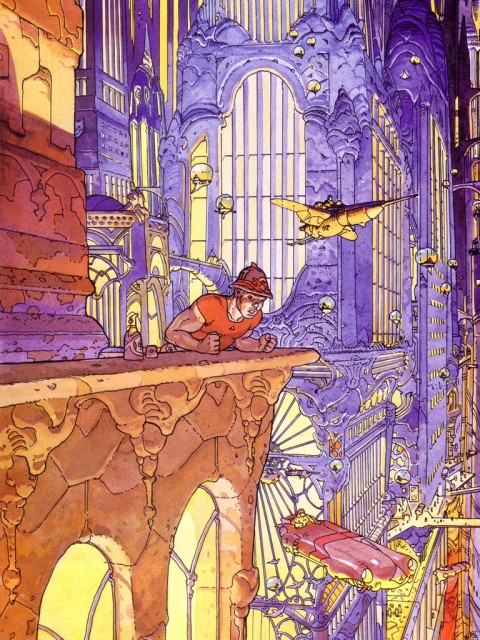
Tim Maughan on the influence of  the Jean Giraud on science fiction for Tor.com:

[The] combination of neon-lit noir streets, cramped towering city blocks, airborne traffic jams and scruffy characters seems almost a cliche today. But this was the first time anything like this had been drawn; and the first time science fiction had embraced the visual chaos of realistic urban environments. And the groundbreaking work is not just there in the architecture and mechanical designs; it’s apparent in the fashions and clothes of the city’s inhabitants. Although fantastic, exaggerated and other-worldy the city of The Long Tomorrow comes alive from the page because it feels so real, so layered and built — it is the urban paradise and nightmare of every industrial city from Tokyo to London.

The Catharsis of Exhaustion — Tim Parks on when to finish a book for the NYRB:

Other writers deploy what I would call a catharsis of exhaustion: their books present themselves as rich and extremely taxing experiences that simply come to an end at some point where writer, reader and indeed characters, all feel they’ve had enough… [These] writers it seems to me, by suggesting that beyond a certain point a book might end anywhere, legitimize the notion that the reader may choose for him or herself, without detracting anything from the experience, where to bow out.

Detachment — Edward St. Aubyn, Patrick Melrose Novels and At Last, profiled in the New York Times:

 “[There] is something morally condescending about forgiveness… Detachment is what interests me, seeing how people couldn’t have been any other way, how they were the product of forces that they had no control over… I was in the downstream of my father’s unhappiness, but it must have been hell to be him.”

And finally…

The Beat Hotel — A new documentary about the cheap no-name hotel at 9 rue Git le Coeur in Paris that harboured the likes of Allen Ginsberg and William Burroughs:

1 Comment