Skip to content

Tag: poetry

Something for the Weekend

Typographica’s favourite typefaces of 2011 (pictured above: A2 Beckett designed by Henrik Kubel for A2-TYPE).

The Coroner`s Report — John Banville reviews The Complete Poems by Philip Larkin for The Guardian:

A “Complete Poems” is a death certificate and memorial combined. After the Selected and the Collected, the Complete marks the poet’s official demise and at the same time erects a carven monument designed to outlast the ages. In the case of this mighty volume of the all of Larkin, there is something too of the coroner’s report.

A twopart interview with William Gibson, author of Distrust That Particular Flavor, in the Wall Street Journal.

And finally…

Go Outside — Ian Leslie responds to criticism of his essay on serendipity:

The inherent limits of older formats like newspapers or bookstores are a feature as well as a bug. They make things a bit difficult for us, and because of that they often push us towards unsought-for discoveries.The modern internet makes each of us like a rich man in his mansion who has the finest food flown in from every corner of the world and whose favourite singers and artists come and perform for him in his bedroom at a moment’s notice. He has a nagging feeling that he ought to go outside and experience the city and its manifold surprises first-hand. Nothing is stopping him from doing so. But it feels like such an effort.


Comments closed

Storm

Tim Minchin’s 9-minute beat poem Storm — a witty and f-bomb fuelled defense of science and critical thinking — is beautifully delivered in this animated movie directed by DC Turner and produced by Tracy King:

(via Quipsologies)

Comments closed

Ted Hughes ‘On Thinking’

Sadly the end of the poem Hughes reads,View of a Pig, is cut off, but otherwise this is still rather wonderful:

The last line of the poem is:

Scald it and scour it like a doorstep.

(via Russell Davies)

2 Comments

Patti Smith on PBS NewsHour

I began, of course, as a poet, but the power of rock ‘n’ roll — rock ‘n’ roll was really the canopy of our cultural voice, and especially in the ’60s, late ’60s and early ’70s, that — and our rock stars, the people who were building that voice, whether it was John Lennon or Neil Young or Bob Dylan, or whoever it was, they were infusing politics and — and political ideology, social justice, sexual energy, poetics, all within the canopy of rock ‘n’ roll, and striving to make this a universal language. It was a real mission. And I — I wanted to add to that. Writing poetry is beautiful, but, when I was young, I wanted to be part of this important cultural voice.

Patti Smith talks about her memoir Just Kids on PBS NewsHour:

(via The BDR)

Comments closed

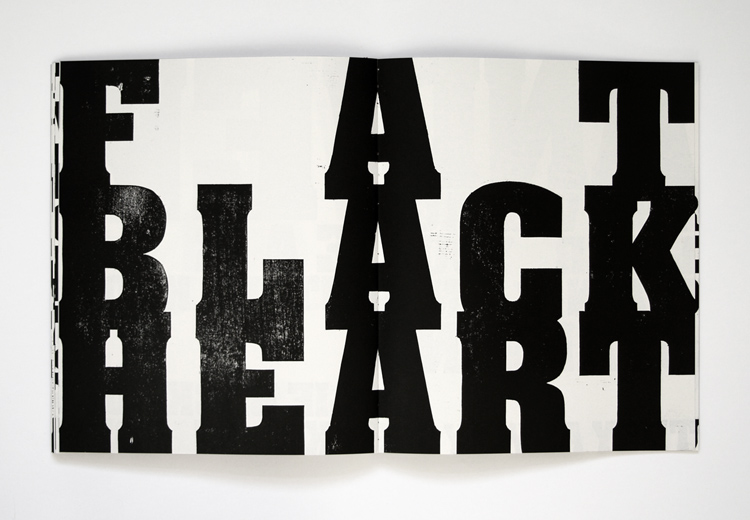
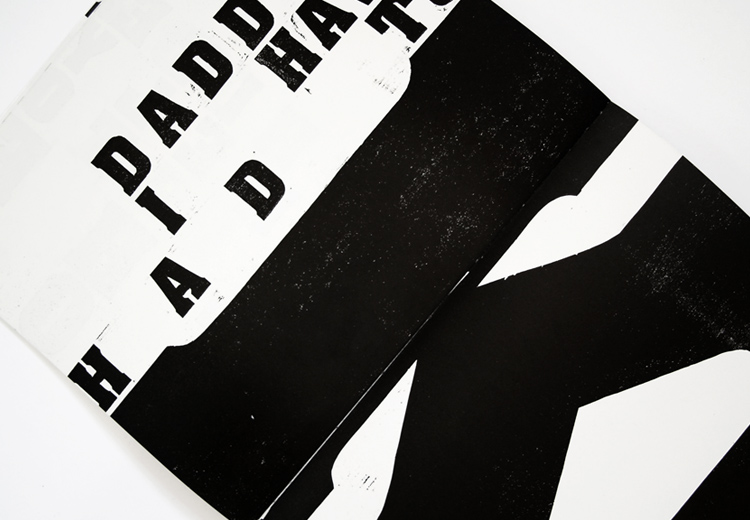
Daddy

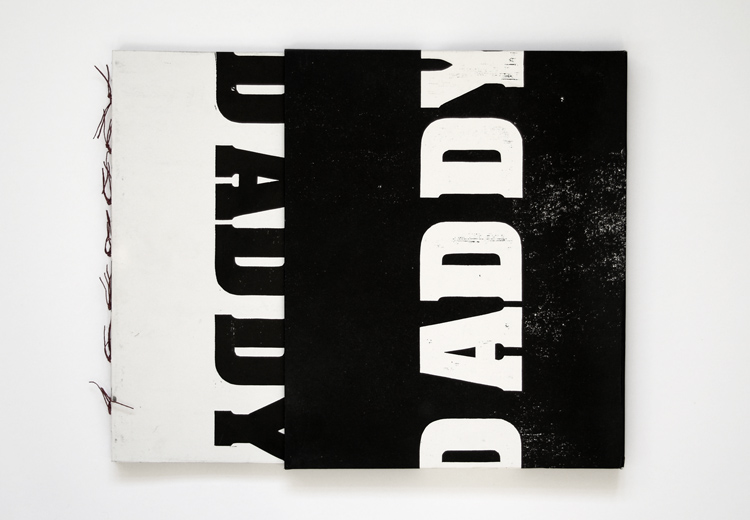
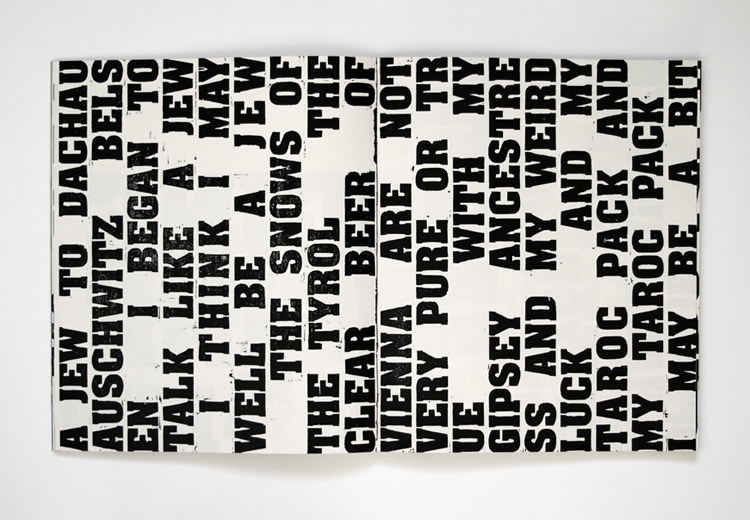
A typographic interpretation of the poem Daddy by Sylvia Plath, printed from 80 hand-carved woodblocks by Copenhagen-based design studio Daddy.

The book “seeks to capture and express the emotions and atmosphere of the text through the typographic treatment and woodblock printing.” Beautiful stuff:

(via Inspiration Lab)

Comments closed

English

In spite of the hardcover’s beautiful jacket design (by Paola Ecchavaria), it was a citation in Nicholas Carr’s recent book The Shallows that finally got me to read Proust and The Squid by Maryanne Wolfe.

It is a fascinating if, at times, academic book that examines the history of written language and the corresponding development of our ‘reading brain’. In a chapter on reading development, Wolfe includes a charming, witty poem on the vagaries of English pronunciation that I wanted to share. Wolfe says the poem is anonymous, but I have subsequently seen it attributed to T.S. Watt. Please let me know if you have any further details…

I take it you already know
Of tough and bough and cough and dough.
Others may stumble but not you,
On hiccough, through, lough and through.
Well done! And now you wish, perhaps,
To learn of less familiar traps.

Beware of heard, a dreadful word
That looks like beard and sounds like bird,

And dead; it’s said like bed, not bead;
For goodness’s sake, don’t call it deed!
Watch out for meat and great and threat,
(They rhyme with suite and straight and debt).
A moth is not a moth in mother,
Nor both in bother, broth in brother,

And here is not a match for there,
Nor dear and fear for bear and pear,
And then there’s dose and rose and lose–
Just look them up–and goose and choose,
And cork and work and card and ward,
And font and front and word and sword,
And do and go and thwart and cart.
Come, come, I’ve hardly made a start.

A dreadful language? Man alive,
I’d mastered it when I was five.
And yet to read it, the more I tried,
I hadn’t learned it at fifty-five.

2 Comments

Q & A with Nick Asbury, Corpoetics

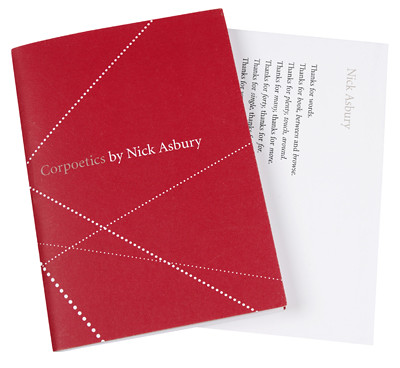
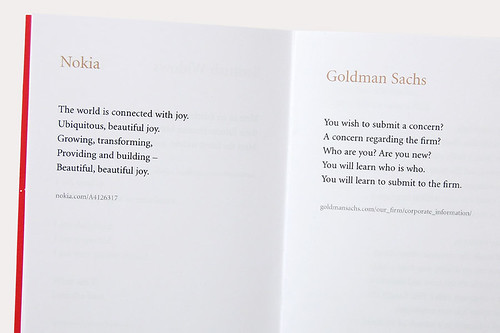
I was quite taken with the lovely design and gentle subversion of  Corpoetics — a chapbook collection of ‘found’ poetry taken from the ‘Corporate Overviews’ of well-known brands and corporations — when I first saw it at Ace Jet 170 in February.

Author Nick Asbury was kind enough to get in touch after I mentioned the project here, so when Corpoetics recently won a Yellow Pencil for Writing for Design at the 2009 D&AD Awards, it seemed like a perfect excuse to talk to Nick a bit more about the project, the corporate use of language, and interesting not-for-profit work…

What inspired Corpoetics?

My day job is as a writer for businesses and brands, so I’ve long been immersed in the corporate world. I’ve often sought refuge in reading and occasionally writing poetry, so I guess it was inevitable that the two would cross over at some point.

How would you describe ‘found’ poetry?

I came across a good quote by Annie Dillard, talking about the ‘doubling effect’ you get in found poems. ‘The original meaning remains intact, but now it swings between two poles.’ I think that’s about right. You get an interplay between the original meaning and where you’ve taken it — and there’s a lot of potential for humour and subversion, particularly when the source material is from the corporate world.

The language of several of the poems is almost Orwellian. Do you have a sense that corporations (deliberately or otherwise) dehumanise language?

Yes, dehumanise is exactly the word. A lot of corporate language is designed to erase any sense of individual responsibility. It’s much safer to talk about how ‘a decision was taken’ rather than saying ‘I took a decision’. So you get this very passive, depersonalised way of talking. Then there’s the widespread tendency to hide behind jargon and non-committal abstractions. In some cases, it’s deliberately intended to conceal or exclude. But a lot of businesses drift into it without realising — it just becomes the norm for writing in a business context.

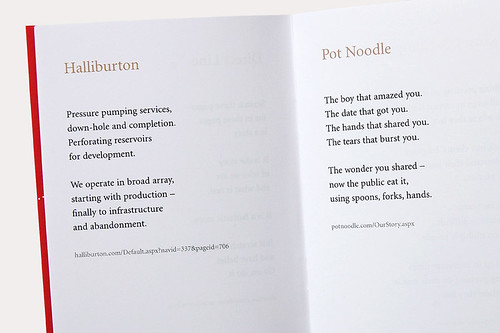
The poem I wrote about Halliburton is probably the most Orwellian in tone. It takes their words and lets their emptiness ring out in this very eerie way. But it didn’t take a lot of rearranging — it’s more like a condensed version of the original.
As a copywriter and consultant, do you feel a certain irony in the subversion of corporate language in Corpoetics?

Definitely. When I first had the idea, I was very aware of biting the hand that feeds me. But then the aim is not just to subvert corporate language and hold it up to ridicule (although some poems do). I also wanted to pick brands that I liked. People like Greggs The Baker — a fixture on British high streets — or Pot Noodle, a famously throwaway junk food here in the UK. It was interesting taking their words and seeing where they went. Pot Noodle became a story of a relationship that begins in furtive excitement and ends in squalor, much like the experience of the product itself.

Is it possible for business writing to have warmth and wit, or is it inherently evil?

That depends whether you think all businesses are inherently evil. I don’t. We all need to earn money and make a living — and work is a noble and necessary thing. Whether it’s the local bakery or a multinational giant, plenty of businesses make an honest living and do good things. Those businesses have a good story to tell — and there’s room for warmth and wit in the telling. Of course, the unfortunate truth is that a lot of ‘good’ business writing is a matter of spin — making companies seem better than they are. But the very best writing will always be for good companies with something truthful to say.

Have you had any response from the companies featured in Corpoetics?

Yes, KPMG got in touch. I took a deep breath when the email arrived, expecting a stern ultimatum from the legal team. But it was very positive. They said they wanted to feature it in their internal company newsletter and run a competition to get people to send in their own poems. I’d like to have seen the results, but still haven’t managed to track them down.

Why did you decide to publish Corpoetics as a book rather than make it a web-based project?

It seemed a very natural thing to do. Poetry just feels more satisfying when it’s in print. I work as one of a partnership (Asbury & Asbury) alongside my wife Sue, who is a graphic designer. So we thought about turning it into a design project as well as a writing project — taking graphic elements from the companies featured and rearranging them in some way. But we decided it was overkill. It’s ultimately a project about language and we wanted to let the words do the work.

Is the visual presentation of written language important to your work?

Yes — ever since I started out in business writing (about 12 years ago), I’ve worked closely alongside graphic designers. In fact, most of my work is commissioned by design and branding companies, so it’s a natural fact of life. I’d find it hard to write anything without having some sense of the way it will be presented visually. It’s never just about the words or the design, but the overall act of communication.
So good writing and good design go hand-in-hand?

Yes, ideally. I find a lot of the best designers are pretty good with words. Both professions have the same base skills. You need to analyse a brief, empathise with an audience, spot lateral connections, tell a story, make an imaginative leap. The disciplines only separate out right at the end, when the designer goes off to do the pictures and the writer gets typing.

What other projects are you currently working on?

I usually have three or four paying projects at any one time. At the moment, I’m writing an annual review for a British charity, some marketing literature for a hotel operator, and an advertising campaign for an Austrian law firm. Alongside all that, as Asbury & Asbury, we continue to work on our own projects. The latest is a collection of children’s poetry called ‘Songs For Animals‘, but it may not see the light of day for a while yet.

Can you tell me about 26?

It’s a not-for-profit collective of writers, editors, journalists, designers, publishers — anyone with an interest in language, both in a business context and more generally. As you might have guessed, the name comes from the letters of the alphabet, the DNA of language — and naturally, it costs £26 a year to be a member. I got involved shortly after it started up in 2002 and am now one of the directors responsible for running the whole thing — or trying to. It’s operated entirely on voluntary time and can be quite chaotic, but they have produced some really interesting collaborations, resulting in books, exhibitions and a whole series of public talks and events. It’s principally UK-based, but there are chapters springing up in South Africa, Sweden and elsewhere. I’d urge anyone with an interest in the subject to join. You’ve got nothing to lose. Except maybe £26.

Thanks Nick. Corpoetics is available for £5 plus p&p from  Asbury & Asbury , with proceeds going to the National Literacy Trust, a UK charity dedicated to changing lives through literacy.

1 Comment

Somthing for the Weekend, May 8th, 2009

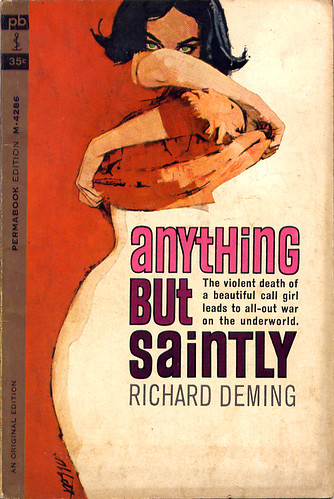
Anything But Saintly — More pulp goodness seen at The Old-Timey Paperback Book Covers Flickr pool.

The Decline and Fall of Books — Nicholas Clee, editor of Book Brunch, dons “The End is Nigh” sandwich-board in The Times:

A Gutenberg-style revolution is not… expected in the next few months. But if you are a lover of well-stocked bookshops, then you should enjoy them while you can.

Poets Ranked by Beard Weight — Or why I <3 the internet (via eightface).

Penguin Automaton made by artist-maker Wanda Sowry to celebrate Penguin’s 70th anniversary and available from Art Meets Matter . Apparently winding the handle “causes the Penguin to drink from a mug, its flippers to waggle and a piece of 70th Birthday cake to rise magically from the table” (via the lovely tweeps at New Directions ).

Good Typography is Invisible, Bad Typography is Everywhere — Stephanie Orma talks to five acclaimed designers about the art of type in the SF Examiner. Interesting to see some conflicting/contrasting opinions in the mix…

7 Habits of Highly Effective People I Know — A nice list from Noisy Decent Graphics Ben Terrett.

Comments closed

Midweek Miscellany, April 22nd, 2009

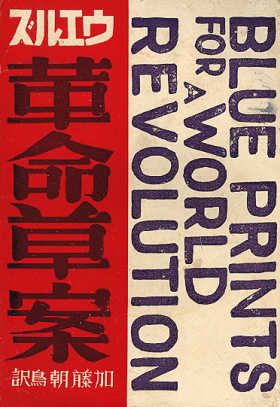
Blue Prints for a World Revolution — seen at the Antiquarian Bookshop 108 Buddhas, which has an amazing collection of avant-garde journals and books from Japan and Eastern Europe  in their gallery section (via Michelle McCormick’s Inspiration Resource ).

12 Steps to Better Book Publishing — Good stuff from Jonathan Karp, publisher and editor-in-chief of Twelve Books in Publishers Weekly:

It seems likely that the influence and cultural centrality of major publishers, as well as other producers of information and entertainment, will diminish as digital technology enables more and more people to create and share their work. This is exactly why publishers must distinguish themselves by doing better what they’ve always done best: champion books that offer carefully conceived context, style and authority.

The State of the IndustryNeil Nyren, senior VP, publisher and editor in chief of G.P. Putnam’s Sons talks to author  J.T. Ellison at Murderati (via @sarahw).

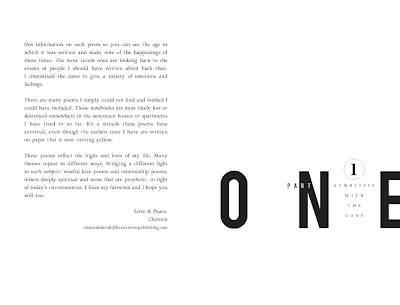
Poetic Interiors — Some lovely typography for Arrays of Conscious by Chanson Duvall at Beyond the Covers.

Embracing Change — Victoria Barnsley, chief executive and publisher at HarperCollins UK,  profiled in The Guardian:

There are still concerns about the digital future, such as how to continue making money. “There are some very big questions that we still have to answer – the biggest one being value,” says Barnsley. “How to make sure that consumers are going to be prepared to pay for digital content, because a lot of them are getting quite used to getting it for free?”

And yet…

Why newspapers can’t charge for online content — Dan Kennedy elsewhere in The Guardian:

I have no philosophical objection to the idea that news organizations ought to be able to charge for their online content. The problem is that it’s highly unlikely to work – mainly because there are too many sources of free, high-quality news with which they’re competing.

Font of Ill Will — Vincent Connare, designer of Comic Sans, profiled at the WSJ:

The font, a casual script designed to look like comic-book lettering, is the bane of graphic designers, other aesthetes and Internet geeks. It is a punch line: “Comic Sans walks into a bar, bartender says, ‘We don’t serve your type.'”

And finally…

Soldiers of Lead — An introduction to layout and typography for use in the Labour Party  (via Design Observer).

Comments closed

Something for the Weekend, April 17th, 2009


Isotype — Gerd Arntz’s amazing pictograms and visual signs for the visual language Isotype at the beautifully designed The Gerd Arntz Web Archive (pictured above).

Jacket(s) — Much as I admire Chip Kidd’s book covers, most of them are just too familiar to re-post here. But I hadn’t seen this ingeniously layered design for Kenzo Kitakata’s Ashes before even though it was published by Vertical in 2003 (pictured above). Seeing it all laid out, it’s really hard to begrudge Mr. Kidd’s reputation for awesomeness.

We like to be part of something — Nick Harkaway on connections:

A paper book has a history. Somewhere, at some time, an author wrote it all down, printed it out, gave it to an editor, who also worked over it. The book was typeset – yes, on a computer, these days, but still — and finally pressed and packaged and distributed. There is a chain of physical events which leads from me to you. With old editions, it’s even more direct. With signed ones, it’s a handshake. We like to connect. And digital books feel as if they’re trapped behind glass. The book is in the machine, and we can’t open the cover and touch the pages.

Black, white and read all overCreative Review looks at Faber & Faber‘s new editions of 20th Century poetry. The books feature specially commissioned woodcut and linocut cover illustrations.  The new editions are part of the Faber’s 80th anniversary celebrations. You can see more of the cover images at designer Miriam Rosenbloom’s design:related page.

The Disappointment Brokers — I going to go out on a limb and say this is another must-read for book-industry types from Poets & Writers — Literary agents Anna Stein, Jim Rutman, Maria Massie, and Peter Steinberg have a fascinating conversation about their profession and the state of the industry:

here’s the silver lining: [The industry’s] unhealthy enough that it’s an exciting time. It’s broken enough that publishers and agents and everyone has to change. Everyone has to rethink what they’re doing. So we have a group responsibility, and an opportunity, in a way that the industry has probably never seen before.

The Legacy of ModernismSpiegel Online celebrates 90 years of Bauhaus (via @PD_Smith).

Comments closed

Something for the Weekend, Feb 21th, 2009

Corpoetics — The text from the websites of  “well-known brands and corporations” remixed and rearranged into strangely engaging and enigmatic poetry by Nick Asbury (photo above from Ace Jet 170). I rather like the one taken from Scottish Widows:

Here in an Edinburgh coffee house,
their futures became history.
Meet the latest widow.

Copies of Corpoetics available for £5 (plus p&p) from Nick Asbury’s website, and all proceeds go to the National Literacy Trust, an independent charity dedicated to changing lives through literacy.
A Q&A With Four Young Editors — Just a fantastic, fascinating conversation between Richard Nash (Soft Skull), Lee Boudreaux (Ecco), Alexis Gargagliano (Scribner), and Eric Chinski (FSG) in the latest issue of Poets & Writers. It’s long. Make some coffee, grab a snack and devote some time to it. Well worth it. Honestly.

In Defense of Readers — Mandy Brown, Creative Director at W. W. Norton & Company,  on designing websites for readers:

Despite the ubiquity of reading on the web, readers remain a neglected audience… Readers flourish when they have space—some distance from the hubbub of the crowds—and as web designers, there is yet much we can do to help them carve out that space.

And last, but by no means least… Coralie in ConversationThe Caustic Cover Critic interviews Penguin’s super-talented book designer Coralie Bickford-Smith.

1 Comment

Something for the Weekend, Jan 16th, 2009

David Mirvish Books, the best fine art bookstore in Toronto, is to close. Damn. At least the Art Gallery of Ontario’s bookstore has re-opened with a decent selection of art books.

“It’s not something you should really do unless you feel really compelled to do it” — An interesting interview with Doug Seibold about founding Chicago-based publisher Agate over at Slate’s Bizbox:

As in a lot of other businesses, there’s a bunch of giant multinational conglomerates that are the big players, and they leave a lot of waste behind them. My feeling was a company that functioned efficiently at the appropriate scale could do a lot of business by being cost-effective and opportunistic. Not too little, but not too grandiose: growing at a careful, natural pace.

Attack of the “renegade cybergeeks”: New York magazine meets the team behind the New York Times’ online operation:

[T]here is something exhilarating about watching web innovation finally explode at the Times, with its KICK ME sign and burden of authority… Despite the effectiveness of blogs, the majority still mainly provide links and commentary. The Times Online suggests what might happen when technology fuels in-depth reportage

A little up it’s own arse and not short on hyperbole (“the New York Times is less a newspaper and more an informative virus”? Really?), it’s still definitely worth a read. Gawker’s predictably acerbic response can be found here.

“Poetry is both flourishing and floundering” — Neil Astley, editor of Bloodaxe Books, argues poetry must be responsive to readers not academic cliques, in the New Statesman:

The producers of poetry aren’t in tune with the lovers of poetry. Many poets and publishers are actually hostile to the promotion of poetry… They see marketing as a dirty word instead of simply the means by which their books are made available to more readers.

“Publishers… lost control of their industry” — a somewhat melodramatic (and therefore much-linked to) “autopsy” of the book business by Jason Epstein in the Daily Beast. I have a lot respect for Epstein, who is indeed a “publishing legend”, but it is worth keeping in mind that he said most of this in Book Business, published in 2001, and in an article for  Technology Review from January 2005. He’s also the man behind the futuristic-yet-seemingly-redundant (is there a word for that? Apart from ‘segway’?) Espresso Book Machine, so he’s not an entirely dispassionate observer.

Grant Morrison talks Batman with Publishers Weekly:

I wanted to assemble all the classical tropes of the pulp noir crime genre: the diabolical mastermind, the femme fatale, the inescapable traps, the secret societies of evil…and push them beyond all reasonable limits to a kind of screaming Death Metal crescendo.

Nice.

The Pelican Project: A collection of Pelican Book covers from the 1930’s through to the 1980’s (pictured). (I was reminded of this wonderful project by the eclectically brilliant FFFFound)

1 Comment