Skip to content

Tag: photography

Something for the Weekend

Terror! — Amis on Don DeLillo and his new book The Angel Esmeralda: Nine Stories in The New Yorker:

DeLillo is the laureate of terror, of modern or postmodern terror, and the way it hovers and shimmers in our subliminal minds. As Eric Hobsbawm has said, terrorism is a new kind of urban pollution, and the pollutant is an insidious and chronic disquiet. Such is the air DeLillo breathes.

It’s Only One Book — A great interview with Art Spiegelman about his new book MetaMaus at The Comics Journal:

[Maus] took me thirteen years to do without any map of how to do it. No matter what somebody says now about graphic novels, this was made without any instruction manual. I didn’t know how to make a comic that was built to be reread, and that held up as it got reread, and be built over such a large span of time. There wasn’t something for me to look at. I guess there were long mangas out there, but I wasn’t that into them. They weren’t translated back when Maus was made. So I didn’t have any way to structure this, and structure is so basic to how I perceive. So I’m stuck with something that took a lot of me to make. So what can one do after it without either betraying it or capitulating to it? It’s an ongoing struggle.

Optimistic — An interview with Toronto’s indie comics heroine Annie Koyama at Comic Books Resources:

I was never under the impression that anyone was getting rich publishing the kinds of books and comics I chose to do but hopefully by staying a certain size, you can at least sustain the business and continue to break out new artists. I’m still figuring out what works and what doesn’t, but it’s nice to see others out there taking risks on new talent too.

Because I wasn’t saddled with preconceived notions of how things worked, I of course made some mistakes but I was also freer to carve my own road. In Toronto, where I’m located, most of the art bookstores have closed but we have one of the best and most supportive comic stores anyway, The Beguiling. I would still personally rather read a book that I hold in my hands, but you cannot ignore the digital content that’s available to anyone now. So, for now, I remain optimistic.

And while we’re on the subject of comics:

An obituary of comics historian Les Daniels, author of Comix: History of Comic Books In America, in the New York Times:

 Mark Evanier, a comic-book writer and historian, said that before Mr. Daniels, “nobody thought to write the history of the industry,” adding that “back then, it was a sloppily run, disposable business that no one thought would exist for long.”

“He was a guy that publishers hired to come in and figure out the histories of their own companies,” Mr. Evanier continued, “and he produced major works upon which all future histories will be built.”

See also: Tom Spurgeon’s more expansive obituary at The Comics Reporter.

And finally…

The Creative Review previews Polish Cold War Neon, a new book by photographer Ilona Karwinska. Putting it on the Christmas list…


Comments closed

Don McCullin

Photojournalist Don McCullin is internationally renowned for his images of conflict. But a new exhibition of his photographs at Tate Britain focuses on three other aspects of his work: his first foreign assignment in divided Berlin in 1961; documentary work on homelessness in East London in the late 60s, and landscape works, both urban, and rural from the 1970s to the present day.

In this short interview, McCullin talks about the exhibition and his sadness a being known only as a war photographer:


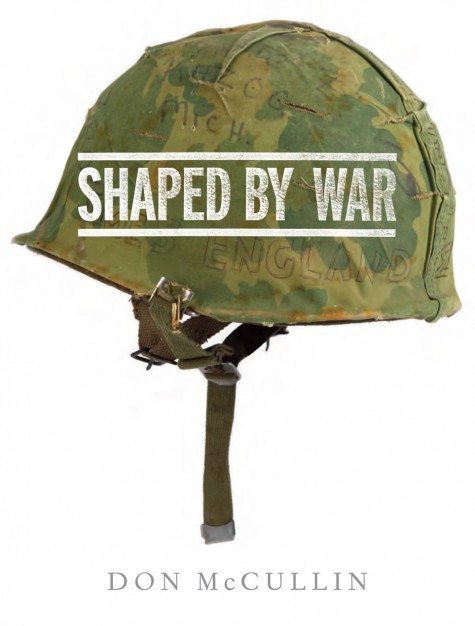
If (like me) you are not able to visit the exhibition, a retrospective of McCullin’s work is available from Jonathan Cape, while his photographs of social deprivation are collected in the 2007 book In England. A selection of his war photographs, shown at The Imperial War Museum last year, can be seen in the exhibition catalogue Shaped by War.

(via Simon Armstrong)

Comments closed

Diana Athill | Michael Salu and Rankin

Designed by the brilliant Michael Salu, the cover for Diana Athill’s forthcoming collection of letters, Instead of a Book, features a stunning portrait of the author by acclaimed British photographer Rankin (co-founder of Dazed & Confused in case you were wondering).

To coincide with the release of the new book in October, Granta are also reissuing paperback editions of Athill’s books Stet, Yesterday Morning and Instead of a Letter with cover designs incorporating Rankin’s photographs.

I don’t think I have made any secret of my love of Stet, Athill’s book about her time as an editor at Andre Deutsch. But I have always been disappointed by the discouraging cover on the tatty copy on my bookshelf, and it makes me incredibly happy to finally see an edition that seems to capture something of Athill’s personality.

Athill’s writing is unflinching and it is remarkable to see that reflected in Rankin’s stark portraits. According to Michael, who art directed series and designed all the covers, “the idea was to not to shy away from age and experience, but to celebrate it and Diana’s distinct personality.” Certainly, it is hard not to be taken by the keenness of Athill’s eyes. One gets the sense she does not suffer fools gladly. There is something of a retired headmistress about her. But I love how in the photograph for Instead of a Letter, Rankin captures Athill’s thumb hooked under her necklace. The author doesn’t appear to be particularly aware that she’s doing it, but it is beautiful and poignant touch.

The type is set in Gill Sans. Of course.

Comments closed

Richard Price Paperbacks | Henry Sene Yee

Columbine and A Wall in Palestine: cover designs by Henry Sene Yee

Henry Sene Yee is a designer and art director at Picador USA. The very of his best work (and all of it is good) — his cover designs for Columbine by Dave Cullen and A Wall in Palestine by René Backmann to pick two recent examples — combine judiciously selected and smartly cropped photographs with bold typographic choices.

Given the poignancy of the images he chooses and the respect he gives to them within his compositions — the room he gives them to breath —  it isn’t surprising that Henry is a photographer himself, regularly capturing scenes of daily life in his beloved New York through a lens.

Photo by Henry Sene Yee

The author Richard Price, who has also written for the HBO series The Wire, was born in and raised in the Bronx. Several of his novels, including Clockers and Freedomland (both adapted to movies), are set in the in fictional town of Dempsy, New Jersey.

Photo by Henry Sene Yee

Over the last couple of years Henry, who also happened to grow up in New Jersey, has designed covers for Picador’s recent reissues of Price’s novels.

Bringing his understanding of photography and type to the designs Henry has, like Price himself, avoided the expected crime fiction clichés.

As fan of Price’s work as well as Henry’s, I thought I would take to the opportunity to ask the designer how he approached the covers.

Here is his reply:

Lush Life: cover design by Aaron Artessa

It started when Picador published the paperback edition of Richard Price’s bestseller Lush Life. Because of its success, the FSG cover was reproduced in ads and displayed prominently in bookstores. Repackaging the cover for paperback would not take advantage of the public familiarity with it so it was decided to keep the original jacket design [by Aaron Artessa].

Clockers final cover by Henry Sene Yee

Clockers: unused designs by Henry Sene Yee

Clockers, probably Price’s most well known backlist was also acquired by us and was reprinted to coincide. It was designed as a stand alone. I couldn’t see how I would or need to relate it to Lush Life.

Bloodbrothers final cover by Henry Sene Yee

It was followed by his next backlist title Bloodbrothers, which was also designed as a stand alone. That book’s themes reminded me of photographer Bruce Davidson’s beautiful 1970s NYC Subway photos. I found this great Davidson photograph from his gang series and kept the colors simple.

The Breaks final cover by Henry Sene Yee

We later acquired The Breaks and Ladies’ Man and I had no intention to follow any previous Price’s look since there was none. Photo research found some great images similar in look to the Davidsons. My two favorite photos happen to both be horizontal and the initial layouts looked similar to Bloodbrothers. I tried to distinguish them by using different colors in the background, type. But in the end, it was just distracting from the great photos. So I decided to have them match Bloodbrothers, keeping the type and same palette of black, warm gray duotones, cream and warm red.

Ladies man final cover by Henry Sene Yee

The Breaks and Ladies Man: unused designs by Henry Sene Yee

Thanks Henry!

Disclosure: As of Fall 2011, book published by Picador will be distributed to independent bookstores and libraries in Canada by my employer Raincoast Books as part of a new distribution arrangement with Macmillan US. For the record, Henry and I discussed featuring his work on The Casual Optimist several times well before details of this deal was known to either of us.

1 Comment

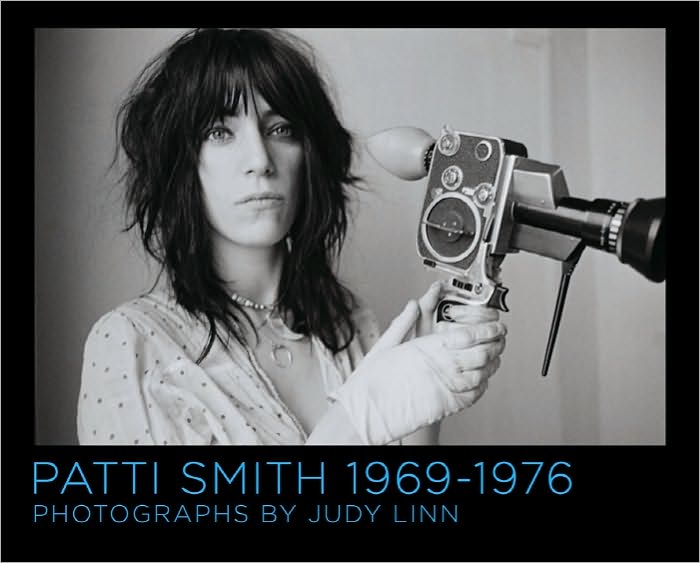
Patti Smith 1969-1976, Photographs by Judy Linn

“I was eager to be Judy’s model and to have the opportunity to work with a true artist. I felt protected in the atmosphere we created together. We had an inner narrative, producing our own unspoken film, with or without a camera.” — Patti Smith

Here’s a short promotional trailer for Patti Smith 1969-1976, Photographs by Judy Linn, mentioned briefly in this morning’s round-up:

(via @theBDR)

Comments closed

Midweek Miscellany

Book Art: Iconic Sculptures and Installations Made from Books by Paul Sloman, a 220-page overview of contemporary art, installation, and design created with and from books , published Gestalten.

La Mémoire Retrouvée — Edmund de Waal, author of The Hare with the Amber Eyes, on his family’s connection to Proust, for The Daily Telegraph:

Proust played with the interpenetration of the real and the invented; his novels have a panoply of historical figures who appear as themselves mingling with characters reimagined from recognisable people. Elstir, the great painter who leaves his infatuation with Japonisme to become an Impressionist, has elements of both Whistler and Renoir, but has another dynamic force. And Proust’s characters stand in front of actual pictures. The visual texture of the novels is suffused not just with references to Giotto and Botticelli, Dürer and Vermeer, Moreau, Monet and Renoir, but by the act of looking at paintings, by the act of collecting them, remembering what it was to see something, the memory of the moment of apprehension.

Doomed — Jonathan Coe, author most recently of The Terrible Privacy of Maxwell Sim, on film adaptations of books for The Guardian:

In the course of their famous book-length interview, François Truffaut once asked Alfred Hitchcock about his approach to literary adaptation, and Hitch’s response was as magisterial, worldly and mischievous as one would expect: “What I do is to read a story only once, and if I like the basic idea, I just forget all about the book and start to create cinema. Today I would be unable to tell you the story of Daphne du Maurier’s The Birds. I read it only once, and very quickly at that.”


Circumventing the Male Gaze The New Yorker‘s Hilton Als on photographer Judy Linn and a new book collecting her photographs of Patti Smith:

I wonder what Patti and Judy saw in one another—I mean, beyond the description Judy provides in her little essay at the back of the book. What is the energy that one being picks up on, and how does it complement the other’s? Judy and Patti went to Detroit one summer and worked for a local paper and Crawdaddy, respectively; Patti wrote rock criticism and Judy took pictures. Lester Bangs was their friend. The world got bigger. Collaboration can be vexing, but there’s not a note of complaint in their work together. The pictures are documents of girls doing things together, sometimes in their summer dresses. And when there’s a third person present—Mapplethorpe, some other boy—they make a little room for him, but he’s rarely center frame; the pictures are rare in that they circumvent the male gaze and thus approval; instead, they document how each woman’s vision is equal to the other’s.

And finally…

Designer Data — The New York Times on data visualization:

Visual analytics play off the idea that the brain is more attracted to and able to process dynamic images than long lists of numbers. But the goal of information visualization is not simply to represent millions of bits of data as illustrations. It is to prompt visceral comprehension, moments of insight that make viewers want to learn more.

And on a related note: The Infographic Inforgraphic by Ivan Cash.

Comments closed

Finding Vivian Maier

Born in New York 1926, Vivian Maier was an American-French photographer who worked as a nanny in Chicago from the mid-1950’s to the 1990’s. In 2007, two years prior to Maier’s death, 26-year-old real estate agent John Maloof purchased a box filled with 30,000 negatives from an estate sale for $400. On discovering the quality of  beautiful street photography, Maloof then bought other boxes of Maier’s negatives in an attempt to find out more about the woman who took them:

An exhibition of Maier’s work opens at the Chicago Cultural Center today, and there is more on Maier and her photography here.

(via PetaPixel)

3 Comments

Q & A with Clare Skeats

Hugo Wilcken’s Colony (published in 2007 and mentioned previously here) is almost certainly the novel I’ve talked up most this year. The cover, something like a jaunty vintage travel poster to a malarial Heart of Darkness (nauseously appropriate for a postmodern novel about a French penal colony), was designed by London-based print designer Clare Skeats.

Specializing in book design and art direction, Clare has a a great eye for partnering distinctive typography with bold creative imagery. Her covers often seem to use elements from the past, but always feel dynamically contemporary.

I’m really happy to have had the opportunity talk to Clare about her work. We corresponded by email.

How did you get into book design?

After graduating in 97, I tried, and failed to get a job as a junior designer at Penguin. They did offer me work experience though — so I moved to London to do that, and basically never left.

Have you always run your own studio? Where were you previously?

No. I stayed at Penguin for 4 years (they did eventually employ me!), then during a brief period at Random House, an opportunity arose to work for UK clothing designer Margaret Howell. It was great to step away from books for a bit and be part of a completely different industry. I was involved in virtually all aspects of the company; from designing Fashion Week press invites to drawing up manufacturing specification manuals. During my time there I was also working freelance — so after two very busy years, I left Margaret Howell to become full-time freelance, which is where I am now.

Could you describe your design process?

I’m lucky in that a lot of my clients allow me to just read and then make all the suggestions. I work in a number of ways; completely independently, or collaboratively with an illustrator or photographer. If I decide that illustration is the most appropriate response, I spend time identifying the right style and finding relevant practitioners. I’ve worked with Kazuko Nomoto (aka Nomoco) a great deal, and I found her initially as I had Andy Warhol’s Vogue illustrations in my head for Lolita. I’ll suggest say 3 or 4 illustrators to the client, along with a rough idea of the brief and composition. I then refine the brief and collaborate with the chosen illustrator.

Whether I’m working on my own, or collaboratively, I spend a lot of time researching — it’s a process I’ve always loved. For Somebody to Love I had to research embalming as the book is about a transsexual mortician who falls in love with one of her, um… clients. I wanted the cover to reflect the surgical and beautifying themes so I started to research embalming tools which lead me to those 18th-Century engravings of surgical instruments. Also used to great effect on this Simian Mobile Disco record cover designed by Kate Moross:

I needed to commission illustrations of modern instruments but retain the engraving reference and I initially proposed a wood engraver to the client, but the idea scared them. So I had to find a vector illustrator who could approximate an engraving style. I found Fred van Deelen who did a brilliant job. What I loved about Kate’s record cover was the way the central black circle (or maybe its a die-cut?) was working as a device to hold the type. So I shamelessly adapted it to my own needs for my cover.

When I started working on Potty!, I read the author’s autobiography which lead to a fun afternoon poking around the posh country outfitters shops of St. James and Saville Row — I took lots of photos and produced a mood board which helped me to get the sample spreads and art direction approved. I teach on the foundation course at Central St Martins and I’m always banging on about research — mostly because I can’t understand why a student wouldn’t want to do it!
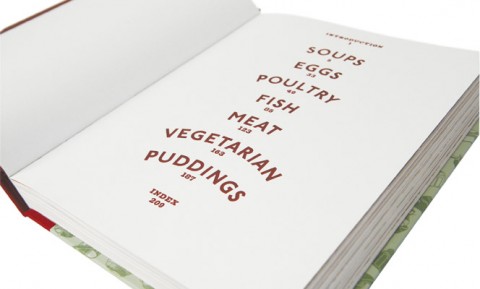
My client for Potty!, wanted an illustrative component to the design and I was wary at first as I think illustration can often look like a whimsical add-on in some cookbooks, which wouldn’t be appropriate at all with Clarissa. The book is about one pot cookery so I decided to make the pots the stars and commissioned scraper-board maestro Joe McLaren to produce them — there are 24 in total and this is my absolute favourite:

Do you prefer to use unconventional typography and hand-drawn lettering than more classic typefaces?

Not particularly — the enjoyment comes from finding the right type style for the job, and that could be making lettering out of cake decorations, or typesetting a whole book — each offers their own sense of fulfillment. Working with the wildly varying content of books offers wonderful opportunities to work with typefaces that wouldn’t normally get considered for most commercial print jobs. I hate snobbery in design — if Dom Casual is right for a job, go with it!

Do you ever create the type or letters yourself ?

I wouldn’t have the confidence to create digital type from scratch, its such a skill in itself — adapting existing fonts is about as far as I go. I’ve hand-drawn lettering quite a bit though — I like to use a dip pen and drawing ink which creates a really nice line. I used this for Lolita, Tom Bedlam and Just in Case, to name a few. Another Meg Rossoff cover I had rejected features lettering that I drew on damp paper to create a cloud-like effect when reversed-out of the sky.

I can’t walk past an art supply shop. The ‘STEINBECK’ stamp in Of Mice and Men comes courtesy of something called Fabfoam, which you’ll find next to the sequins and glitter in the ‘hobby craft’ section.

How do you approach designing a series of covers?

Find the longest combination of title and author, and then work backwards from there! If your design can accommodate One Day in the Life of Ivan Denisovich by Alexander Solzhenitsyn then you know you’re on to a good thing. I think a successful series style has enough consistency and rigour to be easily recognised but has enough flexibility within it to future-proof against unforeseen issues. If there are too many variables within a series style, it lacks identity — and if there are not enough, it looks dry and undynamic. The nice thing about designing the Vintage Classics series design was that I knew the images would be really diverse so I could make the rest of the cover quite restrained and structured.

What are your favourite books to work on?

Its always a thrill to get asked to do a classic. I did Animal Farm very early in my career at Penguin and I’ve always regarded it as a huge privilege — especially as I was so junior at the time. I recently had to re-do the artwork to fit the new Modern Classics grid, so I’m really honoured that it survived a series re-design!

I also like first-time authors (as there’s no baggage), and books about really odd subjects: invisible dogs, menopause, suicide, unicorns … bring it on. I’d like to do more books for young adults, but they usually get rejected!

What are the most challenging?

Without a doubt, it’s the BIG book. The one the publisher has paid huge sums for at Frankfurt as it’s ‘going to be the next … (insert name here)’. The amount of emphasis placed on the role that the jacket is expected to perform is enormous and yet if the book becomes a bestseller its widely regarded as being down to good writing and good reviews. But if it fails, its regarded as being the fault of the jacket. Its this widely-held belief that allows high street booksellers and supermarkets to assert so much influence on the design — so what should be an exciting job can turn into a fairly unrewarding experience for the designer.

Do you prefer working with illustrators or photographers? Or does it depend on the project?

I do enjoy the camaraderie on shoots — the Potty! shoot was great fun — but publishing cover budgets are usually such a feeble match for photographer’s fees that I find I’m constantly looking at ways to cut costs which just becomes a bit boring after a while. The preponderance of headless women on book covers is testament to the fact that there’s rarely budget for a model, hair or make-up. And yet, interestingly, the expectation from the publisher for a Merchant Ivory film still remains pretty high — even if the budget doesn’t.

I love the spontaneity of working with an illustrator — of making the most of their skills and seeing how they interpret a brief. When I saw the physical object that I commissioned from Helen Musselwhite on The Still Point, I gasped (in a good way)! Being able to hand-pick such talented people to work with is a huge privilege — it’s a part of my job that I will always love.

Do you see any recent trends in British book design?

Yes, I think production specs (particularly on hardbacks), have been steadily increasing in a bid to get the public excited about the physical objects again, so we’ve had a glut of cloth-and-foil, sprayed edges etc. There’s been a lot of patterns and a return to traditional typographic sensibilities, and a rediscovery of our British design heritage. Mid-century modern references are still enjoying a bit of a moment…

Where do you look for inspiration and who are some of your design heroes?

My earliest design hero was Charles Schultz. I was obsessed with Peanuts when I was a kid and copied the way that the characters wrote — I loved the way their handwriting appeared above their heads, I thought it was genius!

I was also a huge Roald Dahl fan and consequently grew up with the scratchy inky gorgeousness of Quentin Blake‘s illustrations.

No surprises here, but I greatly admire the work of designers like Saul Bass, Abram Games, Alan Fletcher, Alvin Lustig and Paul Rand — the wit and brevity of their work is so impressive. Slightly more decorative demi-gods include Eric Ravillious, Edward Bawden and Osbert Lancaster. Sorry for the lack of anyone female — or indeed, alive.

What does the future hold for book cover design?

Hopefully the impact of ebooks will be a positive; there’s a lot of books out there that really don’t deserve to see a printing press.

Thanks Clare!

4 Comments

Thomas Allen AV

An AV introduction to the work of artist Thomas Allen who takes vintage paperbacks and cuts, creases, and crimps them into incredible pulp pop-ups:

(thx Jacob)

(And Small World of Happy Coincidences:  The remix of Sarah Vaughan that accompanies the video is by Max Sedgley an old pal from university)

2 Comments

Spirit City Toronto

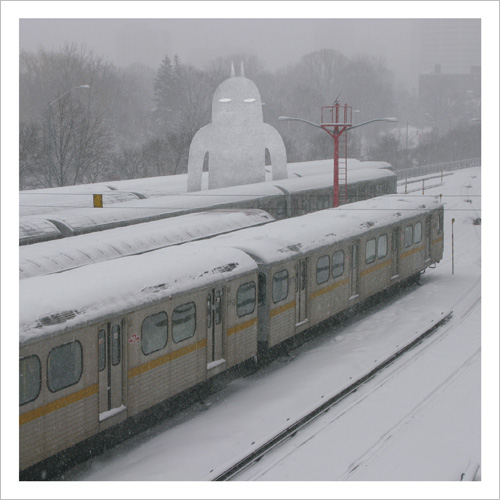
Combining  illustration and photography to depict homeless nature spirits who inhabit the forgotten corners of the city, there are shades of Hayao Miyazaki and Studio Ghibli in freelance illustrator Aaron Leighton’s lovely debut book Spirit City Toronto:

Spirit City Toronto is published by Koyama Press, and Books@Torontoist have just posted a two part interview with Aaron about the book.

(via Drawn!)

Comments closed

Images and Words

Photographer Steve McCurry, best known for his iconic National Geographic portrait ‘Afghan Girl’, recently posted two sets of beautiful photographs on his blog of people reading books. Publishing Perspectives spoke to McCurry about the ongoing project:

As a photographer, McCurry is always on the hunt for the “unguarded moment,” that slice of time that reveals something personal and honest. “I have another gallery of people sleeping and of couples interacting. There’s an intimacy people have with a book and its author that is similar,” he says, adding. “We’re all different and we’re all the same. It amuses me that whether you’re fabulously rich and sophisticated or you happen to be someone on the street in the third world or a classroom in some remote area, reading is all the same act. It’s a common link in our shared humanity, a thing we all do that is regardless of where we are economically or socially.”

The first selection of McCurry’s photographs of readers, titled ‘Fusion: The Synergy of Images and Words’, can be seen here. The second set is here.

Comments closed

Midweek Miscellany

The portfolio of Julia Hastings, Art Director of Phaidon Press (via It’s Nice That).

Rarefied Content — Alan Rapp on the future of photography books at Imprint:

[A]rguably the independently published photo book is flourishing. You can see this from the increasing popularity of on-demand printing services such as Blurb, Lulu, and MagCloud , as well as the number of successful and well-published photographers who have launched their own publishing ventures, such as Alec Soth, Richard Renaldi, and Shane Lavalette (a practice which itself has a long pedigree, from Alfred Stieglitz to Ralph Gibson). Yet this kind of kaleidoscopic output creates another issue—who but the most ardent follower can keep abreast of this vast dispersion of small-scale publishing?

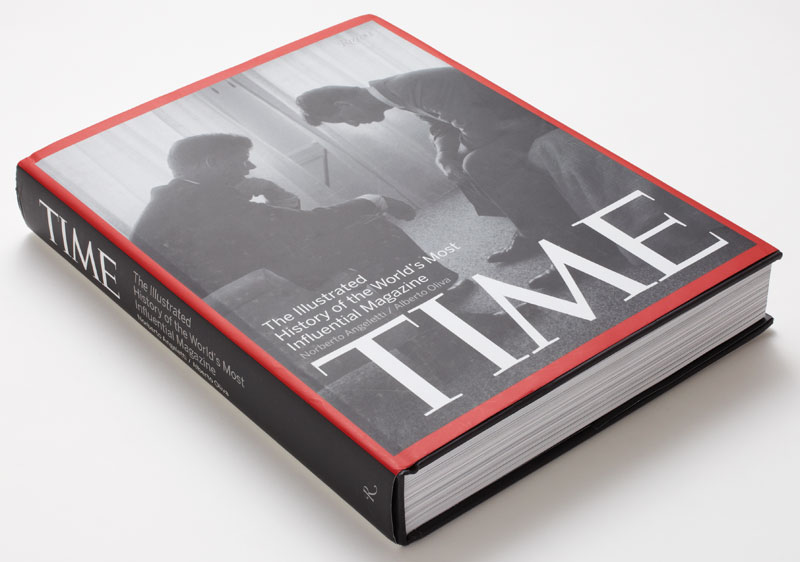
The Illustrated History of Time designed by Luke Hayman at Pentagram:

And finally…

The trailer for the animated adaptation of Shaun Tan‘s The Lost Thing (via The Art Department | Irene Gallo):

I’ve posted this before, but here’s a short documentary about making the film:

The Lost Thing website.

Comments closed