Skip to content

Tag: photography

Trains, Punks, and Photographs


In 2002, 17-year-old Mike Brodie started hopping trains. Over the next five years he took photographs — first using a found Polaroid camera and then an old 35-mm Nikon — documenting his experiences. In the July/August edition of Book Forum, Geoff Dyer reviews A Period of Juvenile Prosperity, a book collecting Brodie’s photographs:

As with Nan Goldin’s Ballad of Sexual Dependency—and if ever a book of photographs deserved to be termed a ballad it’s this one—Brodie’s pictures are entirely from within the world depicted. Goldin always had a knack, according to Luc Sante, for finding beautiful colors and light in what was otherwise a complete dump. The light for Brodie and his fellow travelers is a given, filling their lives with lyric and radiant purpose. The land that blossomed once for Dutch sailors’ eyes whizzes and blurs past as they ride the rails; the light fades, and the dark fields of the Republic roll on under the night. But the book is less a record of sights and places seen than one of the people doing the seeing. Photographs by Helen Levitt don’t just show children playing in the street; they convey what it’s like to be a child. Same here. We share the optimism, recklessness, and manifest romance of these outlaws’ take on destiny.

Earlier this year, Brodie, who is now working as mechanic, talked about the book with All Things Considered on NPR:

NPR: All Things Considered: Trains, Punks, Pictures mp3

I’ve not seen any sign of the book in Canada, but apparently it is available from the publisher Twin Palms, and I’m sure there will be US independent bookstores who have it.

Comments closed

The Photo Man


Mark Kologi collects  found photos. In this weirdly fascinating short film he discusses buying and selling the personal pictures of complete strangers:

(Does he remind anyone of Steve Buscemi? Is that just me?)

Comments closed

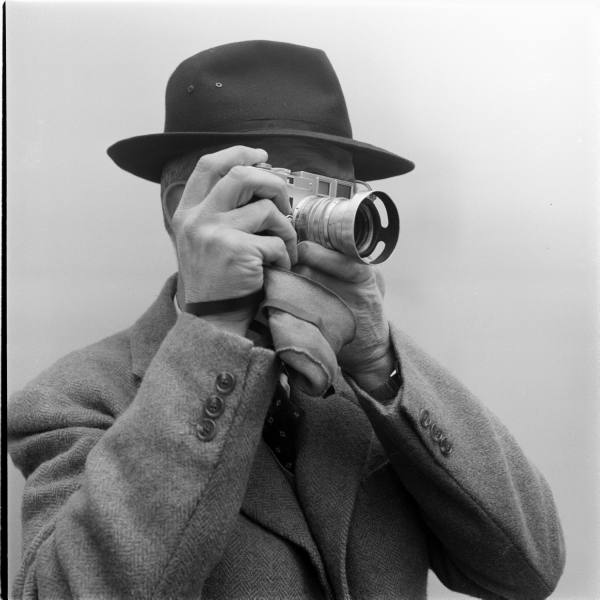
Cartier-Bresson: “photographs are like a Chekhov short story”

On the New York Times Lens blog today there is first part of an interview with the photographer Henri Cartier-Bresson. Conducted by journalist and filmmaker Sheila Turner-Seed in Cartier-Bresson’s Paris studio in 1971, the interview was apparently for a film-strip series on photographers produced for Scholastic:

I’m not interested in documenting. Documenting is extremely dull and I’m a very bad reporter. When I had an exhibit at the Museum of Modern Art in 1946, my friend, Robert Capa, told me, “Henri, be very careful. You must not have a label of a surrealist photographer. If you do, you won’t have an assignment and you’ll be like a hothouse plant. Do whatever you like, but the label should be ‘photojournalist.’ ”

All my training was surrealism. I still feel very close to the surrealists. But Capa was extremely sound. So I never mentioned surrealism. That’s my private affair. And what I want, what I’m looking for — that’s my business. Otherwise I never would have an assignment. Journalism is a way of noting — well, some journalists are wonderful writers and others are just putting facts one after the other. And facts are not interesting. It’s a point of view on facts which is important, and in photography it is the evocation. Some photographs are like a Chekhov short story or a Maupassant story. They’re quick things and there’s a whole world in them.

By a strange coincidence I recently stumbled across a video of Cartier-Bresson talking about his work (via A Piece of Monologue I think). There appears to be at least some overlap between the film and Turner-Seed’s interview at the Times, so I assume it originated with her? (More knowledgeable people, please feel free to chime in!)

Sheila Turner-Seed’s daughter Rachel Seed (also a photographer) is working on a personal documentary about her mother called A Photographic Memory.You can donate to the project on Kickstarter.

(pictured above: Cartier-Bresson photographed by Dmitri Kessel)

Update: The second part of Sheila Turner-Seed’s interview with Cartier-Bresson is now available on the New York Times Lens blog.

Comments closed

Art Shay: The Sporting Life and Times

A short film about writer and photographer Art Shay, who shot pictures regularly for Sports Illustrated, Time, Life, Fortune, the Saturday Evening Post, Forbes, Business Week, Parade and the New York Times Magazine:

An exhibition of Shay’s photographs, ‘Art Shay: The Sporting Life & Times,’ will run from June 20 through September 30 at the HDC studios in Milwaukee.

(pictured above: Art Shay with Nelson Algren, author of The Man With the Golden Arm)

Comments closed

Garry Winogrand: The Photographer as Addict

Geoff Dyer reflects on the recent Garry Winogrand exhibition at the San Francisco Museum of Modern Art (or its catalogue, at least) at the London Review of Books:

The more you feed the Winogrand habit the more Winogrand you crave. Partly this is because of the sheer quantity of data amassed by Winogrand, the mind-blowing amount of information he provided about the social landscape of America in the 1960s and 1970s: suits, dresses, jackets, lapel widths, hairstyles, body shapes, faces, drinks, food, cigarettes, architecture, airports, pets, cars – everything. But it’s far more than the thoroughness and extent of this animate inventory that makes Winogrand so important. Taking his lead from Georg Lukács, George Steiner wrote of Balzac that when he ‘describes a hat, he does so because a man is wearing it.’ Granted, in photography hats are forever being verbed – worn, carried, tipped – but it’s helpful to see Winogrand as a visual novelist whose work was a sprawling human comedy. Or perhaps as a dance to the stilled music of photographic time, with a cast of thousands, that stood no chance of ever being completed. (Winogrand admired Norman Mailer, rivalled him in scope, energy, ambition – and in a disdain for any internal system of brakes. As it happens, he photographed Mailer at his fiftieth birthday party in 1973, on the receiving end of a finger-wagging lecture from a guest, so that the picture seems silently captioned by the Winograndian imperative: ‘Look!’)

Is there a word for something that is very much of Geoff Dyer? Dyerian? Geoffian? Anyway, this is that.

London Review of Books

Comments closed

Kodak: Bankrupted By Its Own Innovations

In an interesting piece on the decline of Kodak, Kenny Suleimanagich describes how it was not simply a reluctance to innovate that caused problems at the company, it was that they brought their innovations to market too early:

No matter what [Kodak] came up with, nothing digital would sell. To consumers, everything was too expensive, and to professionals, the quality was not yet good enough. “It was a difficult thing to market,” [computer engineer Peter] Sucy admits, “especially for people who didn’t have any kind of experience marketing this kind of product; people who didn’t really know what it did.”

In the end, being early did not help, because the market simply wasn’t ready. As obvious as the endgame was, Kodak’s leaders were faced with an unwinnable predicament: either keep investing in end-of-life products until the profits dried up — and die over the long run; or switch to stillborn product lines that produced mostly red ink in the ledgers — and die immediately.

In his book, The Disappearance of Darkness: Photography at the End of the Analog Era, published by Princeton Architectural Press, Toronto-based photographer Robert Burley documented the closure (and destruction) of the Kodak facilities in Rochester, Toronto, and Chalon-Sur-Saône. Pictured above are Burley’s photographs ‘View of Kodak Head Offices from the Smith Street Bridge, Rochester, New York 2008’ and ‘Implosions of Buildings 65 and 69, Kodak Park, Rochester, New York [#2] October 6, 2007.’

Burley talks about the project and the book in this short video:

A slightly longer 5- minute short about the project can be found here.

(On a related note–at least in my brain–the New York Times reported on the resurgence of vinyl over the weekend. The manufacturers are apparently having some difficulty meeting demand. The last new press was built in 1982. Perhaps analogue photography just isn’t out-of-date enough yet for some people?)

(And full disclosure etc: PA Press are distributed in Canada by my employers Raincoast Books)

Comments closed

Something for the Weekend

The Man — An interview with the talented Seb Lester, typographer and artist, at The Raw Book:

People may associate me with flourished calligraphy and intricate formal script styles, but I don’t want to be known as a stylist because I feel I can do a wide variety of things. I want to try to constantly evolve and progress, with quality being the only theme running through my work. No one would guess most of the projects I’ve worked on have been done by me.

There is something quite wonderful about watching Lester at work:


The Beauty of Letterpress — An online resource and showcase created by Neenah Paper, featuring “the best and most innovative letterpress work in the industry today.”

And finally…

Heart-Shaped Box — Phil Bicker, a senior photo editor at TIME, interviews photographer Bert Stern at Time Lightbox:

1962… also saw the release of Lolita, directed by his old friend Stanley Kubrick. He asked Stern to take some publicity shots for the film. Stern took then 13-year-old actress Sue Lyon and her mother to a five-and- dime store in Sag Harbor, on eastern Long Island, to make the pictures. “I walked into the store and saw all these sun heart-shaped sunglasses and candy canes and other fun stuff that became the props for the shoot. I had not seen the movie but I underlined passages in Nabakov’s book that would make picture ideas. I always work with words that become pictures.”

See also: Stern discusses his work and Shannah Laumeister’s new documentary Bert Stern: Original Mad Man at the New York Times’ T Magazine.


Comments closed

Bert Stern: The Original Mad Man

A new documentary about American photographer Bert Stern:   

The movie has been playing across the US and will open in New York next week. There are no Canadian dates that I could see.

(via Coudal)

2 Comments

You’ll Never Get Anywhere Like That

Or a Few Thoughts on the Cover Design of The Bell Jar (An Illustrated Essay of Sorts)

In his recent essay ‘Graphic Design Criticism as a Spectator Sport’ designer Michael Bierut (author of 79 Short Essays on Design) suggested that “at a time where more people than ever are engaged with design,” design criticism has been reduced to a “seemingly endless series of drive-by shootings punctuated by the occasional lynch mob, conducted by anonymous people with the depth of barroom philosophers and the attention span of fruit flies.”

Unsurprisingly, I thought of Mr. Bierut during the recent furore about the cover design of The Bell Jar.

When Faber and Faber published a 50th anniversary edition of Sylvia Plath’s novel last month with a brightly coloured new cover, they can hardly have expected a controversy. But the design, which features a photograph of a woman holding a compact and touching up her make-up, was, it turned out, nothing less than “a ‘fuck you’ to women everywhere.” It was so truly hideous, that if “Sylvia Plath hadn’t already killed herself, she probably would’ve” when she first saw it. It was “THE BELL JAR as chick lit” — “1990s chick lit“!

It wasn’t much better when the designers weighed in. If the diplomatic Jamie Keenan thought Faber hadn’t “got it quite right,” Barbara DeWilde was less equivocal: “it’s a travesty… I’m still almost speechless that it was published in this form.”

We are, of course, morbidly fascinated by Plath, who died tragically young — there are at least 3 new books about her life being published this year alone. That The Bell Jar is both semi-autobiographical and her only novel makes our opinions about it even more intense.

But just how much of the criticism was actually fair?

On the face of it, the image isn’t entirely inappropriate. Mirrors (and photographs) are a recurrent motif in the book (one of its working titles was The Girl in the Mirror). The novel even begins with Esther working for a fashion magazine in New York. She talks about her looks, her clothes and her make-up. She carries a compact in her bag. Esther is fixated with appearances even as she struggles against being defined by hers.

Nor is the new design some kind of “chick lit makeover” — that just seemed like a convenient, if inaccurate, headline. While defining what qualifies a ‘chick lit’ is notoriously difficult, the cover has none of whimsy usually associated with the genre. Furthermore the new design wasn’t a sudden attempt to make the book look more feminine. The beautiful Faber Firsts cover from 2009 designed by Mark Swan also uses a glamorous retro image (albeit a disturbingly cropped one).

In fact, the new cover, also designed by Swan, is much more jarring than the Faber Firsts’ almost romantic image. There’s an angular sickliness to it — an awkward, unpleasant toxicity. The bright colours are unnaturally heightened, the pose mannered, the jerky lettering like “loops of string lying on the paper” blown askew.

As Faber themselves would later would confirm, it was meant to unsettle. The intent “was that the image of the expressionless woman ‘putting on her mask’ and the discordant colour palette would suggest ambivalence and unease.”

Certainly the new cover, is harder to like. It is indisputably ugly, especially compared to Swan’s earlier design or the original Faber cover from 1967 (pictured above) designed by Shirley Tucker (if not more so than this Warholian shocker from 1998). But tasteful covers rarely stand out on the shelves and from a marketing perspective there isn’t anything necessarily wrong with something being dissonant. It can be startling effective as Peter Mendelsund’s covers for Simone de Beauvoir demonstrate. Disruptive designs can also provoke interest in new readers and there is even some anecdotal evidence this is precisely what has happened with The Bell Jar — it is, apparently, “doing the business.”

Still, the design of The Bell Jar fails, at least as an accurate representation of the book. The mirror’s reflection does nothing to imply the introspection or detachment of the novel — only a coquettish vanity and narcissism. The woman in the photograph is just too put-together, too worldly. The mannered glamour is reminiscent of the stifling fashion photography of the 1950’s. This isn’t a 19 year-old’s face, “bruised and puffy and all the wrong colours.” There is no ennui or anxiety on display. No hint of poverty or isolation. Nothing of the suicidal depression aor a person coming apart. There is none of the disappointment. It is just an icily cool model posing for a photograph — an image Esther herself denies:

The magazine photograph showed a girl in a strapless evening dress of fuzzy white stuff, grinning fit to split, with a whole lot of boys bending in around her. The girl was holding a glass full of a transparent drink and seemed to have her eyes fixed over my left shoulder on something that stood behind me, a little to my left. A faint breath fanned the back of my neck. I wheeled around.

The night nurse had come in, unnoticed, on her soft rubber soles.

“No kidding,” she said, “is that really you?”

“No, it’s not me. Joan’s quite mistaken. It’s somebody else.”

To make matters worse for Faber, they also revealed the new cover shortly after Penguin Classics reissued new editions of George Orwell with cover designs by David Pearson. The contrast is unfavourably stark. Where Pearson deftly combines wit and originality with respect for material (not to mention Penguin’s design heritage), the stock photography, anachronistic type and bright colours of The Bell Jar seem crass and gaudy.

Comparisons with similarly stylish new editions of Kafka and Joyce designed Peter Mendelsund, Truman Capote designed by Megan Wilson, and Ralph Ellison designed by Cardon Webb, are unequally unflattering. It’s not hard to see that Plath, like so many other women writers, has been decidedly short-changed.

As Fatema Ahmed, noted in her post ‘Silly Covers for Lady Novelists‘ for the London Review Books blog, “the anniversary edition fits into the depressing trend for treating fiction by women as a genre, which no man could be expected to read and which women will only know is meant for them if they can see a woman on the cover.”

In recent years, contemporary writers as diverse as Francine Prose, Jodi Picoult, Jennifer Weiner, Meg Wolitzer, Fay Weldon, and Lionel Shriver have all noted how fiction by women is marginalized. No matter that women buy the most books, women writers are less well-reviewed, win fewer literary awards, and all too often the covers of their books don’t accurately reflect nature of the work itself.

If books by Jonathan Franzen, Chad Harbach and Ben Marcus are designed to look different and stand out on the shelves, contemporary literary fiction written by women tends to look the same regardless of the book’s subject matter. All too often there is a photograph of woman on the cover — pretty, domesticated, inoffensive and wistful. The assumption is that women only want to read certain kinds of stories, and that men don’t want to read books by women at all. In discussing the treatment of her own work, Shriver dryly pointed out, “publishing’s notion of ‘what women want’ is dated and condescending.”

This isn’t always true, of course. Hilary Mantel’s Thomas Cromwell novels defy all expectations. See Now Then, Jamaica Kincaid’s first novel in 10 years, has a type-only cover. The Casual Vacancy by J. K. Rowling is notable for its hand-drawn lettering and calculated, corporate blandness. Both the American and the British editions of Zadie Smith’s NW — designed by Darren Haggar/Tal Goretsky and Gray318 respectively — are stunning. Alison Forner’s sinister canned cranberries for May We Be Forgiven by A. M. Homes is a neat inversion of domesticated happiness. The Penguin Modern Classics reissues of Carson McCullers designed by Jim Stoddart — with images selected by Penguin Press picture editor Samantha Johnson — also demonstrate that 20th century classics by women do not have to suffer from poor design or gender stereotypes.

There are surely other isolated examples too. But one can’t help thinking they are exceptions that prove the rule, and it is a particularly bitter irony that Plath’s novel about a young woman struggling with society’s expectations of her should, 50 years later, expose that woman writers are still stereotyped and treated poorly in comparison to their male counterparts. My sense is, however, that this latest controversy is a sign that the tide is turning. Women, both writers and readers, are being more outspoken about what is wrong with the way their books are handled by publishers and the media. They expect more and they expect better. This is the upside of design as a spectator sport. White middle-aged men are no longer the only voices being heard. Thankfully.


I was recently asked for my opinion on the new cover of The Bell Jar for an article in the Chicago Tribune. This an edited and expanded version of my comments to journalist Nara Schoenberg for that article. Thanks to everyone who gave feedback on an earlier draft of these remarks.


9 Comments

Finding Vivian Maier Documentary

The official trailer for a new documentary film about street photographer Vivian Maier:

3 Comments

Midweek Miscellany

A bit late in the day on this, but the British edition of HHhH by Laurent Binet, designed James Paul Jones Senior Designer at Vintage Books, is quite something. The book was recently released in paperback in the UK.

And, if you’re curious, the North American edition designed by Rodrigo Corral looks like this:

The Language Policy — Further thoughts from Tim Parks on the role of editors, at the NYRB Blog:

As readers, it seems, we love to feel we are in direct, unmediated contact with an especially creative, possibly subversive mind and that we are getting all of its quirks and qualities unmediated and unmitigated by the obtusity of lesser folks perversely eager to return everything to the expected and mundane. This is no doubt why so little is said about editing even in the more learned papers, while nothing at all appears in the popular press, let alone at a promotional level. One cannot imagine, for example, a publisher launching an advertising campaign to boast that it has the most attentive copy editors in the business and can guarantee that everything you may read from its list has been properly purged of anything grammatically iffy, or foreign, or idiosyncratic.

Numbers — Rick Poyner on The Book of Numbers created by Herbert Spencer Spencer  in collaboration with his daughter, Mafalda:

The concept is simple enough. “We live in a world full of numbers: on houses and shops, on buses and motor cars, on magazines and packages, on stamps and labels, in fairgrounds and markets, on boats and aeroplanes, on road signs and posters,” write the Spencers. A series of photographs documents the occurrence of the numbers 1 to 100 going about their business somewhere out there in the world. Most numbers — seen on a showcard, a trash can, a hanging sign, a ceramic tile, a bus stop — receive their own images. In a few cases, such as house numbers and a set of maps, several consecutive numbers form a photogenic group within the same picture.

(It sounds fantastic).

And finally…

Colin Dickey on the haunted hotels of Los Angeles, at the Virginia Quarterly Review:

All hotels are haunted. It doesn’t matter which hotel; it’s already played host to a murder, an overdose, an accidental death with a story. You’re kidding yourself if you don’t see this, if you don’t recognize you sleep with ghosts. Every hotel staff has its stories, any cleaning woman or bellhop knows the score. In Wilkie Collins’ 1878 gothic novel The Haunted Hotel, an Italian villa is converted to a hotel shortly after it houses an unexplained, horrific tragedy. On opening night, a guest (“not a superstitious man”) takes Suite 14, and leaves hurriedly the following morning. The next night another couple take the suite; throughout the night the woman has horrifying dreams—awake, “afraid to trust herself again in bed,” she too makes excuses and leaves.

Assume, then, that every nightmare you’ve ever had in a hotel was a cry for help, some violence from the past reaching out to you.

Comments closed

Midweek Miscellany

A great post on designer Josef Müller-Brockmann at I Love Typography:

A student from the back of the room shouted out a wish to see JMB’s business card. As JMB casually pulled the business card out of his coat pocket, there was a frenzy like fish at a pond when the morsels are tossed in. He was taken aback as we scurried around to take a peak at the card revealed; novice typographers eager to see his miniature piece of art. I still remember the card clearly. It was on light gray paper stock printed with a solitary color of cool gray ink. All content was in a singular sans serif face, all lowercase, and no punctuation to speak of other than the umlaut and hyphen in his distinguished name. No commas, no periods, no colons. All the elements on the card were restricted to the purest of necessary elements. In that small space he proved the mastery of minimalism; communication clearly achieved without the use of a period or a comma.

Thumbnails — An interview with book cover designer Isaac Tobin at the University of Chicago Magazine:

His approach to cover designs… hasn’t changed even as Kindles have sparked an ink and paper bonfire. Book covers always have had to work at reduced size, to be appealing from afar on a bookshelf or to make attractive catalog displays. “Things like color and shape,” Tobin says, “can do a lot to work from a distance or in a thumbnail.”

My 2009 interview with Isaac is here.

Tom Waits and Anton Corbijn are going to publish a limited edition book of their photographs.

And finally…

Holy Offset Press, Batman! — My favourite thing on the internet this week so far…  Marvel and DC superheroes printing comics (with art by Joe Kubert):


(thx Jacob!)

Comments closed