Skip to content

Tag: letterpress

Typecaster For Life

“I thoroughly enjoy the sound of the machines turning, and seeing the type come out is a joy”

A really wonderful short film about 80 year-old Lewis Mitchell who has been maintaining Monotype casting machines for 62 years and continues to do so for Arion Press:


Comments closed

Earl Kallemeyn Letterpress

The New York Times has posted a short video interview with Earl Kallemeyn of Kallemeyn Press about the beauty of letterpress:

Comments closed

Hand und Werk

Some lovely letterpress action to ease you through your day:

(via Coudal)

1 Comment

Ink & Paper

‘Ink & Paper’ is a bitter-sweet short film directed by Ben Proudfoot about Los Angeles paper company McManus & Morgan Paper and their next-door neighbour Aardvark Letterpress:

(Happy New Year)

Comments closed

Trip Print Press

In this short film, Nicholas Kennedy proprietor of Trip Print Press in Toronto talks about the process of printing with letterpress and running a print shop:

(via Tania)

Comments closed

Letterpress | Naomie Ross

Here’s a nice short instructional video about printing with letterpress by New York-based designer Naomie Ross:

(via Nice Type)

Comments closed

LetterMpress

LetterMpress is a project by graphic designer John Bonadies to create a virtual letterpress environment for the iPad that will allow users to create authentic-looking letterpress designs and prints:

The design process is the same as the letterpress process—you place and arrange type and cuts on a press bed, lock the type, ink the type, and print. You will be able to create unlimited designs, with multiple colors, using authentic vintage wood type and art cuts. And you can print your design directly from LetterMpress or save it as an image for import it into other applications.

The project has already reached its initial Kickstarter funding target to purchase complete collections of wood type, but no doubt additional funds will be useful. The type that acquired by LetterMpress will be housed at a new letterpress co-op called the “Living Letter Press” and project organizers plan to offer authentic letterpress prints from designs submitted by users in future.

(thanks Sio)

4 Comments

Mr Smith’s Letterpress Workshop

The Creative Review visits the South London studio of independent letterpress printer Kelvyn Smith:

Smith’s work is being shown as part of the Reverting To Type exhibition at the Standpoint Gallery in London, opening December 10th (mentioned previously here).

(via Coudal / Acejet 170)

1 Comment

Reverting to Type

Curated by Graham Bignell & Richard Ardagh, Reverting to Type at the Standpoint Gallery in London will showcase the work of twenty contemporary letterpress practitioners from around the world:

Reverting To Type runs from December 10th–24th and continues January 4th–22nd, 2011. The Creative Review has more on the exhibition here.

Comments closed

Something for the Weekend

Dieter Rams book by graphic design graduate Daniel Bartha:

This project was a book I created around the ten most important principles for what Dieter Rams considered was good design. Taking on board these elements myself, I took away as much as I could from his unique designs but to still leave them instantly recognisable.

And since I seem to be on a German theme this week…

Nabokov in Berlin — An essay by Lesley Chamberlain in Standpoint magazine:

As consumerism and Hitler rose together so Nabokov treated totalitarian politics principally as aesthetically repugnant. It was “another beastliness starting to megaphone” in Germany which in 1937 drove him and his half-Jewish wife Vera to leave Berlin for France and the US. It was almost too late. Berlin suited him. The anti-totalitarian novels Bend Sinister (1947) and Invitation to a Beheading (1938) which followed were remarkable, particularly the latter, for not insisting that totalitarianism’s victims were moral heroes, only men of taste. Nabokov, who saw in art the possibility of redemption, was tempted to think taste ruled out evil.

And from Germany, to France (via Norway)…

Master of Understatement — Douglas Wolk, author of Reading Comics, on Jason’s Werewolves of Montpellier:

[I]t’s possible to describe [Werewolves of Montpellier] by saying it’s a low-key domestic drama, with a Harold Pinter play’s worth of portentous silences, about a bored, disenchanted young man who’s in hopelessly in love with his lesbian best friend. Or you can say it’s about a jewel thief who discovers a secret cabal of werewolves. It’s true that you have to pay attention to catch the details: the fact that Jason draws everyone with animal heads makes it a little bit harder to read some of the characters’ interactions. But maybe Jason’s central joke is that you have to take extreme measures to create certain kinds of drama when a lot of the time people aren’t feeling anything in particular.

Techland also have  an exclusive preview of the book.

See also: The Beat’s review of Werewolves of Montpellier

Werewolves of Montpellier is about an art student/thief who dresses up as a werewolf before he goes out to break into people’s homes at night, which a society of actual werewolves is not amused about.

What that boils down to on the page, though, are scenes of people sitting next to each other at the laundromat, looking at each other in silence or talking about French actresses while playing chess—and each time, it’s utterly fascinating, and the scene draws you in almost immediately and you don’t want to stop.

Jason tells stories with comics in ways that never occur to a lot of people who make comics.

From Europe to Asia…

An Obsolete Practice — idsgn considers the end of movable type in China. Fascinating stuff:

The invention of movable type in China developed with Gutenberg’s mechanical press and hot type-metal, proved to have widespread and lasting success in Europe. But in practice, it was not suitable for Chinese—a language with over 45,000 unique characters. Typesetting in Chinese took “minding p’s and q’s” to a whole new level, and accuracy was challenging when characters were essentially compounds of many radicals and ideograms. Running a Chinese letterpress shop required an enormous storage space and basic literacy of at least 4,000 commonly used characters.

And on a strangely similar note…

Rudy Lehman’s Incredible Linotype Letterpress (via Coudal).

Have a great weekend!

Rudy Lehman’s Incredible Linotype LetterpressRudy Lehman’s Incredible Linotype Letterpress

Comments closed

Midweek Miscellany

Born Modern Alvin Lustig

I’m currently in Vancouver for the Raincoast Books sales conference and I was very happy to see Born Modern: The Life and Design of Alvin Lustig by Steven Heller and Elaine Lustig Cohen on Chronicle Books Fall 2010 list. Design:Related has a short piece about the book here.

(Obvious disclosure: Born Modern will be distributed in Canada by my employer Raincoast Books).

Lessons from Allen LaneJames Bridle on what publishers can learn from the founder of Penguin Books:

Amazon is an infrastructure company, Apple a technology and design company, Google is a search engine. None of them will be able to replicate publishers’ passion for books.

But to take advantage of this, publishers need to look… beyond one-size-fits-all definitions of our product, and beyond publicity-grabbing, short-term management and imprint rearrangements that have nothing to do with readers’ demands.

In short, we need to walk down that platform with Allen Lane again, take a long look at where and how people are reading, and help them to find a good book.

Unknown — The Guardian discusses lost and undiscovered literature, including the work Sigizmund Krzhizhanovsky:

Eventually Krzhizhanovsky succumbed to despair and stopped writing, choosing instead to compose his narratives in his skull. Even those works that were written down, however, feel internal, hermetic. Clearly Krzhizhanovsky expected to remain unread, and so could be as dense and complex as he wished. But if the stories are not always easy to follow, they’re always worth the effort.

The marvelous NYRB recently published Memories of the Future, a collection Krzhizhanovsky’s short stories (and it’s very good).

48 Hour Magazine — Can you write, photograph, illustrate, design, edit, and ship a magazine in two days? An interesting team of people want to find out…

A Lack of Ideas — at The New York Times book blog Paper Cuts tries to define what makes a cliché:

“Words can be overused, or used thoughtlessly…but a cliché… is a phrase that substitutes for a thought. The dictionary calls it ‘an expression or idea that has become trite.’ Individual words don’t become trite — except in a context…”

[W]hat ought to concern readers, writers and editors most is not necessarily the overused words (we all get sick of “lyrical” and “compelling” and their ilk), but rather the intellectual laziness their overuse might signal.

And finally…

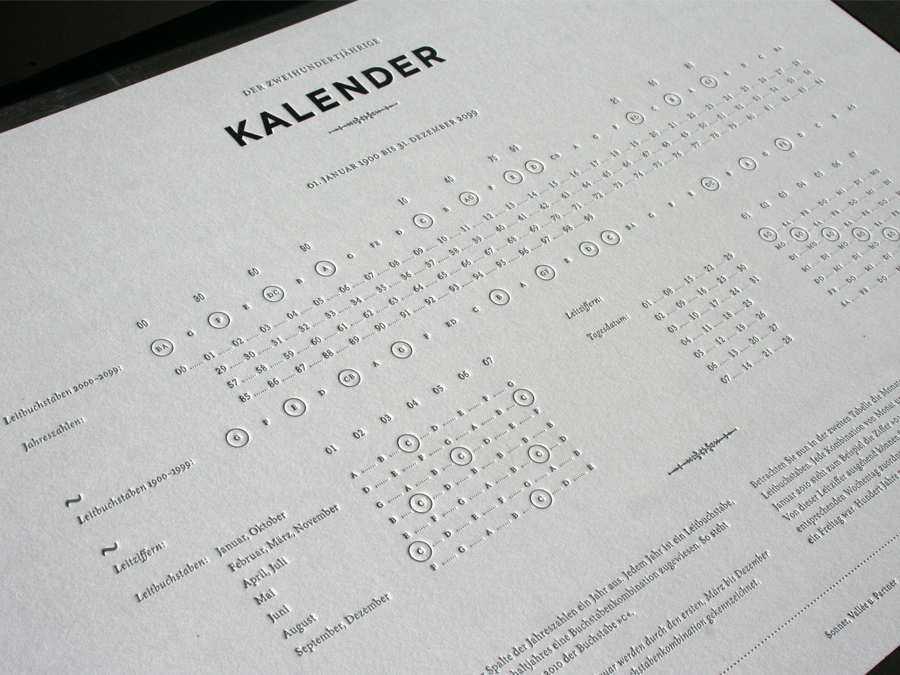
200 Year Kalendar — A beautiful letterpress calendar produced by German design studio Sonner, Vallée u. Partner, seen at Studio on Fire’s blog Beast Pieces (via ISO50).

Comments closed

Midweek Miscellany

A true miscellany here: letterpress to Gil Scott-Heron with a lot of meat sandwiched in between… This is quite possibly why I blog…

Ditoria — An amazing video about showing the letterpress printing process by Roberto Bolado.

The Cost of Creating — Harvard Law Professor Lawrence Lessig, author of Free Culture (and others), discussing the Google Book Settlement on NPR’s On The Media last month (via INDEX//mb):

[W]e need to once again think about what the balance should be between free access to culture and metered access to culture, because both extremes are mistakes, either the extreme that says everything is free because then lots of people won’t create because they can’t cover their cost of creating, or the regime that says everything needs to be licensed, because in that world there’s a whole range of creativity… that can’t begin to happen because the cost of negotiating and clearing those rights is just so extreme.

Stopping Saying “Innovation”Scott Berkun, author of The Myths of Innovation, in The Economist (via Frank Chimero):

Worry more about being good because you probably aren’t. If your organization struggles to make half-decent products, has the morale of a prison, and nothing ever changes much less improves, why are you obsessing about innovation? You need to learn the basics of how to make something good, that solves real problems, works reliably, is affordable, and is built by a happy, passionate well rewarded staff that believes good ideas have a chance. If you can make the changes necessary for these basic but all too rare attributes to be true, then innovation, in all its forms, will be much easier to achieve, and it might just happen all on its own.

New Type York — A (beautifully designed) photoblog by graphic designer James Patrick Gibson recording the typographic artifacts of New York City.

And thinking of New York… The NY Times is planning to spin off its Book Review as a separate e-reader product.

The Vulture Gil Scott-Heron

A Wry Return — Sean O’Hagan profiles musician Gil Scott-Heron in The Observer, revealing an somewhat unexpected connection to Jamie Byng, director of Canongate Books. I say “somewhat” unexpected because having lived in Edinburgh just before Byng wrapped up his funk and soul club Chocolate City, it seems entirely reasonable to me now I stop and think about it:

The story of how Gil Scott-Heron’s new album came to be made is a long and convoluted one. It is, among other things, a testament to the abiding power of great music outside the mainstream to spread like a virus across cultures, across decades. It begins back in 1987 in a rented house in Edinburgh when a young student is mesmerised by his friend’s collection of soul and funk music from the halcyon days of the early 70s… “I was just taken aback by the voice, the words, the poetry,” remembers Jamie Byng who, 22 years on, is the director of Canongate Books and still a fervent soul fan… “Discovering those songs was an epiphanic moment for me…” So taken was Byng by those songs that, having bought and rebranded Canongate, he tracked down his hero and, in 1996, republished his two long-out-of-print novels, The Vulture and The Nigger Factory.

And here’s Gil Scott-Heron’s painfully appropriate cover version of Robert Johnson’s Me and the Devil:

Gil Scott-Heron’s books The Vulture and The Nigger Factory were recently reissued by Canongate.

3 Comments