


Penguin UK is relaunching its nonfiction line Pelican in May with a redesigned logo and design. This short new video from the publisher takes a flying look at the imprint’s history and some of its more memorable covers:
Comments closedBooks, Design and Culture
Penguin UK is relaunching its nonfiction line Pelican in May with a redesigned logo and design. This short new video from the publisher takes a flying look at the imprint’s history and some of its more memorable covers:
Comments closed
GestaltenTV have been reposting some of their past videos, and I just came across this interview with designer David Pearson and Penguin art director Jim Stoddart from 2008 for the Gestalten title Fully Booked: Cover Art and Design for Books (currently unavailable sadly):
Comments closedPenguin Press Art Director and designer Jim Stoddart talks about his design for the (Penguin Classics)RED edition of Thérèse Raquin by Émile Zola:
Penguin designers Coralie Bickford-Smith and Stefanie Posavec also talk about their designs for series.
There’s more information about the videos and the (Penguin Classics)RED editions on the Penguin Blog and you can see all the covers of all 8 books on Flickr.
You can read my interview with the talented Ms. Bickford-Smith here.
2 Comments
John Squire‘s 1980’s covers for the Penguin Decades Series at The Creative Review. The art direction was by Penguin’s Jim Stoddart, but yes, it is THAT John Squire (i.e. awesome).
Fine Independent Publishing — An interesting interview with Barbara Epler, Editor-in-Chief at literary publisher New Directions, at KCRW’s Bookworm (although I could do without the decline of literature being blamed squarely on sales and marketing people. Again):
Permanent Crisis — A post by Rebecca Smart, Managing Director of military history publisher Osprey Publishing, at Digital Book World:
If you perceive that your only environment is that encompassed by your current supply chain then you’re only going to adapt to changes in that environment – so the response to the digital challenge viewed in this way would be to create and sell e-books. If you put the consumer at the heart of your thinking you can consider instead each group of customers you serve and what they might want on top of what you already provide, how they might want you to serve them differently in the future. More to the point, you can ASK them, listen and respond.
Proletarian Erotica — Lorin Stein, former senior editor at Farrar, Straus and Giroux and new editor of the Paris Review, interviewed at The Economist‘s ‘More Intelligent Life’ blog. The National Post also ran a nice interview with Stern last month.
Going Deutsch — Tom McCarthy, whose new book “C” I’m reading right now, interviewed at the New York Times ‘Paper Cuts’ blog:
One critic described “Remainder” as a French novel written in English; well, by that token, “C” is my German novel. What the next one will be is anyone’s guess. Swedish, maybe…
More from Tom on The Casual Optimist soon (if I can twist his arm)…
Print Junkies — An interview at The Second Pass with the publisher and editor of Stop Smiling magazine J. C. Gabel on the launch if the Stop Smiling book imprint:
We’re still operating with the same mentality… but have adopted a Less Is More mindset — and a production schedule to match. It does feel nice to know that what we spend months or years working on is now being released in a permanent format. We’re really trying to reinvent the DIY aesthetic of the magazine to apply it to editing, publishing, and promoting books. The book-making process itself, of course, is much slower and drawn out, which is refreshing as we all get older.
And finally, I give you Oliver Jeffers’ moustache (via Tragic Right Hip)…
3 Comments
Refreshing classic creative texts: Creative Review talks to Penguin’s art director Jim Stoddart about the redesigned and reissued books in the ‘Penguin on Design’ series. The books include Bruno Munari’s 1965 book, Design As Art; Marshall McLuhan’s 1967 The Medium is the Massage; John Berger’s Ways Of Seeing from 1972; and Susan Sontag’s 1977 essay, On Photography.
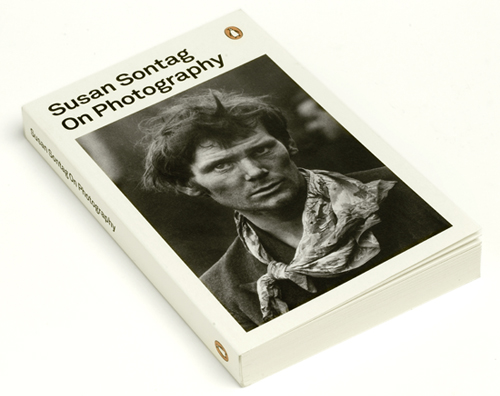
I do like these covers — Susan Sontag’s On Photography (pictured) is particularly striking — but, again, what is with all the white? Surely someone at Penguin has worked in a bookshop. I mean these are clearly meant to be looked at and not touched.
Comments closed