Skip to content

Tag: interview

Design Matters with Louise Fili

Designer, and former art director of Pantheon, Louise Fili discusses her work with Debbie Millman on Design Matters:

Design Matters With Debbie Millman: Louise Fili Interview mp3

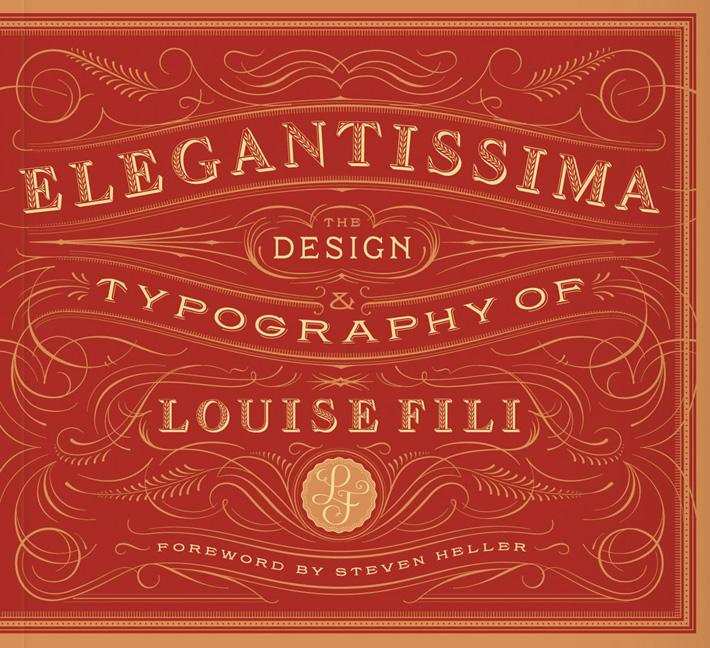
Elegantissima, the first monograph of Fili’s work, was published earlier this year by Princeton Architectural Press (who are, for the record, are distributed in Canada by my employers, Raincoast Books)

Comments closed

Chris Ware on Bookworm

Cartoonist Chris Ware discusses Building Stories with Michael Silverblatt on KCRW’s Bookworm:

KCRW BOOKWORM: Chris Ware Building Stories mp3

Ware will be at the Brooklyn Comics and Graphics Festival tomorrow (November 10) and the Librairie D+Q fifth anniversary party with Charles Burns and Adrian Tomine in Montreal on Sunday (November 11).

Comments closed

William Klein: In Pictures

In this interview for Tate Media, William Klein, one of the 20th century’s most important artists, photographers and film-makers, discusses his experience photographing on the streets of New York, the challenges of publishing his first book and how he working with filmmaker Federico Fellini:

Klein’s work is featured in the exhibition William Klein + Daido Moriyama at Tate Modern, 10 October 2012–20 January 2013. You can watch a Tate interview with Daido Moriyama here.

Comments closed

RDInsights: Alex McDowell, Designer of Worlds

Mike Dempsey interviews innovative and influential production designer Alex McDowell who started out screen-printing t-shirts for Vivienne Westwood before going on to work with film directors such as Terry Gilliam and David Fincher (and with Tim Pope on that wardrobe video for The Cure):

RSA Royal Designers: Alex McDowell Interview mp3

(It’s a fascinating conversation but it took me several attempts to download what is quite a long interview, so I hope it works better for you!)

Comments closed

Q & A with P. D. Smith

City A Guidebook for the Urban Age is the fascinating new book by British writer and reviewer by Peter D. Smith. Published by Bloomsbury, it is a wonderfully meandering collection of essays on cultural history of the world’s cities and an exploration of architecture and urban life from the earliest cities in Mesopotamia to the future dystopias of The Sleeper Awakes and Blade Runner.

I first came across Peter via his reviews for The Guardian newspaper and his lively Twitter feed which, if you are interested, provides the curious with steady stream links about books, history, science and architecture of the kind one might expect from another cultural magpie, William GibsonCity was still a work in progress at that point and having followed it’s development over the past couple of years, I was glad to finally have the opportunity to read it last month. It didn’t disappoint.

Peter and I talked by email…

When did you first become interested in writing?

As a child I was always writing stories, usually fantasy or science fiction. When I was about thirteen we had to write a story for school during the summer holiday. Mine was a space opera about bug-eyed aliens on a distant world. By the end of the holidays I had filled a whole exercise book and even designed a cover for it. I doubt my poor teacher read it all. But I got top marks for effort at least.Afterwards the other kids in my class started reading it and passing it around. Then this boy from another class got hold of it. He had close-cropped hair and wore Doc Martens boots. Weedy bookworms like me generally tried to keep out of his way, but one day he stopped me outside the school gates. I thought he was going to hit me. Instead he started talking about my story. He liked it! I was astonished and I’ve never forgotten that moment. It taught me something about writing and its ability to connect with people.

Your previous books are about superweapons and Albert Einstein. Why did you decide to write a book about cities?

My doctorate was about scientific ideas in German literature, from Goethe to Brecht. The biography of Einstein and the cultural history of doomsday weapons grew directly out of my interest in the way science and culture influence each other. But for my next book I wanted to do something a bit different, from the point of view of both subject and style. I like subjects that cross boundaries and, right from the start, I loved the idea of writing a history of cities. It allowed me to explore everything from the technology of cities to the invention of writing and theatre. It also gave me the opportunity to experiment with different narrative structures. The vast scale of the subject meant it was impossible to explore in a straightforward narrative. Eventually I decided to write it as a guidebook to an imaginary Everycity. Of course, this brought its own challenges, but it was also fun. Most importantly, it made the whole project – which is in a sense a survey of civilisation – manageable as well as opening up the idea of the city, both as an idea and as a physical reality.

Is learning more about the subject you’re interested in part of the impulse for your writing?

Absolutely. I love researching a new idea. Writing a book is a bit like juggling with different bits of information, ideas, places, and characters. You have to keep them all up in the air, then gradually bring them down to the ground in some kind of order. It’s always an immense challenge and sometimes you feel you’re not up to it. But it’s a great thrill when you find something new – an idea, a fact, a juxtaposition. That’s what makes it all worthwhile.

Which books most influenced your thinking about cities?

Lewis Mumford’s The City in History was one of the books that inspired me initially. It’s an immensely impressive survey. Similarly impressive in both scale and erudition is Peter Hall’s Cities in Civilisation. The sheer imaginative range of Geoff Manaugh’s writing on architecture and urbanism on BLDGBLOG is also a constant source of inspiration. And, of course, Italo Calvino’s wonderful Invisible Cities was always there in the background. It’s such an evocative piece of writing about cities and the urban experience.

Why do you think there has been renewed interest in urban living in recent years?

In the US, the 2011 census showed that more young people are choosing to live in cities. For the first time in a century, big cities in America are growing at a faster rate than the suburbs. That’s happening elsewhere too. Perhaps this is because, after the recession, people are less inclined, or able, to buy homes and prefer to rent instead. Or it could be that a new, wired generation has rediscovered the joys of urban life: of living somewhere with public transport, where you can experience diverse cultures and lifestyles, and where you can tap into the creative buzz of city life. In the developing world cities are also growing at an unprecedented rate, morphing into megacities of 20 or even 30 million people. They are the largest artificial structures ever built. People are drawn to them as they have always been – to find work, education, health care, or to escape the confined world of the village. As the medieval German saying goes: Stadtluft macht frei – city air sets you free.

The book covers a lot of different topics, but the idea of ‘the city’ is a vast, open-ended subject. Were there things you were sorry to leave out?

Yes, certainly. There were many topics that had to be dropped. They included urban myths, street painters, and secret cities, like the ones built during the cold war. Even without these, the first draft was too long and more material had to be cut. But I’m very happy with the finished text. Sometimes in a book like this, less is more.

One of the more sobering part of the book addresses climate change. But you see cities as part of the solution. Why is that?

The population of the world is rising inexorably and cities are growing larger. We need to reduce the ecological footprint of our cities. This can be done with good planning and the use of cutting-edge technologies to reduce greenhouse gas emissions. Cities can be green: they can generate their own energy, they can provide bicycle lanes and efficient public transport, they can even grow some of their food in rooftop greenhouses. Concentrating people in cities is a highly efficient way of supplying large numbers of people with clean water, healthcare and energy. By contrast, suburban living, where everyone drives cars and lives in detachedhouses, is wasteful of scarce resources and is unsustainable as a model for the world as a whole. Although New Yorkers produce many times more greenhouse gasses than those who live in Mumbai, New Yorkers are responsible for only a third of the carbon dioxide of the typical American. City living can certainly be part of the solution to the environmental challenges of the future.

Has new technology changed how we live in cities?

Yes, new technologies are always changing the shape of cities. Think of the automobile. The internal combustion engine has had a huge impact on cities and how we live in them, as did railways and subways. In the future, cities will be more aware of their inhabitants. Surveillance technologies and electronic chips and sensors will pervade the structures and spaces of the city. Buildings and streets will respond to your presence, automatically adjusting things like air temperature and lighting. But no matter how advanced our technology becomes, cities will still have to satisfy the same kind of demands that city dwellers have had for millennia. We are social animals and our greatest cities will always be dynamic centres of work, culture, entertainment, and shopping.

Why do you think Blade Runner’s dystopian portrayal of Los Angeles has become the prevalent cinematic vision of the city of the future? 

It’s true – in modern fiction and film, future cities are usually depicted as dystopias. Blade Runner – one of my favourite films – draws on a rich fictional tradition, including HG Wells’ The Sleeper Awakes and Fritz Lang’s Metropolis. But this has not always been the case. In the Renaissance, dreaming up ideal cities seems to have been something of a philosophical game among intellectuals and artists. They wanted to reform society and they believed people could be improved by creating perfect cities. The quest for ideal cities continued among architects and city planners into the twentieth century. But writers and filmmakers became more pessimistic about the urban future. Today these dystopian visions have become something of a cliché. People are no longer fleeing the city as they were in the second half of the twentieth century. Maybe the time is ripe for a new idealism about the urban future. As Calvino said, ‘With cities, it is as with dreams: everything imaginable can be dreamed…’.

Do listen to music while you write? What did you listen to writing City?

Yes, I do usually listen to music, both while reading and writing. If I’m writing non-fiction it tends to be classical music, such as Mozart or Bach, especially the cello suites played by Paul Tortelier, which I really love. But it depends on my mood. Sometimes I’ll choose something by Michael Nyman, Keith Jarrett or Brian Eno’s Apollo soundtrack, which is one of my favourites. If I’m writing fiction then it can be anything from Radiohead or Bjork, to Pink Floyd or Talking Heads.

What books have you read recently?

Fiction: Balzac’s Old Man Goriot, Dashiell Hammett’s Red Harvest, Nick Harkaway’s Angelmaker, and Sam Thompson’s Communion Town. Non-fiction: Taras Grescoe’s Straphanger, Roger Crowley’s City of Fortune, and Man Ray’s Self-Portrait.

Do you have a favourite book?

Mervyn Peake’s Titus Groan. Gormenghast is such a powerful imaginary architectural space – a kind of Gothic megastructure. It’s a remarkable creation.

What are you working on right now?

A new non-fiction book about the city of crime. It’s still in its early stages but I’m enjoying it immensely. It’s a wonderful excuse to watch film noir and to read lots of great crime fiction.

Are you concerned about the future of books and book reviews?

Not really. The world of publishing – both of books and newspapers – is certainly changing. I’m writing this on my new iPad which I’ve bought mostly in order to be able to read e-books. I’ve run out of shelf space in my house, so I’m going to expand my library into the digital realm. I’ll always love paper books, just because that’s the technology I’ve grown up with. But a new generation will grow up using e-readers and they’ll see (and read) things differently. I think people will always want to read book reviews in newspapers, whether they are on paper or online. But now book lovers also read and write book blogs and they want to discuss what they’re reading on Twitter. Once if your book didn’t get reviewed in the press that was probably the end of the story. Now a book can become a bestseller because enough people rave about it online. Clearly there are major challenges facing publishers, especially regarding piracy and the pricing of books in an age when many people seem to think they should be free. There’s no doubt it’s a tough time to be making a living as a writer! Plus ça change…

Thanks Peter!

Comments closed

Jane Jacobs on Writers & Company

In an archive interview from 2002 (rebroadcast this weekend), CBC Radio’s Eleanor Wachtel talks to the late Jane Jacobs, author of Death and Life of Great American Cities, at her home in Toronto:

CBC RADIO WRITERS & CO: Jane Jacobs mp3

Comments closed

Something for the Weekend

No Idea What I’m Doing — Keith Ridgway, author most recently of Hawthorn & Child, on writing fiction:

I have no idea what I’m doing. All the decisions I appear to have made—about plots and characters and where to start and when to stop—are not decisions at all. They are compromises. A book is whittled down from hope, and when I start to cut my fingers I push it away from me to see what others make of it. And I wait in terror for the judgements of those others—judgements that seem, whether positive or negative, unjust, because they are about something that I didn’t really do. They are about something that happened to me. It’s a little like crawling from a car crash to be greeted by a panel of strangers holding up score cards.

A Dog’s Cock — The history of the exclamation mark:

no one really knows the history of the punctuation mark. The current running theory is that it comes from Latin. In Latin, the exclamation of joy was io, where the i was written above the o. And, since all their letters were written as capitals, an I with an o below it looks a lot like an exclamation point.

But it wasn’t until 1970 that the exclamation point had its own key on the keyboard. Before that, you had to type a period, and then use the backspace to go back and stick an apostrophe above it. When people dictated things to secretaries they would say “bang” to mark the exclamation point. Hence the interobang (?!) – a combination of a question (?) and an exclamation point (!). In the printing world, the exclamation point is called “a screamer, a gasper, a startler or a dog’s cock.”

One more on the late Robert Hughes at The Economist:

As our lives grow increasingly distracted and overstimulated, the critic has become both more and less relevant in the service of cultural sieve, filtering out the good from the bad. Mr Hughes didn’t subscribe to such categorical certainties. In turn he placed as much emphasis on the context of a work as he did on its content. To Mr Hughes, experiencing art wasn’t about passing a few hours in some museum, but what made those few hours meaningful to be alive.

And finally…

Larry Tye talks about his new book Superman: The High-Flying History of America’s Most Enduring Hero, on CBC Radio’s The Current:

CBC RADIO THE CURRENT: Superman: The High-Flying History of America’s Most Enduring Hero mp3

Comments closed

Q & A with Barbara deWilde

It would be hard to overstate the impact of Barbara deWilde on contemporary book cover design. Along side Carol Devine Carson, Chip Kidd and Archie Ferguson, Barbara’s designs not only defined the bold, visual aesthetic now commonly associated with Knopf, but helped reinvent American book cover design in the 1990’s.

Barbara left book publishing in 2000 to become the design director of Martha Stewart Living — where she successfully implemented a redesign of the magazine (which gave the world the Hoefler Frere-Jones font Archer, thank you very much) — but returned to Knopf  seven years later and created more characteristically distinctive book cover designs, including the jacket for the Pulitzer Prize winning novel A Visit From the Goon Squad by Jennifer Egan. And yet, not resting on her laurels, Barbara recently changed direction once more. Now studying interaction design full-time at the School of Visual Arts, it seemed the perfect time to look back at Barbara’s work as a book cover designer and to talk to her about what’s next…

Barbara and I corresponded by email.

Do you remember when did you first become interested in design?

I wanted to be an artist, but my parents forbid me to pursue art as a major. My act of defiance was to be an Education major, but to take as many art classes as my schedule could hold. I was taking a Ceramics class and the work area was in an open yard beneath the Graphic Design studio. As I worked into the night, I saw that the lights were always on, in fact, they were never turned off, even long into the night. I had to find out what they were doing up there…

You’re an established designer; why did you decide to go back to school?

I was a bit embarrassed to make this move back to school, but now I can honestly say it was the best thing that I could have done for myself as a designer. In fact, I can’t tell you the number of people who have been enquiring about how to make a similar move. Two years ago I wanted to make the move to working digitally, but there was a barrier to doing this professionally. I’m at too high a level in my design to be be paid to learn. I could have approached the shift by taking on an interactive project and figuring out the digital component like most autodidacts, but I found that I didn’t even know the language of software creation. There is no singular programming language, there’s no silver bullet…learn this software and you’ll understand all. The landscape is changing all the time. I spoke to a lot of people in the digital publishing world and made a list of skills that I would have to acquire. I found that some of the skills could be acquired through continuing education, and some were available online, but most were not available unless you entered a program. There are only a handful of Interaction Design programs in the U.S. and 2 are in New York. I thought if I took off for 2 years and got the degree I would have everything in one place and also get that piece of paper (like in the Wizard of Oz) that attests that I know this field. I’ve never had a graduate degree, so I jumped.

What interests you about Interaction Design?

I find it very humbling. You are designing with the medium of human behavior. As an interaction designer one needs to be more observant and less dictatorial, but most importantly it requires a methodical approach to design. I am extremely intuitive. In the past I have found my way to a design solution by feeling it. The intuitive approach is fine if you work primarily with yourself or with one other person. When you work on building a service, a website, let’s say, or an interactive mobile product, you are working with a team of people. You need a common language, models, and writing skills. The collaborative nature of the work and the relentlessness of content and tasks makes an intuitive approach, if not obsolete, at least secondary.

Are you still designing book covers?

Yes, I love them. I hope I can still work on a few every year. Now, they are my guilty pleasure.

Could you describe how you approach a new design project?

I read whatever I’m given. I try to understand what the usual expectation for a book in the genre is and ditch it…or try my best to stay miles away from it. I don’t start working at my desk until I have some model in my head of what the book is going to look like. I usually make a thumbnail sketch which is totally unrecognizable to anyone but me.

What are your favourite projects to work on?

I like anything that’s well written. I can tell you what I don’t like to work on…anything in the category of “chick lit.” I’m not great at thrillers, but I like working on them occasionally.

How is your approach to art direction different from your own design process?

I art direct projects that I understand, but that I don’t have an aptitude to design. I’m not an illustrator or a photographer, but I do both sometimes. When a book requires a real skill set, I love to hire people. I think an art director is most helpful when they have a vision, can communicate it, and give feedback. Otherwise, they’re useless in the role.

What do you look for in a designer’s portfolio?

Life is boring, make my day… show me something that I wish that I had created. I’d rather see three drop dead great pieces than a couple of great ones and then fifteen mediocre things. It makes me question which designer I’m going to get when I hire you, the great one or the middle-of-the-road one.

Do you see any prevalent trends in contemporary book design?

There’s a lot of illustration now, a lot of charm. I don’t see much ugly stuff, it’s all very masterful. I like ugly, raw work.

What challenges do book designers face currently?

Publishing execs are always grumbling about not making enough money, but lately I think they really believe it. The economics of the publishing model are being challenged by the internet and that turns publishers from idealists to technocrats. That downward pressure always hurts production and design. In addition, whenever a publishing house becomes risk averse, their designers’ choices are limited.

Do women designers have the same creative opportunities as their male colleagues?

Absolutely not…nor do their female writing counterparts. Titles are assigned by the vision of the art director. Usually there is a gender mapping… girl book: girl designer. The publicity budgets are smaller for female writers as are the print runs and the reviews. Meg Wolitzer called it “The Second Shelf.”

What advice would you give a designer starting their career?

At this point, a design student has software and the world has problems…go! There has to be a pretty compelling reason to work for someone else. I would encourage designers to be entrepreneurial.

Where do you look for inspiration, and who are some of your design heroes?

I have print design heroes, like Peter Saville, Francesco Franchi, and Yomar Augusto, and interaction design heroes like Nick Felton and the guys who started Kickstarter: Perry Chen, Yancey Strickler, and Charles Adler.

What books have you read recently?

I just finished Bring Up the Bodies by Hilary Mantel (which I loved) and now I’m reading a book published in 1883 on making candy. It’s called the Frye’s Practical Candy Maker. The stack near my bed has the Steve Jobs biography, Colum McCann, Let the Great World Spin, the new Richard Ford, and Katherine Boo’s Behind the Beautiful Forevers.

Do you have a favourite book?

My last favourite book always changes. Right now it’s a three way tie between Wolf Hall; Blood, Bones, and Butter; and Olive Kitteridge. My favourite book of all times is Suttree by Cormac McCarthy.
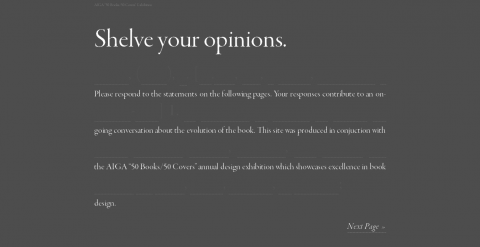
What is ‘What the Book’?

WhattheBook.org is a website that was made in conjunction with the last exhibition at the AIGA of 50 Books/50 Covers. The show had been an annual destination for the best of book and book jacket design but has ended. The AIGA reasoned that the show was no longer relevent, that book design is easily curated and shared on the internet through various blogs, and that it only served the New York elite not the wider national membership.

Within the AIGA gallery I created a 12 foot wide book shelf that allowed visitors to shelve a book, essentially “vote,” for how they feel about the shift in books from physical objects to digital. A red book meant that you agreed and a black book meant that you disagreed. An example of one of the statements is “I silently judge people by their bookshelves.” Agree or disagree. The website runs through the same list of statements and you can vote online. The last part asks the visitor to define what “book” means now that the physical constraints don’t always apply.

We’ve collected nearly 1700 definitions and I’m in the midst of trying to make a visualization of them… and a part 2 to the website. It was the perfect transition project from my old world of book jacket design to interaction design.

What does the future hold for book cover design?

I’m a pragmatist. James Bridle describes the book not in its physical model (pages or no pages) but in its temporal model. What that means is that a book functions first as an advertisement , second as a reading experience, and third as a souvenir. Now eBooks make lousy advertisements, so-so readings experiences, and lousy souvenirs. But some publishers are now selling nearly 60% of each title in eBook form.

So, despite the flaws, people are opting for price and convenience. As a designer, I would ask how my work functions within this model and if it doesn’t how could it in the future? I answered the question by leaving print to learn digital design. I felt there were more creative opportunities elsewhere. (I know I didn’t answer the question.)

Thank you, Barbara!
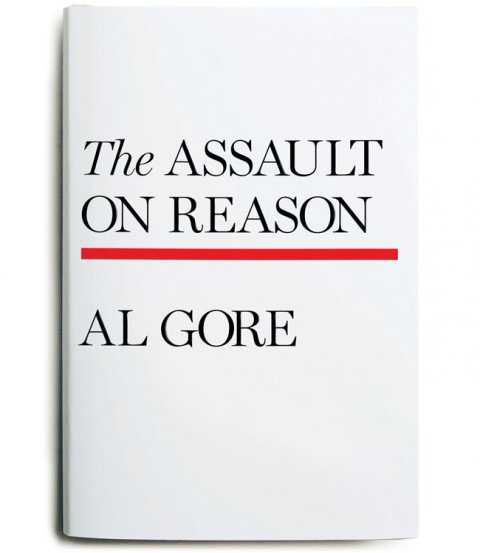
The Assault on Reason

Image 1 of 12

3 Comments

Fully Booked – Interview with David Pearson and Jim Stoddart

GestaltenTV have been reposting some of their past videos, and I just came across this interview with designer David Pearson and Penguin art director Jim Stoddart from 2008 for the Gestalten title Fully Booked: Cover Art and Design for Books (currently unavailable sadly):

Comments closed

TateShots Bruce Davidson’s Subway

“I wanted to transform the subway from its dark, degrading, and impersonal reality into images that open up our experience again to the colour, sensuality, and vitality of the individual souls that ride it each day.”

Photographer Bruce Davidson talked to TateShots about Subway, the groundbreaking series of portraits he began taking in the New York subway system in the spring of 1980:

The series was collected into a book published by Aperture in 1986, and the 25th anniversary edition of Subway was published last year. The New York Review of Books ran excerpt of the introduction to that new edition here.

1 Comment

Typesetting

Typesetting is a new documentary series that explores the relationship between designers, their work, and the cities in which they live. In the first episode designer Elisabeth Kopf talks about living in Vienna and how it inspires her untraditional approach to design. I had never seen Kopf’s highly original work before, but her beautiful Little Orchestra CD packaging is wondrous. Watch:

(via Coudal)

Comments closed

Design Matters with Steven Heller

In a fascinating and wide-ranging conversation, design historian Steven Heller talks about design and his recent book 100 Ideas That Changed Graphic Design with Debbie Millman on Design Matters:

Design Matters: Steven Heller mp3

Heller really is an astonishingly prolific author.

(Full disclosure: 100 Ideas That Changed Graphic Design is published by Laurence King and is distributed in Canada by my employer Raincoast Books)

Comments closed