Skip to content

Tag: Comics

Dystopia

Tom Gauld for The Guardian.

Comments closed

Talking Coffee

I related to Twisted Doodles comics about talking coffee a little too much… 

Comments closed

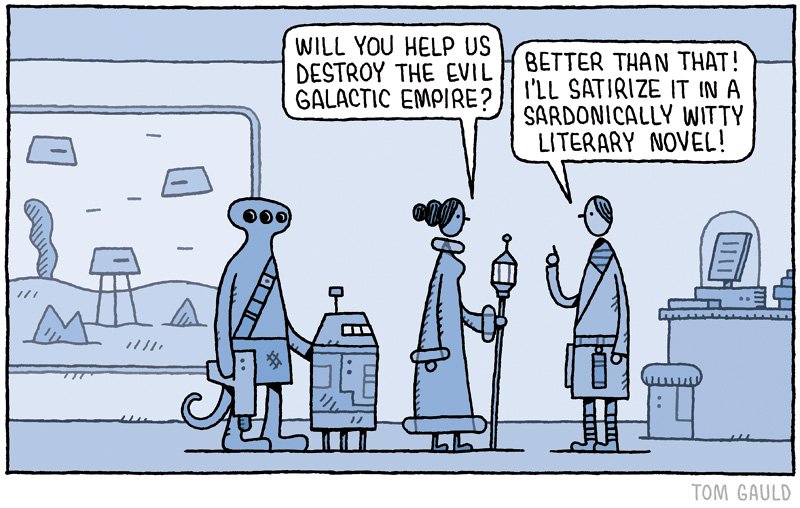
Will You Help Us Destroy the Evil Galactic Empire?

Tom Gauld for The Guardian.

(I’m working on my sardonically witty literary novel as we speak.)

Comments closed

Will Eisner Centenary

On the centenary of his birth, The Society of Illustrators in New York is celebrating the life of cartoonist Will Eisner with an exhibition of his work, including original artwork from his graphic novels A Contract with God (1978) and Life on Another Planet (1983), and over 40 pages of originals from The Spirit (1940–1952) newspaper section.

At the Village Voice R.C. Baker looks back at Eisner’s career:

Humanity leavened with contradiction, pathos, and humor describes the cast of characters Eisner (1917–2005) created in his trailblazing career, most notably in the adventures of a heavy-fisted, lighthearted crime-buster, the Spirit.

The Spirit has been called the Citizen Kane of comics, and it would be accurate to say that Eisner and Orson Welles — the actor/writer/director who brought Charles Foster Kane to life in that 1941 masterpiece — sprouted from the same loam of pulp magazines and cliff-hanging radio serials. Welles then apprenticed in classical theater, while Eisner studied narratives almost as psychologically complex (and more innately American): reams of newspaper strips and Sunday funnies. Both auteurs expanded their mediums in ways we still reckon with today.

Similarly, at Forbes, Rob Salkowitz looks at Eisner’s enduring legacy:

In 1941, comics were not considered high art; they were barely considered art at all. But to a 23 year-old cartoonist named Will Eisner who was just about to debut a new feature called “The Spirit,” comics possessed limitless storytelling potential. “Eventually and inevitably, [comics] will be a legitimate medium for the best of writers and artists,” said the young creator.

Over the next 75 years, Eisner was proved right, due in large part to his own output through the course of a remarkable career that saw him invent significant chunks of the comics’ storytelling vocabulary, pioneer the use of comics for education and training, establish a critical method for teaching and analyzing visual storytelling and virtually invent the long-form comics format known as the graphic novel. A large part of the $1 billion annual publishing enterprise and the multi-billion dollar entertainment, events, media and licensing industries that derive from it, are attributable directly to Eisner’s efforts and innovations.

The Guardian has republished a version of Neil Gaiman’s essay on Eisner from his collection of odds and ends The View from the Cheap Seats1:

Will’s life is, in miniature, a history of American comics. He was one of the very first people to run a studio making commercial comic books, but while his contemporaries dreamed of getting out of that ghetto and into more lucrative and respectable places – advertising, perhaps, or illustration, or even fine art – Will had no desire to escape. He was trying to create an artform.

In seven pages – normally less than 60 panels – he could build a short story worthy of O Henry; funny or tragic, sentimental or hardbitten, or simply odd. The work was uniquely comics, existing in the place where the words and the pictures come together, commenting on each other, reinforcing each other. Eisner’s stories were influenced by film, by theatre, by radio, but were ultimately their own medium, created by a man who thought that comics was an artform, and who was proved right.

And Print has reposted Michael Dooley essay, originally for written AIGA, on Eisner’s best known work, The Spirit:  

The field was already becoming glutted with simplistic adolescent power fantasies, but The Spirit had the texture of real life. He was decidedly not a costumed super-hero but simply a plainclothes sleuth who was prone to frequent noir-like pummelings from two-bit goons. He also displayed an ironic, smart aleck-y sense of humor, highly unique for this genre.

The strip, at seven or eight pages, reimagined itself every time. One week the format might be a fairy tale, another week a seven-page poem. Sometimes the Spirit would be shoved off to the sidelines or shunted altogether if Eisner felt so inclined. A Gerhard Shnobble episode – Eisner’s personal favorite – is a philosophical contemplation of man’s place in the universe disguised as a cops-and-criminals yarn. The Spirit was the first major milestone in his lifetime goal to explore and elevate comics as a mature literary form.

I first came across Will Eisner and The Spirit in The Penguin Book of Comics by George Perry and Alan Aldridge (previously mentioned here). It was a tease — little more than a page of artwork and a couple of short paragraphs on Eisner’s genius. I didn’t actually read a complete strip until years later when I came across a series of reprints from Kitchen Sink Press in a comics shop in London. I could only afford to buy one issue — which collected 3 or 4 stories I think — but it was enough to get me hooked.

Critics tend to focus on the later strips where the Spirit is often peripheral to the stories. These are surely more inventive than Eisner’s early comics. But I miss the Spirit when he is not central to story. He is like Raymond Chandler’s Marlowe — forever getting knocked on the head, and forever waking up in the arms of women who look like Ava Gardner or Lauren Bacall. It doesn’t sound like much, but Eisner imbued even these simple stories with a charm and sophistication that makes them a pleasure to read. 

Will Eisner: The Centennial Celebration 1917–2017 is at The Society of Illustrators, March 1–June 3 2017.

Comments closed

40 Years of 2000AD

The Guardian looks back on 40 years of British weekly SF comic 2000AD:

Forty years ago on 26 February, something extraordinary happened to British comics. Newsagents’ shelves were suddenly stuffed with a brand new title, its masthead garish red and yellow, with an enticing plastic “Space Spinner” taped to the front. “In orbit every Saturday,” the front proclaimed, “for a low price: 8p Earth Money.” 2000AD had landed.

It’s not, strictly, correct to say the world had seen nothing like 2000AD before. A few months earlier, in October 1976, a title put out by the same publishers, IPC, had died an ignominious death. Action was stuffed to the gills with anti-authoritarianism, ultraviolence and gore. Hugely popular with kids, especially boys, it proved too unpalatable for the nation’s moral guardians. Questions were asked in the House, tabloids fulminated against its bloody violence.

The final issue of Action was pulped before it made it to the newsagents. But its successor was already in the works, from the writer/editor who had created Action: Pat Mills.

In Action, Mills had freely taken inspiration from 1970s popular culture, riffing on Muhammad Ali, Jaws and football hooligans. The new wave of science-fiction blockbusters – Star Wars and Close Encounters of the Third Kind – gave him a brainwave.

“I felt, in a way, that science fiction could escape the heavy flak we had got with Action,” says Mills, who now lives in Spain. “With Action, the message was loud and clear because most of it was set in what was the present time. With 2000AD, we could do the same sort of thing but if anyone complained we could say, ‘Look, it’s just some robots in the future.’”

For better or worse, 2000AD was pretty formative for me growing up, although probably less for its best known character Judge Dredd, than for things like Pat Mills and Kevin O’Neill’s bonkers Nemesis the Warlock, Halo Jones and Dr. and Quinch (also bonkers) scripted by Alan Moore, and artist Simon Bisley’s (bonkers) Heavy-Metalesque run on Pat Mill’s Celtic barbarian fantasy Sláine, which were all dark, violent, complicated and, needless to say, extraordinary for a weekly ‘kids’ comic. I don’t know how many of those stories hold up now. At the time they felt subversive, even a little illicit. But then they do say the Golden Age of science fiction is 12.   

I’m not quite old enough to remember Action, 2000AD‘s direct predecessor, but The Guardian also published a piece last year on its 40th anniversary: 

One remarkable thing about Action was that it was tacitly aimed at working-class children.

“The only time we saw working-class characters they were sidekicks, like Digby in Dan Dare, or they were figures of fun,” [Pat] Mills says. “Even Alf Tupper, the Tough of the Track, was presented as this odd character who trained for his races in his pit boots and ate fish and chips as soon as he crossed the finishing line.

“Kids got what we were trying to do immediately. There was this whole culture of punk, of James Herbert books such as The Rats, of Richard Allen’s Skinhead novels … It was all edgy and different, and Action was definitely a part of that.”

Despite that, says Mills, the team putting together Action always had “a definite moral compass”. He says: “We weren’t saying, ‘Go and pick a fight on the terraces’, but we were showing that sort of thing happened, as kids already knew.”

1 Comment

Books

Modern Toss

(This is a little too close to the bone)

1 Comment

Alan Aldridge 1943-2017

British artist and designer Alan Aldridge died last week aged 73. In the words of designer Mike Dempsey, Aldridge “was a major influence on the British design and illustration scene in the 1960’s.” Although he is perhaps best known for his work for The Beatles, The Who and Elton John (not to mention his infamous poster for Andy Warhol’s film Chelsea Girls) it began, Dempsey notes, “with his controversial post as fiction art director of Penguin Books in 1965 where he challenged the status quo, upsetting many on the way.”

The Guardian obituary explains how Aldridge got his start in design:  

Sheer chutzpah won him his first job at a design agency, where he passed off his girlfriend’s portfolio of work as his own and was hired for £3 a week. “I blag beautifully,” as he put it. When he turned up to work the following Monday and was told to wear a suit, he went to Bethnal Green baths and stole one.

He drew portraits in his spare time, and as news of his abilities spread, he was recruited as a trainee by Germano Facetti, the art director at Penguin Books. Aldridge worked his way up to designing book covers, then was offered a job as a junior visualiser at the Sunday Times. The paper had the UK’s first colour supplement, offering new opportunities in design and photography that Aldridge was keen to exploit.

His most memorable contribution was his transformation of a Mini into a four-wheeled work of art, handpainted by Aldridge in a hectic 24-hour session. It was the magazine’s cover image in October 1965, with the title Automania. Meanwhile he had still been creating covers for Penguin, and was lured away from the Sunday Times to become Penguin’s fiction art director. Aldridge set about creating a radical, freewheeling new look for Penguin’s catalogue.

Aldridge talked more about this unorthodox beginning in this video:

My introduction to Aldridge was the revised 1971 edition of The Penguin Book of Comics, the book he conceived with George Perry (the cover of the first edition, originally published in 1967, is pictured above). I found it on the shelf in my grandparents house and pored over the pages of reproduced art. The book was my first introduction to American comics, and the idea that comics could be taken (somewhat) seriously. I found Aldridge’s illustrations, which also appear throughout the book, confusing and fascinating in equal measure. I know they reminded me of Heinz Edelmann’s art for Yellow Submarine — I think for a while I assumed they were by the same person — but you can read about Aldridge’s own work with The Beatles in this 2005 article from Eye Magazine

Aldridge refused to call himself an artist, illustrator, or designer. Instead he was a self-styled ‘graphic entertainer’, a precursor of today’s designer-entrepreneur, who had created a moderately successful product called ‘Put-Ons’, tattoo skin transfers. He was also always pitching projects that could turn a profit. He even convinced Albert Grossman, Bob Dylan’s manager, to produce a book of Dylan lyrics. But when Sgt. Pepper’s was released in 1967, Aldridge had an idea that promised surefire success.

‘I noticed the initials of ‘Lucy in the Sky with Diamonds’ spelled LSD and decided that it would be fun to explore visually the hidden meaning in the Pepper’s lyrics. I called Paul (who I’d never met, but had his home phone number) and said I’d like to interview him [about this], and much to my amazement he not only said yes, he said let’s do it now and come right away to his house in St John’s Wood. You don’t argue with an edict like that.’ The interview and accompanying illustrations appeared in 1967 in The Observer under the headline: ‘A Good Guru’s Guide to the Beatles Sinister Songbook.’ Bags of fan mail rapidly followed. ‘It didn’t take a brain surgeon to figure out that I was on to something. So I pitched a dummy of the book, The Beatles Illustrated Lyrics, which had three or four spreads of illustrated lyrics, to Peter Brown (Beatle manager Brian Epstein’s partner for many years) at Apple. The book would have all the lyrics from ‘Love Me Do’ to ‘A Day In The Life’ illustrated by famous artists; I think I even mentioned getting Picasso, Dali and Magritte! Peter showed the layouts to John and Paul and got the boys’ okay.’

Having Lennon and McCartney’s sanction, however, did not mean Aldridge instantly nailed the book. He still had to present the project to Dick James, owner of Northern Songs, which published and co-owned the Lennon / McCartney lyrics. ‘Dick liked what he saw, then curve-balled me,’ Aldridge winces. ‘An American publisher had come to him with a similar deal, and had offered a lot of money, but since I had the boys’ okay he’d give me two weeks to get a publishing deal that gave him an advance of £20,000, a huge sum in 1968.’ For a week, Aldridge phoned every publishing house in London and New York, explaining the urgency. He was, however, turned down by everyone. ‘Not because of the large advance, but because they all thought the Beatle phenomena wouldn’t last another year.’

The Man with Kaleidoscope Eyes: The Art of Alan Aldridge, a catalogue of Aldridge’s work, is available from Abrams.

Comments closed

The Martian Invasion of 1894

Tom Gauld for The Guardian

Comments closed

Chris Ware on George Herriman and Krazy Kat

The New York Review of Books has an essay by cartoonist Chris Ware on George Herriman the creator Krazy Kat, one of the most beautiful, poetic and inventive comic strips ever created:    

Krazy Kat has been described as a parable of love, a metaphor for democracy, a “surrealistic” poem, unfolding over years and years. It is all of these, but so much more: it is a portrait of America, a self-portrait of Herriman, and, I believe, the first attempt to paint the full range  of human consciousness in the language of the comic strip. Like the America it portrays, Herriman’s identity has been poised for a revision for many decades now. Michael Tisserand’s new biography Krazy does just that, clearing the shifting sands and shadows of Herriman’s ancestry, the discovery in the early 1970s of a birth certificate which described Herriman as “colored” sending up a flag among comics researchers and aficionados. Tisserand confirms what for years was hiding in plain sight in the tangled brush of Coconino County, Arizona, where Krazy Kat is supposedly set: Herriman, of mixed African-American ancestry, spent his entire adult life passing as white. He had been born in the African-American neighborhood of racially mixed, culturally polyglot 1880s New Orleans, but within a decade Herriman’s parents moved George and his three siblings to the small but growing town of Los Angeles to escape the increasing bigotry and racial animosity of postbellum Louisiana. The Herrimans melted into California life, and it was there that George, with brief professional spates in New York, would remain for the rest of his life.

But imagine knowing something about yourself that’s considered so damning, so dire, so disgusting, that you must, at all cost, never tell anyone. Imagine leaving behind a life to which you cannot claim allegiance or affection. Imagine suddenly gaining advantages and opportunity while you see others like you, who have not followed in the footsteps of your deception, suffering. Herriman, once he was considered white, didn’t even have a way of voicing this identity. Until he started drawing Krazy Kat.

Krazy, the new biography of Herriman by Michael Tisserand that Chris Ware mentions, was also recently reviewed for New York Times Book Review by Nelson George: 

Though Herriman’s “Krazy Kat” comic strip was admired in his lifetime, it wasn’t until years after his death in 1944 that his vast influence received widespread critical respect. Herriman’s depiction of the tangled relationships among the black cat Krazy, his white mouse tormentor and sometime love interest Ignatz and the bulldog Officer Pupp, set against a desert backdrop in fictional Coconino County (taken from a real area of Arizona), inspired several generations of cartoonists. Charles M. Schulz’s “Peanuts,” Ralph Bakshi’s “Fritz the Cat” and Art Spiegelman’s “Maus” all owe a debt to Herriman’s draftsmanship and poetic sense.

Schulz got turned on to “Krazy Kat” right after World War II, he said, and it “did much to inspire me to create a feature that went beyond the mere actions of ordinary children.” Theodor Geisel (Dr. Seuss), whose animal characters strongly resemble Herriman’s, told a biographer, “At its best, the comic strip is an art form of such terrific wumpf! that I’d much rather spend any evening of any week rereading the beautifully insane sanities of George Herriman’s Krazy Kat than to sit myself down in some opera house to hear some smiling Irish tenor murdering Pagliacci.” The iconoclastic Robert Crumb called Herriman the “Leonardo da Vinci of comics,” while the ambitious Spiegelman argued that “Krazy Kat” “crossed all kinds of boundaries, between high and low, between vulgar and genteel.” All this alone would have made Herriman worth serious study.

But then in the early 1970s, a quarter-century after his death, a birth certificate was found stating that Herriman was born “colored” to Creole parents in that 19th-century hotbed of miscegenation, New Orleans. Clearly his work had to be re-examined. Not to question its genius, but to see how much of it dealt with hiding a huge part of himself in plain sight.

If you haven’t read any Krazy Kat, seek it out. The strange language, the small, inky art, and the repetitiousness of the strips — collected together into numerous, beautifully designed, paperbacks by Fantagraphics — can seem a little intimidating at first, but it really pays off if you stick with it. 

From “Krazy Kat,” April 16, 1922.

Comments closed

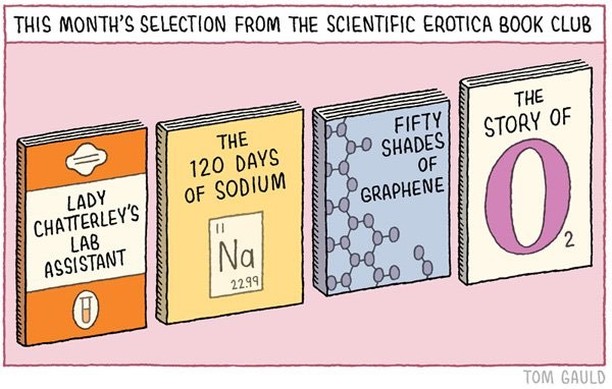
The Scientific Erotica Book Club

Tom Gauld for New Scientist.

1 Comment

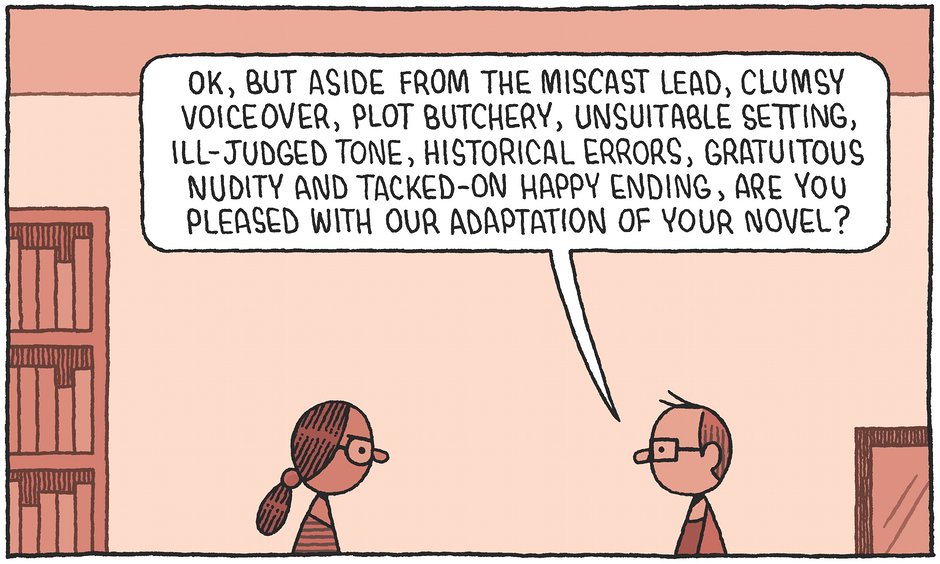
Adaptation

film-adaptation

Tom Gauld for The Guardian

(Tom has touched on this subject before…)

Comments closed

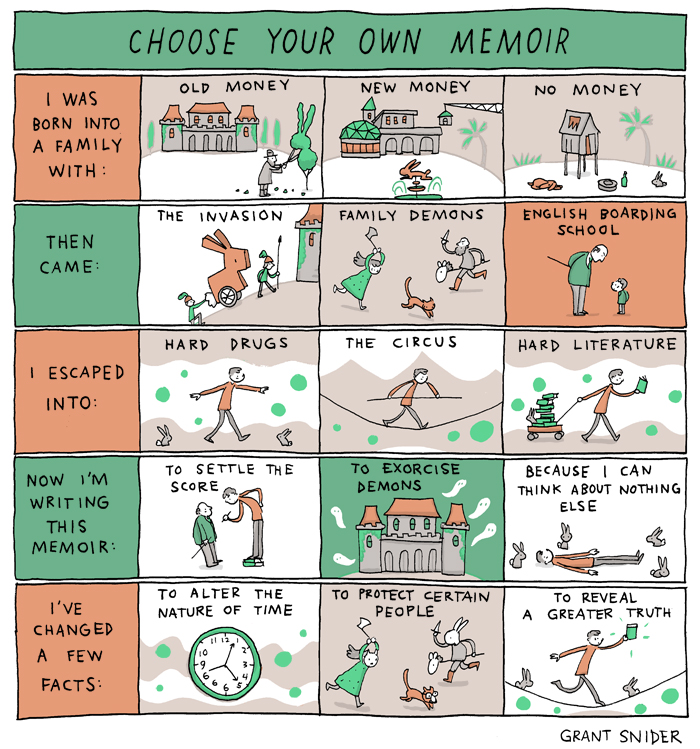
Choose Your Own Memoir

chooseyourownmemoir-web

Grant Snider for the New York Times Book Review.

Comments closed