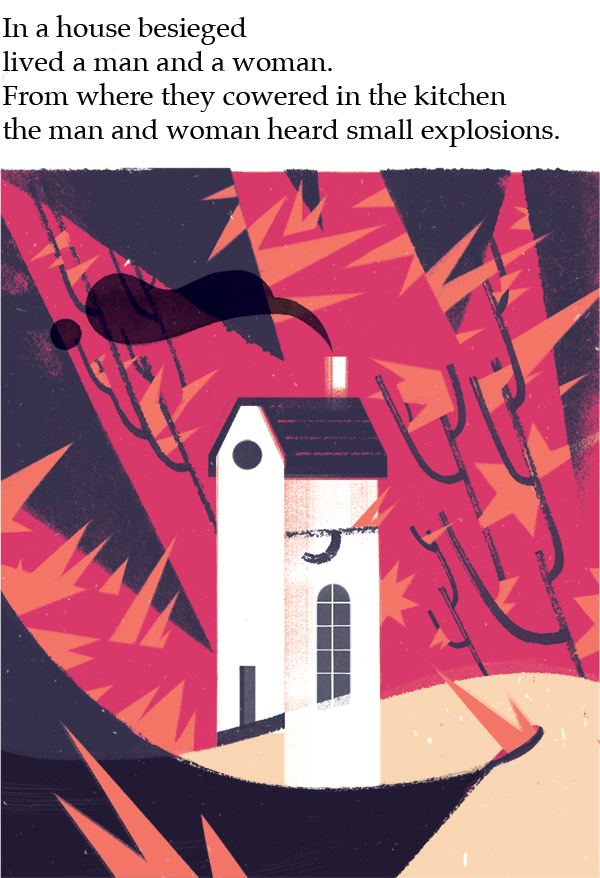
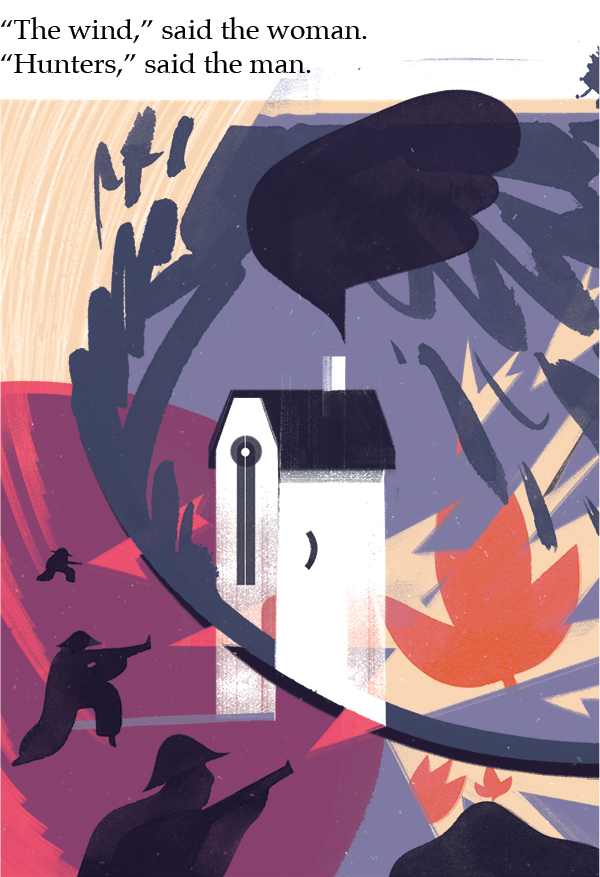
Illustrator Roman Muradov has drawn a beautiful adaptation of Lydia Davis’s (very) short story ‘In a House Besieged’ — originally published in the collection Break It Down (1986) — for The Paris Review:
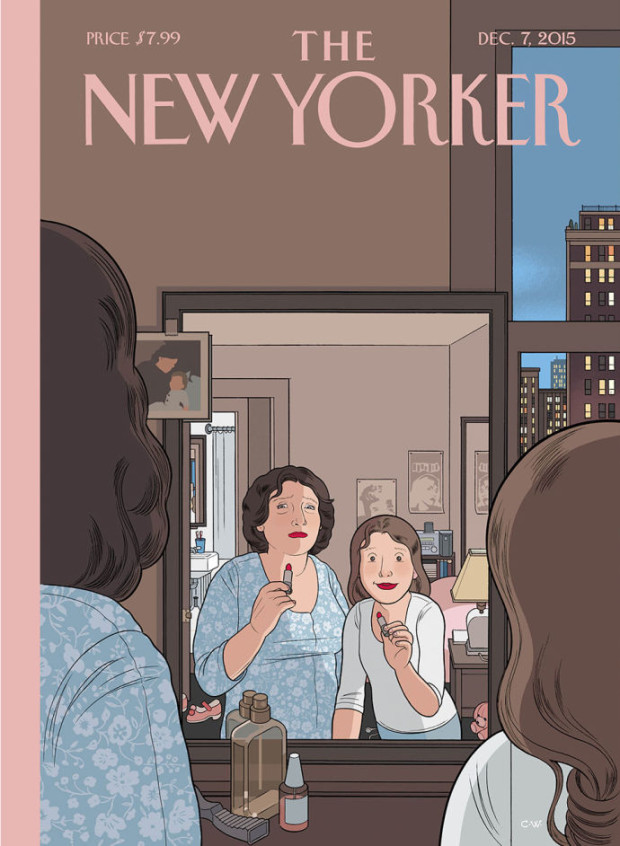
I have to confess that I frequently find This American Life kind of irritating, but this collaboration with Chris Ware and The New Yorker to create an animated magazine cover is neat:
The animation was done by Ware and John Kuramoto. You can read more about how it came about on The New Yorker culture blog.
Roberto Ito profiles cartoonist Daniel Clowes, whose new graphic novel Patience is published by Fantagraphics in April, for The California Sunday Magazine, :
At the heart of Patience are questions posed within every time-travel story: If I could go back in time and change the past, would I? What would I try to fix? And how badly would I muck things up? Clowes has had a lot of opportunities to think about those questions of late. For a 2012 retrospective of his work at the Oakland Museum of California, he revisited a lifetime of rough sketches and comics. And the publication of The Complete Eightball prompted him to look at work he did more than two decades ago, back when “we were assholes,” as one artist friend recalls. “Rereading them, it feels like every little thing that’s happened to me in my life, every little thought that’s ever popped into my head, has made it into my comics,” Clowes says, laughing…
…“Even after you achieve a certain level of success, you still are that guy that was toiling in obscurity in your un-air-conditioned apartment in Chicago,” says Eric Reynolds, a longtime friend of Clowes’s and a Fantagraphics editor. In a strip Clowes did for The New Yorker in 2001, a Clowes doppelgänger identifies himself as a screenwriter at a cocktail party. “I dare not tell anyone I’m really a cartoonist,” he thinks to himself. With each new project, Clowes is still plagued by doubts. That’s why he doesn’t show anyone his work until it’s done, he says. “Half of the time I’m like, Well, this is really fun,” he says. “But the other half I’m thinking, I could always just not publish this. I make sure I just do the book before I even try to get any money for it. So I always feel like, worst-case scenario, I could publish ten copies and sell it as a limited edition to my friends.”