The idea that new media has somehow abolished the old hierarchical structuring of the field (making everything level and equal and rhizomatic and whatnot) is only half right, at best. The hierarchies aren’t as well-marked as they used to be but they aren’t gone. Talk of an “army of amateurs” is at this point persuasive only to people who enlist without paying any attention to the fine print.
The New Sleekness — Ami Greko and Pablo Defendini (and other “bookish types”) try to fill a hole in publishing punditry. Having tried that myself and failed horribly, I can only wish them good luck.
Around The World with the Bodoni Family — A beautiful new 60-page book by graphic designer Teresa Monachino seen at The Creative Review. Each letter of the alphabet is printed in Bodoni to illustrate a place beginning with that letter.
Wave of Mutilation — Tom McCarthy, author of Remainder, on the films of David Lynch in the New Statesman. Yes, it is as weird and unlikely as it sounds (via 3:AM):
Try to count the instances of deformity in Lynch’s work, or of people being deformed on camera, and you’ll lose count pretty quickly… Deformity, for Lynch, is not simply thematic: it is instrumental. In his films, what the continual, almost systematic replacement of body parts and faculties by instruments – crutches, wheelchairs, hearing aids and ever weirder apparatuses sometimes as large as rooms – produces is a whole prosthetic order, a world of which prosthesis is not just a feature, but a fundamental term, an ontological condition.
The new online world has given book publishers good reason to review everything that they do, from what to publish to how to run their businesses. It is a noisy call to new action and fresh efforts, but publishers are well-placed to respond. The core skills we have had for generations – imagining our users, creating shapely products that meet their needs, and identifying the transfer of value that results in a sale, are precisely the skills that make good publishing online successful and satisfying. Information does not “want to be free”; customers want to be inspired and satisfied.
And finally: It seems I’m not the only one who doesn’t take predictions about the book industry entirely serious… Laurence Hughes over at the Huffington Post:
Some time in the next decade, someone will download both The Bible and The Satanic Bible to their e-reader, triggering the Final Conflict and ushering in Armageddon and the End of Days. Expect a slight dip in book sales during the thousand-year reign of the Antichrist.
I really don’t know why smart people make predictions.
Surely one of thelessons of the last couple of years is that experts are actually very, very bad at making predictions — or rather, they are good at making predictions, just not very good at making accurate ones, which is, perhaps, even worse.
And didn’t we learn that experience doesn’t necessarily tell us much about the future?
Nevertheless, it seems the smart book people — like moths to a flame — are undeterred. Here are some predictions from people in and around the industry:
I think 50% of books will be read online by 2020. There will be far more variety for consumers across different formats with enhanced e-books for example. The business model will become much more complicated. The day when we sold only hardbacks and paperbacks will be looked backed at with wonder.
‘Decade of the people’: 2010 and Beyond (Part Two) — Tim Godfray (Booksellers Association), Michael Neil (Bertrams), Tim Coates (library campaigner), Roy Clare (Museums, Libraries and Archives Council), George Walkley (Hachette) in The Bookseller. Tim Godfray:
The big booksellers will develop online presence and independent booksellers will get increased offers of support from publishers, but as ever it will be consumer led and the winners will be the ones that please the consumer…
$64,000 question—where will the book be purchased and on which platform will it lie?
[T]here have been few bright spots… during 2009, and after having taken the pulse of views on the near-term future in publishing by speaking to a number of senior publishing executives, my belief is we will not see any appreciable improvements during 2010. While some of their collective views can be attributed to ‘hedging,’ external trends support the lack of optimism whether they be reductions in education funding and library budgets or the increasing reliance on “blockbuster” authors or pricing issues.
In 2020 we will look back on the last days of publishing and realize that it was not a surfeit of capitalism that killed it, but rather an addiction to a mishmash of Industrial Revolution practices that killed it, including a Fordist any color so long as it is black attitude to packaging the product, a Sloanist hierarchical management approach to decision making, and a GM-esque continual rearranging of divisions like deck chairs on the Titanic based on internal management preferences rather than consumer preferences.
By the end of 2010, the experiment with “windowing” ebooks — withholding them from release when the hardcover comes out — will end as increasing evidence persuades publishers and agents that ebook sales (at any price) spur print book sales (at any price), not cannibalize or discourage them and, furthermore, that this withholding effort does nothing to restrain Amazon’s proclivity for discounting.
2010 Predictions — Joe Wikert, general manager and publisher at O’Reilly Media:
Let’s face it. The e-future of this industry is not quick-and-dirty p-to-e conversions. Pricing pressures and value propositions mean these will be nothing more than revenue rounding errors for the foreseeable future. 2010 will be the year where we’ll see more investment in richer e-content products.
Anyone who proclaims the arrival of a new age and names it web 3.0 , 4.2 or X marks the spot. We are working within a new continuum, every technology we will use in the next 15 years has already been invented and patented, and what remains to be seen is only the way in which consumers react to which combinations of hardware/software/content to solve which problems in what contexts. And nothing is lost by experimentation.
OK, for the record, I do genuinely believe these are all smart people who should have some idea what they’re talking about. But I do think it’s important to ask the following questions:
Who is writing the prediction?
Why are they making predictions about the book industry?
What do they have to gain (or lose) from their predictions coming to pass?
And, remember kids, while predictions are fun, they’re really no more reliable than tea leaves…
Book business faces ‘tectonic’ shift: 2010 and beyond, part oneBook business faces ‘tectonic’ shift: 2010 and beyond, (part one)
In a recent op-ed for The NY Times, ‘There’s More to Publishing Than Meets the Screen’, Jonathan Galassi, president of Farrar, Straus & Giroux, asked:
Are e-books a new frontier in publishing, a fresh version of the author’s work? Or are they simply the latest editions of the books produced by publishers like Random House?
This is essentially a more articulate framing of a question I asked here a couple of weeks ago. But unsurprisingly Galassi offers a far more compelling defence of Random House than I could manage:
[S]hould another company be able to issue e-book versions of Random House’s editions without its involvement? An e-book version of Mr. Styron’s “The Confessions of Nat Turner” will contain more than the author’s original words. It will also comprise Mr. Loomis’s editing, as well as all the labor of copy editing, designing and producing, not to mention marketing and sales, that went into making it a desirable candidate for e-book distribution. Mr. Styron’s books took the form they have, are what they are today, not only because of his remarkable genius but also, as he himself acknowledged, because of the dedicated work of those at Random House.
I think the point here is that books are often a collaboration between author and publisher, and in this sense publishers add value — or, at least, they did in the past. Galassi’s example is Styron, but we now know that Raymond Carver’s editor Gordon Lish was instrumental in defining the author’s trademark style. No doubt there are other high profile examples…
As Peter Ginna, director of Bloomsbury Press, points out in this post, and in a comment on my post here, there are definitely some issues around royalty payments that Random House need to address. But while e-books are little more than converting the file format of a work, I do have some sympathy for Random House’s argument about rights.
Back in November, the chaps at The National Post asked me and a selection of eminently more qualified Canadian book types what we thought the most important publishing story of the past 10 years was. They ran the results at the weekend and the smart answers ranged from decline of literary magazines to the rise of Google.
I have to admit, I was at a bit of loss as to how answer the question. Decades are such arbitrary periods of time. I read somewhere that the 19th Century didn’t really end until 1914, and in a way I feel like the 21st Century didn’t really start until the day after 9/11 2001. And who is to say that epoch is over? So many things still look the same…
Of course I really have no idea what any of the last 10 years meant for books. I don’t have enough perspective. All I knew is that I wanted to say something positive (nobody likes a whiner) and avoid saying anything too obvious, boring or bullshitty (i.e. definitely no talk about either the “death of publishing” or “teh internetz”).
In the end I equivocated and then gushed about something close to my heart — comics:
“J.K. Rowling’s Harry Potter and online retailer Amazon dominated the decade, but they have their roots in the previous century (Amazon was founded in 1994, Harry Potter and the Philosopher’s Stone was published in 1997). George W. Bush surely has a claim — his crimes and misdemeanours created an industry within an industry and produced many fine books including The Dark Side by Jane Mayer and The Forever War by Dexter Filkins — but the very thought of the 43rd President of U.S. being the publishing story of the decade is simply too horrifying to contemplate seriously. Many people will no doubt say e-books, but I think they will be the story of the next decade. So I’m going to go with the popular success and the critical acceptance of long-form comics (the “graphic novel” if you must) as the big story. With the likes of Asterios Polyp, Black Hole, Bone, Epileptic, Fun Home, George Sprott, The Hunter, Jimmy Corrigan, Louis Riel, Paul Moves Out, Persepolis, Safe Area Gorazde, Scott Pilgrim, Skim and Shortcomings (not to mention the beautiful reprints of Peanuts and translations of Tezuka and Tatsumi) to name just a few, we really have had a wonderful decade.”
Perhaps, not the wisest thing I’ve ever written, but hey…
The Post also asked us to nominate our best books of the decade.
But with all those caveats firmly in place, here is my annotated and abridged list of the best books of the decade compiled for The Post:
Remainder by Tom McCarthy (Metronome 2005, subsequently published by Alma and Vintage)
Tom McCarthy’s Remainder was the first book I worked on at Raincoast Books — We briefly distributed the Alma Bookshardcover before Vintage published their own paperback edition (pictured above, cover design by John Gall of course,with the most unlikely of blurbs from Jonathan Lethem) in the US and Canada — so it has a special place on my shelf. Oh and it’s really good.
Here’s what I wrote for The National Post:
“If only for a fleeting moment Remainder, a dark and spare novel about personal authenticity and murderous re-enactment, seemed to offer a creative alternative to the cul-de-sac of overwrought and twee novels emanating from Brooklyn (and creative writing classes everywhere). Sadly the bloated and banal seem to have made a decided comeback (if they ever went away), but even so, the unashamedly intellectual Remainder stands out, perfectly capturing the fears and anxieties of the decade.”
Possibly the polar opposite of Remainder, Chabon’s literary Boy’s Own adventure hit a lot of my buttons: Golden Age Comics, Eisner, Steranko, European folklore, New York, and WWII. Really, what’s not to like? But my affection for this book ebbs with every new effort — including Chabon’s own — to repeat the formula and turn pulp into something politely literary. (And NB the Picador paperback cover design above is by Henry Sene Yee — you can see his sketches here).
Perhaps not my favourite graphic novel favourite of the decade (that slightly dubious honour would probably go to Tekkon Kinkreet — and although the English edition I own was published in 2007, the series itself is actually from the mid-90’s, so I didn’t think it qualified for this list), but Ware’s breakthrough graphic novel began the decade and went on to creatively define it for graphic novels. No Jimmy Corrigan, no McSweeney’s Issue 13.
Like Kavalier and Clay, Ishiguro’s quietly evocative SF novel justifiably appeared on a lot of other Best of the Decade lists. It’s just beautifully, beautifully written and has a silver sliver of ice at its heart.
It’s almost impossible to think about books that are representative of the decade without including at least one on the Bush Presidency, 9/11 and the awful ‘war on terror’. The Dark Side could easily have been the aforementioned Forever War by Dexter Filkins, orGhost Wars by Steve Coll, or Imperial Life in the Emerald City by Rajiv Chandrasekaran, or one of the many other excellent books on these topics. But Mayer’s exposé of state-sanctioned torture chillingly underlines the bureaucratic banality of evil and the horror lived long in the mind after I finished reading it.
And, you know what? TheDark Side reminded me that books are important. They can and should be more than vehicles of self-promotion. Research — real research — requires more than Wikipedia. And — fuck it — we need to keep paying writers to write.
I suspect Louis Riel is now a creative and stylistic albatross for poor ol’ Chester Brown, but it was my joint first choice for the Canadian book the decade. This is what I wrote for The National Post:
“Not only is Louis Riel a uniquely Canadian story, it was published by Drawn + Quarterly (surely the most interesting Canadian publisher of the decade) and it epitomizes their success at unearthing and supporting creative talent. It isn’t a coincidence that Daniel Clowes—author of Ghost World and one the cartoonists of his generation—has decided to publish his new book with them.”
Although Pattern Recognition did not receive good reviews when it was first published and I bought the hardcover out of a reminder bin, it was my other pick for Canadian book of the decade. The book’s obsession with the fringes of pop culture and the dislocation and horror of the globalized world seemed to me (in some small way) to make it the first novel genuinely about the 21st Century. Even if it dates horribly (which many critics seemed to think it would), I think it’s a something of a cult classic. This is what I said to The National Post:
“A prescient post-September 11th novel about viral media, [Pattern Recognition is] the antithesis of the clunking, insular, parochial Canadian novel so beloved of literary prizes. The book is not without its flaws – it was not well received by the critics when it was published in 2003 – but it just fizzes with ideas, oddness, and energy. I can’t think of another Canadian novel that I refer to quite as often in everyday conversation. Give me flawed and brilliant over dull and worthy any decade of the century.”
OK — I love Pattern Recognition and I do talk about it a lot — but I was being a bit of a shit disturber here (which is probably why The Post ignored it). That said, Pattern Recognitionis better than several other books (that shall remain nameless) that did make the cut that’s for sure.
So, that’s my list. You can read the Post’s selections here. What did we miss out?
Unlike indomitable, indefatigable Sarah Weinman, I didn’t read over 462 books this year (think about it — that’s a book-and-a-quarter a day people!), so I couldn’t possibly post a best of the year list and keep a straight face. Still, I thought it might be nice to post an unscientific list of my 10 favourite new books of 2009 on the very last day of the year.
I also realised that — try as I might — it would be impossible to leave out books that I had worked on in some capacity. Apparently I need to get out more, but it I think this is a more universal symptom of work-life, digital-life, and “real” unplugged-life blurring (sometimes uncomfortably) for a lot of people in publishing (or is it just me?).
Anyway, with this in mind, all the books on this list distributed in Canada by Raincoast are identified with an asterisk. They’re here because I genuinely like them, but you’re an adult so you can make up your own mind about their merit.
And one last note: All the title links are to the Book Depository in the UK because they readily ship books worldwide. However, I have also linked to all the respective publishers, and added an IndieBound widget to the left sidebar (with links to all the listed titles) for anyone in the US who would like to support their local independent bookstore (Canadians: You can find your local indie via the CBA website).
My Advent Books recommendation for 2009, Asterios Polyp made it on to so many best of 2009 lists that Mazzuccelli’s beautifully understated and deceptively nuanced book almost feels over-hyped at this point. But you know what? It couldn’t possibly leave it off this list. I loved it. It’s a elegantly balanced combination of show and tell, and like Maus,Palestine, and, hell, even Watchmen before it, Asterios Polyp feel likes it expands the possibilities of the medium. Oh and Polyp reminds me of my art teacher at school — right down to the way he holds his cigarette — which, to be honest, is more than enough reason to be on this list.
A wonderful visual shopping list for any design-minded book collector, each of 100 classic graphic design books in this “ideal library” is shown with its cover and a number of spreads. It’s gorgeous and inspiring.
(NB: I’m hoping to have an interview with Jason in the New Year. Fingers crossed).
Zuckerman’s crisp hyper-real photographs (also see Creature, Wisdom) retain a warmth and genuineness that so often goes AWOL in contemporary digital photography. I mean god knows how much — or how little — work was actually done in Photoshop after the fact, but somehow the grace and natural beauty of the birds comes through. There is nothing clever, or even particularly gimmicky about this book, it is just really, really well done. The perfect coffee table book.
I’d been coveting the oversize and limited editions of this unashamedly beautiful collection of Harper’s paintings and illustrations for a while before Ammo released an affordable hardcover edition this year. This is simply a wonderful, inspiring book, and now there is no excuse not to own it.
Yoshihiro Tatsumi’s lovingly rendered 856 page manga portrait of an artist as a young man in post-war Japan was criminally overlooked in the best of the year lists in my humble opinion. It apparently took Tatsumi a decade to complete. “Epic” is just about the only word that covers it.
The subtitle — “A Collection of Letterpress Examples with Specimens of Type, Ornament, Corner Fills, Borders, Twisters, Wrinklers, and other Freaks of Fancy” — probably sums up this lovely book best. It is, admittedly, slightly bonkers, but it’s exactly the kind of thing that will eventually go out of print and then you’ll wish you’d bought one when you had the chance (and no, I won’t sell you mine).
THE HUNTERBY RICHARD STARK, ADAPTED & ILLUSTRATED BY DARWYN COOKE IDW, ISBN 9781600104930
Bleak, snappy, and fabulously illustrated, Darwyn Cooke’s adaptation of Richard Stark’s hardboiled Parker novel is pretty much pitch perfect. I only hope more Parker adaptations are on the way. Pretty, pretty please.
I deliberated over whether to include Philip Hoare’s charming book about whales in this list. Not that it isn’t worthy — it certainly is (it won the Samuel Johnson Prize for Nonfiction earlier this year) — but because it was first published in the UK 2008 and it is not available in North America until 2010 (HarperCollins’ Ecco imprint are releasing it under the title The Whale in February). So does it count as a 2009 title? In the end I decided it was eligible because it was published in paperback in 2009 and, ultimately, this is the year I read it (admittedly in hardcover) and it was too good to leave out. And Philip Hoare is from my home town. But that has nothing to do with it. Honestly.
The privileged offspring of Harry Potter and The Secret History (and/or Whit Stillman) invade Narnia and shoot things. It’s almost as good as it sounds, although it’s a shame the protagonist is, to be quite frank, a simpering cock. Nice villain though.
A tidy collection of contemporary graphic design inspired by the classic mid-century modern of Saul Bass, Lucienne Day, Alexander Girard, Charley Harper, and others. There are a few too many music posters perhaps, but Naïve is still neato coolsville.
So there you go, that’s my 10 favourite books of the year. What were yours?
Reading a Book is Reading a Book — Peter Ginna has another thoughtful post on about the Random House e-book rights controversy (which better articulates some of what I was trying to get at here).
A Decade of Fear — David Ulin, book editor of The LA Times, looks back at the last 10 years (and forward to the next).
The idea that book publishers are failing to act in their own interests because they somehow do not want to serve their customers, or because they do not “get” electronic distribution ignores the business reality they face… In any case, why is it illogical for publishers to defend their own business interests against those of Amazon, which is a public company trying to extend leverage over them to benefit its own shareholders?
Leaving the specifics of Covey aside (because I just don’t think you can generalize from his position), Peter Ginna doesn’t seem to think Random House has much of a leg to stand on. Nor, for that matter, does Richard Curtis, or the Author’s Guild. And agents are understandably unhappy…
But my question (to someone who does know something about rights) is if e-books remain essentially shovelware and aren’t substantially transforming the original book as edited and designed by the publisher, don’t Random House kind of have a point?
Eye, Eye! — The Creative Review looks at the vibrant work of printing studio/small press Nobrow.
It’s an Anagram! — Indigo’s e-book initiative Shortcovers has become ‘Kobo’. Much fuss has been made about the name (and the slightly iffy redesign), but what’s more interesting is that Kobo is being spun-off from its parent company in an attempt to expand its global reach… The intrepid Mark Bertils and PW have more on the international angle; Wired think Amazon should be worried; and The National Post have a good Q&A with Kobo CEO Michael Serbinis…
Collector’s Items — Vote for your favourite Nabokov cover from John Gall‘s set of individually commissioned redesigns for Vintage.
With the increase of the D.I.Y. sensibility, with renewed emphasis on “making things from scratch,” designers were feeling a need to make physical (not virtual) contact with their materials and outcomes…
[Perhaps less “anti-digital” than “post-digital“? Any thoughts designers?]
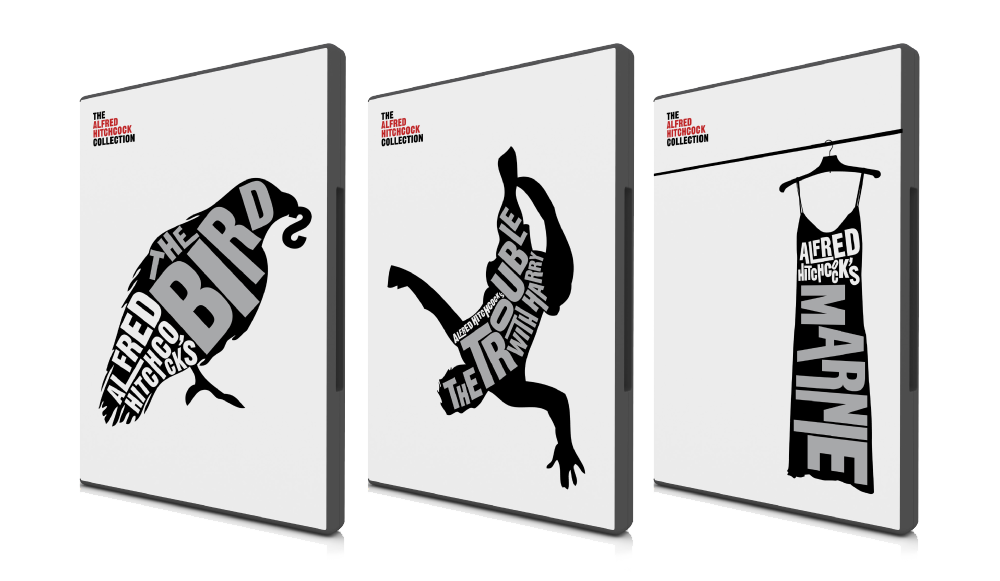
After recently purchasing a badly designed Alfred Hitchcock
DVD box set, I set to work on creating my own collection of
original covers. Each design features an iconic image related
to the film it represents and includes a bold typographic
title.
I would love to see Ryan design some book covers… Wouldn’t you?
On the patronising assumption that books for children are nice, ie morally bland and stylistically infantile, critics, reviewers and prize juries often dismiss those who write them as incapable of writing seriously for adults… Anyone familiar with Jansson knows it would be unwise to dismiss her or patronise her work on any grounds. Her books for children are complex, subtle, psychologically tricky, funny and unnerving; their morality, though never compromised, is never simple. Thus her transition to adult fiction involved no great change. Her everyday Swedes are quite as strange as trolls…
In my total blogging tardiness, Bookslut (inevitably) beat to the punch on this, but Simon Reynolds column on the music of the decade for The Guardianhas so much resonance for books and the book industry:
“The fragmentation of rock/pop has been going on as long as I can remember, but it seemed to cross a threshold this decade. There was just so much music to be into and check out. No genres faded away, they all just carried on, pumping out product, proliferating offshoot sounds. Nor did musicians, seemingly, cease and desist as they grew older; those that didn’t die kept churning stuff out, jostling alongside younger artists thrusting forward to the light. It’s tempting to compare noughties music to a garden choked with weeds. Except it’s more like a flower bed choked with too many flowers, because so much of the output was good. The problem wasn’t just quantity, it was quantity x quality. Then there was the past too, available like never before, competing for our attention and affection. The cheapness of home studio and digital audio workstation recording, combined with the wealth of history that musicians can draw on and recombine, fuelled a mushrooming of quality music-making. But the result of all this overproduction was that “we” were spread thin across a vast terrain of sound.”
(Update: links to Tove Jansson’s The True Deceiver added)