Skip to content

Tag: architecture

Ice Cube Celebrates The Eames

This is doing the rounds today, but it’s simply too good not to post…

Ice Cube, who apparently studied architectural drafting before joining NWA, on the architecture of Los Angeles and the design of Charles and Ray Eames:

The New York Times has an interview with Ice Cube  about the video:

 I had learned about them when I was studying architectural drafting. Back then, I didn’t know I was going to make money. So being that they put together a house in two days and used discarded materials — something about their style caught on.

As I got older, I could equate it to sampling. I see that’s what we were doing, taking discarded records from the ’60s and ’70s and revamping them.

Awesome.

Comments closed

In the Cube: Michael Bierut and James Biber

In this video for Designers and Books, graphic designer and Pentagram partner Michael Bierut chats with architect James Biber about the books he selected for the site. The setting is the Rachel Whiteread-like library, or “book cube”, in Biber’s architectural office, located on the 2oth floor of Cass Gilbert’s Woolworth Building in downtown Manhattan:

The full, unabridged, 30-minute conversation can be seen here.

1 Comment

Private Library

In this short film, New York architect Andrew Berman discusses a commission to design a beautiful writing studio in the woods in Long Island:

Comments closed

Midweek Miscellany

A profile of calligrapher DeAnn Singh at The LA Times:

When the producers of “Mad Men” needed a note in cursive and a signature from Don Draper, they turned to Singh. “Something masculine and from the 1950s” was the request, though they eventually decided that the missive be typed…

Ask her about computers, and she’ll tell the story of Steve Jobs.

Before the founding of Apple and the development of the Macintosh, Jobs dropped out of Reed College and studied calligraphy with artist Lloyd Reynolds. If he hadn’t taken that class, he has said, personal computers might not have come with a variety of fonts.

Fantasy Modernism — Lev Grossman talks to the A.V. Club about The Magician King, the sequel to his 2009 novel The Magicians:

I have this theory about modernism and fantasy, which I’ll do in 30 seconds.

They came into being at the same time, which is very interesting. They were both reactions to the disasters of World War I and the electrification of cities, and urbanization, and the rise of the automobile, the end of that twilight world of the Victorians. They both are reactions to that in different ways. Modernism went very inside and delved into the interior lives of people. Fantasy externalized all that in these fantastical, magical, metaphorical landscapes. I thought, “Well, what if you did both the inside and the outside at once?” I tried to combine those foci of fantasy and modernism into one kind of writing. It sounds like I’m writing a dissertation on my own work, but, you know, you end up thinking about what you’re doing. That’s the kind of thing I thought.

See also: Alexander Chee reviews the book for NPR.

Prussian Pedantry — Susie Harries’ new biography of scholar Nikolaus Pevsner, best known for his 46-volume series The Buildings of England, reviewed by George Walden for The Observer:

For us at least the conflict of national intellectual styles he represented was hugely beneficial. The irony of a “Prussian pedant” lecturing the English on Englishness, for which he was mocked, resolves itself in the fact that, together with Gombrich in art history and Weidenfeld in publishing, Pevsner was one of a golden generation of German/Austrian Jewish refugees who did much to give their adopted country the bottom it prided itself on already possessing.

And for those of you not interested in a county-by-county guide to the wonders of English architecture (what’s wrong with you?), Pevsner also wrote the seminal Pioneers of Modern Design: From William Morris to Walter Gropius. First published in 1936, a revised and expanded edition will be available (in the UK at least) in September.

And finally…

Everyone is an AuteurGuardian correspondent Fiachra Gibbons meets Jean-Luc Godard:

“I am not an auteur, well, not now anyway,” he says as casually, as if it was like giving up smoking. “We once believed we were auteurs but we weren’t. We had no idea, really. Film is over. It’s sad nobody is really exploring it. But what to do? And anyway, with mobile phones and everything, everyone is now an auteur.”

Oh Jean-Luc…

Comments closed

Laurence King on the Future of Design Publishing

In a great interview for Design Observer, UK publisher Laurence King discusses the future of design publishing with Mark Lamster:

Illustrated book publishers, and in particular art publishers, need bookshops to survive, especially the increasingly rare specialist ones where there are discerning buyers who understand art, architecture and design. I think that these need to be treated with a great deal of care by publishers because all too often they serve as shop windows for Amazon. They are more important to us than sales through them indicate. It would be great if they could use their reputations and expert knowledge to become competitive with Amazon on-line. But I dread the day when art publishers have to set up loss-making showrooms to exhibit our books, just because we went on being tough with the specialist booksellers. At the same time, booksellers need to reinvent themselves quite fast, which is obviously difficult.

Laurence King published Bibliographic: 100 Classic Graphic Design Books — one of my favourite visual books from the last couple of years — in 2009, and later this fall, they’re publishing a huge, long-awaited, monograph on designer Saul Bass. Can’t wait.

Full disclosure: Laurence King is distributed in Canada by my employer Raincoast Books. 

Comments closed

The Ark

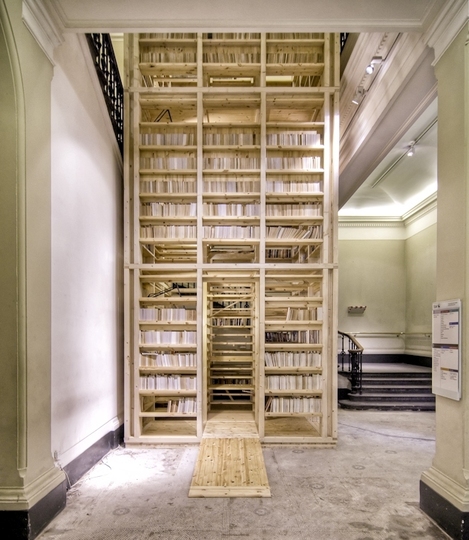
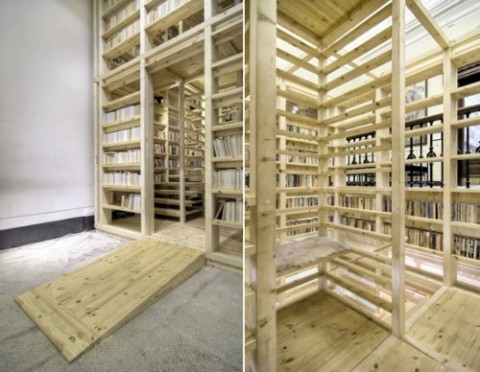
Created by Rintala Eggertsson Architects, Ark is a free-standing wooden tower accessed by a spiral case that connects two floors of the Victoria and Albert Museum in London. The façades of the tower consist of hundreds of shelves, holding thousands of books, which visitors can browse. The books can be read in private chambers within in the structure.

The tower is part of the ‘1:1 — Architects Build Small Spaces’ exhibition at the V&A, which runs until the end of this month. In this V&A video, the architects talk about their practice, the book tower and its installation:

(via Apartment Therapy)

1 Comment

Midweek Miscellany

McGraw-Hill paperbacks designed by Rudolph De Harak — A nice Flickr set of vintage covers from Joe Kral, who apparently has an amazing book collection (via Words & Eggs).

Free Libraries Are Full of Books That No One Reads — Author Paul Theroux talks to The Atlantic about e-books (via The Second Pass):

I don’t think people will read more fiction than they have in the past… but something certainly is lost—the physicality of a book, how one makes a book one’s own by reading it (scribbling in it, dog-earing pages, spilling coffee on it) and living with it as an object… I can’t predict how reading habits will change. But I will say that the greatest loss is the paper archive—no more a great stack of manuscripts, letters, and notebooks from a writer’s life, but only a tiny pile of disks, little plastic cookies where once were calligraphic marvels.

Not Dead Yet — An interesting post at Personanondata on what the resilience of the CD format means for books:

Many believe the physical book will disappear within in the next ten years yet the example of the music CD suggests the future of the book may be more nuanced. The availability of electronic versions of trade content will approach 100% in less than ten years… Despite the availability however, electronic content is likely to represent only one of a number of ways consumers will engage with book content…  Rather than disappear, the lowly print book may retain a position of wide distribution… and become the focal point of a facilitated interaction with numerous content acquisition options for consumers.

The information on CD sales in the post comes from a recent report in The Economist, which also ran an interesting article about the future of copyright on the same day:

The lawmakers intended… to balance the incentive to create with the interest that society has in free access to knowledge and art… Over the past 50 years, however, that balance has shifted. Largely thanks to the entertainment industry’s lawyers and lobbyists, copyright’s scope and duration have vastly increased… They are now calling for even greater protection, and there have been efforts to introduce similar terms in Europe. Such arguments should be resisted: it is time to tip the balance back.

The New York Times obituary for publishing executive and copywriter Nina Bourne:

The campaign she created for “Catch-22” is now regarded as a classic. Ms. Bourne was the most passionate in-house champion of the book, a darkly comic tale of World War II by a first-time novelist. Pleading for an increase in the initial print run, she turned to her colleagues during a production meeting, tears in her eyes, and asked, “If I can’t get this, why am I here?”

And finally…

Architecture Under Construction — a beautiful set of photographs by Stanley Greenberg from a new book published by the University of Chicago Press. Pictured: Untitled, Toronto, Ontario, 2005 — Royal Ontario Museum, Studio Daniel Libeskind (via PD Smith).

Comments closed

The Third & The Seventh

I’m fairly certain that every architect and designer on the planet has seen Alex Roman’s artful short film The Third & The Seventh already. But I haven’t seen it mentioned on any book blogs as yet, and so for the benefit of other architecturally-inclined book nerds who may not have caught it, I thought I would share it here (although you really should go and watch it in full-screen HD at Vimeo).

Even though it is apparently a full-CG animated piece, the film beautifully captures the light and elegance of the architectural space, and yes, there are even a few books in it…

There is an interview with the filmmaker about the film at Motionographer.

1 Comment