Skip to content

Category: Miscellany

Something for the Weekend, June 19th, 2009

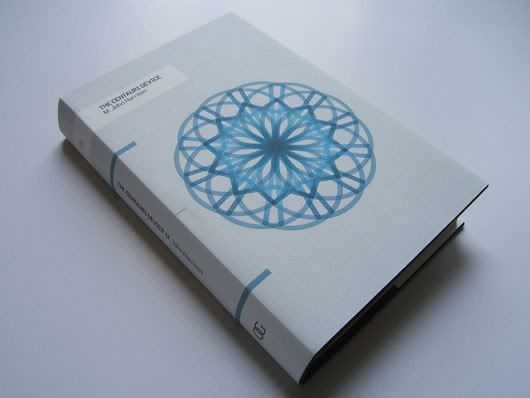
50/50 — AIGA announce their 50 Books/50 Covers of 2008. Included in the fifty is the cover of Kenneth Hayes’ Milk and Melancholy designed by Toronto’s Underline Studio (pictured above).

Gxuu! — Linguist Arika Okrent, author of In the Land of Invented Languages, chooses her 10 favourite words from invented languages for The University of Chicago Magazine. Having been kind of fascinated with Volapük after reading William Gibson‘s  Spook Country, I was happy to see the inclusion of ‘pük’ (via the incomparable Kottke of course):

In Volapük, pük means “language.” It comes from the English word “speak” but it’s hard to tell (vol, means “world”, so Volapük is “world language.”) Unfortunately, it looks a lot like a different English word. And even more unfortunately, it shows up in various other words related to the concept of language: püked – “sentence” and pükön – “to speak.”

Nice Work — Mark Thwaite interviews novelist, critic and Emeritus Professor of English Literature, David Lodge about his new book Deaf Sentence for The Book Depository blog:

One’s ideal reader is intelligent, alert, open-minded but demanding, and equipped with what Hemingway called “a built-in shit-detector.” He/she does not actually exist. In a way you try to be that reader when you read and re-read your own work in progress, and not to kid yourself if something isn’t quite right. That’s a rather different matter from one’s “readership” which in my case, I’m aware, is probably well-educated, well-read, maybe Catholic, and getting more and more senior in years, like myself.

A Special Specimen — A lovely post by James Phillips Williams at amassblog about Paul Rand, Jan Tschichold and a very special type specimen book.

And speaking of Paul Rand, be sure to visit Daniel Lewandowski’s tribute site to the great man (via grain edit).

Comments closed

Midweek Miscellany, June 17th, 2009

Claustrophobic and Irrational — I love these elegantly understated designs by Rodrigo Corral and Christopher Brand Jason Ramirez for Patricia Highsmith’s Ripley books published by W.W. Norton.

A Strategy For Authenticity — Don Linn, prolific Twitterer and publisher at The Taunton Press, on O’Reilly’s Twitter Boot Camp and Twitter as a marketing channel:

I’m relatively new to twitter, but what I’ve loved about it since discovering it is its immediacy and its spontaneity. That’s where the joy is and, in my opinion, that’s where the power is (witness #iranelection and related topics). My fear is that the suits will “Clear Channel” (yes, that’s a new verb) this simple little application into nothing but a giant vanilla message board filled with thinly-disguised spam, planned spontaneity.

Cars and Books Sean Rogers discusses Dutch cartoonist (and cover artist) Joost Swarte at The Walrus:

Swarte has some mild fun, on the Walrus cover, with the nutty rush out of the city that clogs our highways every summer. But the assignment also offers Swarte the opportunity to clear-line the hell out of some cars and books, a couple preoccupations that crop up all over his work.

Why Ulysses? — To coincide with Bloomsday , Gary Dexter explains how Joyce’s masterpiece got its title:

The paradox of Ulysses is that one needs to read it to understand twentieth-century literature, but one needs to read twentieth-century literature to build up the stamina to read Ulysses.

The problem starts with the title. Early readers of Ulysses, exhilarated and appalled after 800 pages, were often still left thinking ‘Why Ulysses?’ Ulysses is barely mentioned.

And lastly… I can’t thank the chaps at the BCA enough for the link love . You are gentlemen and scholars.

And thanks to the scarily talented Nate for creating the Paradox of Awesome album cover yesterday afternoon and sharing on Twitter. Hilarious. Or maybe you just had to be there… It made my day anyway…

5 Comments

Something for the Weekend, June 12th, 2009

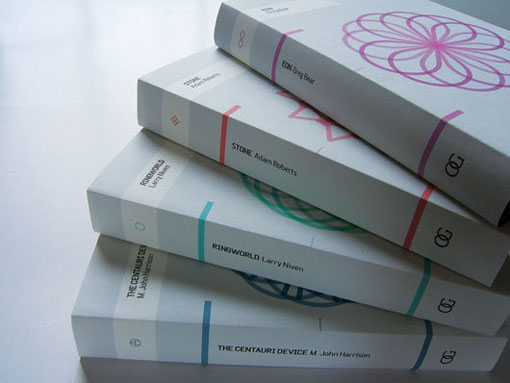
Jamie Conkleton‘s book cover designs for Gollancz’s Space Opera series, as featured in the D&AD Student Annual 2008. Great stuff. (via designworklife).

Are any other publishers pursuing similar initiatives with student designers to repackage their backlist?

Wordnik — More curious word information than dictionary, Wordnik provides definitions, examples, related words, pronunciation, related images, statistics, and tweets for the word searched.  Neat.

The Curse of Maus — cartoonist Art Spiegelman profiled in The Guardian:

Will he ever escape the shadow of Maus? “It’s even worse than that,” he says, lighting a cigarette. “Most other cartoonists are afraid of the same thing.” He means that every graphic novel is compared to Maus. “As a result, it’s sort of a curse on me and all other cartoonists I know.”

Toothy Uncoated Stock — The chaps at The Book Cover Archive pointed me to the design:related portfolio of Alex Camlin, Creative Director at Da Capo Press. His design’s for the Harvard Review are beautiful.

2 Comments

Midweek Miscellany, June 10th, 2009

#BCTO09BookCamp Toronto organiser Mark Bertils’ stream of links about the event at his blog Index//mb. There is also a  list of related press at the BookCamp wiki. I will try and organise my jumble of thoughts about BookCamp sometime… soon… (ish).

The Book Seer — A nice little web project from James Bridle and the chaps at Apt Studio. Tell it what you’ve read and it will suggest what to read next based (currently) on LibraryThing and Amazon recommendations. James has more about the project at Times Emit.

Cultural Life — An interview with Granta magazine’s newly appointed acting editor John Freeman:

We need to expand how we define what it means to publish great writing. This means reaching readers in the way that they want to hear from us. Such as having a print edition for people who treasure the beauty of text and the photo essays on the page; having a dynamic website for those who want to read us online; having a Kindle or iPhone-compatible edition for people who want to read stories in the palm of their hand; sending out links by twitter to readers who want to know the moment new stories appear; hosting events and conversations and parties for people who want to interact with the magazine in person. The challenge is to make sure that none of these respective endeavors cheapens or reduces the complexity and integrity of the work we publish.

Passion and Daring — Ben Myers at The Guardian is heartened by  Canongate winning  publisher of the year.

Frightening But Cute — Illustrator Axel Scheffler,  talks about drawing the much-loved Gruffalo in a video interview also for The Guardian. Which reminds me — I’ve been meaning to link to Terrible Yellow Eyes for a while. It’s a collection of artwork inspired by Where the Wild Things Are (Robert van Raffe‘s contribution to the project pictured below).


Plastic Banality — Author Warren Ellis’ unique take on the “dubious virtues” of  e-books in Wired. Not for the sensitive or the faint of heart:

[W]hen print was king, we would speak of “reaching an audience”. We would talk of doing these things via advertising, or appearances – which were when you’d show up somewhere in the real world, deface books with ink and communicate using small mouth noises… This has changed in fairly savage ways. The complex net of processes designed to take your money and give it to me is kind of ragged, what with newspapers collapsing and the concept of authority being passed… to, in 2009, a Twitter post from the sainted Stephen Fry. It was great to get a review in a music paper (remember those?) and it was amusing to see Oprah recommending Cormac McCarthy’s The Road to housewives, but here’s the new audience mediation: Stephen Fry popping up on your bloody iPhone to tell you he’s enjoying reading The Watchmen graphic novel.

And finally…

I’m rather charmed by The Mandate Press’ customizable letterpress calling cards. I have always wanted a business card set in blackletter… But what literary theme should they add to their list I wonder?

You can see more of The Mandate Press’ lovely work on Flickr (via The Strange Attractor)

Comments closed

Something for the Weekend, June 5th, 2009

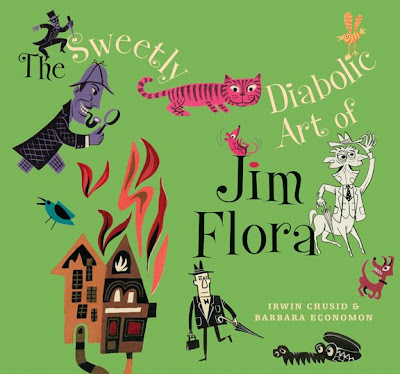
Sweetly Diabolic — A new Jim Flora compendium from Fantagraphics.

I really, truly, wasn’t going to link to any BEA autopsies — and there are plenty out there — but on the eve of BookCamp Toronto I thought Brian O’Leary’s post seem pertinent:

It would be more than nice, more than fun, more than illuminating, if we as an industry could use events like BEA as less an opportunity to predict the future and more a forum in which to examine the options. Okay, piracy is bad, but.. what if it helped sell books? Okay, we love long-form fiction and we think it should survive, but what if the people who read it now just stopped? Okay, a trade publisher provides value in choosing and curating content, but what if the world turned upside down and everyone were a writer, a publisher, a reader… Wouldn’t that be really cool?

Fingers crossed for tomorrow… Follow along on Twitter. The event account is @BookCampTO. The hash-tag is #bcto09.

Access of Evil — More on Google’s big e-book adventure at Business Week. The ‘news’ is that Google will be offering online access to e-books rather than downloads. Which, if I understand it correctly, is what Shortcovers does already. Not that anyone is giving them credit for it.

The ALPHABET chest of drawers by Kent and London, inspired by vintage printing blocks: “The perfect place to file everything from A-Z!” (via source of all good things swissmiss).

The George Orwell Archive at the BBC (via The Book Depository blog):

For two years, between 1941 and 1943, George Orwell – real name Eric Blair – was BBC staff member 9889, hired as a Talks Producer for the Eastern Service to write what was essentially propaganda for broadcast to India.

From recruitment to resignation, this collection of documents reveals the high regard in which Orwell was held by his colleagues and superiors and his own uncompromising integrity and honesty.

The Wickedest Man in the World — Jake Arnott, author of The Long Firm, on how the very real Aleister Crowley became the archetypal fictional 20th century villain. Sadly Arnott doesn’t mention that Oliver Haddo, W. Somerset Maugham’s literary Crowley, appears in the latest League of Extraordinary Gentlemen adventure.

The Future of Mainstream Media — a fascinating article about the success of National Public Radio (NPR) by Josh Catone for Mashable:

NPR’s amazing growth over the past 10 years prompted FastCompany magazine in March to call NPR the “most successful hybrid of old and new media,” and wonder if NPR could be the savior of the news industry. [T]hey owe that success to the culture of open access and audience participation that they’ve cultivated over the past decade.

And… OK I just can’t not link to Design Assembly‘s post about design-hero Wim Crouwel’s ISTD lecture.

Note: if you want me to link to your site, you just need to include a brilliant photograph of Wim Crouwel looking cool as f*ck and then use a genius soccer analogy:

“(For me) a grid is like a football pitch. You see a beautiful game of football, and then you see a not so beautiful one, but it all takes place on the same pitch”.

Yes. I am a cheap date.

4 Comments

Midweek Miscellany, June 3rd, 2009

I’m a little fatigued by all the inevitable post-Book Expo harping, hand-wringing and hubris, so please  forgive me if today’s links are a little light on book-book stuff…

Community Organizer — The New York Observer profiles John Freeman, the new editor of literary journal Granta:

Mr. Freeman believes in the inevitability of books—even if, as he will lay out in his forthcoming manifesto for Scribner, The Tyranny of E-Mail, the Internet is engendering in the people who use it habits that distract them from reading. This is the salve he has to offer a chapped and chafing industry. As people cry doom, he’s there to hold hands and assure them that it’s not that bad.

Cover Versions — Starting with Olly MossVideo Game Classics, Design Week looks at the trend of remixing just about everything to look like vintage 1960’s paperbacks.  What Consumes Me has a nice round-up of recent mash-ups (thx James!). And, if that wasn’t enough, Drawn! points to the another recent example: classic records reworked as classic Pelican paperbacks.

Which leads rather nicely to Emmanuel Polanco‘s Saul Bass inspired design for Moby Dick:

Throwing Down the Gauntlet — As widely reported elsewhere, Google are preparing to sell e-books according to the New York Times.

Making Mistakes — A fascinating interview with designer Paula Scher talking about creative failure at Psychology Today:

If you find yourself defending yourself and protecting yourself and being outraged about what’s around you, you’re in trouble. That doesn’t mean some things aren’t genuinely outrageous. But you have to ask yourself: Why are you outraged by something? What are you hiding from? What are you defending?

And, on a not dissimilar note…

Use It or Lose It — Indispensable creative advice from ad exec Dave Trott (via Mark McGuinness on Twitter):

If we wait for the right opportunity it won’t happen. It’ll stay in our drawer until the world has passed it by. Times will change and newer, more exciting things will be happening. Now it looks old and tired. Now it’s too late.

If we don’t find a way to make it happen, if we don’t take a chance and overcome lethargy and embarrassment to do it, it will disappear.

Students always ask me what I think they should do.

I tell them, “The answer is always the same two words: ‘everything’ and ‘now’.”

Everything and Now… Everything and Now…

Comments closed

Monday Miscellany, June 1st, 2009

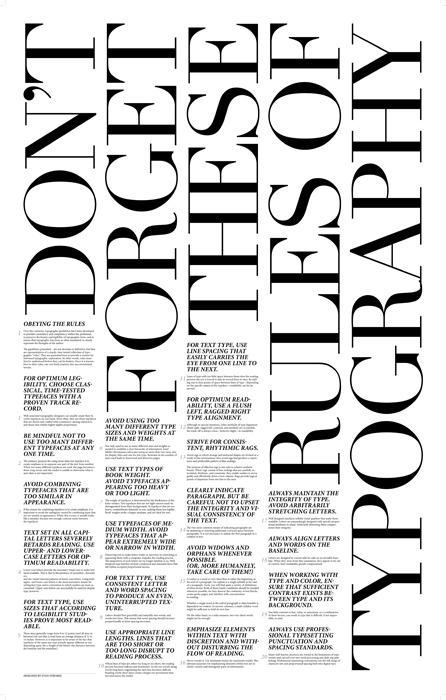
Don’t Forget the Rules of Typography — Nice work by graphic designer Evan Stremke (above). Also available as a handy PDF (via ffffinds). (Update: Evan appears to have redesigned his Rules of Typography. The image above shows the original version which personally I prefer. The new version is here)

The UnconferenceThe National Post reports on BookCamp TO, which takes place Saturday June 6th at the University of Toronto:

“I really think I’m going to get in trouble for saying this, but book publishing needs to stop being so insular. We need to stop just looking at our own industry for inspiration,” says Deanna McFadden, marketing manager, online content and strategy for HarperCollins. “The people who are doing BookCamp in Toronto are all smart people who understand where the industry is and where we need to go, and are really looking at innovative ways for us to keep book publishing alive and healthy.”

I’m going to be at BookCamp on Saturday, so please say hello if you’re there. And I’m still looking for feedback on the role of publishers in the digital age (see my post here). Please leave a comment if you have thoughts.

The London Review of Books now has a blog.

But Thank God I Ain’t Old — In a teaser for forthcoming  Heavy Rotation: Twenty Writers on the Albums That Changed Their Lives edited by Peter Terzian, literary critic James Wood waxes lyrical about The Who album Quadrophenia in The Guardian:

Quadrophenia is itself a nostalgic album – it wants to be there, back on those beaches and in those Soho clubs of the early 60s. So when I listen to the album now, nostalgia is doubled, since I am looking back at my own youth, and also back at the Who’s youth, at an era when I was not even born. I become nostalgic for a rebellion I never experienced and for an England I never knew.

Txt Island — A short film made with a few hundred spare pegboard letters by Chris Gavin at TANDEM Films (via I Like):

Comments closed

Something for Weekend, May 29th, 2009

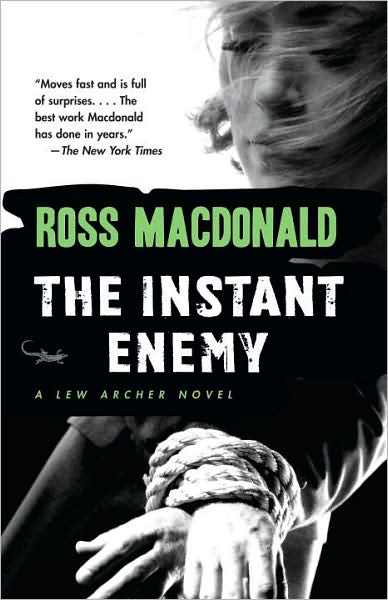
Hard-boiled — New designs for Ross MacDonald’s Lew Archer books by Joe Montgomery seen at FaceOut Books. I know I link to FaceOut just about every other week, but it’s an awesome site and the juxaposition of images in this series are great (as are some of the unused comps).

The Concierge and the BouncerPublishers Weekly report on Richard Nash (formerly of Soft Skull) and Dedi Felmen (formerly of Simon & Schuster) and their plans to “push back against the outmoded idea of publisher as cultural gatekeeper” with their new venture Round Table (announced at BEA this week):

The key is a shift from a caretaker mentality to a service mentality, from a linear supply-chain model to the idea of a free-floating, non-hierarchical “ecosystem” of readers, writers and authors… Nash and Felman’s idea of Publishing 2.0 could make a semi-professional reader, writer, editor and critic out of anyone with the desire.

Reading in a Digital World — A killer line in an otherwise blah article for Wired by Clive Thompson:

“We need to stop thinking about the future of publishing and think instead about the future of reading.”

Book Distribution in Canada — A Canadian Heritage study on book distribution in English Language Canada produced by Turner-Riggs dropped this week.

Can Editors Change Their Spots — David Hepworth’s thoughts on Robert G. Picard’s CS Monitor article ‘why journalists deserve low pay’,  and what “the new dispensation” means for  editors:

Magazine editors spend most of their time deciding what they’re *not* going to do and trying to arrive at a mix that the majority of people will like. They then find that whatever they’ve arrived at is too much for some people and not enough for others. This is made more difficult by the fact that their readers, being the most engaged in their particular area, are the people most likely to tap into other sources themselves. The people who value your mix most are also the people who would feel most qualified to mix it themselves.

The italics are mine.

Cover to Cover —  Steven Heller reviews newly released  ‘visual books’ in the New York Times with a nice accompanying  slide-show. (See image above, but hey NYT, when are you going to let people embed your slide-shows? When?).

Comments closed

Meanwhile, Elsewhere…

As is probably obvious, I spend a lot of time online clicking on stuff.

The things I bookmark, tag, and mentally store away that are (vaguely) about books end up here in one form or another.

But because I have eclectic interests, I bookmark a lot of photographs, illustrations, videos, and other things that just don’t have place on The Casual Optimist.

I’ve been mostly collecting these together in a digital scrapbook at Image Spark.

Image Spark has a really useful bookmarking plugin for Firefox so it’s easy to use and I really like it — despite it’s occasional  slowness.

But whilst Image Spark is great for me, I don’t think it’s so good for sharing.

I tried Tumblr and discovered I didn’t particularly like it (no offensive Tumblr — it’s not you, it’s me… Well, it’s a little bit you…), and so I have switched (at Ehren‘s suggestion) to Posterous which has a neat bookmarklet that makes it incredibly easy to post things when you see them.

So The Accidental Optimist is up and running. It’s just images and videos that I’ve stumbled upon. There’s links and tags but no commentary.

Inevitably there is some overlap with my Image Spark stuff but I don’t post everything to both, and I think the new blog will take on a personality of its own.

Anyway, like The Casual Optimist, it’s a work in progress, only it’s not about books (or anything really — which breaks about a bazillion rules of blogging).

Recent posts include a photograph of World War II airplanes in Texas, a bonkers animated music video by Mcbess and an Eric Gill quotation, so — as I say – eclectic. But maybe you’re interested? OK, maybe not…

(You can also find me — grumpy and misanthropic — on the Twitter if you care to)

Comments closed

Monday Miscellany, May 25th, 2009

Health Insurance and ShostakovichCaustic Cover Critic interviews über-book designer Peter Mendelsund:

Book jackets, mind you — which are already needless, redundant, frivolous items in life’s already cluttered inventory — themselves need designing. This arcane little tidbit came as something of a shock to me. “Someone gets paid for that?”

The Ampersand — a blog about ampersands. Really.

Hard Decisionsthe National Post interview Andrew Steeves, co-founder and co-publisher of Gaspereau Press, about their recently announced cutbacks:

I think it’s important to stress that I don’t think this is directly related to the more general economic downturn. Honestly, when you start a business from scratch you gradually try and figure out what size works for what you’re doing. I mean, you go through so many years where there isn’t a normal; the year previous can tell you nothing about what to expect.

And more good stuff from the National Post — In this month’s installment of their Ecology of Books series, Mark Medley talks to Evan Munday of Coach House Books, and looks at the thankless task of being a book publicist.

The Wankers Shelf — Nicholas Royle on the ethical dilemma presented by authors who are wankers (via 3:Am Magazine):

Do you have a Wankers shelf? I do. It’s for books by Wankers. Books that are so bad – or books by authors who are Wankers, whose books might actually be OK, from time to time, but they themselves are such unbearable Wankers – that you wonder if the best thing to do, rather than giving these books to charity, is to keep them out of circulation.

I fear the nuance is lost here for North American readers — but anyone associated with McSweeney’s is probably a Class A wanker if that helps. Martin Amis, he’s a definitive wanker. Who would be on your wanker shelf?

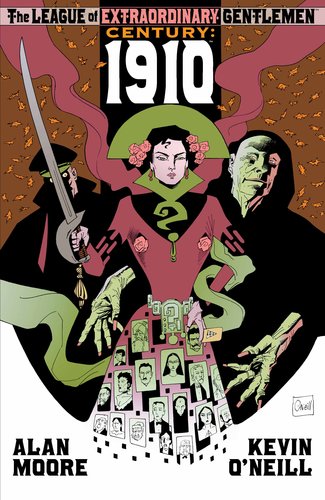
And lastly…, I may have rather unfairly dismissed the new volume of The League of Extraordinary Gentlemen Century: 1910 as “mildly disappointing”, but — like most of Moore’s work — it is undisputedly clever and even if I read 1910 another half-a-dozen times, I’ll still miss half the allusions, references, and knowing winks… Fortunately Jess Nevins has posted some very helpful annotations for the amateur nerd (via LinkMachineGo).

Comments closed

Something for the Weekend

Das Boot — David Drummond’s cover for Canadian Water Politics Edited by Mark Sproule-Jones, Carolyn Johns, and B. Timothy Heinmiller has been selected for the AIGA 50 Books/50 Covers this year. The book is published by McGill-Queens University Press who clearly take pride in the look of their books and have some other rather nice cover designs on their site.

The Long Goodbye — Another long, hard — and somewhat cynical look — at the state of the book industry. This time it’s the turn of Elisabeth Sifton, senior vice president of Farrar, Straus & Giroux, in The Nation.

W. W. Norton Book Design Archive — Publisher W. W. Norton have started posting their book cover designs to designated Flickr set (Crime by Irvine Welsh, designed by Darren Haggar pictured above) . I’d love to see more publishers do this (via The Book Cover Archive Blog).

Bird Brained or Brilliant — The contentious issue live-tweeting conferences. I only mention this because it tallies with my own recent experience of live-tweeting Raincoast’s Fall 09 Sales Conference. And because I’m a nerd (via Kate Trgovac on Twitter).

Gigantic Robot — the awesome Tom Gauld is publishing a new 32-page comic called The Gigantic Robot this summer. According to the Creative Review blog it’s “a fable concerning the production of a secret weapon whose promise apparently goes unfulfilled”. Can’t wait.

And finally (on a completely un-book related note)…

Redux — Muxtape is dead! Long live Muxtape! Whereas the late, lamented Muxtape was a place to upload mp3 ‘mixtapes’ (that fell foul of the music industry lawyers), Justin Ouellette’s new site is a platform for bands to share their music. Nice (via ISO50).

Comments closed
Midweek Miscellany, May 20th, 2009

Cut It Out — Dioramas made from the covers of pulp novels by Thomas Allen, seen at We Made This (via Ingrid Paulson on Twitter).

You Can’t Be SeriousThe Guardian takes a gloomy look at fate of  non-fiction and bookselling in the UK, managing to summon up  some half-hearted optimism towards the end:

Despite decades of predictions to the contrary, the appetite for demanding non-fiction has survived the advent of newspapers, radio and television – and, in Britain, a popular culture with a particular ability to absorb talent and themes that in other countries would be channelled into grand state-of-the-nation volumes. In fact, many publishers think the noise and immediacy of the web will make slow, quiet immersion in a book seem more, not less, appealing. And books, unlike most digital media, are not directly dependent on recession-affected advertising revenues.

Boy’s Own Misadventure3:AM Magazine’s Mat Colgate gets to the heart of why volume 3 of The League of Extraordinary Gentleman Century: 1910 (published by Top Shelf)  is mildly disappointing (by Alan Moore standards). Could it really be that Moore writes better when subverting restrictions of form and genre than when he has free reign?

It’s Not Just Your Type — Priya Ganapati talks to designers, including Henry Sene Yee, about the problems of  e-book design at Gadget Lab.  (And Joshua Tallent’s commentary at TeleRead about the problems of formatting for ePub is also worth reading).

Restraint — I mentioned Marian Bantjes’ gorgeous new typeface at the weekend, and now you can download a rather lovely Restraint desktop from the folks at Typenuts (via I Love Typography on Twitter).

1 Comment