Skip to content

Category: Film

Chaos and Order: A Clockwork Orange and THX-1138

The latest installment of ‘The Laser Age’, Keith Phipps series for The Dissolve on science fiction films of the 1960s, 70s and 80s, considers A Clockwork Orange and THX-1138:

Though released in 1971, THX 1138 plays at times like the last science-fiction film of the 1960s, while the downbeat A Clockwork Orange feels like the first of the 1970s. While superficially, they have little in common, in many respects, both films puzzle over the same obsessions. THX 1138 offers a dour, laconic vision that ends on an up note—THX escapes and stands against one of the biggest, boldest sunrises ever filmed—in contrast to A Clockwork Orange, which keeps a perversely peppy pace, up to an ending that’s happy for its hero, and chilling in its implications for everyone else. And even if, of the two, only Lucas seems fully invested in the argument, and even if both come up short, both make the effort. Both feel driven by a sense that, in the years to come, humanity would need a defense against the dehumanizing forces at work, whatever form they might take.

Last month, in the previous essay in the series, Phipps discussed Soylent Green, Z.P.G., No Blade Of Grass, and Silent Running.

Comments closed
The Sprawling, Obsessive Career of Fritz Lang

As part of the The Dissolve’s ‘Career View‘ series,  Noel Murray surveys the work of German-American film director Fritz Lang:

Over his first two decades as a movie director, Lang was responsible for some of the most memorable images in cinema’s early history, but he’d never filmed anything as shocking as one shot at the start of his 1941 thriller Man Hunt. As renowned hunter Alan Thorndike (Walter Pidgeon) settles into a shooting position on a brushy hill, he looks through his telescopic sight at his target: Adolf Hitler. Given that the United States wasn’t yet involved in World War II when Man Hunt was made (or even when it was released), even the implication that a movie hero might assassinate Hitler was a major provocation, which put Lang in a bit of hot water with the U.S. government and the gatekeepers of the industry’s production code. But Lang held firm, and Man Hunt set the tone for all the war movies he’d make in the 1940s. Even after America entered the war—and even after the war was over—Lang made action movies where the enemy wasn’t some vague antagonist in a different-colored uniform. In Lang’s war films, the villains frequently looked and talked a lot like the heroes, and posed a real, specific threat to ordinary citizens, not just soldiers.

It’s a long post — it spans a 40-year career! — but a really great read if you are interested in film history. I really hope The Dissolve publish more of these.

Comments closed

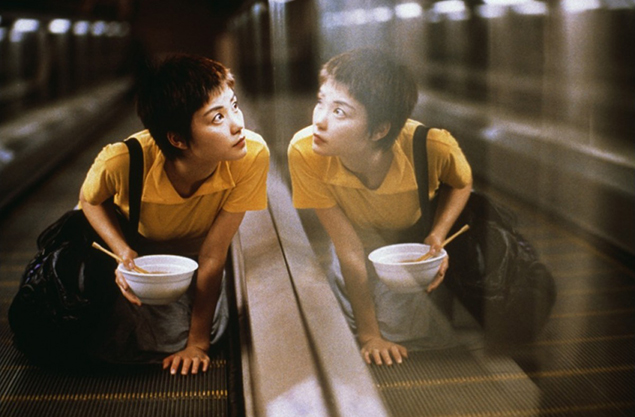
The Melancholy Beauty of Chungking Express


Kevin Phipps on Wong Kar-wai’s hypnotic 1994 film Chungking Express at The Dissolve:

Much of the melancholy beauty of Chungking Express—and later Wong films, for that matter—comes from missed connections, mad love, and soured romances, pairings with little chance of working out, however much heat they might generate in the moment. In many of his later films, the bitterness started to overwhelm the sweetness. (There are few movies more romantic than In The Mood For Love, but also few as inescapably sad.) Shot quickly and loosely in the middle of a place staring down enormous change, Chungking Express ultimately feels more sweet than bitter, defined by a tone of long-shot hopefulness and a sense that maybe it might all work out for those heartbroken young people—the ones whose beautiful faces and sad eyes Wong casts in the neon glow of a terrible, wonderful, forever-changing city, as they watch the first acts of their youth draw to a close.

I loved Chungking Express the first time I watched it. I had never seen anything like it, and was probably the perfect age too. It’s hard to believe  it was nearly 20 years ago.

And now you too can have California Dreamin’ stuck in your head for the rest of the day:

Comments closed

Design Is One: Lella & Massimo Vignelli


Design is One, the new documentary film by Kathy Brew and Roberto Guerra about designers Lella and Massimo Vignelli, opened at the IFC in New York yesterday:

Comments closed

Dear Mr. Watterson


Dear Mr. Watterson is a documentary film about the impact of  Bill Watterson’s beloved comic strip Calvin & Hobbes:

The film was funded by Kickstarter, and will be in theatres and available ‘on demand’ on November 15th, 2013.

(via Coudal)

Comments closed

Frame By Frame: The Art of Stop Motion

The latest episode of the PBS documentary short series Off Book takes a look at the painstaking art of stop-motion animation:

I’ve always loved stop-motion so it’s nice to know that it’s undergoing something of a resurgence in the digital age.

Comments closed

The Laser Age


At Pitchfork’s new film site The Dissolve, Keith Phipps is writing a column about the science fiction movies of  The Laser Age — a period  “rich with idea-driven science fiction” that began in the late 1960s and ended in the mid-1980s with “the poor financial performance of films like Blade Runner, Tron, The Thing, and Dune.”

The first essay looks at the two films that ushered in The Laser Age, Planet Of The Apes and 2001: A Space Odyssey, while the second looks at four post-apocalyptic films of the early 1970sBeneath The Planet Of The Apes, Glen And Randa, Gas-s-s-s, and The Omega Man:

Planet Of The Apes arrived at the beginning of a period of turmoil and dark times that made it easy to think the end was near. There’s a reason the longhaired kook appearing in Mad magazine during this era carried a sign reading just that: “The End Is Near.” Apocalyptic cults, and cults of all kinds, developed a foothold in the counterculture. Millenarianism wasn’t confined to the fringes, either. As Christian fundamentalism became a more powerful force in the American mainstream, the notion of preparing for the End Times became more common. Early Christian-rock star Larry Norman, a man with one foot in the counterculture and the other in fundamentalism, released a 1969 song titled “I Wish We’d All Been Ready.” The message is right there in the title, but the song revels in the dark imagery of dead children and a period in which “a piece of bread could buy a bag of gold.” His mind was straining to imagine unthinkable horrors just around the corner, and to turn those horrors into entertainment carrying a warning.


I haven’t seen it for years, but I’ve meaning to revisit Beneath The Planet Of Apes for some time. There’s a bleak insanity to it that makes it strangely memorable. Certainly the mutant-humans worshiping the nuclear missile at the end of the film absolutely TERRIFIED me a kid (when death by nuclear war seemed quite a real possibility). Perhaps that’s why I haven’t quite got around to watching it again?

Comments closed

The Birdman


The Birdman is a wonderful — and an award-winning — documentary short by Jessie Auritt about Rainbow Music in New York’s East Village and it’s eccentric owner.  The store just has to be seen to be believed:

With CDs, VHSs and old cassette tapes stacked head high, Rainbow Music is a hoarder’s paradise. However, its quirky owner, known as ‘The Birdman’, knows exactly where everything is. Amidst the Starbucks and Subways popping up on every corner of the East Village, Rainbow Music maintains its mom and pop feel, and is a hidden gem to its patrons. Due to the weak economy, online music sales and pirating, and the changing neighborhood, this charismatic curmudgeon is struggling to sell what he has in his store. Despite these challenges, The Birdman carries on to his own tune.

Comments closed

Books: A Documentary

Last year (as some of you may remember) Larry McMurty, author of The Last Picture Show, sold over 300,000 antiquarian books from his store Booked Up at auction. Now, filmmakers Mathew Provost and Sara Ossana of Studio Seven7 Films have started a Kickstarter campaign to help them complete a documentary about McMurty, the auction, and the antiquarian book trade in the US:

The campaign ends August 18th, and as of today they’re some way off their goal, so consider donating a couple of bucks if you want to see the finished film.

3 Comments

Nicolas Roeg: “Well, I’ll Be Damned”

Also at The Telegraph, film director Nicolas Roeg (PerformanceWalkabout, Don’t Look Now, The Man Who Fell to Earth)  talks to John Preston about his new memoir, The World Is Ever Changing:

Roeg insists that he had no idea what sort of films he wanted to make when he became a director. Instead he fell into directing when Donald Cammell, who’d written the original script for Performance, needed someone with visual flair to collaborate with.

Eventually, the film made legends of Roeg and Cammell, but at the time it almost finished them both. At an early screening, one Warner Bros executive was reportedly so appalled by the sight of Mick Jagger and James Fox exchanging sexual partners, clothes and identities that he threw up. On the film’s release, the critic of Life magazine described Performance as “the most completely worthless film I have ever seen since I began reviewing”.

… Now, of course, the wheel has come full circle and, as Roeg notes drily, he’s lost count of the people who claim to have played a critical role in Performance’s success. Is it a film you look back on with fondness and pride? I wonder. “I don’t look back on any film I’ve done with fondness or pride,” he says promptly. “I look back on my films, and on the past generally…” He shakes his head in a bewildered sort of way. “I can only use the phrase, ‘Well, I’m damned’.”

At the Financial Times, Peter Aspden reviews the book with new books about Orson Welles and Roman Polanski:

The greatest auteurs in cinema have traditionally had a habit of gorging on their favourite subjects, their leading ladies, their studios’ cash registers. Today’s directors are less monstrous, and altogether more respectful of the tiresome fact that cinema is a collaborative art form. Put it down to sharper accountants, blander movie stars, infernally complex technological demands. It is more difficult than ever to be a legend in your own lunchtime, and that’s a shame.

Interestingly, Aspden recommends the interactive iPad edition of Roeg’s memoir, which comes “complete with sequences from his films and grandfatherly accounts of their making, which ramble sweetly into occasional dead ends.” Nice.

Comments closed

Martin Scorsese: The Persisting Vision

The August issue of New York Review of Books has a wonderful essay by Martin Scorsese on the history and language of film, Vertigo, and cinema as a great American art form:

As in the case of many great films, maybe all of them, we don’t keep going back for the plot. Vertigo is a matter of mood as much as it’s a matter of storytelling—the special mood of San Francisco where the past is eerily alive and around you at all times, the mist in the air from the Pacific that refracts the light, the unease of the hero played by James Stewart, Bernard Herrmann’s haunting score. As the film critic B. Kite wrote, you haven’t really seen Vertigo until you’ve seen it again. For those of you who haven’t seen it even once, when you do, you’ll know what I mean.

Every decade, the British film magazine Sight and Sound conducts a poll of critics and filmmakers from around the world and asks them to list what they think are the ten greatest films of all time. Then they tally the results and publish them. In 1952, number one was Vittorio de Sica’s great Italian Neorealist picture Bicycle Thieves. Ten years later, Orson Welles’s Citizen Kane was at the top of the list. It stayed there for the next forty years. Last year, it was displaced by a movie that came and went in 1958, and that came very, very close to being lost to us forever:Vertigo. And by the way, so did Citizen Kane—the original negative was burned in a fire in the mid-1970s in Los Angeles.

So not only do we have to preserve everything, but most importantly, we can’t afford to let ourselves be guided by contemporary cultural standards—particularly now…We have to remember: we may think we know what’s going to last and what isn’t. We may feel absolutely sure of ourselves, but we really don’t know, we can’t know. We have to remember Vertigo…

(New York Review of Books)

Comments closed

Alan Moore: The Revolution Will Be Crowd-Funded


photo: Leo Williams

Alan Moore discusses his short films, crowd-funding, the Occupy movement, The Prisoner, and zombies (amongst other things) at Salon:

While the revolution will be certainly televised, it strikes me that there is a strong possibility that the revolution will also be crowd-funded. If Kickstarter and other enterprises are giving projects like Occupy Comics a chance, then it does suggest there are imaginative ideas out there with incredible use and application across the board. Not just in the arts, but in the sciences as well. It’s an exciting concept, and I look forward to seeing what emerges from it.

Moore talks more about his Lynchian short film Jimmy’s End — created with Mitch Jenkins — in this short ‘behind-the-scenes’ documentary for Motherboard TV (worth watching just for the interior of the actual Jimmy’s End Working Men’s Club around the 10 minute mark):

He also discusses crowd-funding and ‘The Jimmy’s End Cycle’ of films — the last of which, Heavy Heart, you can still support on Kickstarter —  in an interview with Bleeding Cool from earlier this month.

Comments closed