Skip to content

Category: Comics

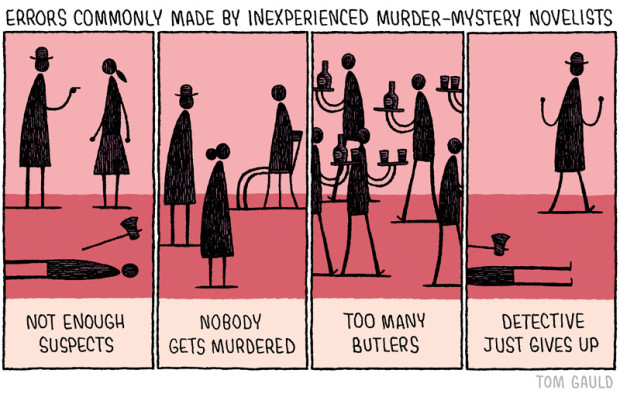
Errors Commonly Made by Inexperienced Murder-Mystery Novelists

errors-commonly-made

Tom Gauld.

Comments closed

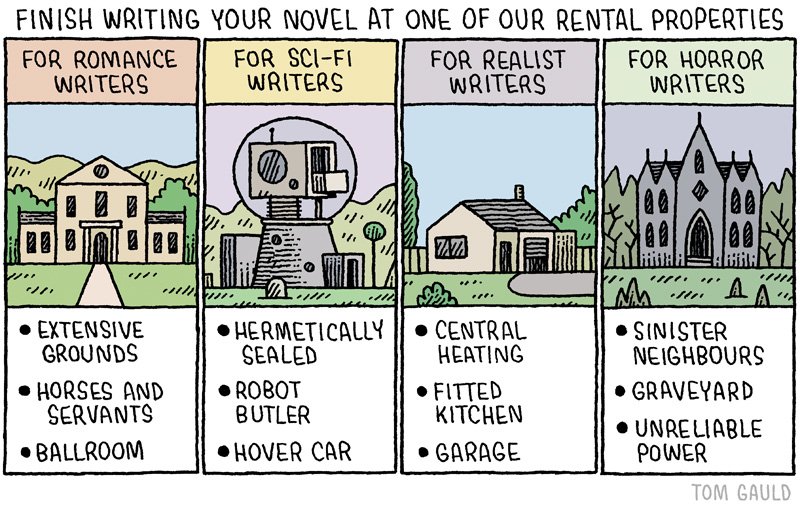
Finish Writing Your Novel…

finish writing tom gauld

Tom Gauld.

Comments closed

25 Years of Drawn and Quarterly

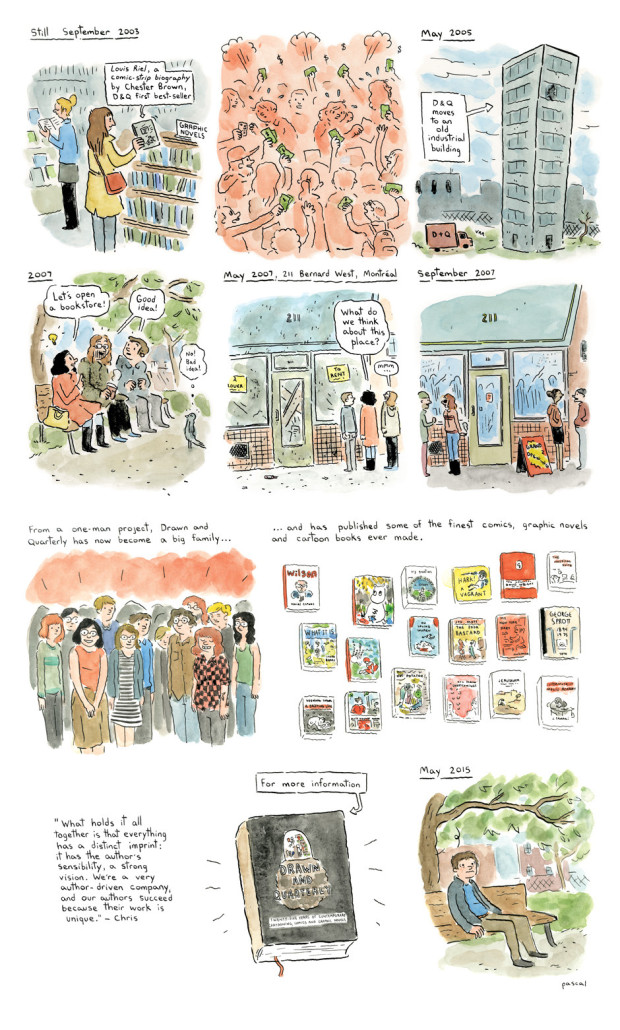
This past weekend at the Toronto Comic Arts Festival, Montreal publisher Drawn and Quarterly celebrated their 25th anniversary. D+Q cartoonist Pascal Girard (Petty Theft, Reunion, Bigfoot) drew a history of the publisher for the National Post:
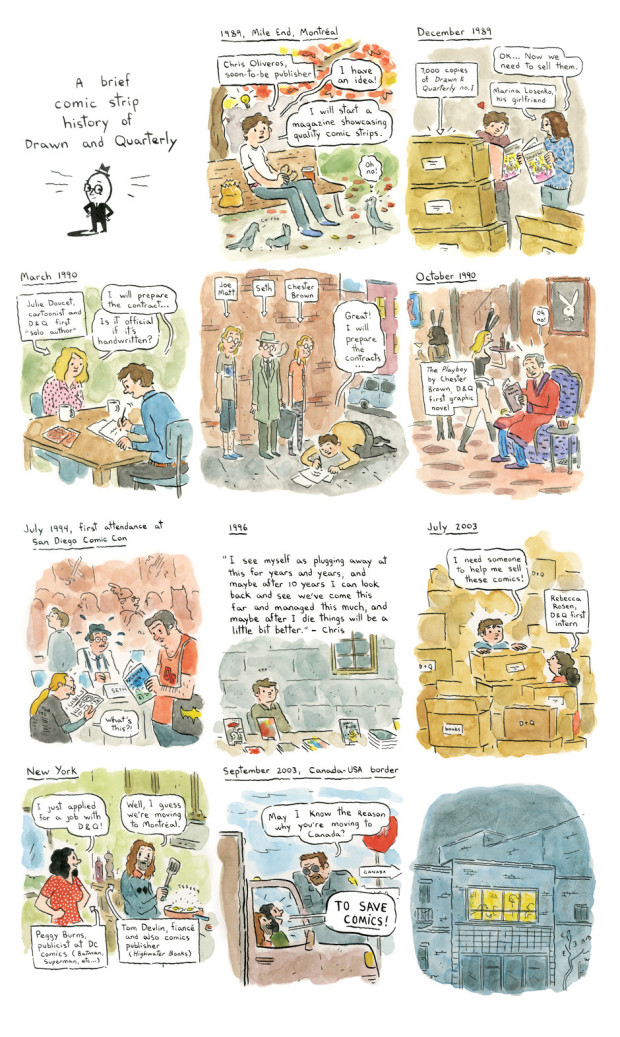
tcaf_comichistory1

tcaf_comichistory2

While in a lengthy profile of the publisher by Mark Medley, the Globe and Mail revealed that founder Chris Oliveros is handing the company over to long-time collaborators Tom Devlin and Peggy Burns:

If Drawn and Quarterly is “like a big family,” as Chester Brown described the company to me earlier this week, then, in a sense, the family is losing its father.

A little more than a year ago, Oliveros pulled aside Burns and Devlin, his longest-serving co-workers, and told them he was thinking of stepping down, and that he wanted them to take over the company.

“It was a complete surprise,” says Devlin. “We kind of assumed he’d just do it forever.”

Burns says she burst into tears upon hearing the news.

“I’ve personally taken it as far as I can take it,” says Oliveros. “It would have been fine if I continued. It’s not like they were telling me to go or anything. I could have been around for the 30th anniversary, for the 35th, and the 40th, if I’m still alive, but I just feel, you know what, I don’t think I can accomplish – me, personally – I don’t think I can accomplish more.”

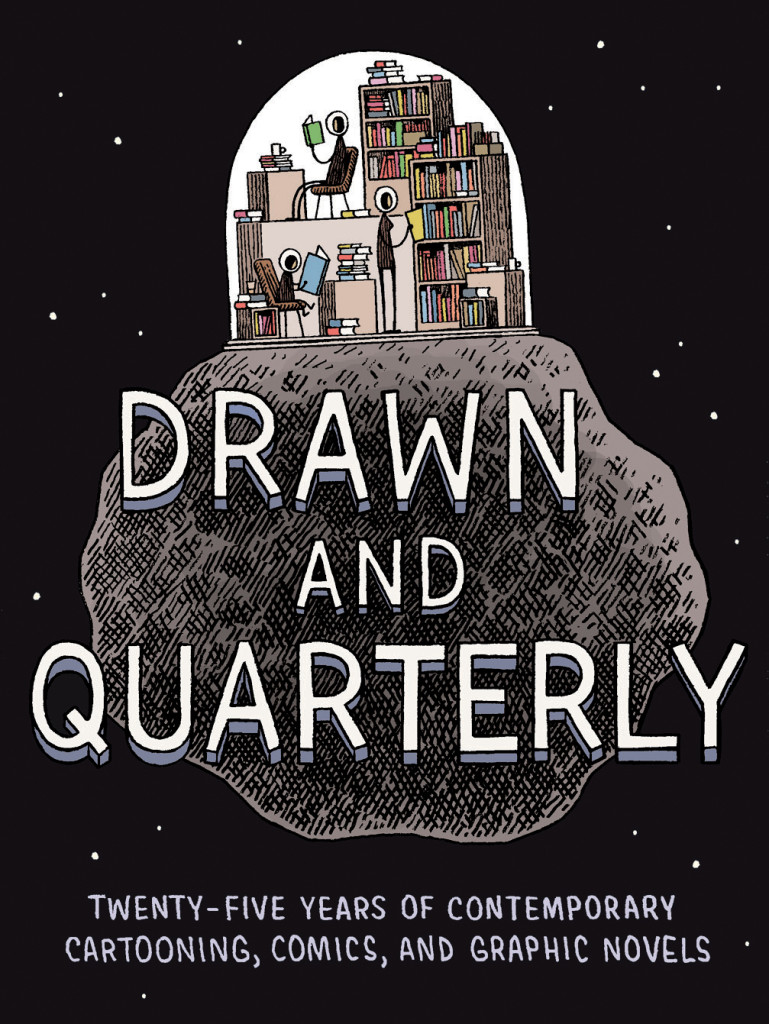
A new book celebrating the publisher, Drawn and Quarterly: Twenty-Five Years of Contemporary Cartooning, Comics, and Graphic Novelswill be published later this month.

DQ25_tomgauld

Comments closed

Samplerman

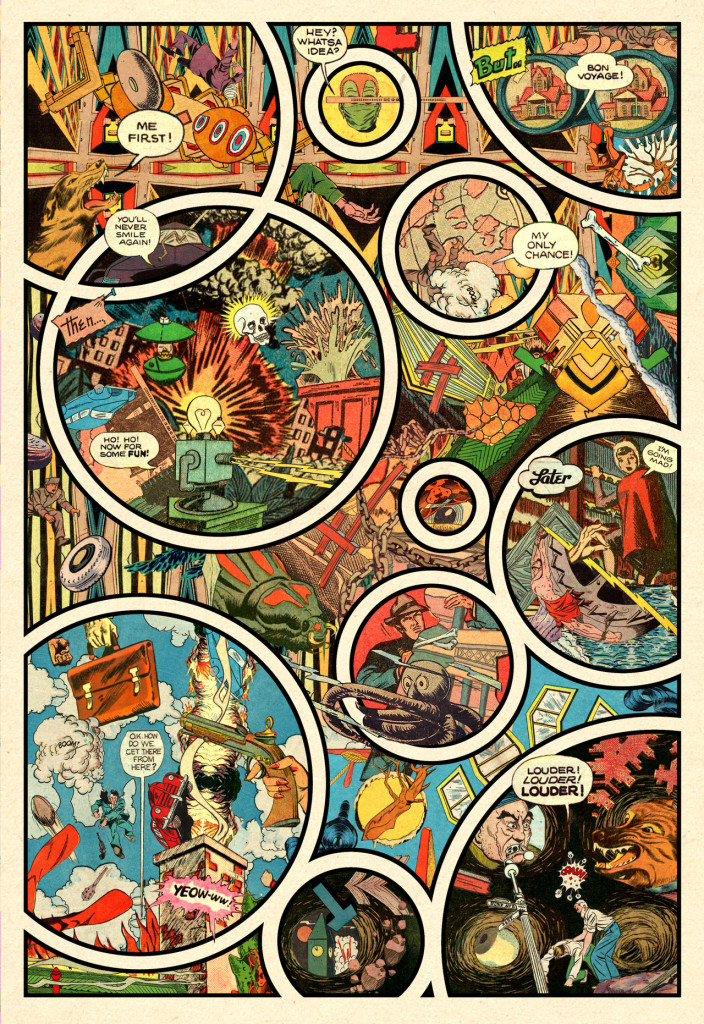
samplerman-01

Thanks to David Gee (and others), who alerted me to the extraordinary Samplerman comics this week.

You can read an interview from earlier this year with Yvan Guillo, the French cartoonist and designer behind Samplerman, at It’s Nice That:

I’ve always downloaded tonnes of scans of American comics, from the golden age to the bronze age. I could scan the ones I have but I’ve done it only once or twice. I don’t really read the stories, but I love how they look: the cheap paper, the bright primary colours, the screen-tone, the drawings, the conventional representation of landscapes, the simplicity of the lines. I have to make a choice among this mountain of graphic elements. I pick what I like: face, hand, clothes, tree, car, text balloon etc. and start to (digitally) cut them out. At the same time I start to place the elements on one or several pages made of blank comic panels. Some elements are duplicated, rotated, arbitrarily cut in half, reduplicated and mirrored. It’s a mix of kaleidoscope and collage; I add, I move, I replace until I feel it’s done. At the end it has to remain visually surprising and dynamic.

samplerman-03

Bonkers.

1 Comment

Superhero Comics and The Tyranny of Pew-Pew

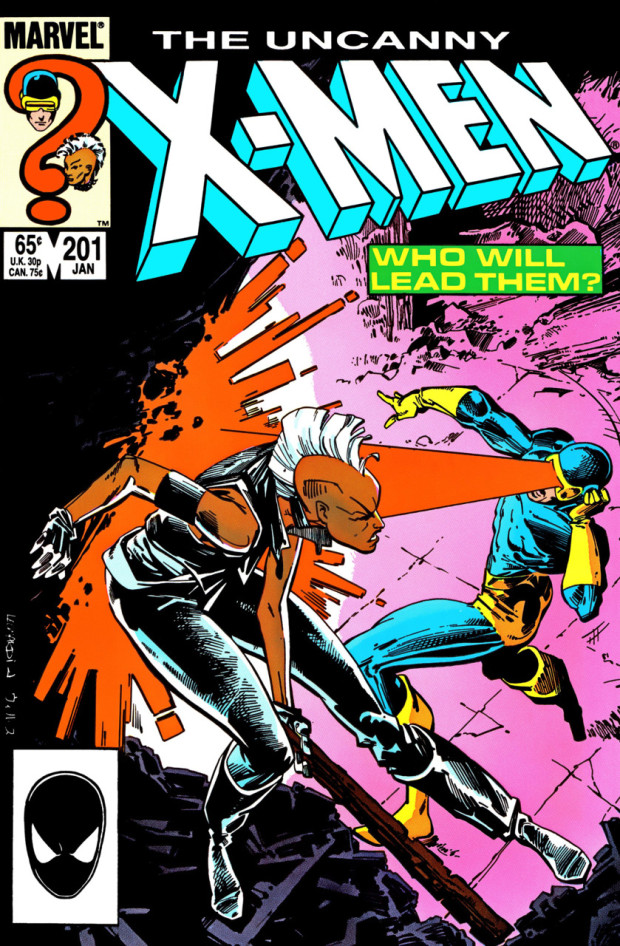
uncanny-x-men

Ta-Nehisi Coates, who writes so compellingly about culture and politics for The Atlantic, talks to Vulture about superheroes and his love of (Marvel) comics:

Comic books aren’t perfect, but listen: In the 1980s, Marvel had a black woman — not just a black woman, a woman who was born in Harlem, a woman who was African-American and whose mother was Kenyan — leading their most popular title. And then when she lost her powers, she was still kicking ass. Like she still had enough to whip Cyclops’s ass. That was something they were doing. I can’t really think of anywhere else I would’ve went at that time to see something like that. Just today I was reading that Hickman one. And this kid, Manifold, is like an Aboriginal. This is incredible! I mean this has to do with Hollywood: You don’t actually see that diversity reflected on-camera. [Comics] are not perfect, especially around gender and the women’s stuff, but you start comparing it to Hollywood, it’s not even a conversation. I mean consider it like this: There could’ve been [a Hollywood] adaptation, a true adaptation, of X-Men in which Storm was the protagonist in the way that we were reading it; that would’ve been a true rendering of what the comic book actually was. But that’s not possible, that’s not possible in Hollywood. It’s deeply sad.

Meanwhile, at the Village Voice, Alan Scherstuhl ponders The Tyranny of Pew-Pew, or how fun fantasy violence became inescapable:

Just a generation before it came to dominate our culture, comic and fantasy violence was disreputable, a little underground, scruffy and impolite. It didn’t yet have clearly established rules covering what was and wasn’t acceptable: Note how the ‘Fangoria’-lite bloodiness of the first two ‘Indiana Jones’ pictures contrasts with the gentlemen’s fisticuffs of the third one, a course correction made after the public scolded Lucas and Spielberg for having gone too far with the heart-ripping and kid-whipping. But the sadism of ‘Temple of Doom or the ‘Daredevil’ Netflix series differs from that of the Marvel films or ‘Indiana Jones and the Last Crusade’ only in tone and degree: At root, they’re all still about how awesome it would be to run around and kick everyone’s ass.

Comments closed

Chris Ware: Beyond the Cover

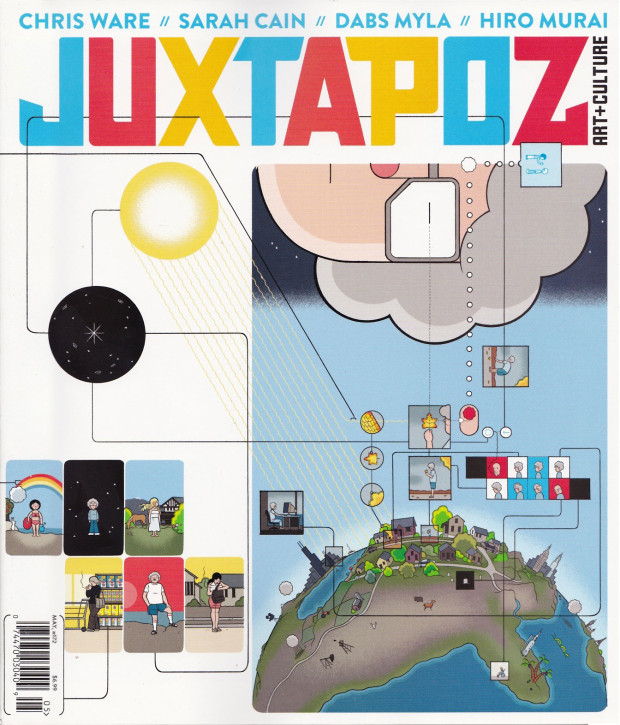
juxtapoz-may-2015

Juxtapoz contributing editor Kristin Farr talks to Chris Ware, the magazine’s May 2015 cover artist, for their Beyond the Cover site:

Beyond setting a very specific mood, tone or feeling of a time of day or era, color in my stuff sometimes acts as a separate, countervailing story, connecting elements and images in ways that I sometimes hadn’t even predicted when I was simply drawing the page, reflecting more the way we see the world than how we define it. At the same time, the page compositions are also an attempt to get a glimpse at the way we edit, remember, and clean up our own experiences into “stories”…

…Comics best approximate how I remember and think about the world and how I also think many other people do; I believe even Nabokov at some point expressed frustration at not being able to induce a non-verbal image-based sort of page-memory (but he still did it better than anyone, except Joyce). I find myself thinking about my stories at odd times during the day, almost as if they’re an alternate reality; I can’t liken the experience to anything other than the psychosis of false or self-induced memories. Then again, any memories are always going to have some falseness, all of which add up to a fairly unreliable sense of one’s life and experience.

Comments closed

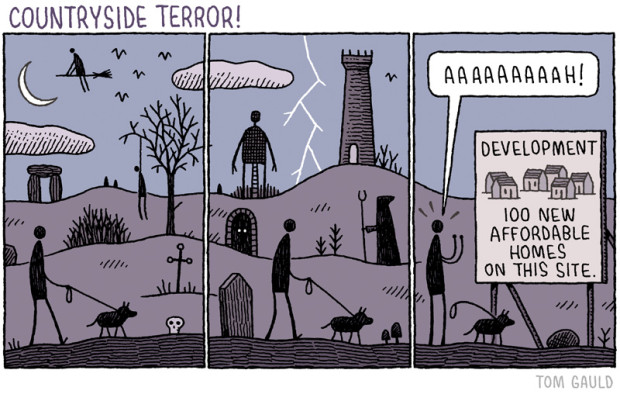
Countryside Terror!

countryside-terror

Tom Gauld.

(Not having seen The Guardian this past weekend, I can only assume that Tom’s cartoon is a reference to this).

Comments closed

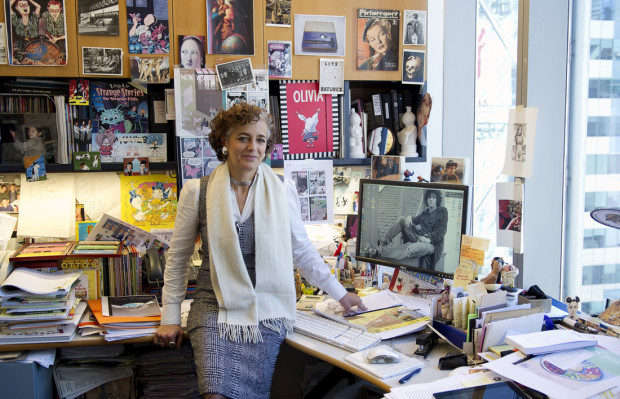
Françoise Mouly on Voice

francoise-mouly-photo-sarah-shatz.

Grace Bello interviews the always interesting Françoise Mouly, art director of The New Yorker and founder of Toon Books, for Guernica:

I know what I respond to is a voice. A voice is not just a stylistic thing, but it means someone who really has something to say. I think a lot of what I get from books—whether they be books of comics or books of literature—is a window into somebody’s mind and their way of thinking. I love it when it’s so specific. It’s a new way to look at the world. It’s as if I could get in and see it through their eyes. It also reaches a level of universality because, somehow, I can recognize some of my feelings in seeing somebody who is actually expressing their own inner reality. Even though Flaubert has not been in Madame Bovary’s skin, you do get a sense of what it’s like to be that person. It’s a kind of empathic response when you’re reading it.

Comments closed

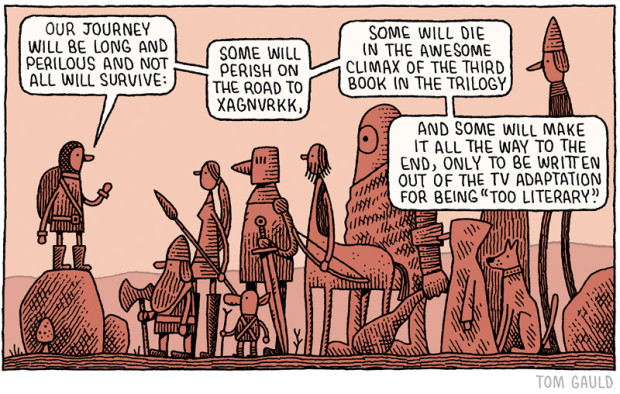
Our Journey Will Be Long…

our-journey-will-be-long-tom-gauld

Tom Gauld

Comments closed

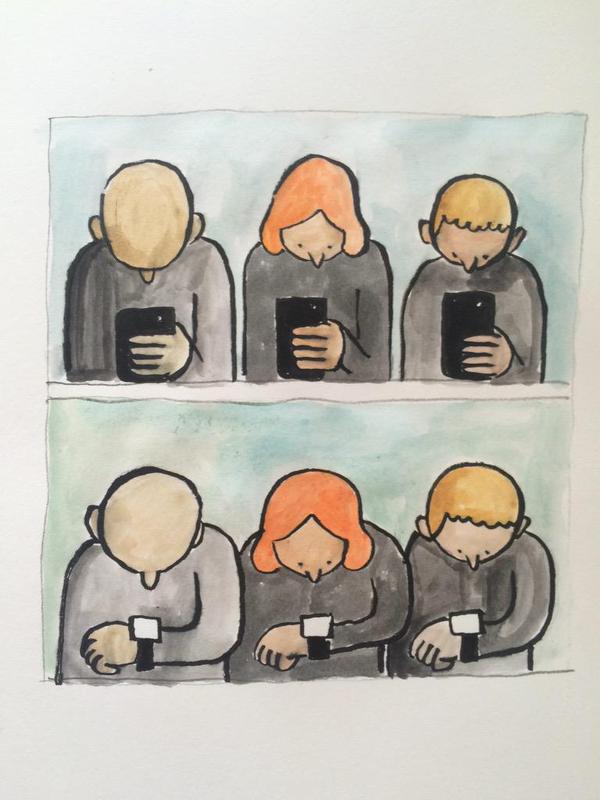
Apple Announces Revolution

apple-i-watch-jean-jullien

Jean Jullien

Comments closed

I’ve Been Thinking…

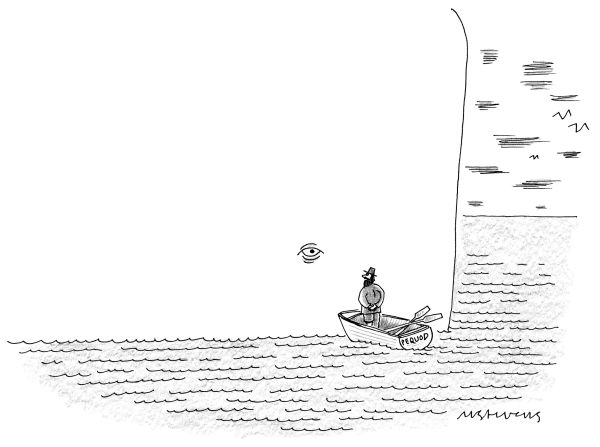
Posting Kim Warp’s Moby Dick cartoon last week reminded me to post this The New Yorker cartoon by Mick Stevens from February:

ive-been-thinking

(There’s probably a New Yorker book Moby Dick Cartoons, isn’t there?)

Comments closed

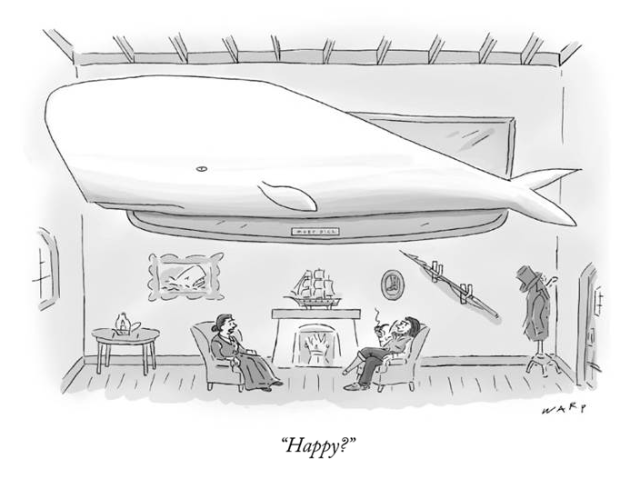
Happy?

happy

Kim Warp for The New Yorker.

(via This Isn’t Happiness)

1 Comment