Skip to content

Category: Publishing

Midweek Miscellany, Nov 5, 2008

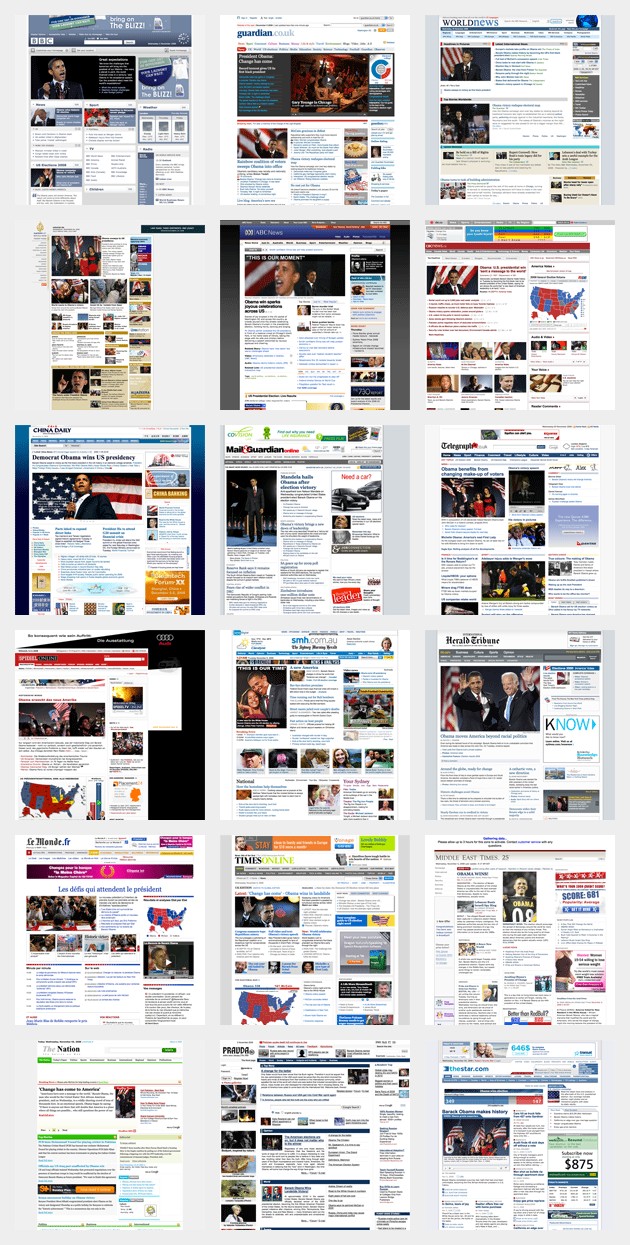
Konigi has posted a ‘small’ sampling of international front page newspaper coverage of the US Presidential Election (pictured) .   The US Sources are here. It’s hard not to be swept up in the excitement today. Breathtaking. (via SwissMiss)

“Publishing: Media’s Last Diehard?”: James Bridle (apt/booktwo)  has posts his v. interesting notes from a talk at the London School of Economics given by HarperCollins CEO Victoria Barnsley. More at The Bookseller.

“Seven hundred friends, and I was drinking alone”: Toronto author Hal Niedzviecki discovers the fickleness of Facebook friends in the New York Times (via DesignNotes).

Doubleday Dismissals Were Self-Inflicted: The New York Observer examines the recent lay-offs at Random House’s DoubleDay division and looks at the career of their publisher Steve Rubin (via Sarah Weinman).

Science Fiction and Fantasy editor Lou Anders interviewed on the Amazon blog Omnivoracious. What’s the hardest part of his job?

“Saying no to a piece of sheer brilliance because I know that the audience for it is about 200 people. I don’t for a minute believe that commercial and literary concerns are mutually exclusive … But not every worthy work has commercial potential. Trying to find books that fire on all cylinders means saying no to a lot of competent fiction that only fires on one or two. Being determined not to compromise on quality while still being commercially viable means that I am hunting in a very narrow bandwidth and have to read hundreds upon hundreds of submissions to find a very few prizes. I worry that a lifetime of saying no is bad for my karma, and have to remind myself that its the yes that the readers see and they are who I am serving.”

1 Comment

Midweek Miscellany, Oct 22th, 2008

Having skipped Monday (thanks Amazon grid!), here’s a bumper Midweek Miscellany for your (digested) reading pleasure…

Publishers put on a brave face on the economic downturn in Frankfurt according to the Washington Post (thanks for link Stephanie!):

“While luxuries are increasingly unaffordable, most people still have enough money to buy a book, and booksellers could even use the opportunity to stage a resurgence”

Traditional book binders John and Ardis Mankin featured in the San Diego Union Tribune (via Shelf Awareness):

“Our main machinery is our hands,” said Ardis, 74. “Technology can’t do what we do.”

The Serif Fairy (pictured) for the junior typographer in all of us (via Design Observer).

The Legendary Mr. Typewriter: Reveries on Martin K. Tytell the owner of the Tytell Typewriter Company, in Lower Manhattan who died, age 94, on September 11th, 2008. If I could  type for tuppence and wasn’t a pathological re-writer, I would definitely use a typewriter…

Books for Bibilophiles’   in The Observer:

“At a time when bibliophiles are an endangered species, these books about books tell us why it’s reading that makes us human”

Literary agent Pat Kavanagh, “doyenne of the London literary scene”, has died:

“She had the values of an earlier generation. People like Kingsley Amis loved Pat. She was old school but she never seemed jaded. We all thought she would always be there, that she would never retire.”

Jonathan Ross revisits Watchmen by Alan Moore and Dave Gibbons for The Times (via LinkMachineGo):

“But what makes this a genre-transcending bona fide masterpiece is that… Moore and Gibbons… manage to deliver a devastating critique that cuts to the very heart of the pitiful, timid male fantasy that is the superhero genre at its purest and worst: muscular men and busty women in tight costumes solving all the world’s problems with a well-placed punch”

Over and out…

2 Comments

On Being Skipped

GalleyCat pointed me in the direction of  a refreshingly frank essay by Andrew Wheeler, Marketing Manager for John Wiley & Sons, about books that are passed over, or  skipped’,  by a bookstore:

“bookstores are businesses, not public conveniences. No store has the responsibility to carry every book published… I market books for a living, so I can tell you an unpleasant truth: the order for any book, from any account, starts at zero. The publisher’s sales rep walks in the door with tipsheets and covers, past sales figures and promotional plans, to convince that bookseller’s buyer to buy that book. In many categories… the chain buyers say “yes” the overwhelming majority of the time. But not all the time. Sometimes, that buyer is not convinced, and the order stays at zero.”

None of what Andrew says will be news to any one working in publishing — skips are an accepted, if unpleasant, part of the business — but, as Andrew notes, authors on the receiving end of skips are outraged by them, and I’m sure more than a few debut authors will be shocked to discover that there is such a thing and that it happens frequently enough to have its own terminology.

In most cases agents or publishers don’t discuss the possibility of skips with their authors before they actually happen — no one wants to be that pessimistic about a book’s chances! But that is not to say we should be less than forthright about the realities of business, or pretend that this doesn’t happen.

I recently had an exchange with a freelance publicist who told me with all confidence that he was going to book his client-author on national radio and television. Knowing the book, and having had some experience of the challenges of book publicity, I just about spat out my coffee. Charitably he was naively optimistic. Uncharitably, he was bullshitting me, and probably his client, to justify his hourly rate.

A publicist, however good he or she is, cannot guarantee an author publicity any more than the greatest sales rep can guarantee sales or prevent the dreaded ‘skip’. You can charm and you can twist arms,  but ultimately the decision lies with someone else — a producer, a book review editor, or a buyer — with a set of priorities different to your own. To pretend otherwise, leaving things unspoken  or offering overconfident assurances is a disservice to your author, and will probably bite you in the ass in the long run as a publisher (or freelance publicist).

Authors, unsurprisingly, have a tendency to be smart people. By and large they don’t want to be left in the dark, or have their hopes unrealistically raised. Sure they should take some responsibility — ask questions and educate themselves  — but we should  be honest and upfront about how the book business works, putting books in their proper context and giving an author a realistic sense of what is possible.

Comments closed

Monday Miscellany, Oct 13th, 2008

A belated Happy (Canadian) Thanksgiving and a belated Monday Miscellany (on Tuesday)…

An interesting  Q & A with George Jones, President and Chief Executive Officer of Borders Group, on HarperStudio’s The 26th Story Blog:

“I do not agree that it’s all doom and gloom in the book business… I think people are always going to want books…they will always want to be entertained and informed by books and I do not see that changing.  It’s true that the format books take may change over time and evolve, and the places where people buy books and how they access them have changed over time and will change further, but books themselves will always be part of our culture and our world in my opinion.”

Marketing in Tough Times. The American Booksellers Association ask successful booksellers to share their advice on marketing  during the economic downturn.

Book-lined stairs (pictured) designed by Levitate Architects for a space-challenged London apartment, as seen on the lovely Apartment Therapy (via image bookmarking site FFFFound).

50 of your favourite words on the BBC online magazine (as inspired by Ammon Shea’s book READING THE OED). I’m rather partial to ‘metanoia’ – “the act or process of changing one’s mind or way of life” – myself…

Comments closed

Generous Criticism

“Being generous in speaking of another’s work doesn’t mean “heaping praise”. It means delivering the critique from a place deeper than the insignificant nitpicking that comes so easily, deeper still from a place that harbors no envy, and even further down where the critique is offered in a genuine effort to improve the project, to the benefit of the discipline as a whole. Everyone wins.”

I came across Nam Henderson’s  Archinect op-ed on ‘Generous Criticism’ via Michael Surtees DesignNotes.

Design blogs, like DesignNotes, Design Observer, Ace Jet 170, Grain Edit,  and Swissmiss – to name just a few – are such an inspiration. The breadth of the design community’s interests, the generosity, willingness to share, and sheer enthusiasm for what they do is remarkable.

I wish I saw more of this kind of online dialogue about publishing.

The best lit-blogs, like ReadySteadyBlog, and Sarah Weinman’s blog, Confessions of an Idiosyncratic Mind, rightly save their enthusiasm for writing and writers. But blogs that concern themselves with the business of books lack that kind of energy.

Although there are notable exceptions –  James Bridle’s booktwo and Shelf Awareness come to mind – the book business seems to have very little to say for itself, and even less that is positive. We hear so little  about the agents, publishers, editors, designers, publicists, sales reps and booksellers who just nail it. Instead our conversations are dominated by  hell-in-a-handcart pessimists or told-you-so digital evangelists. We link to the same gossipy controversies and angry rants. We take cheap shots and wonder why we’re being marginalized by things that are more fun.

We seem short generosity and lacking in curiosity.

Publishing is not perfect, but we do some great stuff. Of course we should be critical, but we should do it to improve what we do, not to tear it down. To go back to Nam Henderson:

“we should, as a community of professionals, be able to expect respectful commentary, considered and generous… if something is bullshit, SAY SO… If someone is skating by on laziness, call them out and challenge them – positively – to make a better effort. And challenge yourself, in every critique, to be generous: reflect on what you’re seeing in the bigger context…, identify the elements that are good, apply the logic of the good parts to the overall scheme to see where improvements can be made. Think about how much effort you would want a critic to put into a comment made to you.”

I can’t say I am without fault. I’m as snarky as the next guy. But I hope — and strive — for something better.

2 Comments

Are E-Books Shovelware?

Introducing his five-part series BASIC Principles of Online Journalism (discussed last week), Paul Bradshaw notes:

It shouldn’t have to be said that the web is different, but I’ll say it anyway: the web is different. It is not print, it is not television, it is not radio.

So why write content for the web in the same way that you might write for a newspaper or a news broadcast?

Organisations used to do this, and some still do. It was called ‘shovelware’, a process by which content created for another medium (generally print) was ‘shovelled’ onto the web with nary a care for whether that was appropriate or not.

It was not.

With Peter Kent of DNAML recently suggesting  on the O’Reilly TOC blog that publishers treat e-books like software, and many e-books just digitalized versions of their print edition, are e-books falling into the category of  ‘shovelware’?

Certainly trade publishers have tended to think of the e-book as a ‘format’ a cheaper, more convenient way to read text than an ordinary book that requires little amendment rather than an entirely different ‘medium’ with new rules and possibilities.

Andrew Gallix, editor-in-chief of 3:AM Magazine mulled some of this over in The Guardian last week:

Bar a few notable exceptions (Penguin’s wiki-novel or We Tell Stories project), traditional publishers have used the internet as a glorified marketing tool providing them with new ways of flogging the same old same old: e-books, Sony Readers, digi-novels, slush-pile outsourcing… So far, the brave new world of digital literature has been largely anti-climatic…

I don’t think you  don’t need to embrace Gallix’s avant-garde e-lit leanings or see e-books as completely detached from print to appreciate that if they simply reproduce what’s already available, e-books are not really reaching their potential.

At the very least, authors and publishers should consider how the digital reading experience differs from that of print, whether this is producing new texts specifically intended to be published as e-books, or providing additional digital content for existing texts.

Thinking about Bradshaw’s  principles brevity, adaptability, scannability, interactivity, community, and conversation seem like a good place to start.

2 Comments

Wide-Eyed Horror

Is it just me, or is Penguin raising the bar for book cover design right now?

Inspired by the two-tone crime covers produced by Romek Marber for Penguin in the 60s, senior designer Coralie Bickford-Smith  has created some remarkable designs for 10 gothic horror novels – including books by Edgar Allan Poe, H. P. Lovecraft and M. R. James –  to be released by Penguin in their Red Classics series on October 2nd.

In this video from the Penguin Blog, Coralie discusses the genesis of the covers:

The whole set can be seen on the Penguin Blog.

Link

4 Comments

Mamet to Pinter to Beckett

The maverick publisher of Grove Press Barney Rosset is to receive a lifetime achievement award on November 19th, 2008, from the National Book Foundation in honor of his many contributions to American publishing, according to the New York Times:

In its heyday during the 1960s, Grove Press was famous for publishing books nobody else would touch. The Grove list included writers like Samuel Beckett, Jean Genet, William S. Burroughs, Che Guevara and Malcolm X, and the books, with their distinctive black-and-white covers, were reliably ahead of their time and often fascinated by sex.

Also the subject of a new documentary ‘Obscene’ about his life and work, Mr. Rosset said:

“All my life I followed the things that I liked — people, things, books — and when things were offered to me, I published them. I never did anything I really didn’t like. I had no set plan, but on the other hand we sometimes found ourselves on a trail. For example, out of Beckett came Pinter, and Pinter was responsible for Mamet. It was like a baseball team — Mamet to Pinter to Beckett… Should we have had more of a business plan?” he added. “Probably. But then the publishers that did have business plans didn’t do any better.”

Link

UPDATE:

More on Barney Rosset and ‘Obscene’ at New York Magazine

Comments closed