
Author Sarah Bakewell talks about How To Live: Or, A Life of Montaigne in One Question and Twenty Attempts at an Answer with Ramona Koval for ABC RN’s The Book Show:
THE BOOK SHOW: HOW TO LIVE, A LIFE OF MONTAIGNE
Comments closedBooks, Design and Culture
Author Sarah Bakewell talks about How To Live: Or, A Life of Montaigne in One Question and Twenty Attempts at an Answer with Ramona Koval for ABC RN’s The Book Show:
THE BOOK SHOW: HOW TO LIVE, A LIFE OF MONTAIGNE
Comments closed
“It Looks Pretty Cool” — Chip Kidd on his design for Haruki Murakami’s new novel 1Q84:
logistically the title is a book designer’s dream, because its unique four characters so easily adapt it to a very strong, iconic treatment.
F**ked — Author Dale Peck on founding Mischief + Mayhem, a new publishing collective, in The Financial Times:
“The whole point of writing literature was that in exchange for not getting paid a lot of money, you could say whatever you wanted; now, you don’t get a lot of money and you don’t get to say what you want. All of which segues to why writing is f***ed.”


The Last of the Old-Style Hollywood Actresses — A Ballardian Primer to Elizabeth Taylor:
What did Taylor represent to Ballard? Less a sex symbol and more an emblem of the parallel landscape that celebrity culture in the 1960s and 70s inhabited, a virtual reality colonising the private lives of ‘ordinary’ people exposed, through mass communications and on a hitherto unprecedented scale, to a world as strange as an alien planet yet paradoxically erotic and near – a synthetic substitute for reality itself.
(images: cropped photograph of Elizabeth Taylor by Bert Stern via Dan Shepelavy (top). Cover of Crash by J.G. Ballard designed by David Wardle).
Too Much Information —The New York Times of the meaning and the use of the word “information”:
The use of the word “information” itself… seems to have exploded since its earliest recorded appearance in 1387. (“Fyve bookes com doun from heven for informacioun of mankynde.”) As Michael Proffitt, the managing editor of the Oxford English Dictionary, notes in an essay written for the recent relaunch of the O.E.D.’s digital edition, “information” is the 486th most frequently occurring word in Project Gutenberg’s searchable corpus of mostly pre-1900 literature. A 1967 survey of contemporary American English ranked it 346th. And the rise of digital technology seems only to have speeded its ascent. One recent survey of online usage lists “information” as the 22nd most common word.
And finally… It seems unlikely that you haven’t seen these already, but still…

New Vintage paperback designs for James M. Cain “conceived by Megan Wilson, executed by Evan Gaffney.” Stunning stuff.
Comments closed
Picador have just posted all their Spring 2011 covers to Facebook. There’s some lovely work. Here are a few favourites:
 The Fever: Cover design by LeeAnn Falciani
 Watching the World Change: Cover design by Henry Sene Yee • Cover photograph by Patrick Witty
 Winterland: Cover design by Keith Hayes • Cover photograph by eyespy/GettyImages
(Thanks Henry).
6 CommentsScreening at MoMA next month, How To Make A Book With Steidl is an award-winning documentary by Jörg Adolph and Gereon Wetzel about book publisher Gerhard Steidl:
(via Coudal. Of course.)
Comments closedA short profile of Benedikt Taschen from CBS Sunday Morning:
Comments closed Literary editor Lev Grossman (author of The Magicians) discusses why Time put Jonathan Franzen on the front cover the magazine of with Ramona Koval on ABC Radio National’s The Book Show:
ABC RADIO NATIONAL THE BOOK SHOW: LEV GROSSMAN
Comments closed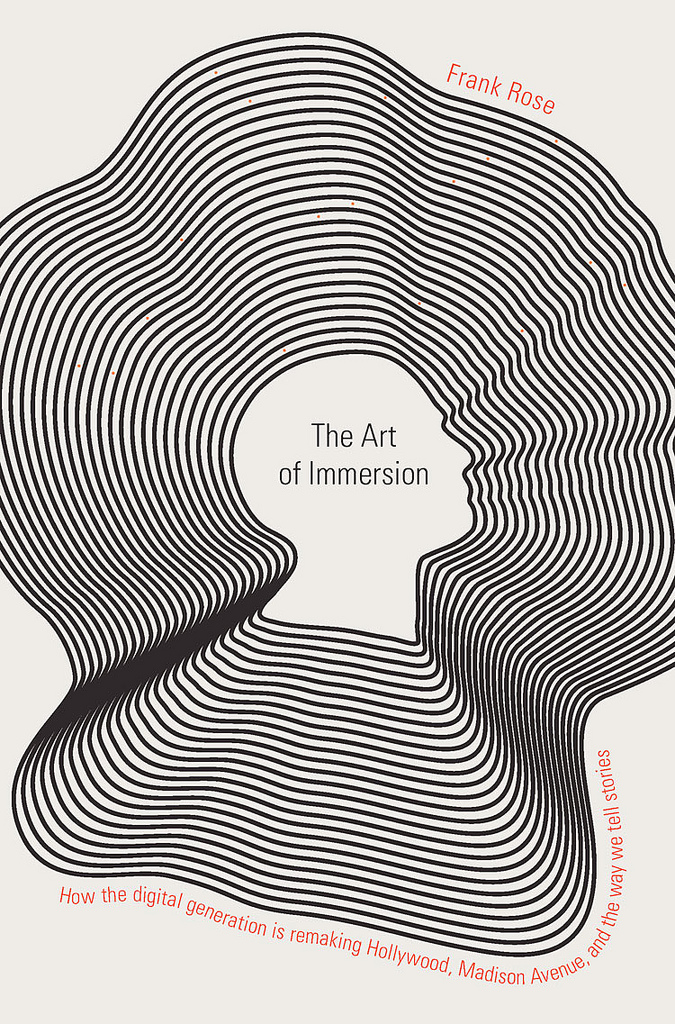
The nice folks at W.W. Norton were kind enough to give me a heads up about this beautiful new cover design by Jason Booher for The Art of Immersion by Frank Rose. Stunning stuff.
Be sure to check out W. W. Norton’s Book Design Archive on Flickr if you haven’t already.
Comments closed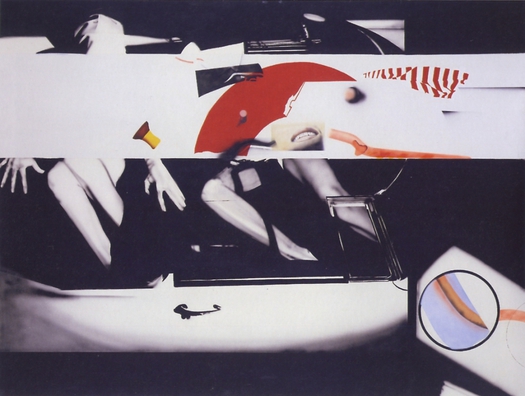
The Analytical Eye — Rick Poyner’s second essay for Design Observer on the visual interpretation of J.G. Ballard examines the work of French artist Peter Klasen:
What both Ballard and Klasen share… is a cold, appraising, analytical eye. It’s impossible to tell how they feel about what they show, or to know what they want us to feel, if anything at all. Their findings are disturbing and perhaps even repellent from a humanist perspective, yet the new aesthetic forms they use to embody them are, even today, exciting, provocative and tantalizingly difficult to resolve.
Any Colour — So Long As It Is Black — The WSJ profiles Massimo Vignelli:
“The greatest design has to provide a little pleasure,” he explained, producing the straightforward black bag he carries; Mr. Vignelli wears nothing but black. Proudly reporting that he’d bought the bag from a local street vendor, he pulled out a black Leica camera…, a pair of black Ray Bans and a tape measure—alas, bright yellow, not black.
“This is my dictionary,” Mr. Vignelli said of the tape measure. He explained that even as a child he had such fascination with the dimensions of things that he would challenge his friends to guess their size. He believes that subtleties of shape conjure emotion. “Is that three centimeters or four centimeters?”
All Forest, No Trees — David L. Ulin reviews The Information by James Gleick for The LA Times:
Over the course of human culture, there have been a number of significant transformations, beginning with the alphabet, which Gleick calls “a founding technology of information. The telephone, the fax machine, the calculator, and, ultimately, the computer are only the latest innovations devised for saving, manipulating, and communicating knowledge.” It is his idea that all these technologies exist as part of a continuum, with each developing from the last.
The key to such an argument is perspective, which is often in short supply when it comes to the information culture, with its tendency to inspire either paeans or jeremiads. Gleick, however, is too smart for that; he’s all about the forest, not the trees.
And finally…
Breaking Machines — Richard Conniff, author of The Species Seekers, on what the Luddites really fought against:
Comments closedDespite their modern reputation, the original Luddites were neither opposed to technology nor inept at using it. Many were highly skilled machine operators in the textile industry. Nor was the technology they attacked particularly new. Moreover, the idea of smashing machines as a form of industrial protest did not begin or end with them. In truth, the secret of their enduring reputation depends less on what they did than on the name under which they did it. You could say they were good at branding.

Charlotte Strick, art director at Faber & Faber, Farrar, Straus and Giroux and The Paris Review, writes about the book design process for The Atlantic:
Even though I frequently have designs for titles from the previous season still on my plate, and just when I think I can’t possibly come up with another original idea for a cover, the creative sparks begin to fly. At the launch meetings, editors take turns presenting recent acquisitions… As the books are introduced, each of us begins to wonder: Will I solve the problem with illustration or photography? If the title is brilliant and descriptive, maybe an all-type treatment that’s bold and clever is the best solution. (These are always my favorites.) Is there even any budget for art after the copy-editing fees, production costs, and author’s advances have been tallied? No? Never mind! We’ll get out our paintbrushes and dust off our cameras and get to work.
She is also interviewed by The Atlantic’s Daniel Fromson:
Everyone has an opinion on whether or not the book publishing world as we know it is doomed. Just as the design of websites was becoming more interesting and thoughtful by the late ’90s, it’s clear that the look and feel of e-books will transform over the next decade. As a designer who makes her living creating covers for actual books, I hope to take part in this. I don’t want our work to be reproduced exclusively in black and white or viewed only at postage stamp size.
(Pictured above: sketches by Chris Silas Neal for the cover of Poser: My Life in Twenty-Three Yoga Poses, by Claire Dederer, published by FSG)
Comments closed
Anthony Gottlieb writes on the renewed interest in 16th Century French essayist Michel de Montaigne for The New York Times:
Like Socrates, Montaigne claims that what he knows best is the fact that he does not know anything much. To undermine common beliefs and attitudes, Montaigne draws on tales of other times and places, on his own observations and on a barrage of arguments in the ancient Pyrrhonian skeptical tradition, which encouraged the suspension of judgment as a middle way between dogmatic assertion and equally dogmatic denial. Montaigne does often state his considered view, but rarely without suggesting, explicitly or otherwise, that maybe he is wrong. In this regard, his writing is far removed from that of the most popular bloggers and columnists, who are usually sure that they are right.
And, funnily enough, Sarah Bakewell author of How To Live: Or, A Life of Montaigne in One Question and Twenty Attempts at an Answer — one of the books mentioned by Gottlieb — recently spoke to Eleanor Wachtel about Montaigne for CBC Radio’s Writers & Company:
CBC RADIO WRITERS & Co. WITH SARAH BAKEWELL
The cover of the US edition of How To Live, published by Other Press, is by Mr. John Gall (pictured above). But you knew that already of course….
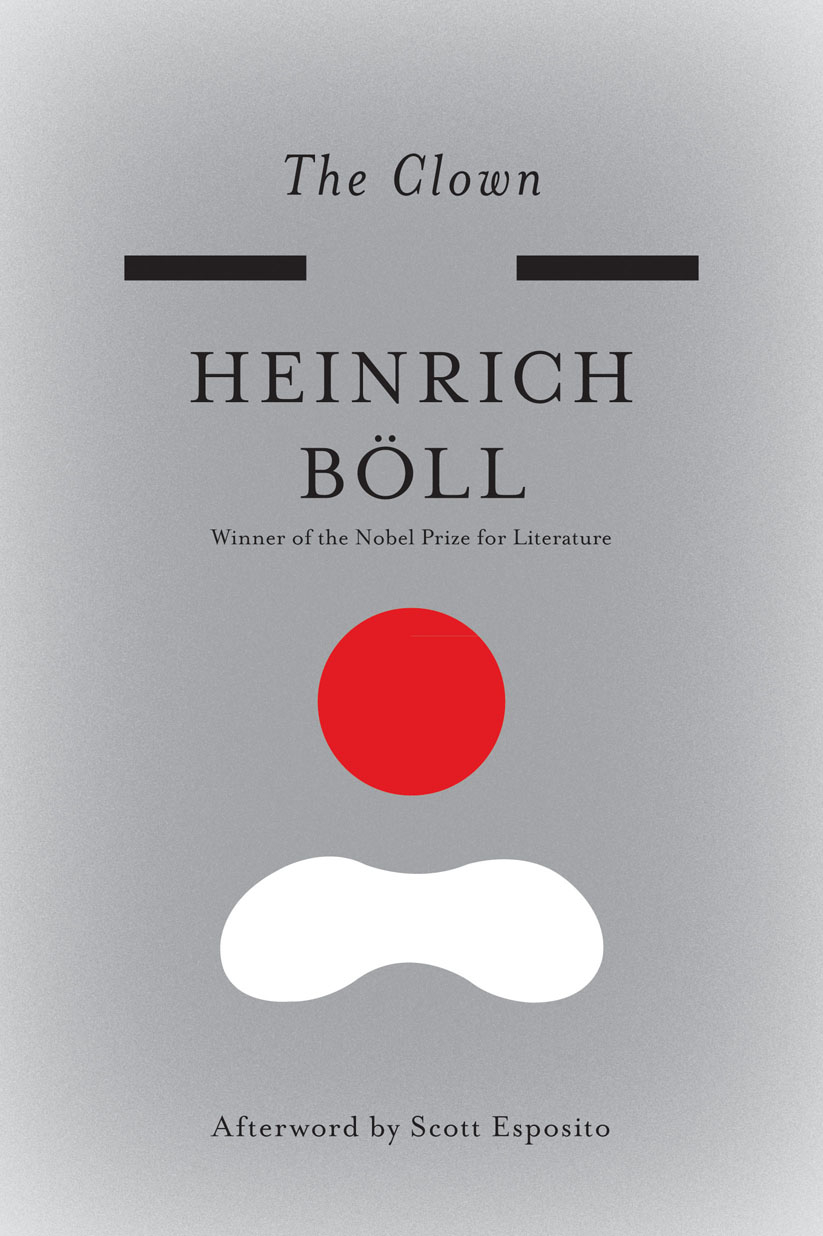
The Book Bench interviews designer Kelly Blair about her work and her Heinrich Böll redesigns for Melville House:
There are so many amazing and striking book covers out there, yet I am most often drawn to the simplest thing on the shelf. Perhaps it’s because I am so immersed in book design day-to-day, but sometimes going into the bookstore can feel visually overwhelming, like the cereal aisle at the grocery store. To that end, David Knopka’s series design for the Melville House novellas still stands as one of my favorites. For the same reason, walking into the Persephone book shop in London feels like a breath of fresh air.
And on the subject of book covers, I’ve been loving designer Andrew Henderson‘s Lovely Book Covers Tumblr.
You can find The Casual Optimist Tumblr here.
Cabaret — Author Hanif Kureishi on the art of writing for The Independent:
There’s no connection between being able to write and being able to explain your work in a rain-swept tent to an audience staring at you like hungry animals contemplating a suspect steak. Listening and reading are different experiences. Reading, writing for a reader, and being read, are intimate acts, and there’s something about trying to articulate what you’ve done that can flatten and reduce it, horrifyingly so.
Some writers choose the written word because they find it difficult to speak directly; many writers are in love with solitude. Whichever it is, good writing should resist interpretation, summary and the need for applause.
The Information — Michael Dirda reviews Too Much To Know: Managing Scholarly Information Before the Modern Age by Ann M. Blair for The Washington Post:
Just how to present information for easy use was a constant vexation. In late antiquity, one might simply find a list of authorities cited. Gradually, though, compilers began to employ categorical headings or to arrange entries alphabetically or according to elaborate branching diagrams of knowledge. “One historian has counted nineteen different systematic orders present in early modern encyclopedic works, including the order of creation, of the Decalogue, of the biblical narrative,” and various “chronological and geographical orders,” as well as others that follow “the chain of being.”
While people during the Middle Ages and later drew much of their learning from dictionaries and digests, the more ambitious also took extensive notes from whatever classics came their way. By the Renaissance one could even purchase the equivalent of “Reading for Dummies”: Francesco Sacchini’s 1614 “De ratione libros cum profectu legendi libellus,” i.e.,”A Little Book on How to Read With Profit.”
The Science of Making Decisions — Sharon Begley on how too much information impairs our ability to make decisions:
The problem has been creeping up on us for a long time. In the 17th century Leibniz bemoaned the “horrible mass of books which keeps on growing,” and in 1729 Alexander Pope warned of “a deluge of authors cover[ing] the land,” as James Gleick describes in his new book, The Information. But the consequences were thought to be emotional and psychological, chiefly anxiety about being unable to absorb even a small fraction of what’s out there. Indeed, the Oxford English Dictionary added “information fatigue” in 2009. But as information finds more ways to reach us, more often, more insistently than ever before, another consequence is becoming alarmingly clear: trying to drink from a firehose of information has harmful cognitive effects. And nowhere are those effects clearer, and more worrying, than in our ability to make smart, creative, successful decisions.
And related… Jonah Lehrer, contributing editor at Wired and the author of How We Decide and Proust Was a Neuroscientist, on why easy decisions seem so hard:
Comments closedThe problem, of course, is that the modern marketplace is a conspiracy to confuse, to trick the mind into believing that our most banal choices are actually extremely significant. Companies spend a fortune trying to convince us that only their toothpaste will clean our teeth, or that only their detergent will remove the stains from our clothes, or that every other cereal tastes like cardboard. And then there is the surreal abundance of the store shelf… While all these products are designed to cater to particular consumer niches, they end up duping the brain into believing that picking a floss is a high-stakes game, since it’s so damn hard. And so we get mired in decision-making quicksand.
Chip Kidd, book designer and associate art director at A.A. Knopf, profiled at Stodgy is Sexy:
Comments closed