Skip to content

Category: Books

Midweek Miscellany

Design Auteur — Steven Heller on Erik Nitsche for Print Magazine:

For some, book publishing was akin to the Internet of the sixties and seventies, a means of communicating information to large numbers in large volumes. In this milieu Nitsche practiced design auteurship before it was given a name, and the body of work he produced is extraordinary even by today’s standards. After moving to Geneva in the early 1960s Nitsche Founded ENI, S.A. (Erik Nitsche International) to produce some of the finest illustrated history books ever designed. The first series, a twelve volume The New Illustrated Library of Science and Invention, with a multilingual print run of over two million copies, covered the histories of communication, transport, photography, architecture, astronomy, and the machine, and flight… The second ENI series on the History of Music was even more ambitious — twenty volumes — that covered an expansive range of musical experience from composition to instrumentation, from classical to jazz.

Our Dreams of Ourselves — An interview with Alan Moore in The Independent:

Moore was always ahead of the times with respect to female fans – unlike much of the comics industry, – and was the creator of the revolutionary The Ballad of Halo Jones, a sci-fi strip to run alongside Judge Dredd in the UK comic 2000AD. First appearing in 1984, Halo was one of the first non-superhero women to headline her own series, at a time when most girls’ comics had folded.

“There wasn’t a single – I mean, I was annoyed – there wasn’t a single girls’ comic in Britain,” Moore remembers. “I thought, well if you do more stories that are aimed at women, you’ll get more women reading the comics. It would seem fairly simple and straightforward, but there was a lot of resistance [to the idea].”

Insane, Not Crazy — Chip Kidd, book designing Bat-thusiast, reviews The Joker: A Visual History of the Clown Prince of Crime by Daniel Wallace:

Created by artist Jerry Robinson and writer Bill Finger in 1940 for “Batman” issue #1—though Batman himself first appeared in “Detective Comics” #27 the previous year—the Joker, with his garish purple suit, ashen skin and emerald hair, was imagined as the maniacally taunting yang to Batman’s unrelentingly stern yin. Thus was born perhaps the single most classic pair of adversaries in comics history. Really, does it get any better than the Dark Knight Detective and the Harlequin of Hate matching wits and ultimately duking it out? I don’t think so.

Step by Step — Umberto Eco talks about his new book The Prague Cemetery at The Paris Review:

For me, the process of writing usually takes six years. In those years I collect material, I write, I rewrite. I am in a sort of a private world of myself with my characters. I don’t know what will happen. I discover it step by step. And I become very sad when the novel is finished because there is no more pleasure, no more surprise.

And finally…

Melvyn Bragg on John Steinbeck’s The Grapes of Wrath for The Guardian:

It was the bestselling book in America in 1939. A film version starring Henry Fonda and directed by John Ford followed, itself a classic. Arthur Miller wrote of Steinbeck, “I can’t think of another American writer, with the possible exception of Mark Twain, who so deeply penetrated the political life of the country.” And yet Steinbeck was also called “a liar”, “a communist” and “a Jew acting for Zionist-Communist interests”. The book was burned in the streets; it was banned in schools and libraries, with its explicit sexuality given as the excuse. It was virulently attacked in Congress, and Steinbeck’s subsequent success in Russia eroded his reputation from the cold war onwards. He bought himself a revolver for self-defence and had good reason to fear for his life. The book has sold about 14m copies and still sells steadily.

Comments closed

In the Cube: Michael Bierut and James Biber

In this video for Designers and Books, graphic designer and Pentagram partner Michael Bierut chats with architect James Biber about the books he selected for the site. The setting is the Rachel Whiteread-like library, or “book cube”, in Biber’s architectural office, located on the 2oth floor of Cass Gilbert’s Woolworth Building in downtown Manhattan:

The full, unabridged, 30-minute conversation can be seen here.

1 Comment

Design Matters with Brian Rea

In the latest Design Matters podcast, Debbie Millman interviews artist and illustrator Brian Rea. The former art director for the Op-Ed page of The New York Times, Rea recently illustrated three of Malcolm Gladwell’s most popular books for a new boxed-set, Malcolm Gladwell Collected, designed by Paul Sahre:

DESIGN MATTERS: Brian Rea mp3

Comments closed

Fictions | Peter Mendelsund

Knopf designer Peter Mendelsund has just posted the second of his meditations on designing book covers for fiction:

When setting out to design a book jacket for a work of fiction, whether we are aware of it or not, we designers are picking our subject matter from a limited set of bins. Though the choices we can make as designers are unlimited, the categories that define most of the choices we make when we pluck these ideas from their native fictions, are, on the face of it, quite easy to list.

Well worth reading all the way through, including the extensive footnotes.

Comments closed

The Title Design of Saul Bass (A Brief Visual History)

I’ve been waiting for a book about Saul Bass since I was bookseller. Now Saul Bass: A Life In Film & Design is finally in bookstores, Ian Albinson of the brilliant Art of the Title has put together a brief visual history of some of Bass’s most celebrated work:

(For the record: Saul Bass: A Life in Film & Design is published by Laurence King and distributed in Canada by my employer Raincoast Books)

Comments closed

Jay Rubin on Translating Murakami

In an interview for the New Yorker, Haruki Murakami’s longtime translator Jay Rubin talks about the work of the Japanese author (whose new book 1Q84 has just been published) and his own work as a translator:

New Yorker Outloud: Translating Murakami mp3

The New Yorker also published a Murakami short story, Town of Cats, translated by Rubin, in September.

Comments closed

Mendelsund on Lolita

Knopf book designer Peter Mendelsund has written a fascinating essay on cover design and Lolita by Vladimir Nabokov:

Book jackets these days, for reasons I won’t unpack, seem to revel, overtly, in wit, conceptual deviousness, unusual clever or droll juxtapositions — we, as a professional community, seem to have elevated the visual bon mot above all other virtues. Again, I won’t delve into the “why” of the matter here for want of space, but suffice it to say that clever work is the work that is celebrated in our community. Not that wit in itself isn’t valuable, and doesn’t have an appropriate place in design — but wit is not the same thing as insightfulness, and often insightfulness is what is called for in a book jacket. Our fetishizing of cleverness has taken a toll I believe, in that (quite often) these clever solutions work at cross-purposes to the (more often than not sincere) narratives they represent. A book in which an author has gone out on a considerable limb in order to write in a genuine and unaffected fashion does not want a cover that winks at the reader. Wit, when it becomes compulsive (as anyone knows who has a friend who puns too often) quickly becomes its opposite- dullness or predictability.

Peter says this is just the first in a series of posts about the process of “jacketing works of fiction”. One can only hope.

(pictured above: a proposed jacket for Nabokov’s Lolita by Emmanuel Polanco)

Comments closed

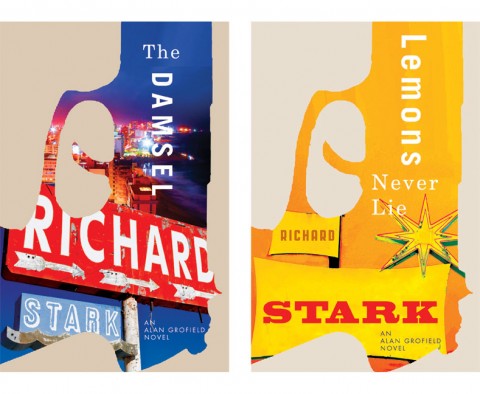
Stark’s Grofield Novels Designed by David Drummond

David Drummond designed the covers for the University of Chicago Press recent reissues of Richard Stark’s ‘Parker’ novels. Now David has designed great new covers for the reissues of Stark’s ‘Alan Grofield’ novels as well – The Dame, The Damsel, Blackbird and Lemons Never Lie.

I actually really like these earlier, slightly looser, alternatives as well:

David has written more about the design process on his blog, and you can read my interview with him here.

Comments closed

John Hodgman, The Deranged Millionaire

I don’t post book trailers here very often, but the video for John Hodgman’s new book That Is All is too funny to pass up:

Comments closed

C. S. Richardson | Quill and Quire

In the first of a new podcast series from Quill and Quire, web editor Sue Carter Flinn talks with C. S. Richardson, vice-president and creative director at Random House Canada, about his 30-year career in book design:

Quillcast: C. S. Richardson mp3

Comments closed

Rob Ryan: Beauty in the Everyday

London-based paper-cut artist Rob Ryan talks about his work and his recently released book A Sky Full of Kindness in this short film for to Etsy:

Comments closed

Ted Striphas on Algorithmic Culture

In this interview for CBC Radio show SparkTed Striphas, associate professor in the Department of Communication & Culture at Indiana University and author of The Late Age of Print, talks to Nora Young about algorithmic culture and the social implications of leaving discovery and serendipity to complex math:

CBC RADIO SPARK: Ted Striphas on Algorithmic Culture

Striphas has written a series of posts about algorithmic culture on his blog (also called The Late Age of Print funnily enough).

Comments closed