Skip to content

Category: Books

Midweek Miscellany

Accidental Effects — Rick Poynor on the street photography of designer Robert Brownjohn, at Design Observer:

Brownjohn tended to include enough of the setting to give a strong sense of the look and atmosphere of the place where he found the lettering or graffiti. The British capital’s dour post-war street texture was fascinating and meaningful to him. As an American and a recent arrival in London, he would have seen everything with the newcomer’s hungry and hypersensitive eye, whether the pictures were taken in a single day touring around town by taxi, as the story would have it, or in the course of several trips. Brownjohn shows the bricks, the stone, the doorways and window frames, the railings, the adjacent fixtures, the surrounding structure… [He] valued the accidental effects wrought by dilapidation, the elements, or human hands, in their own right, as a kind of visual music or poetry, irrespective of the formal design applications that these expressive details might go on to inspire.

Drowning in Film — Movie critic David Thomson, author most recently of The Big Screen, in conversation with Greil Marcus, at the LA Review of Books:

I have become more and more interested in the way different movies are like the water in a river. They’re constantly flowing into each other. Indeed, it’s a form that you can’t actually think of or describe as separate items. It’s the flow, it’s the sequence. And I think that we’re at a point in history where it’s not really as significant who makes what particular movies, it’s the constant flow. And like any flow of that kind, you say it’s like being carried down a river, and a lot of time perhaps you feel it’s on a sunny day and it’s very pleasant, but you can drown in a river. It seems that a lot of the culture, elements that I would hope to see maintained, are in danger of being drowned.

And finally…

Abnormal Activities — Patrick Ambrose interviews Iggy Pop for The Morning News:

Iggy Pop… obliterated the barrier between the artist and spectator. “I’m interested in being able to do that while maintaining the formality of the dinner engagement,” he says with a hearty laugh. “There has been a tremendous change in the cybernetics of rock and roll over the past 50 years. If you look back to the mid- to late-’50s, you’ve got maybe Elvis or Eddie Cochran playing on a flat-bed truck in a gas station parking lot with presumably 1,200 doomed teenagers dancing, chewing gum and knifing each other while religious leaders burn records and make racial slurs about the music. Now, you’ve got thousands of people obediently shuffling into these concrete civic centers to sponge up something in places where nothing really happens.”

Comments closed

Something for the Weekend

In Search of Lost Time — Jimmy Stamp on Chris Ware’s Building Stories, at Design Decoded:

If there’s a central theme to Building Stories, it is the passing of time – and our futile struggle against it. The comic book is the perfect medium to explore this idea. After all, what is a comic but sequential, narrative art? Unlike a photograph, a comic panel does not typically show a single moment in time but is, rather, a visual representation of duration. That duration might be the time it takes Superman to punch out a giant robot, the seconds that pass while a failed artist chops a carrot, or the years it takes for a single seed to travel around the world. In every comic book, time passes within the panel. More noticeably though, time passes between the panels. This is where the art of storytelling comes in. There are no rules in comics that standardize the duration of a panel or a sequence of panels. In Building Stories, sometimes milliseconds pass between panels, sometimes entire seasons, and sometimes even centuries can expire with the turn of the page.

See also: Mike Doherty interviews Chris Ware for the National Post.

Nuts — Jon Ronson, author of The Psychopath Test, interviewed at The Awl:

the stuff I was gravitating towards at the beginning was people who lived on the fringes of society and funny, absurd stories about the kind of crazy things that see us through. You know, belief systems that seemed kind of completely irrational to me. And I’ve got to admit, at the time, in my early 20s, I probably thought I was better than them. They were kind of nuts and I was, you know, sane and rational. But the older I get, the less I feel that. Now I feel completely on a par of irrationality with them.

And finally…

Cents — Damon Krukowski of Galaxie 500 and Damon & Naomi on musicians and streaming music services, at Pitchfork:

the sale of recorded music has become irrelevant to the dominant business models I have to contend with as a working musician. Indeed, music itself seems to be irrelevant to these businesses– it is just another form of information, the same as any other that might entice us to click a link or a buy button on a stock exchange.

As businesses, Pandora and Spotify are divorced from music. To me, it’s a short logical step to observe that they are doing nothing for the business of music — except undermining the simple cottage industry of pressing ideas onto vinyl, and selling them for more than they cost to manufacture.

Comments closed

Midweek Miscellany

Look Closer — Adrian Tomine talks about moving to New York, and his new book of drawings with The New Yorker:

I’m not one of those artists with an incredible imagination who can just make things up out of nothing, and I’m not the kind of person who would throw himself into some exciting or dangerous situation just to get material. So I tend to go about my normal, boring life, and just try to look at things a little more closely. And even though I’ve lived in New York for eight years now, I still feel like a recent transplant, and I think that’s a big influence on how I see and draw the city.

Invisible — Jeanette Winterson on Tove Jansson and the Moomins, for The Telegraph:

I keep the Moomin books in my study and if I am tinkering about preparing for work I will often open one at random and read a page – they are funny and subversive, (Hemulens of either gender only wear dresses). And playful. Whatever happened to playfulness? Why, as adults, is serious/superficial the boring binary of our lives?… Tove Jansson believed in happy endings… Not the Disney kind but more solid and ambiguous, which is a paradox, but more truthful than black-and-white solutions. Ever-after is what is invisible on the next page.

Approaching Zero — Michael Faber reviews How Music Works by David Byrne, for The Guardian:

Everyone knows that the music industry is in terminal decline. Unlike many doomsayers, however, Byrne feels the changed landscape is good for musicians. Even 20 years ago, any artist wishing to make a record needed a huge sum of money to pay for studio time (and thus needed a large corporation to loan it to him). A lucky few shifted the millions of units necessary to repay the industry’s investment, but the majority got hopelessly into debt. Nowadays, recording costs are “approaching zero”. Distribution costs in the digital era are also negligible compared to the days of physical warehousing. As long as artists can find ways of holding on to a fair percentage of their income (an impossible challenge in the heyday of the record companies), even modest sales can sustain a career. Indeed, says Byrne, “there have never been more opportunities for a musician to reach an audience.”

And finally…

A Short Lesson in Perspective — A fantastic essay by Linds Redding. First published in March of this year, this seems to have taken on a life of its own. If you work in a ‘creative industry’ and haven’t read it yet, make sure you read the whole thing:

The compulsion to create is unstoppable. It’s a need that has to be filled. I’ve barely ‘worked’ in any meaningful way for half a year, but every day I find myself driven to ‘make’ something. Take photographs. Draw. Write. Make bad music. It’s just an itch than needs to be scratched. Apart from the occasional severed ear or descent into fecal-eating dementia the creative impulse is mostly little more than a quaint eccentricity. But introduce this mostly benign neurosis into a commercial context.. well that way, my friends lies misery and madness.


Comments closed

Lip Service

The most recent cover of Playboy is, as some have been quick to point out, reminiscent of John Gall’s original cover design for the Vintage edition of Lolita by Vladimir Nabokov, reissued in 2005. John’s design is more subtle than the Playboy cover and more effective for it (but then Lolita is not Playboy after all):

Were Playboy inspired by the book cover? It seems unlikely. The image in John’s design was actually rotated for the final cover and looks quite different:

If I remember correctly the change was made because original orientation was too suggestive. For Lolita. (Just think about that for a minute.)

Is it also seems unlikely that they were inspired by Georgia O’Keeffe (Black Iris III pictured above) although there are some obvious similarities. Has anyone used O’Keeffe for the cover of Lolita?

Interestingly, the cover for the current Penguin edition of Lolita uses a similar colour palette to the Vintage edition and (to a lesser extent Playboy). The head is upright in this version as well. The vertical line of the nose is broken the horizontal features of the eyes and mouth, as well as by the title. Disconcertingly, the photograph and the round sans-serif font are suggestive of a YA novel. Perhaps that unsettling thought is the desired effect?

John’s design for Vintage replaced an earlier photographic cover by Megan Wilson which took an altogether different approach,  placing the book firmly in a historical context. It’s interesting, however, that John’s unused design echoes the crooked vertical line created by the legs in Wilson’s image:

While maintaining a vertical line, David Gee’s unpublished cover cuts to the chase in a far more clinical fashion…*

Inadvertently referencing spatialist painter Lucio Fontana

And one cannot talk about vertical lines and vaginas without mentioning Barnett Newman and his infamous “zip”. Or at least I can’t. But surely Mr Newman wasn’t thinking smutty thoughts was he?

Somehow I doubt Playboy was influenced by either Fontana or Newman. However, here is a 2003 poster for the Vagina Monologues designed by Chermayeff & Geismar that pre-dates both Playboy and Gall. The message is different, I think, but the photograph is clearly being used in a similar way. I’m sorry I don’t have a better image:

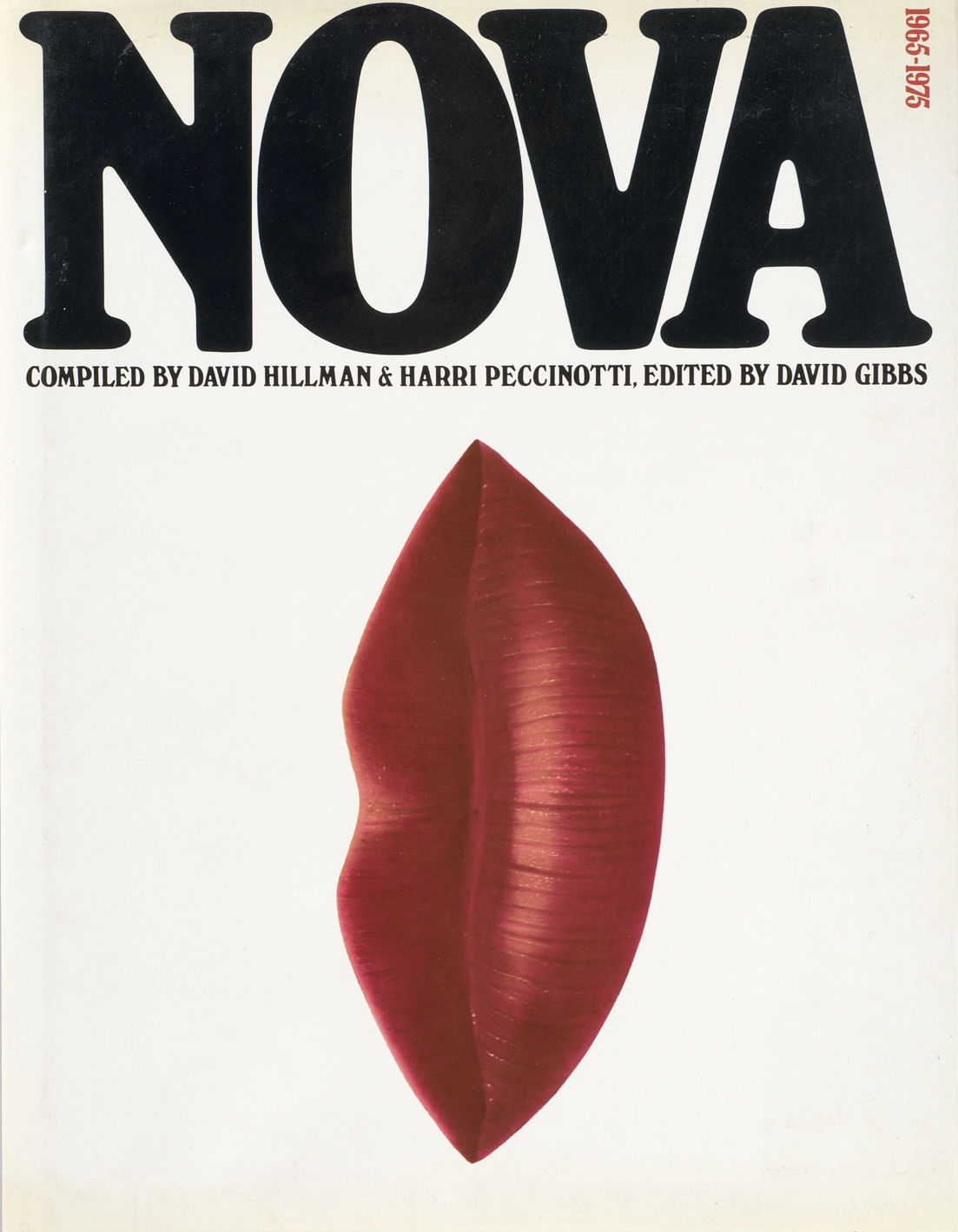
And finally, here is the cover of Nova 1965-1975, which utilizes an original cover from the innovative women’s magazine where Harry Peccinotti was art director. Is this the design that started it all?

*You can see many (many) more Lolita book covers here, and read Print magazine’s article ‘Recovering Lolita’ about John Bertram’s cover competition, here. The mighty Peter Mendelsund also weighs in on covering Nabokov here.

Comments closed

Meeting John Berger

A beautifully shot portrait of English art critic, writer, artist and philosopher John Berger by filmmaker Jos de Putter:

Berger is probably best known for his BBC TV series and book, Ways of Seeing.

3 Comments

Something for the Weekend

Comics Without Borders — a long interview with cartoonist Joost Swarte at The Comics Journal:

In the graphic field of comics I was inspired by Will Eisner’s Spirit. If I see these title pages, the constructions in his title pages, and what he does with the lettering, that was very interesting. And then another thing is, I love the older comics like Little Nemo and Lyonel Feininger. And I was interested also, because I studied industrial design… about the Dada people in Holland and Germany, and Bauhaus architecture and design world, in which there are almost no borders. I mean, people do whatever they like. Then you have the older artists like Tatlin. They designed their own clothes, they do architecture, they do flying machines, they do painting, they do everything. I mean, it was always nice to know that if you want to do different things, that you’re not standing alone. That somebody else did it, and they survived.

Losing Their Grip — Peter Aspen reviews three new books on cinema — The Big Screen by David Thomson, Do the Movies Have a Future? by David Denby, and Film After Film by J Hoberman — for the FT:

It is one of the most famous one-liners in the history of cinema, which also turned out to be an inadvertent prophecy. “I am big,” says the slighted Norma Desmond in Sunset Boulevard (1950). “It’s the pictures that got small.”

She had no idea. The past half-century has seen the pictures get smaller and smaller, to the point that we wonder if they can ever be big again. From television screen, to laptop, to smartphone, the ever-shrinking movies reach a greater part of the world than ever before. But what have we lost along the way?

Holberman’s book is given more in-depth consideration at the LA Review of Books.

And finally…

In the shit — book shopping with Michael Dirda at The Paris Review:

So this is how a man acquires 10,000-odd books, more than he could ever display or read. It’s a combination of maniacal persistence and utter nostalgic whimsy. You have to be willing to search high and low for a potential beauty, but most of the time you’ll take a Book Club hardcover of a book you don’t like if it reminds you of something from your past.

As if to illustrate the point, Dirda found a mass-market paperback of Black Alice, by Thomas Disch and John Sladek. Dirda was a friend of Disch until the sci-fi author killed himself in 2008. “He was a wonderfully cynical man,” Dirda said. “I have a first edition of this but I’ll get it anyway.”


Comments closed

Midweek Miscellany

Designer Jon Gray (AKA Gray318) has launched a new website.

Jon has also been interviewed by We Love This Book:

A book cover only becomes iconic because the book that it covers becomes iconic. The cover is just a face for the content. I have been lucky to work on some really great books and have benefitted from their success. People often assume that by copying the cover of a successful book it will help their book sell, and are always surprised when it doesn’t work. It always has to start with the content.

The Browser — Author Anthony Daniels on the digital challenges faced by books, at The New Criterion:

An intellectual might be defined as someone who elaborates justifications for his own tastes and preferences, as metaphysics was once defined as the finding of bad reasons for what we all believe on instinct. And so the reader of books soon finds reasons for the supposed superiority of the printed page over the screen of the electronic device: for nothing stimulates the brain quite like the need for rationalization. The dullest of minds, I have found, works at the speed of light when a rationalization is needed…

Whether the book survives or not, I am firmly of the opinion that it ought to survive, and nothing will convince me otherwise. The heart has its beliefs that evidence knows not of. For me, to browse in a bookshop, especially a second-hand one, will forever be superior to browsing on the internet precisely because chance plays a much larger part in it. There are few greater delights than entirely by chance to come across something not only fascinating in itself, but that establishes a quite unexpected connection with something else. The imagination is stimulated in a way that the more logical connections of the Internet cannot match; the Internet will make people literal-minded.

And finally…

As am I, as am I — Edward Docx on the Sherlock Holmes ‘pilgrims’ and a re-enactment of The Final Problem organised by The Sherlock Holmes Society of London:

I have come to like the pilgrims a good deal. They’re warm-hearted, engaging and amusing people, which is more than can be said for the moped brethren. There are many from the legal profession—Moriarty is a practising barrister; Cardinal Tosca and Queen Victoria (who are married) are retired from the bar. Sherlock Holmes, I learn, is an ex-head teacher—and is (disconcertingly) married to Mrs Hudson. Watson works for Lloyd’s of London. The strangest and most impressive folk are those who have come the furthest—not least the two ladies from the aforementioned Japan Sherlock Holmes Club (founded in 1977; about 1000 members), who do not, I think, speak English and who are posing as “Baritsu Assistants”—this being some kind of martial art that Holmes knew and that saved  him in his struggle with Moriarty on the falls. There are also policemen, toxicologists, bookmakers, engineers, historians, and many who—nobly—refuse to admit to any other existence save that of their character. If these people have anything in common, beyond the obvious, it is that they are all comfortable with a very elastic sense of reality… As am I, as am I.

Comments closed

Cruel Britannia

An astonishing short film for what looks to be a very important book:

Ian Cobain’s exposure of Britain’s secret history of torture Cruel Britannia is published by Portobello Books. The starkly brilliant cover (on which the video is based) was designed by FUEL.

Comments closed

Building Stories

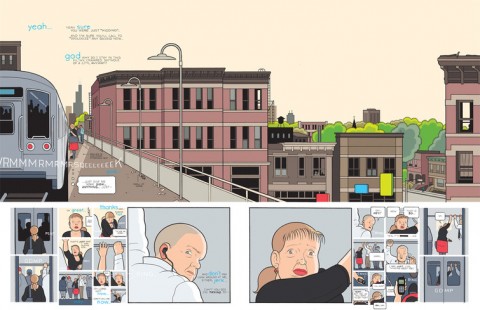
Cartoonist Chris Ware has rightly been garnering a lot of attention for his new ‘graphic novel’ Building Stories14 books, booklets, magazines, newspapers and pamphlets that collect a decade of comics from The New Yorker, The New York Times and McSweeney’s, as well as previously unpublished work.

Douglas Wolk, author of Reading Comics, reviews the book for The New York Times:

You will never be able to read “Building Stories” on a digital tablet, by design. It is a physical object, printed on wood pulp, darn it. It’s a big, sturdy box, containing 14 different “easily misplaced elements” — a hard-bound volume or two, pamphlets and leaflets of various dimensions, a monstrously huge tabloid à la century-old Sunday newspaper comics sections and a folded board of the sort that might once have come with a fancy game. In which order should one read them? Whatever, Ware shrugs, uncharacteristically relinquishing his customary absolute control. In the world of “Building Stories,” linearity leads only to decay and death.

Comics historian Jeet Heer is as insightful as always for a somewhat undeserving Globe and Mail:

This marriage of comics and architecture might sound surprising, but it has a long history, which Ware, deeply knowledgeable about the past, knows well. The modern skyscraper emerged at the same time as modern narrative cartooning, in the middle of the 19th century, although both forms had prehistories that extend further into the past. The classic Sunday newspaper comic strip, with many panels on the page laid out on a grid, has obvious parallels with tall many-windowed office buildings, a fact that pioneering cartoonists like Winsor McCay played with when they drew stories that used the New York skyline not just as a backdrop but as a virtual character. The drawing board of a cartoonist is not unlike the drafting table of an architect. And in both drawing comics and imagining homes, you work with grids, rectangles and cubes and need to have mastered perspective.

And Rick Moody, author of The Ice Storm, gets terribly excited at Salon:

Building Stories is a masterpiece, above all, because it cares about human beings, many of them women. It cares enough to observe human beings closely, both when they are behaving themselves, and when they are engaging in their manifold selfishnesses. It cares enough about them to depict them when they are attractive and when they are singularly unattractive. The contemporary novel, it bears mentioning, does not care this much, because the contemporary novel is so preoccupied with affirmation that it will not risk what Ware is willing to risk.

Other reviews include David L. Ulin for The LA Times, Glen Weldon for NPR, Ian McGillis for the Montreal Gazette, and Rachel Cooke in The Guardian.

The Guardian and New York Magazine also have short interviews with Ware, but there also several excellent longer ones.

At Publishers Weekly, Ware speaks to Calvin Reid:

the idea behind the book is to try to get at the way we remember things, the way we put our lives together in our memories and kind of rewrite our own memories sometimes to suit ourselves. Also to get at a sense of how when you are remembering something that’s happened to you, sometimes you can almost lose yourself in that memory to the point where you lose the sense of the world around you, maybe just for a few seconds or something like that. I had hoped that with this book, that if say you start reading one story and interpret it as the present and then move on to another part of the book and realize that it wasn’t actually the present you were reading about, it was actually the character’s past, that that that might get at a little tiny bit of that feeling. I mean, every book is about a story happening from beginning to end and somebody changing as the story goes on but I wanted to try to create something that is maybe a little more analogous to the way that it feels in my brain, which is maybe a little more three dimensional and uncertain than that…

At the The LA Review of Books, Casey Burchby:

I don’t draft or script; the drawings and stories form themselves out of the images and what they suggest as I draw them, along with the memories they might dredge up. There’s really no way I could plan these things; the connections and coincidences that occur have to happen on the page. I’ve noticed that there’s a sort of nervousness on the part of the reader as to when exactly it is that the writer or artist starts winging it, as if that information has to be taken into account when assessing whether a story is believable or not, but it seems to me that writing an outline or a script on typing paper is just as much winging it as drawing directly on the page, and the latter approach allows the composition and scale to structure and shape the story, as well – which only taking notes or making thumbnails does not do. I do erase. I also have general ideas, themes, notions — whatever you want to call them, but I think that scripts come too perilously close to turning the process into illustrating words, which overlooks the inherent power of what cartooning — essentially a key to visual memory via the structure of language — can be.
And at The New Statesman, Alex Hearn:

I’m simply trying to present life as I’ve experienced it, though admittedly in my own very shielded, first-world way. My characters suffer very little compared to someone who might’ve seen their parents killed in a genocide, or endured starvation or disaster. I don’t know why some readers or viewers don’t find it more depressing that most popular books and movies and television programs can’t seem to not be about murderers or rapists or psychopaths — as if a story simply isn’t interesting unless someone is brutally threatened or killed. Violence is always the cheapest shortcut to emotional involvement.

And finally, Debbie Millman chats with Ware for the design podcast Design Matters:

Design Matters: Chris Ware mp3

Comments closed

Midweek Miscellany

A fantastic new cover for the Vintage (UK) edition of Gravity’s Rainbow by Thomas Pynchon, designed by Matt Broughton (via the Vintage Books design Tumblr CMYK)

CTRL+C; CTRL+P — Music critic Simon Reynolds, author of Retromania, on remix culture and ‘recreativity’ at Slate:

Recreativity has many proponents and represents a wide spectrum of opinion. Still, it’s striking how easily some of these critics and theorists glide from relatively sensible talk about the role of appropriation and allusion in art to sweeping claims of an ontological or biological nature. They seem so confident. How they can be certain that nobody has ever just come up with some totally new idea, ex nihilo? The remixed nature of everything (not new) under the sun has become an article of faith. Impossible to prove, these assertions tell us way more about our current horizons of thought and our cultural predicament than they do about the nature of creativity or the history of art.

The A.V. Club list their 50 best films of the ’90s. (Their list of their most-hated movies is here).

Picture This — Cartoonist Adrian Tomine discusses his work and his new book New York Drawings with the The Paris Review:

If you were to go back in time and talk to the people who invented cartooning, and were doing it for newspapers, and told them that there were going to be guys who were going to do twenty-four-page long stories, they would think that was a strange use of the medium. And if you then said, they’re going to try and inject that with a singular vision and personal experience and do six-hundred-page long stories—I mean, their heads would have exploded.

See also: Adrian on his first cover for The New Yorker at the The Thought Fox, the blog of his UK publisher Faber & Faber.

And Finally…

Speaking of The Paris Review, an interview with editor Lorin Stein at the LA Review of Books:

The tradition of discovering new writers makes it easy to go out and find stuff that excites me, and at the same time feels of a piece with the history… To me it’s like that line in the great Italian novel, Lampedusa’s The Leopard. If you want things to stay the same, everything’s going to have to change. Nowadays we have to exist in the digital world if we don’t want to be strictly of the digital world.

2 Comments

50 Memorable Covers From the Last Four Years

The Casual Optimist turned 4 years old at the end of last week. While not exactly a historic achievement, the blog has lasted the length of a presidency and exactly 3 years, 11 months longer than I thought it would. In order to celebrate this minor triumph, I thought I would post some memorable book covers from the last 4 years. It was going to be 10 covers, then it was 20… It quickly became 25, then it was 30… by 30 I figured I might as well do 40… I missed 40 and had to cap it at 50. It was just for fun and not meant to be a definitive survey — it’s just 50 covers that have stuck in my mind. Let me know what you would’ve included in the comments. Leave a comment or send me an email if I am missing details or have incorrectly attributed something.

The keen-eyed among you will also notice that there are no covers from 2012. I’m keeping my powder dry. You can expect a post of my favourite covers of the year in the not too distant future. You can let me know your picks for 2012 in the comments as well. In the meantime, I’m going on vacation so this will be my last post for a while.

So here you go — 50 great covers with some occasional notes. Enjoy…

13 Comments

Midweek Miscellany

A design collaboration between Paul Buckley and Jessica Hische, Penguin Drop Caps is  a 26-book series of hardcover classics. The first six books go on sale November 27th. See the covers at Imprint.

Plumbing — An interview with book designer John Gall at The Believer:

A cover is a structural part of the book. It protects the pages. It provide the first impression of the content. It’s an eye-catching device – maybe the book’s only means of advertising. It can even add to the editorial content of the book; you can kill bugs with it.  Then, after you buy the book, the cover takes on another function. It’s your visual connection to the book as you develop a relationship with the material. It can also communicate to others who you are. I’m one of those people, who when I visit someone, I snoop around and see what’s on their bookshelves. I’m not doing this to judge them, but to find some common interest, a connection to that person.

There is also this great anecdote about Tom McCarthy and the cover for Remainder:

We did a photo shoot for his cover so it appeared that the book was being slowly immersed into blue liquid. We had to create a somewhat elaborate setup to get it just right. We sent the author a photo of the studio setup as a souvenir, showing the tripods and lights and water tanks. A year later he wrote back saying he had an argument with some artist friends of his over dinner. They were looking at the studio-set photo and were insisting that it was all a fake setup and that the cover was executed in Photoshop; that the photo shoot was all staged to provide “proof,” like a fake moon landing!

My Q & A with John is here.

Graveyard Stillness — Andrew Beckett reviews Unknown Pleasures by Joy Division bassist Peter Hook for The Guardian:

Joy Division, for all the graveyard stillness of their record sleeves, were participants in a frenetic golden age for British pop, which had begun with punk in 1976 and would peak, commercially at least, with the British dominance of the American charts in 1983. Groups grew up fast and seized their moment, or disappeared. Yet Joy Division did not earn enough from their feverish touring and recording to give up their day jobs. Hook worked in the offices of the Manchester Ship Canal Company, Curtis at an employment exchange, and Sumner for a film company where his “job was to colour in Danger Mouse”.

And finally…

The Fight Against Loss — A lovely essay by Simon Schama on why he writes:

Orwell’s four motives for writing still seem to me the most honest account of why long-form non-fiction writers do what they do, with “sheer egoism” at the top; next, “aesthetic enthusiasm” – the pleasure principle or sheer relish of sonority (“pleasure in the impact of one sound on another”); third, the “historical impulse” (the “desire to see things as they are”), and, finally, “political purpose”: the urge to persuade, a communiqué from our convictions.

To that list I would add that writing has always seemed to me a fight against loss, an instinct for replay; a resistance to the attrition of memory.


Comments closed