Skip to content

Category: Design

Q & A with Clare Skeats

Hugo Wilcken’s Colony (published in 2007 and mentioned previously here) is almost certainly the novel I’ve talked up most this year. The cover, something like a jaunty vintage travel poster to a malarial Heart of Darkness (nauseously appropriate for a postmodern novel about a French penal colony), was designed by London-based print designer Clare Skeats.

Specializing in book design and art direction, Clare has a a great eye for partnering distinctive typography with bold creative imagery. Her covers often seem to use elements from the past, but always feel dynamically contemporary.

I’m really happy to have had the opportunity talk to Clare about her work. We corresponded by email.

How did you get into book design?

After graduating in 97, I tried, and failed to get a job as a junior designer at Penguin. They did offer me work experience though — so I moved to London to do that, and basically never left.

Have you always run your own studio? Where were you previously?

No. I stayed at Penguin for 4 years (they did eventually employ me!), then during a brief period at Random House, an opportunity arose to work for UK clothing designer Margaret Howell. It was great to step away from books for a bit and be part of a completely different industry. I was involved in virtually all aspects of the company; from designing Fashion Week press invites to drawing up manufacturing specification manuals. During my time there I was also working freelance — so after two very busy years, I left Margaret Howell to become full-time freelance, which is where I am now.

Could you describe your design process?

I’m lucky in that a lot of my clients allow me to just read and then make all the suggestions. I work in a number of ways; completely independently, or collaboratively with an illustrator or photographer. If I decide that illustration is the most appropriate response, I spend time identifying the right style and finding relevant practitioners. I’ve worked with Kazuko Nomoto (aka Nomoco) a great deal, and I found her initially as I had Andy Warhol’s Vogue illustrations in my head for Lolita. I’ll suggest say 3 or 4 illustrators to the client, along with a rough idea of the brief and composition. I then refine the brief and collaborate with the chosen illustrator.

Whether I’m working on my own, or collaboratively, I spend a lot of time researching — it’s a process I’ve always loved. For Somebody to Love I had to research embalming as the book is about a transsexual mortician who falls in love with one of her, um… clients. I wanted the cover to reflect the surgical and beautifying themes so I started to research embalming tools which lead me to those 18th-Century engravings of surgical instruments. Also used to great effect on this Simian Mobile Disco record cover designed by Kate Moross:

I needed to commission illustrations of modern instruments but retain the engraving reference and I initially proposed a wood engraver to the client, but the idea scared them. So I had to find a vector illustrator who could approximate an engraving style. I found Fred van Deelen who did a brilliant job. What I loved about Kate’s record cover was the way the central black circle (or maybe its a die-cut?) was working as a device to hold the type. So I shamelessly adapted it to my own needs for my cover.

When I started working on Potty!, I read the author’s autobiography which lead to a fun afternoon poking around the posh country outfitters shops of St. James and Saville Row — I took lots of photos and produced a mood board which helped me to get the sample spreads and art direction approved. I teach on the foundation course at Central St Martins and I’m always banging on about research — mostly because I can’t understand why a student wouldn’t want to do it!

My client for Potty!, wanted an illustrative component to the design and I was wary at first as I think illustration can often look like a whimsical add-on in some cookbooks, which wouldn’t be appropriate at all with Clarissa. The book is about one pot cookery so I decided to make the pots the stars and commissioned scraper-board maestro Joe McLaren to produce them — there are 24 in total and this is my absolute favourite:

Do you prefer to use unconventional typography and hand-drawn lettering than more classic typefaces?

Not particularly — the enjoyment comes from finding the right type style for the job, and that could be making lettering out of cake decorations, or typesetting a whole book — each offers their own sense of fulfillment. Working with the wildly varying content of books offers wonderful opportunities to work with typefaces that wouldn’t normally get considered for most commercial print jobs. I hate snobbery in design — if Dom Casual is right for a job, go with it!

Do you ever create the type or letters yourself ?

I wouldn’t have the confidence to create digital type from scratch, its such a skill in itself — adapting existing fonts is about as far as I go. I’ve hand-drawn lettering quite a bit though — I like to use a dip pen and drawing ink which creates a really nice line. I used this for Lolita, Tom Bedlam and Just in Case, to name a few. Another Meg Rossoff cover I had rejected features lettering that I drew on damp paper to create a cloud-like effect when reversed-out of the sky.

I can’t walk past an art supply shop. The ‘STEINBECK’ stamp in Of Mice and Men comes courtesy of something called Fabfoam, which you’ll find next to the sequins and glitter in the ‘hobby craft’ section.

How do you approach designing a series of covers?

Find the longest combination of title and author, and then work backwards from there! If your design can accommodate One Day in the Life of Ivan Denisovich by Alexander Solzhenitsyn then you know you’re on to a good thing. I think a successful series style has enough consistency and rigour to be easily recognised but has enough flexibility within it to future-proof against unforeseen issues. If there are too many variables within a series style, it lacks identity — and if there are not enough, it looks dry and undynamic. The nice thing about designing the Vintage Classics series design was that I knew the images would be really diverse so I could make the rest of the cover quite restrained and structured.

What are your favourite books to work on?

Its always a thrill to get asked to do a classic. I did Animal Farm very early in my career at Penguin and I’ve always regarded it as a huge privilege — especially as I was so junior at the time. I recently had to re-do the artwork to fit the new Modern Classics grid, so I’m really honoured that it survived a series re-design!

I also like first-time authors (as there’s no baggage), and books about really odd subjects: invisible dogs, menopause, suicide, unicorns … bring it on. I’d like to do more books for young adults, but they usually get rejected!

What are the most challenging?

Without a doubt, it’s the BIG book. The one the publisher has paid huge sums for at Frankfurt as it’s ‘going to be the next … (insert name here)’. The amount of emphasis placed on the role that the jacket is expected to perform is enormous and yet if the book becomes a bestseller its widely regarded as being down to good writing and good reviews. But if it fails, its regarded as being the fault of the jacket. Its this widely-held belief that allows high street booksellers and supermarkets to assert so much influence on the design — so what should be an exciting job can turn into a fairly unrewarding experience for the designer.

Do you prefer working with illustrators or photographers? Or does it depend on the project?

I do enjoy the camaraderie on shoots — the Potty! shoot was great fun — but publishing cover budgets are usually such a feeble match for photographer’s fees that I find I’m constantly looking at ways to cut costs which just becomes a bit boring after a while. The preponderance of headless women on book covers is testament to the fact that there’s rarely budget for a model, hair or make-up. And yet, interestingly, the expectation from the publisher for a Merchant Ivory film still remains pretty high — even if the budget doesn’t.

I love the spontaneity of working with an illustrator — of making the most of their skills and seeing how they interpret a brief. When I saw the physical object that I commissioned from Helen Musselwhite on The Still Point, I gasped (in a good way)! Being able to hand-pick such talented people to work with is a huge privilege — it’s a part of my job that I will always love.

Do you see any recent trends in British book design?

Yes, I think production specs (particularly on hardbacks), have been steadily increasing in a bid to get the public excited about the physical objects again, so we’ve had a glut of cloth-and-foil, sprayed edges etc. There’s been a lot of patterns and a return to traditional typographic sensibilities, and a rediscovery of our British design heritage. Mid-century modern references are still enjoying a bit of a moment…

Where do you look for inspiration and who are some of your design heroes?

My earliest design hero was Charles Schultz. I was obsessed with Peanuts when I was a kid and copied the way that the characters wrote — I loved the way their handwriting appeared above their heads, I thought it was genius!

I was also a huge Roald Dahl fan and consequently grew up with the scratchy inky gorgeousness of Quentin Blake‘s illustrations.

No surprises here, but I greatly admire the work of designers like Saul Bass, Abram Games, Alan Fletcher, Alvin Lustig and Paul Rand — the wit and brevity of their work is so impressive. Slightly more decorative demi-gods include Eric Ravillious, Edward Bawden and Osbert Lancaster. Sorry for the lack of anyone female — or indeed, alive.

What does the future hold for book cover design?

Hopefully the impact of ebooks will be a positive; there’s a lot of books out there that really don’t deserve to see a printing press.

Thanks Clare!

4 Comments
Michael Bierut on Typography

In this 2008 interview with The Atlantic, Michael Bierut, author of 79 Short Essays on Design*, talks about typography, Stanley Kubrick’s favorite font and the cover design of The Catcher in the Rye:

(via Design Observer)

*79 Short Essays on Design is distributed in Canada by my employer Raincoast Books.

Comments closed

Field Notes: Wings

A short documentary by Coudal Partners about the production of the new limited edition Field Notes notebook Raven’s Wing:

Comments closed

Daddy

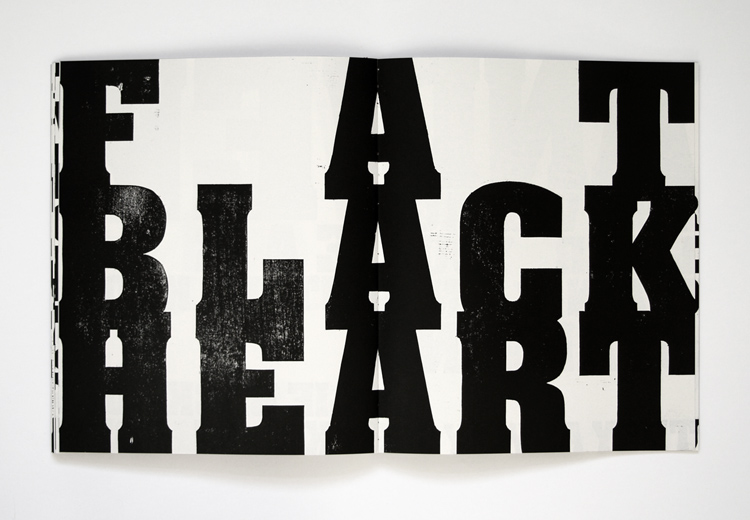
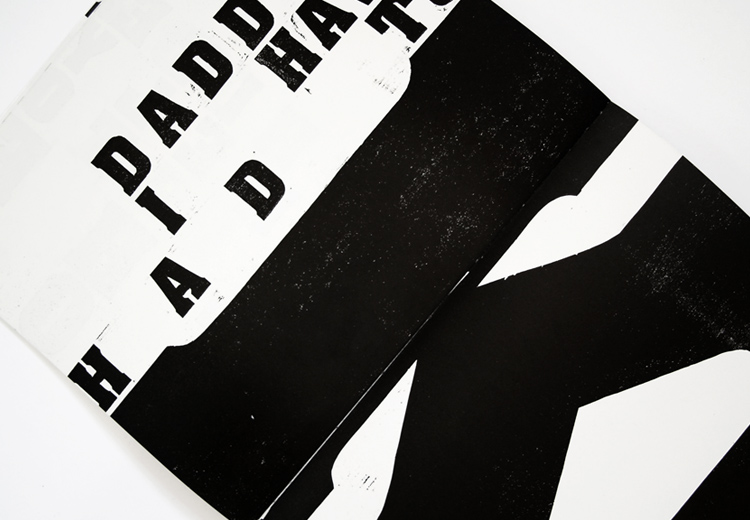
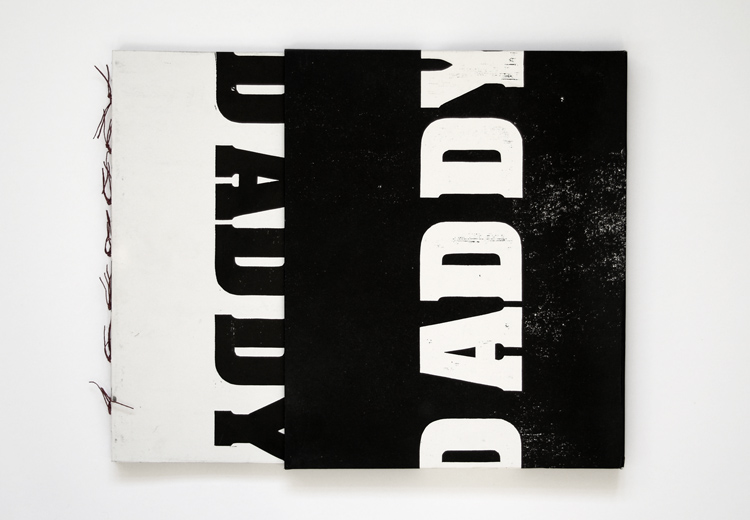
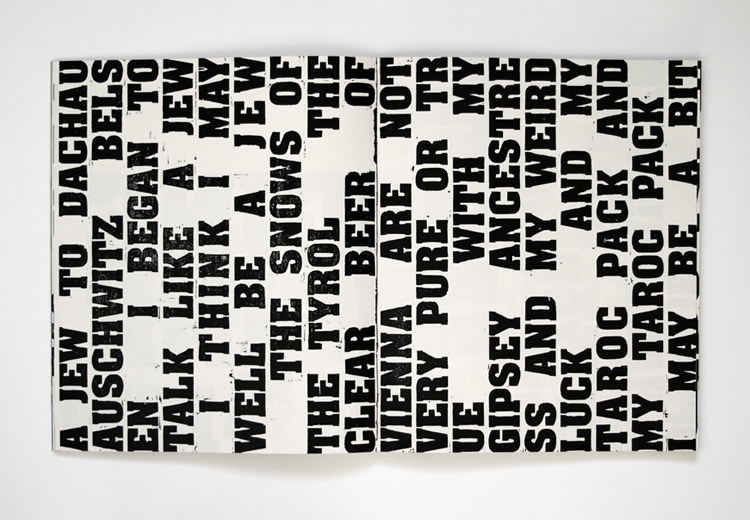
A typographic interpretation of the poem Daddy by Sylvia Plath, printed from 80 hand-carved woodblocks by Copenhagen-based design studio Daddy.

The book “seeks to capture and express the emotions and atmosphere of the text through the typographic treatment and woodblock printing.” Beautiful stuff:

(via Inspiration Lab)

Comments closed

Type Case

Martin Bircher’s oddly hypnotic art installation Type Case uses a printers’ type case and 125 LED lights to display the latest headlines:

There’s more about the project here.

1 Comment

Gastrotypographicalassemblage

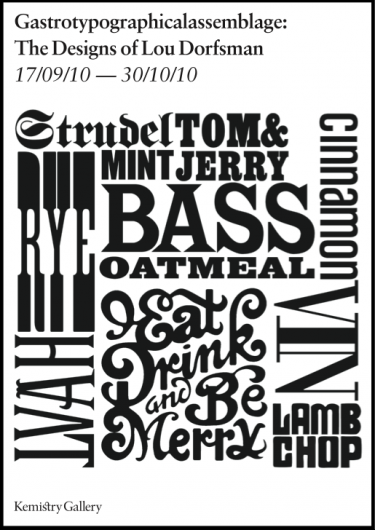
Over the last month, Kemistry Gallery in London has been exhibiting the work of legendary designer Lou Dorfsman, art director for the CBS network. The exhibition, which closes at the end of the October, centres on Dorfman’s most famous creation, the 11 metre wide handmade wooden typographic wall Gastrotypographicalassemblage. With custom type created by Herb Lubalin and Tom Carnase, it contains almost 1500 individual characters:

Comments closed

Q & A with Karen Horton, Design:Related

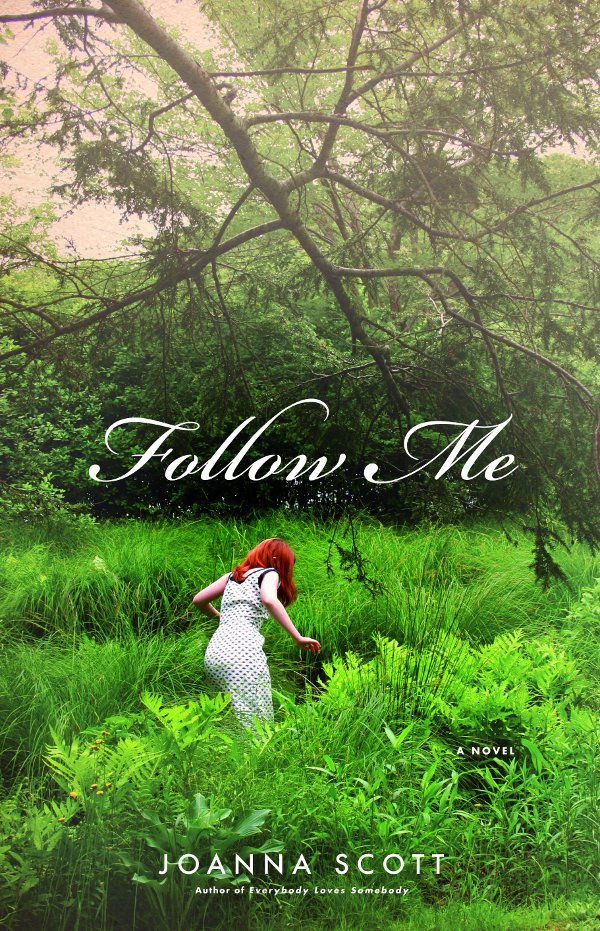
It is possible that the cover for Follow Me by Joanna Scott — with its lovely typography and curious undertones of David Lynch’s small town America — was the first time I noticed the name of designer Karen Horton. But then again, it might have been because of something on Design:Related, which she co-founded, or her blog Daily Design Discoveries, which is (as the name suggestions) a daily source of eclectic design inspiration.

Certainly, once I started to notice Karen’s name, I kept noticing it.

I’m grateful to Karen for taking time out from her busy schedule to reply to my emails and questions, and for providing all the amazing covers accompanying the Q & A (full credits and notes can be found at the end of the post).

What inspired you to become a book designer?

Working as a book cover designer almost happened by accident. Shortly after graduation I moved to NYC. I wanted to work on print design and started by applying to either magazines or book publishing houses almost exclusively. If the right opportunity came along to work at a magazine, I might be on a different track today. I liked the idea of designing something tactile and I already loved books.

Until recently you were the Art Director at Little, Brown & Company. Where did you work previously?

The first position of my professional career was as a Junior Designer in the Ad/Promo department of St. Martin’s Press. One of my responsibilities involved being a liaison between the Ad/Promo department and the Trade Art division. This might’ve been my lucky break. I felt that I was a nag visiting the cover designers weekly to remind them we needed layered files and cover tiffs for an upcoming catalog. When a junior level position opened in the cover art department, the art directors thought of me and suggested that I apply. I’m so thankful that I had the chance to work among such a talented group of designers and mentors. The job was very challenging and after a couple of years I began to question if I was a book cover designer just because I fell into that role and if it was my real niche. I wanted the experience of designing more than what fits within the constraints of a 6×9 rectangle. This led to my next position at The Children’s Museum of Manhattan where I had opportunities to work with my hands with an endless variety to the kinds of projects I collaborated on. The people working with me were fantastic, but I knew from the beginning that I missed book publishing. It took leaving it for me to appreciate what I left behind.

My next book-publishing job was at Oxford University Press where I started as a Design Associate and quickly moved up to the level of Art Director (partly due to unusual circumstances). It was surreal to have a team reporting to me, and this proved to be very rewarding. I have an incredible amount of respect for the editors and quality of books published by OUP, and there are many reasons why I loved the culture within a university press. All the same, I didn’t have the personal confidence yet to be in this leadership role and believed I still had much to learn before becoming the kind of art director I aspired to be. Also, I sought the opportunity to work on fiction in addition non-fiction books. After OUP, I worked at Little, Brown and Company as a Senior Designer and was later promoted to an Art Director.

Could you describe your design process?

This varies dependent on the kind of assignment.  For fiction titles I will always start with reading the full manuscript if available. I spend a good amount of time thinking, researching, and when applicable looking for historically appropriate typefaces. Although, sometimes I might be better off spending more time on the execution of my ideas than the preparation before-hand.

What are your favourite books to work on?

This is a hard question; there isn’t a clear favorite. Having a personal connection to an aspect or subject can greatly contribute to my enjoyment. Last year I had the privilege of designing the Picador paperback edition of Israel is Real. My mother is Israeli so I naturally had an interest.

What are the most challenging?

The same things that can make a project enjoyable can also contribute to the challenges. When you feel too attached to a cover design it can become tough to edit down your ideas and discard ones that you have an attachment to and may not appeal to the wider audience. In the past I’ve had the habit of saving my favorite projects to the end, wanting all the time to try out all options and make the design perfect.

Now you’ve left Little, Brown & Co., What’s next for you?

It’s too soon to tell. I’m still spending a good portion of my time designing book covers for various clients, including Hachette. The flexibility of working from my own studio will eventually allow more time to devote to the Design:Related project. The responsibility of managing a social community while having a full-time job was becoming increasingly difficult. I didn’t bring my Design:Related tasks to the office, but at a point it was evident that I was needed in a greater capacity if the site would succeed. I was always feeling behind (and lacking sleep) and the CEO and fellow co-founder of the site also had a full-time job he recently left. We both decided to make a greater investment of our time in order to take the project past the level of a side project and onto the next chapter.

For people unfamiliar with the site, could you describe Design:Related?

Design:Related is an online community where designers can share inspirations and resources to fellow creatives in a broad range of fields related to design. It also provides networking opportunities and portfolio tools to help with your online presence as a creative professional.

What motivated you and your co-founders to start it?

While Matt Sung (CEO, co-founder) and I were in school at the University of Florida we started conceptualizing a site for designers to share their work and ideas. It took a few years after graduating for us to transform our initial concept into a fully functioning design network.

Approximately how many users does it have now?

For now these numbers are subjective to me and the figures change daily. What’s interesting is how many quality members we have who contribute to the integrity of the site by sharing relevant design news, inspirations, comments, and encouragement to students. We are working on enhancements to the overall experience and functionality of the site that we hope will help continue to grow the network in a positive direction.
What is your current role at Design:Related?

I’m the Co-founder and Content Director. Since we are still a small team with limited resources, all who are involved with the project are continuously juggling tasks outside of their designated responsibilities.

You also blog at Daily Design Discoveries. Do you think it’s important for designers to have a strong presence online?

It’s important for a designer to have an online presence separate from Facebook, but I don’t think having a blog is necessary. For me it is just a welcome distraction from my real work. As a co-founder of Design:Related, all of the content I make is tied to our brand, which adds importance and value. With my Daily Design Discoveries blog I don’t overthink my posts, which is nice from time to time.

Where do you look for inspiration?

One of my favorite past times is browsing a flea market or used bookstore.  As a kid I used to beg my mom to take me to garage sales on weekends. I’m fortunate to be walking distance from The Strand and the Chelsea Flea Market. This is dangerous for my bank account though. Some book assignments can lead you on field trips. For the book Worst Case by James Patterson, the kind of imagery I was looking for was limiting with just search browsers. My Creative Director suggested that I spend a couple hours browsing the Metropolitan Museum of Art. Right when I was about to leave, I found the perfect book at the museum’s shop. It is more exciting when you find imagery in an unexpected source.

Who are your design heroes?

Although I admire many designers, Alvin Lustig comes to mind.

What does the future hold for book cover design?

I wish I knew. At times I think the profession of being a book cover designer is in jeopardy with the increasing popularity of reading on smartphones and other portable devices. There may be greater emphasis placed on starting with a strong design, without the luxury of relying on fancy printing effects or being neatly displayed in a shop window. For example, designers may need to review their covers as small thumbnails to determine the legibility of delicate text and elements when sitting in an iBooks shelf. Who knows? Maybe in an over-saturated marketplace, with rampant closures of bookstores, design could be more important than ever before.

Thanks Karen!

Images:

  1. Follow Me by Joanna Scott
    Jacket photograph ©Christine Callaghan/Arcangel Images
    Creative Director: Mario J. Pulice
    Publishing house: Little, Brown and Company
  2. The Natural History of Uncas Metcalfe by Betsey Osborne
    Art Director: Michael Storrings
    Cover illustration from Bibliotheque des Arts Decoratifs, Paris/Archives Charmet/The Bridgeman Art Library
    Publishing house: St. Martin’s Press/Griffin imprint
  3. I Never Loved a Man the Way I Love You by Matt Dobkin
    Art Director: Michael Storrings
    Cover photograph of Aretha Franklin ©Michael Ochs Archives
    Publishing house: St. Martin’s Press/Griffin imprint
  4. Dictionary of American Art and Artists by Ann Morgan
    Jacket photograph: Installation view: 20th Century American Art, 1989. Whitney Museum of American Art, New York.
    Paintings, left to right: Summer Table (detail), 1972-73 © 2007 Brice Marden/Artists Rights Society (ARS), New York. Day One (detail), 1951-52 © 2007 Barnett Newman Foundation/Artist Rights Society (ARS), New York. Three Flags, 1958 © Jasper Johns/Licensed by VAGA, New York, New York.
    (Karen’s note: securing the image rights for this photo was very difficult/tricky because not only did it include an interior wall from the Whitney Museum, but included artwork from three different artists. I worked with a photo researcher who helped with dealing with the vendors directly.)
  5. Discovering Modernism by Louis Menand
    Cover photograph of T.S. Eliot and Virginia Woolf courtesy of Princeton University Library
    Publishing house: Oxford University Press
  6. The Swan Thieves by Elizabeth Kostova
    Creative Director: Mario J. Pulice
    Jacket painting credit: Leda, 1832 by Francois Eduard Picot, Paris collection © Peter Willi/Superstock
    Publishing house: Little, Brown and Company
    (Karen’s note: final jacket has foil and embossing, printed on Neenah Eames painting paper stock)
  7. Israel is Real by Rich Cohen
    Art Director: Henry Sene Yee
    Cover painting of Jerusalem: William Holman Hunt/Getty Images
    Publishing house: Picador USA
  8. Kabul in Winter by Ann Jones
    Art Director: Henry Sene Yee
    Cover photograph © Ann Jones
    Publishing house: Picador USA
  9. The Lion’s Eye by Joanna Greenfield
    Creative Director: Mario J. Pulice
    Cover photograph of lion © blickwinkel / Alamy
    Publishing house: Little, Brown and Company
  10. My Paper Chase by Harold Evans
    Creative Director: Mario J. Pulice
    Cover photograph of Harold Evans © Lord Snowdon
    Publishing house: Little, Brown and Company
  11. Angel Island by Erika Lee & Judy Yung
    Art Director: Brady McNamara
    Jacket photos provided by authors and the Angel Island Immigration Station Foundation
    Publishing house: Oxford University Press
  12. China: Fragile Superpower by Susan L. Shirk
    Art Director: Kathleen M. Lynch
    Jacket photograph © Andrew Wong/Getty Images
    Publishing house: Oxford University Press
  13. Worst Case by James Patterson
    Creative Director: Mario J. Pulice
    Jacket photograph from Faces in Stone: Architectural Sculpture in New York City by Robert Arthur King. © 2008 by Robert Arthur King. Used by permission of W. W. Norton & Company, Inc
    Publishing house: Little, Brown and Company
    (Karen’s note: final jacket has foil and embossing)
  14. Don’t Blink by James Patterson & Howard Roughan
    Creative Director: Mario J. Pulice
    Jacket painting credit: Leda, 1832 by Francois Eduard Picot, Paris collection © Peter Willi/Superstock
    Publishing house: Little, Brown and Company
    (Karen’s note: final jacket has foil and embossing)
  15. The Postcard Killers by James Patterson & Liza Marklund
    Creative Director: Mario J. Pulice
    Jacket Photo imaging by Debra Lill
    Jacket photographs: man running ©Yolande de Kort/Arcangel Images; woman in running © Roberto Pastrovicchio/Arcangel Images; street in Stockholm, Sweden © Karin Smeds/Getty Images
    Publishing house: Little, Brown and Company
    (Karen’s note: final jacket has foil and embossing)
1 Comment

Just My Type

Journalist Simon Garfield talks about book design, typography and his new book Just My Type in this video for The Guardian:

The Guardian also has an excerpt from the book here.

Comments closed

Q & A with Daniel Justi

Twenty-nine year old Brazilian designer Daniel Justi graduated in graphic design and art direction from centro universitário belas artes de são paulo, and has been working in editorial design and type design in São Paulo for the last 6 years.

Regular readers of Caustic Cover Critic and Design Work Life will already be familiar with his distinctive book jackets and typography, but I’m happy to post a new interview with Daniel here.

Daniel and I corresponded by email, and he was good enough to answer all my questions in English.

How did you get into book design?

When I was finishing university, I received a proposal for an internship job at an publish house called Editora Manole. So I started working as an editorial assistant. After a while, I started to get very interested in the various methods of making books, so I started studying typography, grids, proportions and many things about Fibonacci, Villard and the golden ratio more deeply. Today, I think that designing the interiors of books is one of the most technical fields of graphic design.

What is your current role in the industry?

Fortunately, I got a position that is rather rare nowadays, which is working with both the cover design and the interiors of books. Sometimes there isn’t enough time so I need to hire freelancers and, in these cases, I need to act as art director. Besides, I run my small type foundry and also do freelance work for some publishers.

Are there a lot of opportunities for book designers in São Paulo?

Yes and no. The publishing field in São Paulo is quite busy. There are many publishers and most of them hire freelancers. At the same time is unusual to work for several publishers. It is more common to do work for only one or two. The editors don’t seem to like to vary their freelancers. So when an editor trusts you, you usually get a lot of work.

Could you describe your design process?

My design process is often not linear. Of course I always start with basics like color, shape and typography, but I think its important not to have total control of the process. The accidents, incidents and coincidences are important in my process. For books, I usually say, “let the text control.” The content is what sets the decisions like to using or making illustrations, pictures, collages, textures, typography, etc..

There is nothing better than content to define the shape.

What are your favourite books to work on?

Definitely literature and art.

I believe that literature books are the best. They don’t need obvious solutions. You can be daring, try something new or maybe weird, since that has something to do with the content and, most important, makes the reader think.

I think the main function of a book cover is to create a communication with the reader and not just give you all the obvious way. It is important never to underestimate the reader.

I also enjoy working on academic books, containing information graphics, charts and timelines. I like to find the visual solutions for these kind of books.

What are the most challenging?

Medical books.

The publishing company where I work is well known for his books on medicine. It’s always a great challenge to make good design books on this topic. Currently I think it’s a fun challenge, but a few years ago, it was terrifying!

When did you become interested in type design?

In my last year of university, I had an extra course of a project called Tipocracia.

Tipocracia is a project of a graphic designer and professor called Henrique Nardi. The purpose of this project is to disseminate the typography and type design in Brazil. It is a very important initiative and encourages students to engage in the field.

I’ve always had a great interest in typography, but contact with Tipocracia was what motivated me to start my own type foundry.

Does working so closely with type inform your book design?

Absolutely! Work with type design completely changes your view of typography.

Currently, my attention is more focused on covers, but I never want to stop designing the interiors of the books, which is where all your technical knowledge is put to the test. So, for me, doing both (cover and interior) will always be enjoyable.

What are some of the current design trends in Brazil?

Hard to say. Brazil is a very big country and many things happen outside of São Paulo.

In São Paulo, for example, I don’t think there’s a specific local trend. I think it’s more like trends that exist in other large cities and urban centers, like London or New York.

Trends end up becoming more global. This year, for example, designers from Pentagram (including Paula Scher and DJ Stout ) came to São Paulo to promote workshops. At the end of the year Stefan Sagmeister is coming. Maybe it’s all about a global trends.

Who are some of the Brazilian designers we should look out for?

There are so many names, but I’ll try to summarize my favorites by area:

Book covers: Retina_78

Graphic Design: Rico Lins

Type design: Fabio Haag

Illustration: Thiago Queiroz

Photo: Cia de Foto

Where do you look for inspiration and who are some of your design heroes?

I try not to look for inspiration in graphic design field. I think it’s necessary to have other interests to inspire you. Things that inspire me are simple like skateboarding on a Saturday afternoon, reading a book, listening to some music, photography and going to the movies or art exhibitions.

Some of my heroes are Paul Rand, Alvin Lustig, Neville Brody, László Moholy-Nagy, Josef Müller-Brockmann, Jan Tschichold and so many others…

What does the future hold for book cover design?

I believe that things tend to increasingly professionalize. The market is saturated of free stock images. It’s important to create customized solutions so we don’t repeat what has already been done.

My central philosophy is to never underestimate the consumer. Design is communication, and for it to exist, you must not deliver everything and let people think for themselves. There must be an interaction.

I really like Massimo Vignelli’‘s phrase:

“I disagree with people who think the word dog should look like a dog. Even worse are people who think the word dog should bark.”

Thanks Daniel!

1 Comment

Bruce Mau and the Problems of Success

“Most of the problems we are facing are the problems of success, not failure.”

Canadian designer Bruce Mau, author of Massive Change, talks about sustainability and framing the issue positively with Jeanne Park of the PBS show Need to Know.

When asked which approach — carrot or stick — is more the effective way to change people’s habits,  Mau replies, “I think you have to paint the stick orange”:

(via Bookslut)

Comments closed

Smith and Vignelli

As is no doubt clear from recent blog posts, I have a huge amount of respect for the work of designer Massimo Vignelli and so I really enjoyed this recent interview with Debbie Millman for the new series of Design Matters.

Vignelli, however, does not want for ego, and so I was struck how humble British designer and cycling enthusiast Paul Smith is in this fascinating and inspiring conversation with designer Mike Dempsey by comparison:

Paul Smith Interview

Egos aside, it interesting that the lives and careers Smith and Vignelli seem share some unlikely common threads — from their early apprenticeships and life-long partners, to their sense of design, tradition, and detail.

Comments closed

Homage to the Square

A short documentary about the artist and educator Josef Albers, author of the seminal Interaction of Color and widely regarded as the father of modern colour theory:

The film is the first part of ‘The Full Spectrum’ a three-part series on colour produced earlier this year by Dwell Magazine.

(via Swiss Legacy)

Comments closed