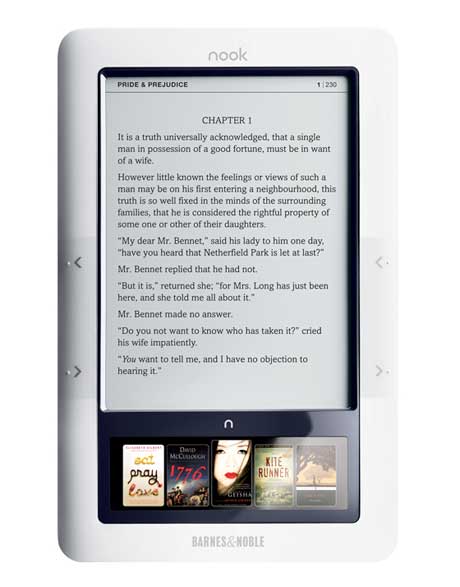
Despite being lumbered with “the worst product name in recorded history”, Barnes & Noble‘s new dual screen e-reader the ‘Nook’ is getting a lot of favourable reviews.
An appallingly kept secret, the Nook was officially unveiled earlier this week and is being widely touted as a ‘Kindle Killer’ (whatever that actually means).
Direct comparisons with Amazon’s e-reader are inevitable of course — especially given the Nook will go on sale for $259, the same price as the Kindle 2. And, if nothing else, US publishers seem relieved that Amazon finally has some serious competition from the country’s largest bookstore chain.
As reported in Publishers Weekly and the New York Times, part of what is attractive to publishers (aside from the simple fact it is not owned by the Amazon) is that the Nook is relatively flexible and supports formats, including ePub. and — perhaps more crucially in the short term — PDFs, that can be read on other devices.
Of course, that B&N has 1,300 stores and already understands books (and the publishers that publish them) doesn’t hurt.
Much is also being made of the Nook’s promising ‘LendMe’ feature, which will let readers share their books (within limits) with others, even though some people aren’t entirely happy about it.
Unsurprisingly, B&N are describing the Nook as “The World’s Most Advanced eBook Reader”, although it is unclear whether the Nook will be available outside the US, which could be problematic in the long run (especially as Amazon and Sony both have global reach). The Guardian Technology Blog does point out, however, that the Nook’s 3G wireless is provided by AT&T, “one of the GSM [Global System for Mobile Communications] providers in the US, so from a technical standpoint, it should be easy to launch the reader internationally.”
But does B&N really have the will or the way to make the Nook available beyond its US home base? And could it do so successfully?
Ultimately perhaps, the real question though is whether there is actually a mass market — either in the US or internationally — for single purpose e-readers. Some smart people clearly think so, but given that non-proprietary formats like ePub can be read on more useful, convenient and competitively priced multi-purpose devices such as laptops and cellphones (and whatever else Apple are currently cooking up), and that books still look like the most robust, simple and elegant format — I’m not so sure…