I decided to go in a slightly different direction with my covers list this year (see my lists for 2012, 2011, and 2010). It’s just a straight up list of the fifty covers designs with a few annotations and links a long the way. I’m sorry for woeful under-representation of Australian and NZ designers, and for completely ignoring the entire non-English-speaking world. I will try and do better in 2014. But until then, here, in alphabetical order, are my fifty covers of 2013:
33 Comments59 search results for "chris ware"
Something for the Weekend

Wondrous Horrors — Ariella Budick on the centenary of the 1913 Armory Show in New York, for the Financial Times:
Critics did not reject every European innovation. They nodded at the impressionists, puzzled respectfully over Cézanne, and tolerated Gauguin. But cubism blew their minds. The impact was not merely aesthetic. American writers perceived a defiant rejection of rules and a contempt for tradition – qualities they associated with violent political movements. Painters who blasted convention with their brushes gave comfort to bomb-throwing subversives. When critics invoked anarchy, it was not just a figure of speech.
New York viewers, including artists, to some degree knew what they were in for. Pictures of avant-garde art had been included, often with mocking commentary, in New York newspapers and magazines for years. And by no means were all Armory reviews pans; one critic wrote that he was grateful for “these shocks to our aesthetic sense.” Others were glad for a certain perspective the show offered: compared with avant-garde work from Europe, American art looked sane.

Freedom from conventional and institutional expectations—freedom even from his audience—means that Dyer is also free to make it up, like jazz, as he goes along. Every book is different, and every book is different from everybody else’s books. Zona is a running commentary, almost shot-by-shot, on a single film. But Beautiful consists of a series of quasi-imagined episodes—vivid, textured, saturated with feeling—from the lives of the jazz greats. Out of Sheer Rage is memoir, travelogue, criticism—“about” Lawrence in the physical sense of the word: spinning around and around him with a manic, comic, centrifugal energy. The Ongoing Moment makes a poem of the history of photography by considering not artists or schools, technics or techniques, but, improbably, subjects (hats, benches, stairs): a ridiculous idea, it seems, until you figure out that Dyer’s real quarry is the relationships we have with those quotidian objects, the way they can be made to stand for the lives that move among them. “Spare me the drudgery of systematic examinations,” he writes in Out of Sheer Rage, “and give me the lightning flashes of those wild books in which there is no attempt to cover the ground thoroughly or reasonably.”
[Dyer] claims, ‘if I had not seen Stalker in my early twenties my responsiveness to the world would have been radically diminished’. He shares with his idol an artistic ideal of awareness, describing Tarkovsky’s aesthetic as a length of take demanding ‘a special intensity of attention’. The inverse dominates much contemporary culture where, ‘a lot of what’s being shown on the world’s screens is fit only for morons’ with the result that ‘there are more and more things from which one has to avert one’s ears and eyes’. Rubbish art that warrants ignorance. A bit broad-brush and heavy-handed, but its Dyer’s reason for writing. Against a social dystopia of willed numbness, Zona documents a profound engagement with an artwork. It is not so much homage to the film alone, but to the dialogue it inspires.
And finally…
What Is This Shit? — Brian Dillon interviews photographer and filmmaker William Klein:
Comments closedI didn’t know how to do a book. I was just discovering photography and once I had all these pictures, I showed them to editors in New York and nobody thought it was worthwhile to do a book with these photographs. They said, “What is this shit?” I came back to Paris and discovered there was a series of travel books called Petite Planète. I called them up and got an appointment and I went to this office which looked like NASA. Chris Marker was there with a laser gun in his belt, and he saw the photographs and said, “We’ll do a book!” In fact he said, “We’ll do a book or I quit!”
Something for the Weekend

The Technological Sublime — Rick Poyner on the science fiction artist Chris Foss and Hardware, a new book collecting his work, at Design Observer:
These visionary images have a stillness, a control of atmosphere and a mood of mystery and wonder, even when something huge, alien, imponderable and beyond our terrestrial grasp is taking place. Foss loves the paintings of J.M.W. Turner and his finest pictures, often from the 1970s, seem as much concerned with ambience and painterly effect — they are cosmic cousins of Turner’s Rain, Steam and Speed, at least in spirit — as with the engineering of the vast structures they depict. They are also early visual encapsulations of what came to be known in the 1990s as the technological sublime. The vertiginous sense of awe, wonder, poetry and terror that people experienced in nature, when opening their senses to the sky, mountains, forests, rivers or oceans, could now be felt when contemplating the frightening immensity of a machine’s harnessed power, the magical effectiveness of electricity, or the boundless matrix of digital connection.
(Pictured above: Chris Foss, The Bloodstar Conspiracy by Stephen Goldin and E. E. “Doc” Smith, Panther, 1978)
Those Who Can… — Eric Olsen, journalist, editor and co-author of We Wanted To Be Writers, discusses writing and picks 5 books on the subject:
There are always ways that you can help a writer along. You’re not going to take a mediocre writer and turn him or her into a great writer, and there are also some things that can’t be taught, like the basic desire to be a writer. That seems to be a given. You’re not going to make someone want to be a writer. Sometimes what goes on in a writing workshop is that you convince the writer that he doesn’t want to be a writer. That is a kind of teaching too…
The Source Code of Our Being — Tom McCarthy, author of Remainder and C, on the influence of Freud:
As a writer, I’m in love with Freud. I can’t imagine any serious writer not being. Freud, ultimately, concerned himself not with the mind, nor with the individual, but with the question of meaning’s emergence in the world, and of the mechanisms through which this emergence takes place. What, according to him, are these mechanisms? Why, they’re substitution and elision, condensation and displacement, metaphor, metonymy — in short, the very mechanisms at work in a poem or a novel. For Freud, if you want to understand mental and social life you don’t take a biopsy of a murderer’s brain or observe groups of people in a room: you study Antigone and Hamlet. That’s why his case-histories read like Gothic novels. It’s why his best patients are fictional characters like Jensen’s Norbert and Goethe’s Werther. And it’s why his preferred model for memory is a mystic writing pad.
And finally…
A short film homage to author Jorge Luis Borges by Ian Ruschel:
Comments closedMidweek Miscellany
A shiny new (and somewhat unsettling) cover for Joyland’s next e-book, How I Came to Haunt My Parents by Natalee Caple, designed by the shiny (and somewhat unsettling) David A Gee.
Holden Caulfield’s Goddam War — Vanity Fair excerpts J. D. Salinger: A Life by Kenneth Slawenski:
Tuesday, June 6, 1944, was the turning point of J. D. Salinger’s life. It is difficult to overstate the impact of D-day and the 11 months of combat that followed. The war, its horrors and lessons, would brand itself upon every aspect of Salinger’s personality and reverberate through his work. As a young writer before entering the army, Salinger had had stories published in various magazines, including Collier’s and Story, and he had begun to conjure members of the Caulfield family, including the famous Holden. On D-day he had six unpublished Caulfield stories in his possession, stories that would form the spine of The Catcher in the Rye. The experience of war gave his writing a depth and maturity it had lacked; the legacy of that experience is present even in work that is not about war at all. In later life, Salinger frequently mentioned Normandy, but he never spoke of the details—“as if,” his daughter later recalled, “I understood the implications, the unspoken.”
An excerpt from Jason Epstein’s review Merchants of Culture: The Publishing Business in the Twenty-First Century by John B. Thompson for the latest NYRB:
Digital enthusiasts should… consider that as the embrace of other electronic media has widened, the average quality of their product has declined: from Masterpiece Theatre to Jersey Shore, from Franklin Roosevelt and Adlai Stevenson to Sarah Palin, from Julia Child to Rachael Ray. My own guess is that the digital future in which anyone can become a published writer will separate along the usual two paths, a narrow path toward more multilingual variety, specificity, and higher average quality and a broader path downward toward greater banality and incoherence, while the collective wisdom of the species, the infallible critic, will continue to preserve what is essential and over time discard the rest.
(The full review requires a subscription)
Best Online Comics Criticism 2010 chosen by contributors to The Comics Journal. And from that list, film scholar David Bordwell on Tintin (via Robot6):
Most commentators on Hergé mention that he was a film fan and drew many situations from movies of the 1920s and 1930s. Like Hollywood studio cinema, his tales put striking technique in the service of fluent storytelling. Pause to study the narrative and you’ll find a surprising richness to the imagery; start by looking at the pictures as pictures, and you’ll see how composition, color, and detail smoothly advance the action. Hergé was well aware that his polished imagery could stand scrutiny in its own right, but he saw it as serving a larger narrative dynamic.
(Out of curiosity, does anyone compile annual list of the best online literary criticism?)
Montaigne and Monkeys — Saul Frampton, author of the ridiculously titled When I Am Playing With My Cat, How Do I Know She Is Not Playing With Me?: Montaigne and Being in Touch With Life, on 16th Century French philosopher Michel-de-Montaigne and neuroscience in The Guardian:
For Montaigne, as for contemporary neuroscientists, humans… have an inbuilt imitative, sympathetic capacity. Moreover, he does not see it as species-dependent… In one of his most famous aphorisms he asks: “When I am playing with my cat, how do I know she is not playing with me?” And he tells how animals themselves form “a certain acquaintance with one another” and greet each other “with joy and demonstrations of goodwill”. Then, in a lengthy comment added to the final edition of his essays, he completes the circle from animal-to-human to human-to-human again, concluding that we cannot help but communicate ourselves in some way… even if it is something to which we are habitually blind…
And finally (in the unlikely case anyone missed it)…
Caustic Cover Critic interviews Christopher King, the new Art Director at Melville House Publishing.
1 CommentSomething for the Weekend
Psycho Cover — Penguin art director Paul Buckley discusses his new book Penguin 75 with Imprint:
I am very aware of how much product gets put out there that is completely unnecessary, be it music, movies, books, whatever—it seems that for every good piece of culture we experience, we are bombarded with 99 pieces of redundant crap. I’ve been in the industry for awhile, and of course want to show off the great work we do here, but was not going to put out yet another design book and take your money—you can get that in any annual. To me, often more interesting than the covers are the stories, the psychology that created all the variables that led to this cover over the 20 other proposed covers.
Paul has recently updated his Flickr with new covers from the Penguin Ink series, which utilizes art by tattoo artists, as well as the latest additions to the excellent Penguin Graphic Classics series, which have art by contemporary cartoonists.
My interview with Paul and Penguin 75 designer Christopher Brand is here.
Also at Imprint… Thurston Moore of Sonic Youth and book editor Eva Prinz (formerly of Abrams and Rizzoli) talk about their new publishing venture Ecstatic Peace Library.
Writing on the Wall — Andrew Franklin, publisher and managing director of Profile Books, offers an overview of the current state of the book business in the UK (via Dan Mogford):
Bookshops enliven high streets, create communities of readers and stage author events, while good booksellers encourage reading and shape taste. For most readers, browsing is a key part of deciding what to read, and publishers put huge effort into packaging and presenting their books. Of course many of these activities can migrate online with Facebook groups, online forums, feeds and websites helping to steer readers to the books they will most enjoy. For some online shoppers bookshops are part of this process: they browse in bookshops, write shopping lists and then buy (perhaps more cheaply) online. But no bookshop can be in business as a shop window for other retailers. You don’t have to be hopelessly nostalgic or sentimental to believe something very precious is lost with every bookshop that closes.
And at the other of the spectrum…
Another Reading Revolution — Historian Andrew Pettegree talks about his new book The Book in the Renaissance with The Atlantic (via Shelf Awareness):
Comments closedThe situation really is that the first generation of printers, encouraged by scholars, naturally produced the sort of books these people wanted. But it’s hard to apply this sort of commercial model—this small, bespoke model used for manuscripts—to a new process that produces 300 or more identical items. The irony is that there were plenty of other readers out there. The first printers ignored the groups that we might call pragmatic readers. Literacy was already widely-disseminated in the fifteenth century. There were lots of people who could read but did not habitually buy books, so the trick was to discover how to reach them.
Father’s Day: Men and Reading
Thriller writer Jason Pinter recently rattled some publishing china by suggesting that a stubborn belief that Men Don’t Read is alienating male readers:
I’m tired of people saying Men Don’t Read. Men LOVE to read… But the more publishing repeats the empty mantra that Men Don’t Read the less they’re going to try to appeal to men, which is where this vicious cycle begins.
Publish more books for men and boys. Trust editors who try to buy these books, and work on the marketing campaigns to hit those audiences. The readers are there, waiting, eager just under the surface… They’ve been alienated for a long time and might need to be roused from their slumber. But as I’ve always said the biggest problems facing the publishing industry are not ebooks, or returns, but the number of people reading. This is a way to bring back a lot of readers who have essentially been forgotten about.
Pinter is right in a sense. The idea that men don’t read books is a glib generalization and publishers really should be worried about literacy and declining readerships. But are men really turning away from reading because the book trade isn’t trying to reach them?
The scandal engulfing former Penguin Canada CEO David Davidar is a prickly reminder that the upper echelon of publishing is still largely a boy’s club. And even if you accept Pinter’s assertion that “that most editorial meetings tend to be dominated by women”, Rebecca Smart, Managing Director at Osprey Publishing, ably demonstrates that women can publish effectively for a predominantly male readership.
And even if you ignore all the books on football mentioned last week (not to mention the endless number of books on baseball and cricket), and the entire output of writers like Cormac McCarthy, George Pelecanos and the late (but still in print) Patrick O’Brian, the New York Times best seller lists reveal more than a few new books have been successfully published for men.
Recent bestsellers have included The Big Short by Michael Lewis, Crisis Economics by Nouriel Roubini and Stephen Mihm, The Pacific by Hugh Ambrose, Operation Mincemeat by Ben Macintyre, Matterhorn by Karl Marlantes, and Sh*t My Dad Says by Justin Halpern.
The perception that publishers are marginalizing men is just as much an illusion as Men Don’t Read. At least if men read the NY Times and like books on economics, war and expletives. (And who doesn’t?)
But this is, of course, completely subjective. The New York Times bestsellers — war, history, politics, and angry (funny) old men — may not be the kind of books Pinter had in mind. I certainly didn’t read the book that caused Pinter so much angst, A Lion’s Tale by pro-wrestler Chris Jericho, but then I don’t read much Roth, Amis, or Coetzee either, though I suppose plenty of men do. Perhaps the real problem is publishing along stereotypical gender lines? Not all men (or women) want to read the same books…
I was thinking about this because of two books I finished recently: War by Sebastian Junger (Twelve 2010) and Colony by Hugo Wilcken (Harper Perennial, 2007). Both are books by men about men — and I enjoyed them both — but otherwise they have almost nothing in common.
Full of piss, vinegar, and shit blowing up, War is a nonfiction account of Junger’s time embedded with the Second Platoon of Battle Company in the Korengal Valley, eastern Afghanistan.
Dexter Filkins, author of the excellent The Forever War, reviewed the book for The New York Times:
At one level, Junger’s book is a chronicle of Second Platoon’s days. He takes us up the mountains, along the valley floor, on helo-lifts, into firefights. We sit with the men in their bunks — infested with fleas and tarantulas — and we listen to their low-grade (and sometimes hilarious) philosophizing as they pass the hours… But Junger is aiming for more than just a boots-on-the-ground narrative of the travails of American fighting men. As the book’s grandiose title suggests… “War” strives to offer not just a picture of American fighting men but a discourse on the nature of war itself.
With it’s acronyms, hot military hardware and bunker philosophizing War is, without question, a compelling read. But it is also a deeply troubling book. Junger’s intimate dependence on this closely knit platoon clearly affects his journalistic perspective, and Junger’s narcissism aside, I was left wondering whether there is a psychological condition in embedded journalists similar to Stockholm Syndrome.
Lewis Manalo, a former sapper in 82nd Airborne Division, describes Junger as a “war tourist” in a scathing review of the book for Publishing Perspectives:
[W]hat a fantasy it is. All the thrill of being in combat with none of the responsibility of knowing what to do. He endows the different engagements with the excitement and clarity of a Hollywood action film… As Junger paints them, these fights are where all those big words like “heroism” and “courage” and “sacrifice” come into play, where men achieve amazing things and where they die dramatic deaths. Over and over, Junger and the men he depicts rave about how exciting battle is. In Junger’s world, war is a glorious thing where everyone should want to be.
“Fantasy” is an interesting choice of words. Certainly, the phrase ‘war-porn’ came to mind when I was reading it. Perhaps not surprisingly then, Junger’s experiences in Korengal are also the basis for a feature-length film called Restrepo co-directed with photographer/filmmaker Tim Hetherington:
If War is a dirty nonfiction hypemachine, Colony by Hugo Wilcken is a beautifully constructed — if largely ignored — literary novel.
With echoes of Conrad and Camus, Colony is a sophisticated post-modern adventure story. Sabir — a war veteran and petty criminal — finds himself on a boat to a brutal penal colony in French Guiana. He escapes the camp, but as his plans unravel, the book takes an unexpected tack, throwing the previous narrative into doubt. The past, present, and future mix in memory and imagination.
John Self, who has long championed the novel, had this to say about it:
The book’s sometimes elusive nature seems to be reflected in the references to Poe’s Narrative of Arthur Gordon Pym. But what impresses most is Wilcken’s unwillingness to try to impress the reader: the prose is unfussy, the scenes uncluttered. There is no ‘fine writing’. Instead, there is very fine writing indeed.
The theme of Colony is escape: from captivity to freedom, and vice versa; from reality into dreams and memories; from one identity to another; from life to elsewhere.
Colony is simply an extraordinary book. It also feels like an old-fashioned one, especially compared to War‘s heady multimedia blend of insider reportage and violence stuck together by hasty research and memoir. My sense is that it is War‘s template that will be imitated by publishers trying to capture Pinter’s elusive male reader. But personally it will be Colony that endures, and lives long in my mind.
Q & A with Michel Vrana, Black Eye Design
Michel Vrana, AKA Black Eye Design, has been on my radar since we first crossed paths on Twitter in the run up to Book Camp Toronto earlier this year.
I had hoped to run into the Montreal-based designer in person at Book Camp, but unfortunately, in the dehydrating hustle of the day, I didn’t get chance to introduce myself.
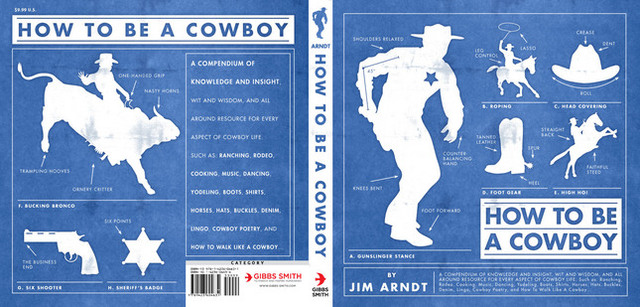
Nevertheless, a few weeks after the event, I came across a series of reissued cowboy books from publisher Gibbs Smith in a Raincoast sales meeting. The witty retro cover designs — with their pop culture references and knowing wink to the distinctive letterpress work of the Hatch Show Print studio — stood out among the more traditional covers in the catalogue.
It turned out that they were designed by Michel.
Small world, I thought.
A little later I found out that Michel also designed covers for Casual Optimist favourite Drawn & Quarterly (also distributed by Raincoast for the record).
And then it seemed Michel’s work was everywhere. Or perhaps it just seemed that way. My love of letterpress, comics, vintage magazines, typography, ephemera and stuff certainly make me notice his work, which often seems to draw on these elements.
Although we still haven’t met in person, we’ve stayed in touch through the electronic wonder of Twitter and email over the past couple of months, and despite some major changes at Black Eye Design during that time, Michel seemed a natural fit for this series of interviews.
You can see more Michel’s work at his design:related portfolio and, of course, follow him on Twitter @michelvrana.
Briefly, could you outline the history of Black Eye?
In 1993, I started Black Eye Productions as a comic book publishing company. Inspired by Drawn and Quarterly, I sought to do justice to all the hard work that the cartoonists put into the books I published by making sure they were well packaged and designed. Over the years, I did more and more graphic design, and less publishing, in order to pay the bills, and eventually decided to dedicate myself design full time in 1998.
From 1998 onward, Black Eye Design became a boutique design studio specializing in publication design. I spent much of my time running the studio and art directing and not as much time as I wanted doing what I enjoyed most: the hands-on design. Starting in 2006, I rolled up my sleeves and started doing book design again, though I was really splitting my time between running the company and doing hands on work. In 2009, I decided to shutter the studio and concentrate on book design full-time. It’s really what I’ve enjoyed the most over the years, from those first days as a comics publisher onward.
Do have a ‘house’ style? How would you describe it?
I’m sure anyone looking at my work would see a style more than I can. I’m sure the word ‘retro’ applies. Someone once described the work I do as ‘prop design’, where the design emulates something else but that is not always the case. My business card, for example, is set up like a vintage boxing ticket. Two of my most recent fiction covers have the titles incorporated into a matchbox and a postage stamp. So that’s probably a trend in my work.
I try to incorporate, whenever I can, a subtle ‘punchline’ into my covers. For example, the book that has the match box is called The Last Shot; it’s a collection of short stories where many of the characters are stuck at a dead end in their lives, and are looking for that one ‘last shot’ to change things. The cover has a few spent matches, and a matchbox with one last match sitting in it. I like to think a reader is going to look at the title, look at the visual and then it will click and they’ll get that little ‘Aha!’ in their head, and feel like they’re in on the joke.
The (English-speaking) Canadian book industry is largely focused in Toronto. What are the pros and cons of being a book designer based in Montreal?
It’s a pat answer, but in this day and age, you can be anywhere in the world and succeed as a graphic designer. As long as you get the word out there to the right people, you’ll find contracts. I’ve worked very hard in promoting my studio, and now myself. Not having lived/worked in Toronto, maybe it would be easier to find new projects if I lived there, but it’s hard to say for sure.
Could you describe your design process?
I front-load my process with questions, thinking and pencil sketching, rather than sitting down straightaway at the computer.
When I’m not sure I have enough info from my design brief, I’ll usually ask many questions of my publisher, editor, or art director for the project. I find that that really helps clarify things.
When possible, I also try to get a sample, or the whole manuscript to read. I use Stanza on my iPhone to read manuscripts and annotate them with ideas, as I read. When I don’t have a manuscript, I just start by writing out ideas and brainstorming.
I usually delay sitting down at the computer as long as I can. I sketch out rough thumbnails for myself, and sometimes even show these (very) rough sketches to the art director, editor or publisher I’m working with, to get the discussion going. I find that keeping everything loose and unpolished at the beginning frees me from getting too attached to any one idea, from it becoming too precious, and that keeps creativity flowing. It’s a valuable lesson I learned from designer Jan Wilker at the SVW 2008 workshop.
What are your favourite projects to work on?
I’m going to be a cliché and say that I love working on all book covers. To me, the fun in visual problem solving remains the same whether it’s a kids’ humour book about Gross Stuff, or a collection of short stories by a budding young talent. That being said, my absolute favourite ones are the ones that require me to push myself out of my comfort zone and try something new. Scary, but fun.
What are the most challenging?
The ones with a short design brief. I’ve come to realize that these seemingly ‘easy’ projects are deceptively so, and the covers often require the most revisions. Now when I get a quick design brief, I try to dig deeper with my art director, editor or publisher to find out more about their goals with the cover.
What are some of the common frustrations working with publishers?
My number one frustration would be that sometimes publishers underestimate their audience. As a culture, we’re a lot more savvy about visual communication than many people assume. We’re all continually exposed to clever ad campaigns, posters, book covers; so let’s not underestimate the intelligence and experience of the audience. For books this seems especially important, since you’re talking about a segment of the population that’s especially literate.
What do you think makes a good cover design?
Marketer Seth Godin hit the nail on the head for me, when he described the role of a cover as ‘to tee up the reader so the book has maximum impact’. The goal of a book cover is to engage the reader, and get them to pick it up, to interact with it (look at the back cover copy, maybe read a quick passage). That’s the stuff that sells the book. The cover is the invitation, and that invitation needs to be enticing.
Do you see any current trends in cover design?
Illustration and hand-drawn type are definitely a trend these days. And I think that Peter Mendelsund‘s design for Stieg Larsson’s The Girl with the Dragon Tattoo opened up the idea of type layered with the image. In fact, dimensional type, or maybe even ‘environmental type’ seems to be a meme in graphic design these days.
Where do look for inspiration?
I’m a big fan of ephemera: retro packaging, book design, comics. I love that stuff. I also try more and more to keep up to date with what other ‘big’ designers are doing, hopefully without finding myself overly influenced by their work. There are so many talented designers, photographers and illustrators online that it’s hard not to be inspired! Of course, if I ever get ‘stuck’ on a design, I find that tuning out for a while is the best way to go for me, knowing that somewhere in the back of my head, the ideas are still percolating.
Who are some of your design heroes?
The first designer I was ever aware of was Art Spiegelman. The work he did on Raw magazine, and on Maus has always been influential (right down to my love of the font Metro, which Spiegelman often uses). David Mazzucchelli would also be another cartoonist/designer that’s always impressed me: from his work on Batman Year One to his self-published Rubber Blanket, to his newest Asterios Polyp.
In 1992 I picked up a copy of Jeanette Winterson’s The Passion in London, and it was part of an edition of tiny hardcovers published as Bloomsbury Classics. The design of that first book, and the series, has always stuck with me [see pictures pf the Bloomsbury Classics here and here]. Jeffrey Fisher is the amazingly talented illustrator who worked on the series.
I’m also a big fan of Paul Sahre: I bought Rick Moody’s Demonology completely based on the elegant Paul’s cover: a photo of the multi-coloured ‘Rocket’ candy. I thought the design was brilliant at conveying the idea of the book being a collection of short stories.
Amy King is great, her work shows such variety, but it’s all so well executed. John Gall‘s paperback covers for Haruki Murakami are lovely. Of course, Henry Yee‘s work always blows me away – his cover for The Adventures of Kavalier and Klay is a favourite. And let me not forget fellow Canadian designers Peter Cocking and David Drummond. Not to mention the work of my colleagues on twitter Ingrid Paulson, Christopher Tobias, David Gee.
What do you think e-books mean for book designers?
It’s going to be interesting to see how new e-book readers shape the reading experience. I’m keeping my fingers crossed that fine typography and graphic design will continue to be important. What I can see in the future is the incorporation of more rich media into book design – childrens’ books with motion graphics, novels with musical cues, or even embedded video. Who knows, maybe we’ll even see book covers with motion graphics on the e-book front? Ultimately, I think it means that books are going to evolve. Down which path I’m not sure, but book designers will have to evolve along with them. Whether we end up with books that act like the publications in the Harry Potter world, or if they’re something completely different.
Thanks Michel!
Next Week: Alex Camlin, Creative Director at Da Capo Press.
Comments closedSomething for the Weekend, July 24th, 2009
Group Thinkery — Book-designing, tuba-playing Christopher Tobias has launched a new blog to discuss books, design, and publishing. Group Thinkery is also on Twitter.
I came across the stellar portfolio of High Design’s David High — which includes this rather brilliant cover for The Management Myth for W.W. Norton — earlier this week thanks to a tweet from the chaps at FaceOut Books. Go take a look.
Luck — In another one of those long, fascinating Agents and Editors Q&As from Poets and Writers that are always well worth your time, Jonathan Galassi, president and publisher of Farrar, Straus and Giroux, looks back at his career and comments on the current state of the industry:
One of the really hard lessons was realizing how much of a crapshoot publishing is—how you can love something and do everything you can for it, and yet fail at connecting it to an audience. Maybe you misjudged it. Maybe it didn’t get the right breaks. One of the hardest things to come to grips with is how important the breaks are. There’s luck in publishing, just like in any human activity… That was one of the hardest lessons: how difficult it is to actually be effective… Writing is its own reward. It has to be. I really believe that. This is a part of publishing that’s really hard to come to grips with. But publishers can’t make culture happen the way they want it to happen… We can huff and puff and pay money and advertise and everything else, but in the end, if the readers don’t come, we can’t do anything about it.
The lovely-looking limited edition, hand-made Done Walking With My Regular Shoes by recent graduate Stina Johansson. The cover design is screen-printed onto canvas (via DesignWorkLife).
Andy designing — The New Directions blog looks at the book designs of Andy Warhol:
Andy Warhol worked for New Directions as a book designer off and on for almost 10 years. Our editor-in-chief recalls James Laughlin telling her an Andy Warhol anecdote:
“He was a very strange looking man. But all the secretaries loved him because he would sneak little origami creatures on their desks when they weren’t looking. One time as he was walking out of the office he looked bashfully over at a secretary goggling at him and said ‘I like you. You’re so hirsute.’ Her reply? A very soft and giggly ‘thank you.’”
Personalization — Steven Heller talks to Rick Smolan about The Obama Time Capsule, a book that can be customized by the reader before it is printed:
I wondered if there was a way to create a book that wove together all these amazing images with each individual book buyer’s own story, photos and even their children’s artwork, so that every single copy was unique. I intentionally didn’t want to do a trade book edition because part of the goal was to have no books in warehouses, no print run, no books printed that might have to be later pulped and destroyed, no books shipped over by container ship from China or Korea (where all the big coffee table books are printed). The idea was to do the book of the future 10 years ahead of its time.
In this particular instance the customization of the book sounds a little gimicky to me, but possibilities it opens up seem pretty endless…
And lastly… Not being very quick on the uptake (what, you noticed?) I just came across the winners of The Strand bookstore’s Eye on The Strand photography contest. The Grand Prize was awarded to Josh Robinson for ‘Strand Shadows’ (above) and the contest exhibition, which opened on July 15th, will run through August 26, 2009 at the Pratt Institute CCPS Gallery, located at 144 West 14th Street, New York. I’m also rather fond of Cary Conover’s ‘Upside Down’ which took second place:
1 Comment1/3 Alligator: The Book Cover Archive Q & A
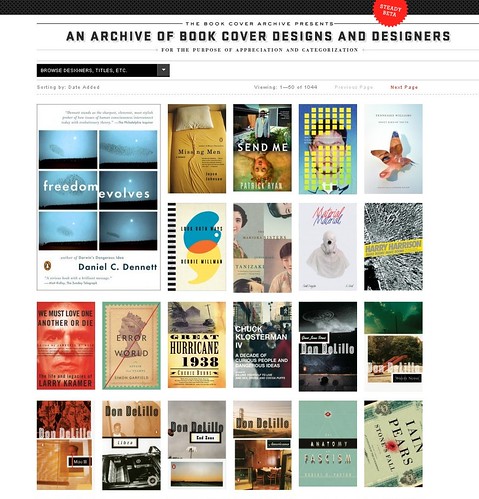
Lauded and linked to by everyone from The Guardian newspaper to the New Yorker blog (not to mention the really important folks like Drawn!, Kottke, We Made This, and Veer) the dazzling The Book Cover Archive is — as the name suggests — a hand-picked archive of book cover designs and designers, collected “for the purpose of appreciation and categorization.”
Edited and maintained by frequent collaborators Ben Pieratt of General Projects and Eric Jacobsen of Whisky Van Gogh Go, it’s an indexed database of credited book covers sortable and searchable by title, author, designer, art director, photographer, illustrator, genre, publication date, publisher, and even typeface.
Earlier this month, I emailed Ben and Eric with a series of questions about the project.
What was the impetus behind BCA?
Ben: In all honesty, the Book Cover Archive is meant to serve as a passive teaching tool for people like me who suck at book cover design but want to get better.
Do you see BCA as expansion on Covers, the book cover design project you created for Fwis?
Ben: The two sites provide different services. The Fwis Covers blog serves as a platform from which to comment and critique. You can’t post a cover on Covers without commenting on it. Whereas the Archive is passive in its function and editorial voice. The only curatorial decision is the binary It’s In Or It’s Not.
You’re getting quite well known—notorious even—for online not-for-profit ventures like Covers, ReadyMech, Schtock, and now BCA. How do you get started on these projects?
Ben: For every launched project there’s 10 failed ones that never got off the ground. It’s really just a matter of having ideas for projects that you know no one is ever going to pay you for and then running with it anyway because its fun as hell.
How did you become interested in book cover design?
Ben: Senior year of college I was struggling with my thesis project. I think I had been doing a study of “bad taste” and was just having a hell of a time with it. At around the same time my former business partner, Chris, told me to read Ender’s Game, a Sci Fi classic. I hadn’t read any sci-fi growing up because my dad kept feeding me non-fiction stuff. I loved the book but was embarrassed to carry it around because the cover was so incredibly bad. So I changed my thesis project to redesigning the book covers of science fiction classics. I’ve been mildly obsessed with both sci-fi and book covers ever since.

How do you select which covers to include in the archive?
Ben: I’m picky as hell.
Are there particular designers you look out for?
Ben: I’d like to think that I judge each cover on its merits alone, but there’s no question that I’m super biased. If its American and it’s coming out of New York then I’m probably going to love it.

Do you have any recent favourites?
Eric: I’m very excited about the new promotional work that Gollancz/Orion has been putting out, the Future Classics and Totally Space Opera series. Besides being surprisingly conceptual and classy takes on genre fiction, I think they point at a trend toward collectible and fetishable books as a revenue stream for authors and publishers. I hope we’ll be seeing more of these kinds of editions soon. More on this in a below.
You’re actually designer yourself. How do you go about designing a new book cover?
Ben: I don’t think I’ve designed anything decent enough to merit being asked this question, honestly. I have no tricks beyond embracing the power of utter panic.
What do think makes a good cover design?
Ben: one-half concept, one-quarter contextual appropriateness, one-half design, one-half je nais se quois, one-third alligator.
And, I have to ask, what makes for a bad one?
Ben: I’m starting to come to realize that the biggest difference between a good design and a mediocre one is the typography. Most covers have a decent, if not passable, concept. Everyone has concepts. It’s really the typography that sets the best apart from the rest. That’s my current thought anyway, subject to change.
Which book would you like to redesign?
Ben: I really dislike the covers of Malcolm Gladwell’s books. They’re completely decent, but they rub me the wrong way. They take a visual from his books and find a piece of related stock art and slap it together. I think he’s earned better. I’d also love to standardize Stephen Hawking’s catalog into some kind of glorious uber-nerd package with a lo-fi sci-fi aesthetic.
Have you ever seen a cover and thought “I wish I’d thought of that”?
Ben: Jamie Keenan’s design for Faster makes me want to give up on life. Jon Gray’s cover for Steinbeck’s Murder makes me feel inadequate in any number of ways. Rodrigo Corral’s design for Invisible Monsters makes me question my sense of self. Most recently Helen Yentus’ cover for The Way Through Doors leaves me questioning if I should pack it all up and become a plumber.
Have you ever bought a book just for the cover design?
Eric: Lots, particularly from McSweeneys. I also re-buy a lot of books I already own when newer, nicer editions come out.
Ben: I was looking for a good book on Ben Franklin recently and bought the Evan Gaffney-designed The Americanization of Benjamin Franklin specifically because I hated all the other covers. Great book, by the way.
With the growing popularity of e-books, are you concerned that book cover design may soon be a lost art (hence the need to archive it)?
Eric: Nope. See next question.
Ben: The only thing I’m worried about is animated covers. You know that shit is coming.
Are we finally seeing “The End of Print”? What’s next for books?
Ben: I have no idea. I don’t think I’m qualified to have an opinion on the issue. I certainly don’t think so. The tactility of the technology is going to have to improve significantly before people are willing and ready to abandoned their hard[cover]ware for hardware (sorry, I had to). As far as books are concerned, I assume the industry will go through the same pains as the music industry. The number of independent publishers and self-publishers will increase dramatically as technology allows them to bypass the major booksellers altogether.
Eric: I think that due to the nature of reading and readers, adoption of e-books will be much slower than that of digital music (a similar paradigm shift), so even if e-books herald an ‘End of Print,’ it’s at least a decade off.
Will it even happen at all? I think so. I hope so. When I read about objections to e-books, it’s usually a lot of hemming and hawing about tactility and comfort and even the smell of pages; these complaints rarely touch on such trivialities as book availability and overall readership, which e-books would certainly expand.
E-book detractors have of a strange idea of what most books are. Those beautiful dusty old encyclopedias, that rare first-edition of Ulysses, even your fancy new Vintage paperback? That is not most books. The Grisham and Grafton paperbacks at the airport, Chicken Soup for the Spirit, college textbooks — that’s most books. Does anyone really care if the next Janet Evanovich thriller has no corporeal form? Wouldn’t that be an improvement?
Those who fear e-books should have a discussion with audiophiles. While CD sales have been steadily declining all decade, vinyl — the choice of music lovers everywhere — has gone up. iTunes downloads didn’t destroy the serious album market; it got more people listening to more artists, at the expense of bulk CDs (which “real” music fans sneered at to begin with) by one-hit-wonders. Listen to audiophiles talk about the “warmth of sound,” fidelity and tactility of vinyl, and compare their words to those of bibliophiles talking about the scent of pages; these are kindred spirits.
Here’s a possible future scenario: e-books become wildly successful, at the expense of “airport paperbacks” and the bestseller list. Big Box bookstores go the way of Virgin Records. Readership and literacy grows (this is already happening), leading to more bibliophiles and Serious Book Lovers. As the market of crappy, badly designed books diminishes, the demand for beautifully crafted, fetishable books grows (sparking an unexpected return of the Independent Bookstore). There will ultimately be fewer books “in print,” but more awesome, well-designed books than ever.
Thanks Ben and Eric!
Link.
5 CommentsSomething for the Weekend, Dec. 12th, 2008
The 10 Commandments of Book Giving by Michael Dirda, Pulitzer Prize-winning critic and Senior Editor of the Washington Post‘s Book World (via Right-Reading):
Over the years I’ve gone through all kinds of Christmas presents, and nearly all of them quickly broke or have been long forgotten. Not so the gift books, whether Edgar Rice Burroughs’s Tarzan and the Golden Lion, a paperback copy of Ovid’s Metamorphoses or the Pléiade edition of Stendhal’s Oeuvres Intimes. Given to me by relatives, teachers and friends, they helped to make the season bright — and they also helped to make me who I am.
“Book apps for the iPhone keep getting better” according to Maud Newton (via DesignNotes)
Lying Liars: “Nearly half of all men and one-third of women have lied about what they have read to try to impress friends or potential partners”, the BBC reports.
Nintendo launches ‘great books’ package:
The creator of Donkey Kong and Super Mario is hoping that Austen and Dickens will prove as great a pull to computer game fanatics. It has worked with HarperCollins to select 100 titles – from 20,000 Leagues Under the Sea to Gulliver’s Travels, Pride and Prejudice, A Tale of Two Cities and Treasure Island – which will be available in a single software package for the Nintendo DS
Mwa ha ha! Chip Kidd discusses Bat-Manga! (via Books Covered)
The Age of Mass Intelligence — Are we actually smarter than we think we are? John Parker thinks so (via kottke):
One of the commonest complaints by cultural doomsayers is that nobody reads good books any more. Yet in the past two years, the Oprah Book Club in America recommended Tolstoy’s “Anna Karenina” and three novels by William Faulkner–good by any standard, and they all made the bestseller lists. This year, Waterstone’s, which owns over 300 bookshops in Britain, asked two celebrated novelists, Sebastian Faulks and Philip Pullman, each to choose 40 titles and write a few words of recommendation. The chain then piled copies of the books on tables next to the entrances of its main shops and waited to see what would happen. Faulks and Pullman hardly dumbed down their choices: they included Fernando Pessoa’s “Book of Disquiet”, Rudyard Kipling’s “Kim”, and Raymond Queneau’s “Exercises in Style”. The sales increases for these books over the same period the year before were, respectively, 1,350%, 1,420% and 1,800%–clear evidence of latent demand. If you offer it, they will come.
In this brief interview at inFrame.tv, award-winning Australian artist and author Shaun Tan discusses his work and the adaptation of his book The Lost Thing into an animated movie (via drawn):
And on a similar note, stills of the 25 minute animated adaptation of Oliver Jeffers’ book Lost and Found (to be broadcast on Channel 4 in the UK on Christmas Eve) can be seen on the STUDIOaka website. Looks lovely.
And this is probably my last regular post for the next couple of weeks. In the extremely unlikely instance you get withdrawal symptoms, you can always check out the links in the sidebar and/or send me an email!
See you in the New Year!
1 CommentMegalisters
“What fun is there in clicking… compared to the pleasure of handling a fine copy of a rare book?”
Mick Sussman examines used-book selling in the internet age for the New York Times:
[T]he state of the art in used-book selling these days seems to be less about connoisseurship than about database management. With the help of software tools, so-called megalisters stock millions of books and sell tens of thousands a week through Amazon, AbeBooks and other online marketplaces.
But, it’s not all bad news for the small dealer:
“Though the rise of the megalisters has hurt many mom-and-pop operations, the toll has been less than catastrophic. A database maintained by Susan Siegel of Book Hunter Press lists 3,968 “open shops” — as brick-and-mortar outlets are known — across the United States today, down from 4,119 in 2002. A 4 percent drop over six years might not be something to cheer about, but it would seem downright enviable to record or video store owners.”
What are smaller used-book sellers doing to survive? Using their experience, sharing “alchemical trade wisdom” in online forums, focusing on books that are rare–if not exactly collectible–and combining labour-intensive hand-selling with the selective use of e-commerce:
Comments closedAfter the great wave of creative destruction set off by e-commerce, the more adaptable breed of used-book seller seems to have survived… Chris Volk, a store owner and the vice president of the Independent Online Booksellers Association, says her colleagues are frustrated but undaunted by the megalisters. “In the long run,” she said, “people who know what they’re doing will win out.”
Can't find what you're looking for? Try refining your search: