Skip to content

59 search results for "chris ware"

Building Stories

Cartoonist Chris Ware has rightly been garnering a lot of attention for his new ‘graphic novel’ Building Stories14 books, booklets, magazines, newspapers and pamphlets that collect a decade of comics from The New Yorker, The New York Times and McSweeney’s, as well as previously unpublished work.

Douglas Wolk, author of Reading Comics, reviews the book for The New York Times:

You will never be able to read “Building Stories” on a digital tablet, by design. It is a physical object, printed on wood pulp, darn it. It’s a big, sturdy box, containing 14 different “easily misplaced elements” — a hard-bound volume or two, pamphlets and leaflets of various dimensions, a monstrously huge tabloid à la century-old Sunday newspaper comics sections and a folded board of the sort that might once have come with a fancy game. In which order should one read them? Whatever, Ware shrugs, uncharacteristically relinquishing his customary absolute control. In the world of “Building Stories,” linearity leads only to decay and death.

Comics historian Jeet Heer is as insightful as always for a somewhat undeserving Globe and Mail:

This marriage of comics and architecture might sound surprising, but it has a long history, which Ware, deeply knowledgeable about the past, knows well. The modern skyscraper emerged at the same time as modern narrative cartooning, in the middle of the 19th century, although both forms had prehistories that extend further into the past. The classic Sunday newspaper comic strip, with many panels on the page laid out on a grid, has obvious parallels with tall many-windowed office buildings, a fact that pioneering cartoonists like Winsor McCay played with when they drew stories that used the New York skyline not just as a backdrop but as a virtual character. The drawing board of a cartoonist is not unlike the drafting table of an architect. And in both drawing comics and imagining homes, you work with grids, rectangles and cubes and need to have mastered perspective.

And Rick Moody, author of The Ice Storm, gets terribly excited at Salon:

Building Stories is a masterpiece, above all, because it cares about human beings, many of them women. It cares enough to observe human beings closely, both when they are behaving themselves, and when they are engaging in their manifold selfishnesses. It cares enough about them to depict them when they are attractive and when they are singularly unattractive. The contemporary novel, it bears mentioning, does not care this much, because the contemporary novel is so preoccupied with affirmation that it will not risk what Ware is willing to risk.

Other reviews include David L. Ulin for The LA Times, Glen Weldon for NPR, Ian McGillis for the Montreal Gazette, and Rachel Cooke in The Guardian.

The Guardian and New York Magazine also have short interviews with Ware, but there also several excellent longer ones.

At Publishers Weekly, Ware speaks to Calvin Reid:

the idea behind the book is to try to get at the way we remember things, the way we put our lives together in our memories and kind of rewrite our own memories sometimes to suit ourselves. Also to get at a sense of how when you are remembering something that’s happened to you, sometimes you can almost lose yourself in that memory to the point where you lose the sense of the world around you, maybe just for a few seconds or something like that. I had hoped that with this book, that if say you start reading one story and interpret it as the present and then move on to another part of the book and realize that it wasn’t actually the present you were reading about, it was actually the character’s past, that that that might get at a little tiny bit of that feeling. I mean, every book is about a story happening from beginning to end and somebody changing as the story goes on but I wanted to try to create something that is maybe a little more analogous to the way that it feels in my brain, which is maybe a little more three dimensional and uncertain than that…

At the The LA Review of Books, Casey Burchby:

I don’t draft or script; the drawings and stories form themselves out of the images and what they suggest as I draw them, along with the memories they might dredge up. There’s really no way I could plan these things; the connections and coincidences that occur have to happen on the page. I’ve noticed that there’s a sort of nervousness on the part of the reader as to when exactly it is that the writer or artist starts winging it, as if that information has to be taken into account when assessing whether a story is believable or not, but it seems to me that writing an outline or a script on typing paper is just as much winging it as drawing directly on the page, and the latter approach allows the composition and scale to structure and shape the story, as well – which only taking notes or making thumbnails does not do. I do erase. I also have general ideas, themes, notions — whatever you want to call them, but I think that scripts come too perilously close to turning the process into illustrating words, which overlooks the inherent power of what cartooning — essentially a key to visual memory via the structure of language — can be.

And at The New Statesman, Alex Hearn:

I’m simply trying to present life as I’ve experienced it, though admittedly in my own very shielded, first-world way. My characters suffer very little compared to someone who might’ve seen their parents killed in a genocide, or endured starvation or disaster. I don’t know why some readers or viewers don’t find it more depressing that most popular books and movies and television programs can’t seem to not be about murderers or rapists or psychopaths — as if a story simply isn’t interesting unless someone is brutally threatened or killed. Violence is always the cheapest shortcut to emotional involvement.

And finally, Debbie Millman chats with Ware for the design podcast Design Matters:

Design Matters: Chris Ware mp3

Comments closed

Something for the Weekend

For the launch of his new book Building Stories, Chris Ware has two exhibitions opening this weekend. The first opens tonight at the Carl Hammer Gallery in Chicago. The second opens on Saturday at the Adam Baumgold Gallery in New York. Both shows will display original art from the new book.

The Snail — The ‘accidental’ history of the @ symbol at the Smithsonian Magazine:

Called the “snail” by Italians and the “monkey tail” by the Dutch, @ is the sine qua non of electronic communication, thanks to e-mail addresses and Twitter handles. @ has even been inducted into the permanent collection of the Museum of Modern Art, which cited its modern use as an example of “elegance, economy, intellectual transparency, and a sense of the possible future directions that are embedded in the arts of our time.”

A short profile of artist and designer Ray Eames at Dwell:

According to Beatriz Colomina, in her essay “With, or Without You: The Ghosts of Modern Architecture,” even though Charles and Ray Eames were revolutionary by including her name in the brand as an equal partner, Ray didn’t always receive her fair share of credit. An editor from the New York Times once erased Ray’s name from an article on the Eameses, despite protests from the writer, Esther McCoy. McCoy was outraged, and wrote Ray an apology letter outlining her frustrations over the omission (and the editor’s insistence on calling the Eames lounge a casting couch), “This is sheer nonsense; the broad audience isn’t titillated by the phrase casting couch nor does it object to a woman being credited for work,” she wrote.

And finally…

ShortList on Mary Harron’s movie adaptation of American Pyscho:

If there’s one moment in American Psycho that sums up the film’s utter greatness, it’s the business card scene. On the one hand, parodying the narcissism of Eighties yuppies, on the other, lending an insight into the warped psyche of the film’s protagonist… And 10 years after the film was first released, it’s certainly one of the reasons why this darkly hilarious Wall Street satire, based on the Bret Easton Ellis novel, is considered a cult classic and one of the greatest films of the past decade.

Comments closed

Something for the Weekend

Chris Ware’s astonishing cover for Crockett Johnson and Ruth Krauss: How an Unlikely Couple Found Love, Dodged the FBI, and Transformed Children’s Literature by Philip Nel. See the full thing in detail here.

A free interactive e-book about British artist Francis Bacon created by the estate of the artist and Katharina Günther is available from iTunes (via A Piece of Monologue).

Page 1: Great Expectations, the first book by GraphicDesign&, “collects the responses of 70 international graphic designers when posed with the same brief – to design and lay out the first page of Great Expectations by Charles Dickens.” The Creative Review and We Made This have more on the project.

And finally…

Jon Contino’s beautiful cover  illustration for The Marlowe Papers by Ros Barber. You can’t really tell from the image above, but the apple is actually brown foil, the grub and stalk in are in gold on finished book. You can see better in these pictures Contino posted to Instagram:

Comments closed

Something for the Weekend

The Art of Daniel Clowes: Modern Cartoonist is out next week.

Ware’s World — Seth Kushner’s photos of cartoonist Chris Ware in his Chicago home.  Leaping Tall Buildings: The Origins of American Comics by Christopher Irving and Seth Kushner is published by Powerhouse Books in May.

Redefining ‘Contrarian’ — Armond White on film critic Pauline Kael, and her reputation as a ‘contrarian’, in the CJR (via Bookslut):

Since the advent of the Internet and the rise of review aggregators like Rotten Tomatoes, the illusion of consensus opinion now dominates the culture’s perception of criticism. Individual critics’ voices matter less than the roar of the crowd, which judges films as “fresh” or “rotten” and drowns out anyone who begs to differ. Outlying critics are isolated and deprecated, their deviations from the consensus seen as proof of their eccentricity or ineptitude. As an icon of mainstream critical influence, and as someone who had little use for group hugs, Kael’s independent stance presents a real challenge to the current critical order.

Addressing this change is more urgent than simply championing Kael; it’s a matter of defending the endangered voice of independent criticism that Kael represented so well. Now is a good time to redefine “contrarian” as autonomous, uncoerced journalism. Kael’s writing—and the new, ongoing controversy she engenders—makes this absolutely necessary.

(I’m not at all sure White accurately reflects readers’ expectations of critics, but it makes for a fun article).

And finally…

Nobody’s Perfect — Noah Isenberg reviews Masters of Cinema: Billy Wilder by Noël Simsolo for the LA Review of Books:

A writer by nature, Wilder was a man of uncommon wit and unforgiving sarcasm who made his martinis with the same verve as he made his movies… His was a raconteur’s cinema, long on smart, snappy dialogue, short on visual acrobatics. And though his dizzyingly prolific, half-century-long career brought us everything from romantic comedy masterpieces Some Like it Hot (1959) and Sabrina (1954) to such acerbic gems as Double Indemnity (1944), Sunset Boulevard (1950), Ace in the Hole (1951) and The Apartment (1960), Wilder remained forever reluctant to embrace the notion of director as artist; he saw himself merely as a trafficker in mass entertainment.

Comments closed

Midweek Miscellany

Kate Beaton’s Wonder Woman returns.

Five-Pointed Stars of Pain — An excellent post on Dan Clowes and his latest book The Death- Ray at The Brooklyn Rail:

Clowes engaged themes consistent with those of literary fiction in visual terms and in bookstore-friendly formats, and he was not alone. By the turn of the millennium there emerged a critical mass of graphic novels ready to join Maus on the shelves of bookstores and libraries, and some far-sighted publishing insiders took notice. Chief among them was Chip Kidd, the acclaimed book designer for Knopf who also consulted on a handful of comics projects at Pantheon… Kidd perceptively encouraged Pantheon to make a stronger commitment to the comics form, and in late 2000 the publisher debuted two books: Chris Ware’s Jimmy Corrigan: The Smartest Kid on Earth and Clowes’s David Boring.

Ware’s critically lauded book, originally serialized in his Acme Novelty Library series, somewhat overshadowed Clowes’s deadpan investigation into lust and obsession. But the simultaneous publication of these two works by a major publisher made an unmistakable statement: a generation of cartoonists laboring in obscurity had come of age.

A Complicated Life — Los Angeles Times television critic Robert Lloyd on Tintin creator Hergé:

Hergé had left orders that, after his death, Tintin would go no more a-roving. That is not how it is with many fictional characters — or “properties” as they are sometimes called, perpetually prey to the whims of whoever holds the deed. James Bond has long outlived every thing Ian Fleming ever thought to do with him; a single comic-book hero may be the work of any number of cooks, prepared for a range of readers in a variety of flavors, from plain vanilla to something laced with rum, coke or Lithium. But Tintin without Hergé is as unthinkable — or if thinkable, still as wrong — as Charlie Brown without Charles Schulz.

Good Manners — Lorien Kite, the Financial Times’s books editor, has lunch with bookseller (and now managing director of Waterstone’s) James Daunt:

He was recently quoted as having referred to Amazon as “a ruthless money-making devil” that did not operate in the consumer’s interest – comments that generated an angry response in some quarters. Playing devil’s advocate, I ask: isn’t it up to consumers to decide what is more important, the price or a congenial experience? “I wouldn’t disagree with that at all,” he says. “Oddly enough, completely contrary to that headline, I genuinely don’t feel sorry for myself. As long as I deliver something that people enjoy, I’ll be fine.”

And finally…

Alice Rawsthorn on graphic designer Robert Brownjohn for The New York Times:

Talented though he was, Brownjohn’s contemporaries knew him as much for his decadent lifestyle as for his work. Charming and gregarious with a flair for grand gestures, he was haunted by drug addiction. As his friend, the British graphic designer Alan Fletcher, once wrote: “He had real charisma rather than character. You always knew he was about five jumps ahead of whatever you were thinking…”

A few years after his arrival in London, Fletcher arranged for him to talk to a group of designers. Brownjohn spoke lucidly but looked fragile and, at times, struggled to stay awake. An architect in the audience asked: “What is graphic design?” Brownjohn replied: “I am.”

(NB: Posting will probably be a bit sparse here from now until mid-January, so just reminder that there’s also The Accidental Optimist, The Casual Optimist Tumblr and Facebook which will be updated more frequently).

Comments closed

My Favourite Covers of 2010

At the end of last year, Joseph Sullivan, curator of the late lamented The Book Design Review, asked me to write about my favourite covers of 2010. I’d always stayed away from such posts in the past because it was Joseph’s thing (his 2009 list is here). But since it was Joe who was doing the asking and The BDR was on “indefinite hiatus,” how could I not?

For various reasons, the list I compiled didn’t get used in the end, and it has sat in my drafts folder for about year now. I now have a list of my favourite covers of 2011, but before I post it I thought I would share that original list from 2010, if only for a bit of context.

I’ve made a few minor alterations to the list I sent to Joe — mostly to better accommodate the series designs and to fully utilise 12 months of regret and hindsight — but it is more or less intact, in spirit at least.

I’ve included the short introduction I wrote for the original piece to explain my process (or lack thereof…).

(Hindsight = 20/20: Apparently I like negative space. A LOT).

The Top 10 Book Covers of 2010

Selecting an annual top 10 of anything — film, music, books — is fraught with difficulty. Not only do you have to sift through all things you have seen, heard, and read over the course of a year (assuming you can remember them all), you must somehow take into account all the things you meant to get to and didn’t (where does one even start?). Worse, you are haunted by the awful, inevitable realization that there were any number of incredible things so outside your usual cultural range that they didn’t even register on your consciousness — the “unknown unknowns,” to borrow Donald Rumsfeld’s immortal phrase. Fate usually decides that you will discover at least one previously unknown work of brilliance exactly 24-hours after you publicly declare your favourites…

Then, having grappled with (ignored) all those thorny issues (and plunged on regardless), there is further problem of what actually constitutes good (let alone “great”) book cover design. Part science, part art (part pleasing interested parties), good book cover design is slippery and alchemical. How does one judge? Using what criteria? Ask 10 designers and you will surely get 10 differently nuanced answers.

I have not read all the books on this list, so I cannot claim authority on appropriateness of every cover to its subject (surely an significant consideration, and yet who would want to limit their list only to the books they had read?), so my criteria, such as they were, included the quality of the overall design — the composition, image selection and typography — as well as originality, swagger and the indefinable  je ne sais quoi essential in my opinion to really great covers.

And with that complete abdication from any claim to comprehensiveness or authority, I introduce my picks for the top 10 book covers of the last year with apologies to all the designers — particularly outside of North America and the UK — whose amazing work I have missed, forgotten, or otherwise neglected.

The covers are presented in alphabetically by title.

3 Comments

Q & A with Tom Gauld

Tom Gauld is a cartoonist and illustrator based in London. I first came across his work a few years ago in a book called Both published by Bloomsbury in 2003. Both (sadly now out of print) collected comics by Tom and Simone Lia originally self-published as First and Second under their imprint Cabanon Press.

Since then Tom’s book cover illustrations and literary cartoons have featured regularly here and on The Accidental Optimist. His work is funny (oh so funny) — silly even — but it combines pathos with the farcical. His heroes are unlikely or put-upon; his robots lonely, mundane or murderous; detectives are clueless; scientists baffled. Everyone (including the robots), it seems, would rather have stayed at home with a cup of tea and a good book. There is a gentle subversiveness to it all, although it is never mean-spirited. I hesitate to describe it as Pythonesque, but it is in a way. Tom’s machines all look as if they go ‘ping’. Other references include superheroes (less than you might think), adventure serials, mysteries, literary fiction, 1970’s science-fiction, Stanley Kubrick, fairy tales, and old Open University TV shows. It’s eccentric to say the least, but wonderful nonetheless.

Tom and I corresponded by email.

When did you first start drawing cartoons?

I’ve drawn for as long as I can remember and I drew a lot of cartoons when I was at school, but I suppose it was when I was studying at Edinburgh College of Art (around 1998) that I really began drawing comics and cartoons seriously.

Why did you start self-publishing your work?

I first self-published a comic called  First with my friend Simone Lia in 2001 when we were studying at the Royal college of Art in London. I’d say we did it partly because we didn’t know anyone else who would publish it, but also because I was interested in the business of designing and hand making the whole object. I had bought a self-published comic called OAF by Mat Brinkman a few years earlier and it inspired me to self-publish: it was small and hand-made and quite rough, but really unique and lovely. I suppose I’d seen self-published stuff before, but OAF really excited me.

Was the design of your books always important to you?

Yes, definitely. I think with any book, but particularly with a picture book of some kind, the experience for the reader begins before they even pick up the book. So I try to make every aspect of my own books contribute towards the story or idea. When I started, I was as much interested in designing, making and publishing a book as I was in the actual stories within.

Is Cabanon Press on permanent hiatus?

I wouldn’t want to say that Simone and I won’t ever start it up again. But we don’t have any plans to do anything with it for the moment. I’m still self-publishing things, but for Cabanon to work I think it has to be something Simone and I do together and we’re too busy with other things.

Where are your cartoons published now?

I do a weekly cartoon for The Guardian which appears in the (art and books) Review every Saturday, some of these cartoons also appear in The Believer’s comics section. I do something to accompany the The New York Times “Riff” essay every Sunday but that’s usually more an illustration than a cartoon. I also regularly put my work on my Flickr photostream.

Briefly, could you describe your working process?

I sit and think and doodle in my sketchbook until I have a good idea. Then I’ll make rough pencil sketches on copier paper till I have things worked out visually. Then I hone these sketches on paper and in photoshop till I have a rough version of the image which I can send to anyone who needs to approve it. Then I will print out the image and use a lightbox to trace an ink version which I crosshatch then scan back into the computer where I can clean it up, tweak bits and add any colour. I love using the computer but I try to stay away from it till I’ve done most of the thinking for an idea, looked at it from all sides, because I feel that once the computer is involved things are on an inevitable path to being finished. Whereas in my sketchbook the possibilities are endless.

How is illustrating a book cover different from your weekly cartoons?

It’s very different. I feel more pressure doing a book cover than almost anything else, I think “This author has probably spent years writing this book: I mustn’t mess it all up with a crap cover”. So I have to try and find a way to react to the book and make something which is suitable, but is also strong and interesting in its own way.

Are you planning any more full-length comics?

My forthcoming book Goliath is really the first time I’ve written a book-length narrative (albeit quite a short book) and I found it much harder than writing short pieces, but I’m happy with the result now. I will probably write another one, but not straight away. I’ve got a couple of shortish things I want to do, then after that I don’t know what I’ll do.

Where do you look for inspiration, and who are some of your cartooning heroes?

I listen to the radio, watch TV and films, go to museums and most of all read.

Cartooning heroes: William Heath-Robinson, Gary Larson, Roz Chast, Richard McGuire, Ben Katchor, Daniel Clowes, Chris Ware, Jochen Gerner.

How has Edward Gorey influenced your work?

I’m a big fan of Edward Gorey. I discovered his work when I was at college and immediately wanted to seek out everything he’d ever produced. I like that what he makes is unclassifiable: he makes picture books for adults which aren’t comics, many are self-published but they’re beautifully produced. I love his drawing, the odd narratives, the design of the books, the compositions, the hand drawn typography: everything really. The way I crosshatch (with small “patches” of short lines rather than long ones) I learned from Gorey.

Are you obsessed with robots?

I think I probably am a bit. I find they are very good props/characters for my stories and ideas. I like the inherent sadness in robots: they are sentient beings but also products which can break or be discarded (in my stories anyway). Also, they are much easier to draw than real people.

Who else do you think is doing interesting work right now?

Jon McNaught, Kate Beaton, Anders Nilson, Sammy Harkham.

What are a few of your favourite books?

Off the top of my head:

The Inheritors by William Golding
The Vinegar Works by Edward Gorey
Tinker, Tailor, Soldier, Spy by John le Carre
Teratoid Heights by Mat Brinkman
The Summer Book by Tove Jansson
The Stanley Kubrick Archives by Alison Castle

Are there any books you would love to illustrate? 

I’d like to do a book of fairy-tales or folk-tales.

What have you read recently?

The Thousand Autumns of Jacob de Zoet by David Mitchell
Through the Language Glass by Guy Deutscher (A fascinating book about language and colour)
The Annotated Brothers Grimm by Maria Tatar
The Cardboard Valise by Ben Katchor

What’s next for books and print?

One thing which might happen with the rise of e-books is that the books that DO get published in paper may have to justify themselves by being better made, designed and illustrated. That would make me happy.

Thanks, Tom!

For the sake of full disclosure,  I should mention that Tom’s forthcoming book Goliath, will be published by Drawn & Quarterly and distributed in Canada by my employer Raincoast Books.

7 Comments

Something for the Weekend

A two-part interview with Chris Ware, author of Jimmy Corrigan: The Smartest Kid on Earth,  in The Comics Journal:

I just wanted to make a comic book that had a bit of density to it, and build on the cartoonists whose work I really deeply admire. I could list hundreds of cartoonists whose work I’ve stolen from, and I try to acknowledge them all, so I just wanted to make a book that didn’t lie, as much as I could.

Part One | Part Two.

And, designer Eric Heiman on Chris Ware for Eye Magazine:

Ware’s aims are literary, not pragmatic. But his work is still a subtle reminder that no amount of order we – as designers or otherwise – impose on our lives can ever eliminate the unexpected twists and turns they take. Quantitative data, no matter how clearly and beautifully presented, is not always the know-all, end-all answer, even in this age of Google analytics.

The Literarian — The new online journal for The Center for Fiction.

Science Fiction Lesson – Author Ursula K. Leguin talks about writing and science fiction with Owen Bennett Jones for the BBC World Service.

Split Personality — Author John Banville on author Benjamin Black in The Boston Globe:

I do a Benjamin Black in the spring and early summer. I hate summer so this is a wonderful excuse to sit in my room and pound away at a crime book. I write those quickly on the computer, in three to four months. What I want from Benjamin Black is spontaneity; John Banville writes in longhand with a fountain pen. I can’t do them both at the same time. Banville was never much interested in character, dialogue, and plot, and Black is entirely character and dialogue and plot. With the crime novels, it’s delightful to have protagonists I can revisit in book after book. It’s like having a fictitious family.

And finally…

A neat animated trailer for the documentary Waiting for “Superman”:

Comments closed

Something for the Weekend

Limits and Boundaries — Peter Mendelsund, associate art director at Knopf, discusses his cover design for Jo Nesbø’s The Snowman with The New Yorker’s ‘The Book Bench’:

[O]ften my favorite jackets are the ones done after repeated rounds of failure and rejection. There’s something to be said for the desperation that rejection engenders in me. Sometimes, when the process feels most intractable and hopeless, a kind of last-ditch clarity appears. That being said, it’s also nice when you get it on the first stab.

And on the subject of super-talented book designers… A short Q &A with Coralie Bickford-Smith, Penguin senior cover designer, at 10 Answers.

I, Reader — Alexander Chee on e-books and life spent reading for The Morning News:

Many ponderables remain regarding the e-book. At a personal level, I am someone who has read books in poor light for decades without hurting my vision (despite what my mother claimed), and I’m keeping, well, an eye on that—the iPad gives me headaches in ways reading on paper never did. As a writer and former bookseller, I understand the e-book’s imperfections and limits, and monitor the arguments that it will end publishing or save it, and potentially kill bookstores, which would kill something in me, if it were to happen. But I also believe that the book as we know it was only a delivery system, and that much of what I love about books, and about the novel in particular, exists no matter the format. I’ve lately been against what I see as the useless, overly expensive hardcover, and I admit I enjoy the e-book pricing over hardcover pricing. Still, I’ll never replace the books on those shelves, and there’ll always be books I want only as books, not as e-books, like the new Chris Ware, for example, which would be pointless on an e-reader. This really is just a way for me to have more.

Rage Against the Machine — Onnesha Roychoudhuri’s long and much talked about article on Amazon for the Boston Review:

What happens when an industry concerned with the production of culture is beholden to a company with the sole goal of underselling competitors?…

The conceit is that that $9.99 price tag is what the market demands. But in this case Amazon is the market, having—with no input from its suppliers—already dictated the price and preempted the standard fluctuations that competition and improved efficiency impose on prices…

Cheap books are easy on our wallets, but behind the scenes publishers large and small have been deeply undercut by the rise of large retailers and predatory pricing schemes. Unless publishers push back, Amazon will take the logic of the chains to its conclusion. Then publishers and readers will finally know what happens when you sell a book like it’s a can of soup.

Talking About My Generation — The LA Times’ David L. Ulin on Gary Trudeau’s 40: A Doonesbury Retrospective:

[T]he trick, the secret of “Doonesbury,” that, in its topicality, its ongoing dailiness, it is really about something more profound. Trudeau highlights that in his introduction: “It’s not about Watergate,” he writes of the collection, “gas lines, cardigans, Reaganomics, a thousand points of light, Monica, New Orleans, or even Dubya.” No, indeed, although such elements do show up here, more important are the people, the dance of generations, their humanity. This is where “Doonesbury” is at its most compelling…

And finally…

Andrew Kuo, who creates off-beat music infographics for The New York Times,  talks about his new book of personal work,  What Me Worry (published by The Standard), at Interview Magazine (thx PMac!).

2 Comments

Somthing for the Weekend

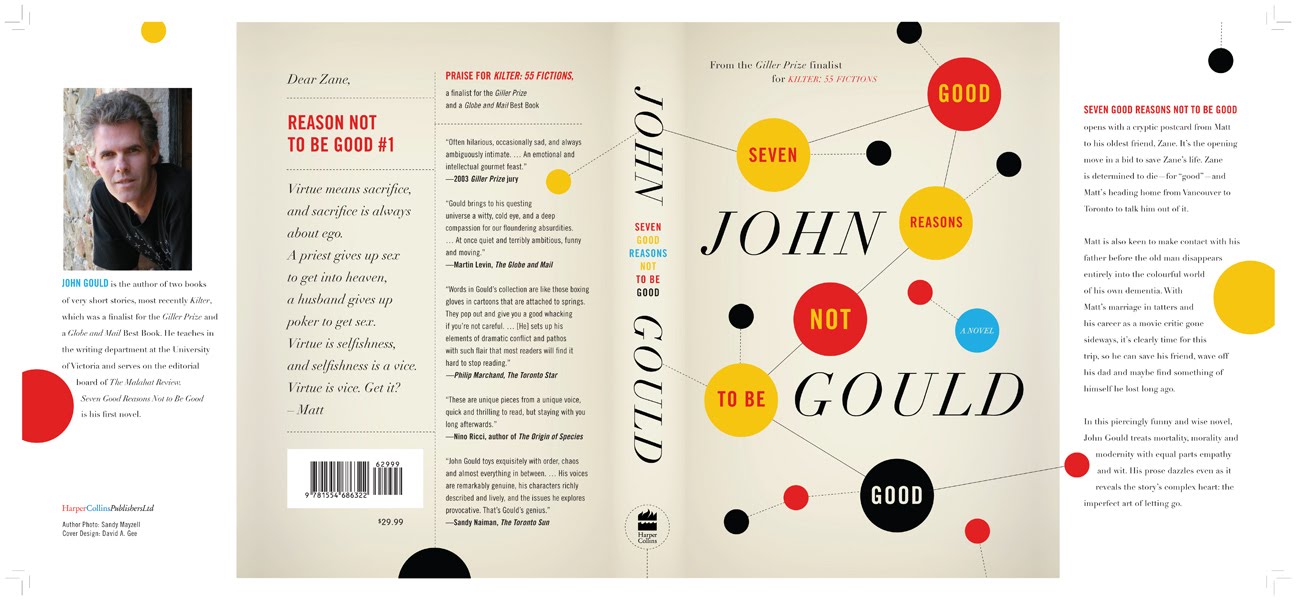
“Spot gloss on the molecules” — David Gee’s cover for 7 Good Reasons Not To Be Good by John Gould.

Going Back — Artistic Director Michael Salu on the creating the cover of the new issue of Granta magazine:

For this concept to work, we needed to strive for authenticity – to create the physical object ourselves. The typefaces would need to be sourced, traditionally hand-set and photographed to give the cover the depth that the issue deserves. For this I approached St Bride Printing Library, which has long been a place of fascination and wonder for me. My first visit to the library – with its oil, wood and metal, its smell of history – made a huge impression on me.

The Connoisseurs — Peter and Charlotte Fiell, who recently ended their 15-year tenure as heads of the design branch of Taschen, talk about their new publishing venture Fiell at More Intelligent Life:

What is design? It’s the forethought that goes into the making of man-made things. It’s films, pharmaceuticals, airplanes, chairs, tape recorders … it’s the world of stuff. It’s huge, so everybody should have a big interest. It’s not some avant-garde, highly expensive niche. We want to make money by publishing books that sell, but we’re in the business of promoting ideas, culture, taste, connoisseurship. If you want to make a difference you want to get into as many people’s heads as you can and change their opinion. The secret is to strike this balance between making your books appealing to learned type readers, while at the same time, making them useful and interesting to novice readers. Our aim is to make books as appealing to teenagers in Tokyo as architects in Amsterdam.

(Above: Spreads from Tools for Living: A Sourcebook of Iconic Designs for the Home by Charlotte and Peter Fiell)

Designing In Order To  Eat — Chris Ware’s introduction to Penguin 75 excerpted at GQ magazine:

Book designers, you should know, have to be ready to create something new, exciting, and original almost every day in order to eat, and a certain degree of burnout smokes out the weaker specimens; I can’t imagine coming up with cover after cover without at some point resorting to an out-of-breath take, intentional or not, on someone else’s great idea. This urge toward ever-freshness brings the profession perilously close to that of fashion, and the worst examples of such greet us at the grocery store checkout among the tabloids, gum, and ring pops. But the best of it, those that last, have recently been appearing from Penguin (yes, Penguin, not just the bearer of boring spring break assignments anymore!), following a path led by designer Paul Buckley into beautiful new ways of graphically proffering the written word.

The excerpt is accompanied by a slideshow of covers from the book. My interview with Paul Buckley and designer Christopher Brand about Penguin 75 will be up early next week.

And Finally… The book cover design Tumblr (via Alan Trotter’s ≥ notes)

1 Comment

Something for the Weekend

An Ethics of Interrogation — Another stunning cover design by Isaac Tobin (via This Isn’t Happiness). My Q & A with Isaac here, if you missed it.

Isaac also has at least two covers in AIGA’s 2009 selections for 50 Books/50 Covers.

Reader Despair Syndrome — An unintentionally Onion-esque post about RSS anxiety (something we can all relate to I’m sure) by Leon Neyfakh for the New York Observer (via Sarah Weinman):

Legions of jittery, media-conscious New Yorkers are eating themselves alive signing up for feeds they never end up reading  in hopes of becoming better people—more knowledgeable, more fun to talk to, more in control of their Internet consumption. They subscribe to dozens, sometimes hundreds of news sources, each of them added to the list with the best of intentions…

Hark! — Dave Howard interviews artist Kate Beaton about her comic Hark! A Vagrant for The Torontoist:

It’s very calculated, it takes me a long time to write a strip, but when you read it, part of the delivery is that timing, that kind of bouncyness of flow, getting a punch-line in without being obvious about it. Or getting the slip on someone, to make them laugh.To make somebody laugh is a difficult thing, it takes a lot of precise steps.

And speaking of comic strips…More Chris Ware posters seen at OMG Posters!

And finally…

The Superhero/Villain Name Generator

Comments closed

Midweek Miscellany

Chris Ware’s cover for the latest issue of The New Yorker (via The Ephemerist).

Pop Will Eat Itself — Author Lev Grossman (The Magicians) on automated recommendations:

[Recommendation engines] introduce us to new things, which is good, but those new things tend to be a lot like the old things, and they tend to be drawn from the shallow pool of things other people have already liked. As a result, they create a blockbuster culture in which the same few runaway hits get recommended over and over again. It’s the backlash against the “long tail,” the idea that shopping online is all about near infinite selection and cultural diversity. It has a bad habit of eating its own tail and leaving you back where you started.

The Dark Underside of American LifeThe Observer‘s film critic Philip French on the late Jim Thompson and Michael Winterbottom‘s film adaptation of The Killer Inside Me:

Thompson was a man of the left, a lifelong alcoholic and became closely acquainted with the dark underside of American life, the lonely crowd where petty criminals, low-level cops, conmen and prostitutes rub shoulders… One of Thompson’s critics has called him without disparagement “a dime novel Dostoevsky”…

And finally… Popville, a super stylish pop-up book by Anouck Boisrobert and Louis Rigaud, published by Macmillan (thanks Sio!):

5 Comments