Skip to content

The Casual Optimist Posts

Something for the Weekend

It Will All Be Over Before You Know It… — A six-page, six-chapter comic by the brilliant Richard Sala (a must for fans of Edward Gorey, I’d say).

Something Lost — Edmund de Waal, ceramicist and author of The Hare with Amber Eyes, on inspiration for writing and art at The Browser:

[T]here is still something extraordinary about art which comes out of an encounter between a person and a material. The further you get away from that, the more you get into something which is commodified and reduced to a series of other people’s interactions with it. There is something extraordinary which is lost.

Talking Covers — A new blog, edited by writer Sean Manning, where authors, designers, and artists discuss book covers. The cover to Sean’s own book, The Things That Need Doing is discussed here.

The Solitary World — Ellen Handler Spitz, author of Illuminating Childhood, on the late Maurice Sendak:

Sendak knew from within the profound sense in which every child, from time to time, perceives himself or herself to be alone—an outsider—and feels the need to retreat into some private space, some nook or secret hiding place. Sendak’s books are themselves such places; they can so function even when being read aloud by an adult. Sendak’s supreme gift, as visual artist as well as author, was to discover pictorial as well as verbal and narrative means to portray the existential separateness of childhood.

And finally…

Championship Hoarding — Steven Heller on “stuff”:

It is one thing to have stuff and another to collect it. It is one thing to accumulate stuff and another to exhibit it. What’s the point in just keeping stuff in drawers, out of view? Stuff is/are trophies, evidence of championship hoarding — finding the perfect rarity that no one else has found. Collecting stuff can be competitive, even if only in the mind. Therefore, showing one’s bounty is essential to having stuff. So the vehicle for display is just as essential as the objects themselves.

Have a great weekend.

Comments closed
Typesetting

Typesetting is a new documentary series that explores the relationship between designers, their work, and the cities in which they live. In the first episode designer Elisabeth Kopf talks about living in Vienna and how it inspires her untraditional approach to design. I had never seen Kopf’s highly original work before, but her beautiful Little Orchestra CD packaging is wondrous. Watch:

(via Coudal)

Comments closed

Midweek Miscellany

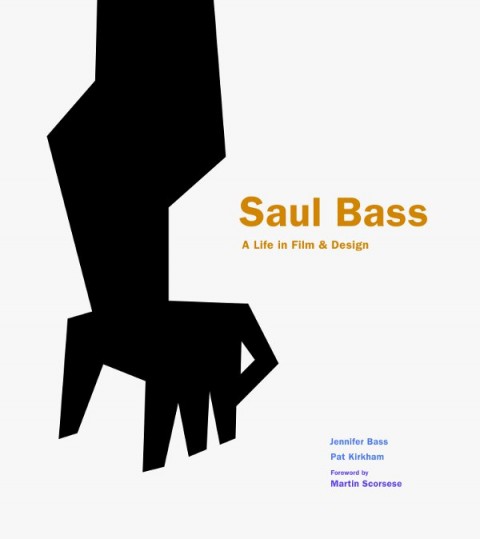
Lyra Kilston reviews Saul Bass: A Life in Film and Design for the LA Review of Books.

The Well-Made Book — An interesting article by Michael Agresta on how printed books, and their design, are changing in the digital age:

Now, as we move into the digital age, the well-made copy has come to occupy a familiar, almost nostalgic middle ground between the aura of an original and the ghostly quality of a computer file. A mass-produced paper book, though bulkier and more expensive, may continue to be more desirable because it carries with it this material presence. And presence means something—or it can, at least, in the hands of a good book designer.

Innards and Interiors — The Bauhaus: Art as Life exhibition at the Barbican reviewed at The Financial Times:

Paul Klee favoured risotto with steamed calf’s heart, sour liver and lung ragout: in the kitchen, as in his paintings, he was obsessed with innards, interiors, reconfiguring essential forms. Wassily Kandinsky lived in a streamlined white apartment but, incongruously, cooked on a “kamin” – a Russian wood-burning stove made from heavily ornamented black iron. Josef Albers claimed “I paint the way I spread butter on pumpernickel” – robustly and straightforwardly; he called the colour mixes in his “Homage to the Square” series his “recipes”. And Swiss painter and vegetarian zealot Johannes Itten was driven out of Weimar because he hijacked the Bauhaus kitchen and alienated director Walter Gropius by producing only “uncooked mush smothered in garlic”. The Barbican’s new exhibition… gives a whole new flavour to the story of the art school long seen to embody sober, purist German modernism.

Weird Comics — Local small press publisher Annie Koyama profiled in the Quill & Quire:

Koyama says her strategy for the year ahead is “to throw everything against the wall and see what sticks,” but she acknowledges her biggest business challenge is twofold: increasing print runs to improve margins and lining up reliable distribution for the fledgling firm. After working around the clock for nearly four years… she says her goal now is to create a sustainable enterprise that can continue to fulfill its artist-centric mandate… She’s also considering expanding into children’s books. But not in the way you’d expect. “While there are a million good kids’ books out there, there aren’t a million good kids’ comics I can see – especially not weird ones,” she says.

And finally…

Maurice Sendak, “author of splendid nightmares” has passed away aged 83. The New Yorker has made a short Art Spiegelman comic about meeting Sendak available online. And here is a wonderful interview with author from December last year:

Comments closed

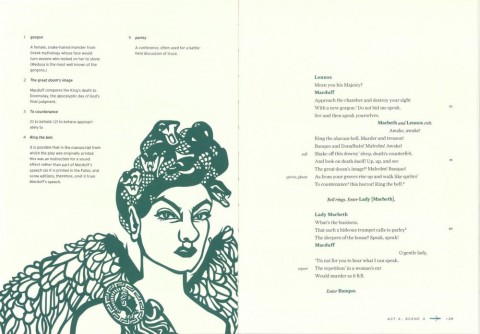
Signature Shakespeare Illustrated by Kevin Stanton

Freelance illustrator and paper artist Kevin Stanton recently contacted me about his book illustrations for the new Signature Shakespeare editions of Romeo and Juliet and Macbeth.

Art directed by Ashley Prine at Sterling Publishing, and with additional typography by the immensely talented Chin-Yee Lai, both books have laser-cut covers, as well as five laser-cut interior illustrations per book, and more than 30 other illustrations.

The results are beautiful and the project sounded like fascinating undertaking, so I thought I would ask Kevin a little more about it.

We corresponded by email.

How did the project come about?

Two years ago, at the very beginning of my foray into freelancing and just a month after graduating from Pratt, I received an unsolicited email from Pamela Horn, a Editorial Director at Sterling Signature. It turns out that a higher-up in the company had seen my work at Pratt’s Annual Pratt Show and passed my portfolio on to her!

After we met a few times, she mentioned that she’d been looking to do a project with a paper artist, and that when the right one came along she would let me know. Initially this had meant a series of Classics book covers, but that fell through. Nine months after our first interview, I got the call — Pam wanted to do a series of Shakespeare plays, starting with Romeo and Juliet and Macbeth, each with a cover and fifteen plates! And that was a dream job right there! And after some discussion with my Art Director, Ashley Prine, it got even better, even more unreal: today it is a hardcover book with a laser-cut cover, five interior two-layer laser-cut illustrations, and almost forty printed spots, spreads, act openers and motifs. And my name on the cover to boot!

How did you approach such a big project? 

The process was interesting to figure out. After hand-cutting a great deal of the book, we realized that scans of the pieces didn’t look good and there was no quick-fix for turning them into vectors. Enter my friend and assistant, Victoriya Baskin. Since my sketches before I cut are like maps of everything (I don’t freehand anything), she was able to vector it all together so that we had a product that could be printed on the pages and sent to the laser-cutter with clean, expert lines! And the work can be edited, which was our primary concern with paper.

How you feel about the final results?

It’s been an absolute dream. As a young illustrator, and one that works in paper, I couldn’t have hoped for a better display of my work than these books. I am so happy with them, although seeing them on the shelves in a book store is the most surreal experience for me. It’s a privilege to work with my entire team, and an honor to have been a part of such a phenomenal production! Much Ado about Nothing and Hamlet are next in line to be published in November!

Thanks Kevin!

You can see more of Kevin’s work on these books on his blog.

7 Comments

Design Matters with Steven Heller

In a fascinating and wide-ranging conversation, design historian Steven Heller talks about design and his recent book 100 Ideas That Changed Graphic Design with Debbie Millman on Design Matters:

Design Matters: Steven Heller mp3

Heller really is an astonishingly prolific author.

(Full disclosure: 100 Ideas That Changed Graphic Design is published by Laurence King and is distributed in Canada by my employer Raincoast Books)

Comments closed

More Matt Taylor le Carré

Under Paul Buckley’s art direction at Penguin US, UK-based illustrator Matt Taylor has produced two more stunning John le Carré covers. The type and design is by Gregg Kulick.

You can see the previous covers in the series here, and, according to Matt, there are a couple more on the way. Happy day.

Comments closed

Something for the Weekend

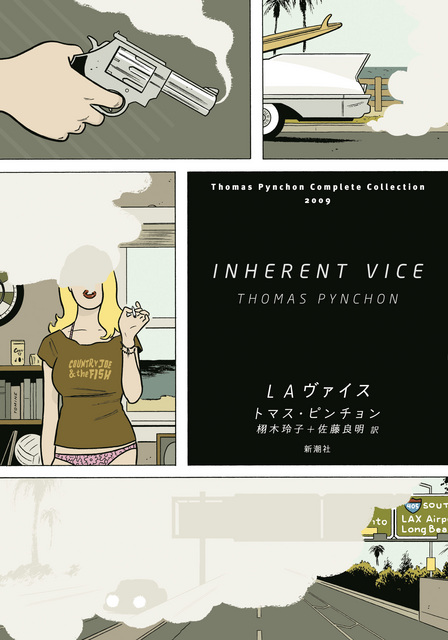
Cover illustration by Adrian Tomine for the Japanese edition of Inherent Vice by Thomas Pynchon, published by Shinchosha Publishing.

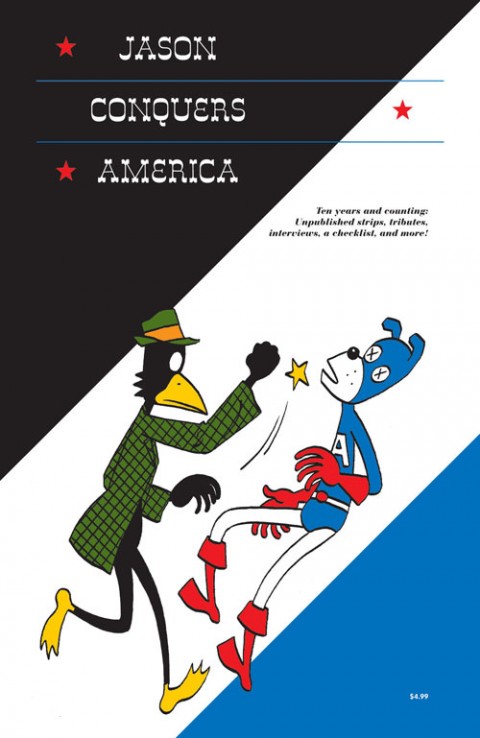
The Darkness — Norwegian cartoonist Jason profiled in The National Post:

“A comedy that has some darkness, like The Apartment, is more appealing than if it’s just fluff. Ingmar Bergman’s best film, to me, is Fanny and Alexander, that is dark, like many of his early films, but there is a joy also, an affirmation of life,” he continues. “Darkness just for being dark doesn’t interest me that much. … I prefer the vitality of something that isn’t perfect.”

Jason will be at the Toronto Comic Arts Festival this weekend, and you can read my Q & A with him here.

Bam… Bam… Bam… David L. Ulin, writing at the LA Times, on interviewing William S. Burroughs:

“Life is a cutup,” Burroughs says about halfway through his conversation with Ginsberg, referring to his technique of bisecting pieces of text and reconfiguring them as collages, letting the juxtapositions create a meaning that transcends traditional narrative. “And to pretend that you write or paint in a timeless vacuum is just simply … not … true, not in accord with the facts of human perception.”

Yes, yes, I found myself thinking, not least because four years later, Burroughs had said virtually the same thing to me. “Life is a goddamn cutup,” is how he put it. “Every time you look out the window, or answer the phone, your consciousness is being cut by random factors. Walk down the street — bam, bam, bam…. And it’s closer to the facts of your own perception, that’s the point.”

Ulin is referring to a conversation between Allen Ginsburg and Burroughs recently published in Sensitive Skin magazine.

And finally…

A Deadman’s Masterpiece — Gabriel Winslow-Yost on Tarkovovsky’s movie Stalker, the Chernobyl disaster, and the S.T.A.L.K.E.R. series of video games, for the NYRB:

The Zone in the video games is a beautifully dangerous place, bigger and grimmer than Tarkovsky’s, but somehow still appropriate. There are plenty of long, tense walks through damp weather or empty, creaking tunnels. Packs of dogs wander the landscape, ruined farmhouses give shelter from the rain; here and there the ground ripples strangely. Stalkers gather around campfires, bandits take potshots at passersby, and a man lies wounded in a ditch, begging for help. Watching Stalker, one is occasionally brought up short by remembering that it was not filmed in Chernobyl, so perfect an analogue does that event seem for the film’s images of technology and nature, beauty and danger in strange alliance. The games, at their best, can seem like a sort of miracle: a dead man’s masterpiece, come home at last.

Comments closed

Midweek Miscellany

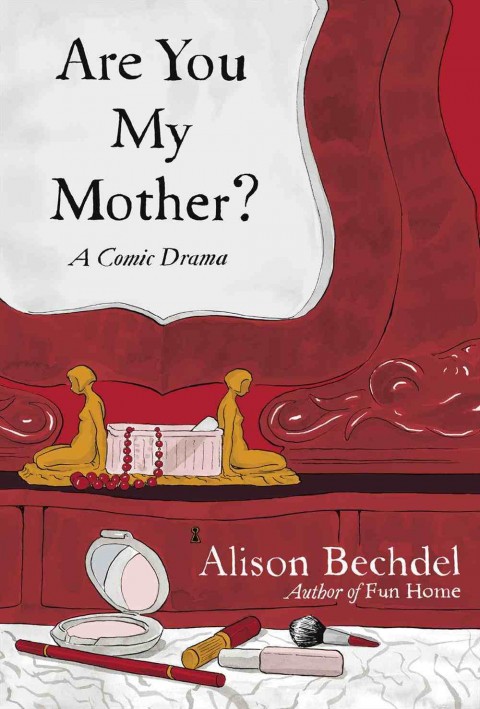
This Precarious Balancing Act — Maud Newton talks to Alison Bechdel, author of (the astonishingly good) Fun Home, about her new graphic novel Are You My Mother?. Fascinating stuff:

I feel like cartooning for me has been like a way to be a crypto-writer. I couldn’t ever say I wanted to be a writer because my mother was a writer, and even now I’ve had to find this alternative way of expressing myself as a writer. I don’t want to diminish the drawing. I think it’s integral to what I do. But I’m kind of a secret writer… I’m very wordy for a cartoonist. I’m always struggling against that, because the more space your words take up the less room you have for pictures. So it’s always this precarious balancing act.

School Disco — Mark Medley’s latest National Post piece on House of Anansi Press follows the publisher to the London Book Fair:

The London Book Fair, now in its 41st year, is one of the biggest, and most important, in the world — though it is dwarfed by Frankfurt, which takes place in October. This year, the fair hosted more than 1,500 exhibitors from 57 countries and expected more than 25,000 attendees, almost half from overseas. During the festival’s three days, MacLachlan describes it variously as “a meeting of the tribe,” “highly social,” and “like [a] school dance. The cool kids are in one corner, the nerds are somewhere else.”

Confused By the eBook Lawsuit? So Is Everyone else” — Peter Osnos, founder of Public Affairs Books, writing at The Atlantic.

And finally…

With the Bauhaus: Art as Life exhibition opening at the Barbican tomorrow, author Fiona MacCarthy (William Morris: A Life for Our Time)  looks back at the revolutionary design school at The Guardian:

Gropius’s idea for the Bauhaus emerged from his experience of the first world war in which he served as a cavalry officer on the western front for almost the whole four years. His response to the devastating scenes he lived through was a stark determination to “start again from zero”. Only a new outlook on design and architecture could provide the means for a shattered civilisation literally to rebuild itself… Gropius’s vision was for the “unification of the arts under the wings of great architecture”. It was a democratic concept of art for the people, art for social betterment in which everyone would share. The Bauhaus aesthetic replaced bourgeois furbelows with a geometry of clarity, sharp angles and straight lines.

The Guardian’s art critic Adrian Searle reviews the show here.

2 Comments

St. Aubyn Redesigns by Stuart Wilson

A few weeks ago, I mentioned Stuart Wilson’s unsettling redesigns for the Picador (UK) editions of the Patrick Melrose novels by Edward St. Aubyn. Here’s the full the set:

3 Comments

Something for the Weekend

Sturm und Drang — Author Nick Harkaway (Angelmaker and the forthcoming The Blind Giant: Being Human in a Digital World) on Amazon and the publishing industry for The Guardian:

The most thunderous argument in Amazon’s favour is that the market has spoken, and demands cheaper product. This one I find utterly bizarre. We know very well, in this post-crash age, that the market can be an idiot. The market wanted easy credit extended to all, low taxes and plenty of public spending. The end result was a financial catastrophe that has just plunged us into a double-dip recession and shows no sign of being played out. Sometimes, things cost more than we want. That is a truth we were encouraged to forget in the 90s, but it’s one we’re going to have to remember.

See also: Jason Epstein in the NYRB and Dennis Johnson’s on-going commentary on the Department of Justice’s legal shenanigans at MobyLives (archive).

Literature Needs More Than E-booksJames Bridle for Wired Magazine:

What we are coming to realise is that no one thing can pick up where the book left off; instead it is everything, all of our networks, our services, our devices, the internet plus everything else, which will carry literature forward. Literature is unique among art forms in that it is enacted entirely in the minds of author and reader; a psychic dance. Literature is everything, and thus everything must be employed in its support. And publishers, so long accustomed to doing a couple of things well, are adrift in a world that needs them to do everything — or GTFO.

And finally…

No Sympathy for the Creative Class — A fascinating piece by Scott Timberg for Salon:

Creative types, we suspect, are supposed to struggle. Artists themselves often romanticize their fraught early years: Patti Smith’s memoir “Just Kids” and the various versions of the busker’s tale “Once” show how powerful this can be. But these stories often stop before the reality that follows artistic inspiration begins: Smith was ultimately able to commit her life to music because of a network of clubs, music labels and publishers. And however romantic life on the edge seems when viewed from a distance, “Once’s” Guy can’t keep busking forever.

Yes, the Internet makes it possible to connect artists directly to fans and patrons. There are stories of fans funding the next album by a favorite musician — but those musicians, as well, acquired that audience in part through the now-melted creative-class infrastructure that boosted Smith.

(And on that cheery note, have a good weekend).

Comments closed

The Penguin English Library

Award-winning director Woof Wan-Bau has created a wonderfully weird animated short for the launch of the  Penguin English Library:

(via Ace Jet 170)

1 Comment

Something for the Weekend

A busy week for John Gall, Art Director at Anchor/Vintage: he unveiled a beautiful new website, and his design for the paperback boxed set of 1Q84 by Haruki Murakami (pictured above). My Q & A with John is here.

Los Angeles Review of Books also has a swanky new website.

Let’s Not Get Carried Away — Harvard professor Ann Blair, author of Too Much To Know, on the history of information at The Browser:

“Reading” covers a wide range of practices. Medieval scholasticism, for example, favoured a ponderous kind of reading of difficult Latin texts done by a few qualified scholars with pen in hand to comment on them. This kind of reading typically took place in a library or study with access to many other learned books. Novel reading was very different when it developed, especially in the 18th century – novels were viewed as engrossing and escapist entertainment, which was typically enjoyed in a nice comfy chair. Interestingly, this kind of reading, which we try to encourage in our children today, worried people in the 18th century. Wouldn’t girls especially get carried away by flights of fancy? People thought it important to control reading. For instance, it was considered better to have girls read in a circulating library since a public setting imposed limits on how far they could get carried away. So some of the fears parents have today about kids playing video games used to apply to reading.

And finally…

Howard Jacobson on Wisden’s Cricketer’s Almanack for the Independent:

What a wonderful thing is Wisden, that lovely, lozengy, yellow-jacketed, Bible-shaped and Bible-weighted cricketers’ almanack, 1,500 pages deep, in which the averages of batsmen and bowlers and wicketkeepers, English and not-English, male and female, living and dead, are collated with a mystic punctiliousness that proves beyond argument the existence of God. You want to see the Divine Watchmaker at work on the mathematics of life? Then read Wisden.

Comments closed