Skip to content

The Casual Optimist Posts

Something for the Weekend

For the launch of his new book Building Stories, Chris Ware has two exhibitions opening this weekend. The first opens tonight at the Carl Hammer Gallery in Chicago. The second opens on Saturday at the Adam Baumgold Gallery in New York. Both shows will display original art from the new book.

The Snail — The ‘accidental’ history of the @ symbol at the Smithsonian Magazine:

Called the “snail” by Italians and the “monkey tail” by the Dutch, @ is the sine qua non of electronic communication, thanks to e-mail addresses and Twitter handles. @ has even been inducted into the permanent collection of the Museum of Modern Art, which cited its modern use as an example of “elegance, economy, intellectual transparency, and a sense of the possible future directions that are embedded in the arts of our time.”

A short profile of artist and designer Ray Eames at Dwell:

According to Beatriz Colomina, in her essay “With, or Without You: The Ghosts of Modern Architecture,” even though Charles and Ray Eames were revolutionary by including her name in the brand as an equal partner, Ray didn’t always receive her fair share of credit. An editor from the New York Times once erased Ray’s name from an article on the Eameses, despite protests from the writer, Esther McCoy. McCoy was outraged, and wrote Ray an apology letter outlining her frustrations over the omission (and the editor’s insistence on calling the Eames lounge a casting couch), “This is sheer nonsense; the broad audience isn’t titillated by the phrase casting couch nor does it object to a woman being credited for work,” she wrote.

And finally…

ShortList on Mary Harron’s movie adaptation of American Pyscho:

If there’s one moment in American Psycho that sums up the film’s utter greatness, it’s the business card scene. On the one hand, parodying the narcissism of Eighties yuppies, on the other, lending an insight into the warped psyche of the film’s protagonist… And 10 years after the film was first released, it’s certainly one of the reasons why this darkly hilarious Wall Street satire, based on the Bret Easton Ellis novel, is considered a cult classic and one of the greatest films of the past decade.

Comments closed

Midweek Miscellany

Steven Heller shares a few pages from Effective Type-use for Advertising, self-published by Benjamin Sherbow in 1922, at Imprint.

Lost in the Shuffle — Brian Appleyard profiles the writer and critic Clive James:

James’s television work, brilliant as it was, has tended to blur his identity as one of the most influential writers of his time. At one level every newspaper is still packed with James wannabes, his prose tricks and tropes are imitated everywhere; at another level, the whole 1980s wave of new British fiction, especially Martin Amis, showed signs of having learnt from James. Most important was his invention of a way of writing seriously about popular culture.

Listed — Phil Patton on the age of the list, for the New York Times:

We’re living in the era of the list, maybe even its golden age. The Web click has led to the wholesale repackaging of information into lists, which can be complex and wonderful pieces of information architecture. Our technology has imperceptibly infected us with “list thinking.”

Lists are the simplest way to organize information. They are also a symptom of our short attention spans.

And finally…

Swallowing Up the Past — John Gray on J. G. Ballard and memory, for BBC Magazine:

Through a kind of inner alchemy, the Shanghai of his childhood became the London of his first major novel The Drowned World, also published in 1962.

Irreversibly altered by climate change so that it has become a region of tropical lagoons and advancing jungle, the city is almost unrecognisable, though the weed-choked streets remain intact in the depths of the lagoons and the upper floors of a few crumbling hotels continue to be habitable.

Like many of Ballard’s characters, the novel’s central protagonist – a biologist who shares many of Ballard’s own preoccupations with time and memory – doesn’t regret the passing of the old world. At the end of the novel he finds fulfilment in the sun-filled wilderness that is swallowing up the past.

Comments closed

Something for the Weekend

Less Shit Please — A great article on British political cartoonists by Helen Lewis for The New Statesman:

[Martin] Rowson tells me that his fellow Guardian cartoonist Steve Bell always files as late as possible to make the staff grateful that the picture has arrived at all. “There’s a wonderful story about Georgina Henry, when she was deputy editor, going past the comment desk at about eight o’clock one evening and Steve’s cartoon had just come in,” he says. “It was a wonderful one of [George W] Bush as a monkey, squatting on the side of a broken toilet, wiping his arse with the UN Charter. And there’s all this shit splattered on the wall behind it, and she looks and says, ‘Oh God, no.’ [Alan] Rusbridger had put down this edict saying less shit in the cartoons, please – you know, the editor’s prerogative – and she and Steve had this eyeball-to-eyeball confrontation.” What happened? “He finally caved in. In one of the greatest betrayals of freedom of speech since Galileo, he tippexed out three of the turds.”

Holding On — An interview with Francis Ford Coppola at The Rumpus:

when I wanted to do Apocalypse Now, no one would do it. I couldn’t believe it. I was so disgruntled that I had played by their rules and won, yet they still didn’t want to make it. So I just went on myself, and took all the money and property I had, went to the bank, and made Apocalypse Nowmyself. When it came out it was very dicey. People didn’t know what to make of it; it got bad reviews. My films have always gotten a lot of bad reviews. I was very scared that I was going to be wiped out because the Chase Manhattan Bank had all my stuff. I decided I would make a movie that would be very commercial. Every time I’ve tried to do something commercial it’s always failed. So I made One From The Heart.

And what happened was that Apocalypse Now, little by little, started to be a big success and thought of as a classic, a great movie. But by then I was already making One From The Heart and that was a big flop and I lost everything. So from age forty to age fifty I just had to pay the Chase Manhattan Bank all that money, and I just barely ended up holding onto everything. So ironically, the thing I did to solve the problem ended up causing a problem.

Coming or Going? — Tim Parks on the unevenness of globalization for the NYRB Blog:

To what community does a writer belong today? The whole world, might seem to be the obvious answer in an era of globalization. Alas, it’s not that simple… I am known in England mainly for light, though hopefully thoughtful non-fiction; in Italy for polemical newspaper articles and a controversial book about soccer; in Germany, Holland, and France, for what I consider my “serious” novels Europa, Destiny, Cleaver; in the USA for literary criticism; and in a smattering of other countries, but also in various academic communities, for my translations and writing on translation. Occasionally I receive emails that ask, “But are you also the Tim Parks who…?,” Frequently readers get my nationality wrong. They don’t seem to know where I’m coming from or headed to.

And finally…

A new excerpt from Linotype: The Film, which will finally be released in mid-October apparently…

Comments closed

Midweek Miscellany

Drowning Not Waving — A short profile of Toronto-based cartoonist Jeff Lemire, creator of Essex County and The Underwater Welder, for The Globe and Mail:

Lemire, who profited from art classes in high school but is otherwise self-taught as a graphic artist, first heard about the profession of underwater welder from a colleague at one of the restaurants where he worked before comics started paying the bills three years ago. The father of a three-year-old boy, also named Gus, Lemire felt that underwater welding seemed like a good metaphor for parenthood.

Burdened with Cinema — Clive James reviews The Age of Movies: Selected Writings of Pauline Kael, for The Atlantic:

She could talk well about popular art because she had not only seen all the movies that there were, she would have gone to all the opera performances that there were if she had not been so burdened with tickets to the cinema. When she talked about Fred Astaire or Gene Kelly, her remarks were up there with the professional dance critic Arlene Croce’s because she, Kael, had been a connoisseur of dance all her life. She knew her way around a jazz band. Apart from mental equipment like that, her reading was prodigious in its volume, and fully serious in its content. Her house had all the Oz books in first editions—I saw them, and marveled; they looked as beautiful as her Tiffany lamps—but she was by no means restricted just to film-linked popular literature. When she reviewed a Russian movie based on a Dostoyevsky story, she could refer with daunting ease to anything by Dostoyevsky, including all the major novels chapter by chapter.

And finally…

An interview with film director David Fincher at Art of the Title:

I was eight years old and I saw a documentary on the making of Butch Cassidy and the Sundance Kid. It had never occurred to me that movies didn’t take place in real time. I knew that they were fake, I knew that the people were acting, but it had never occurred to me that it could take, good God, four months to make a movie! It showed the entire company with all these rental horses and moving trailers to shoot a scene on top of a train. They would hire somebody who looked like Robert Redford to jump onto the train. It never occurred to me that there were hours between each of these shots. The actual circus of it was invisible, as it should be, but in seeing that I became obsessed with the idea of “How?” It was the ultimate magic trick.

Comments closed

RDInsights: Alex McDowell, Designer of Worlds

Mike Dempsey interviews innovative and influential production designer Alex McDowell who started out screen-printing t-shirts for Vivienne Westwood before going on to work with film directors such as Terry Gilliam and David Fincher (and with Tim Pope on that wardrobe video for The Cure):

RSA Royal Designers: Alex McDowell Interview mp3

(It’s a fascinating conversation but it took me several attempts to download what is quite a long interview, so I hope it works better for you!)

Comments closed

TateShots: Bruce Davidson’s London

Bruce Davidson talks to TateShots about his photographs of London in the early Sixties, a series he undertook after photographing teenage gangs in Brooklyn:

The photographs are on display as part of the Another London exhibition at Tate Britain, until September 16th.

Comments closed

Midweek Miscellany

The Creative Review previews an exhibition of the graphic design of the Eames opening at the PM Gallery in London next month.

Gravity — A profile of playwright Tom Stoppard, at Intelligent Life:

He gets the old books he needs from the London Library, the open-stack treasure-house in St James’s Square. It was founded by Thomas Carlyle and others in 1841, and Stoppard has been its energetic president since 2005. “I get a big kick out of the very existence of the London Library. I’d say it was an ornament to society, only it is more than an ornament. The centre of gravity of our morality is our literary culture.”

Special — China Miéville’s keynote speech at the 2012 Edinburgh World Writers’ conference on the future of the novel:

The blurring of boundaries between writers, books, and readers, self-publishing, the fanfication of fiction, doesn’t mean some people won’t be better than others at the whole writing thing, or unable to pay their rent that way – it should, though, undermine that patina of specialness. Most of us aren’t that special, and the underlining of that is a good thing, the start of a great future. In which we can maybe focus more on the books. Which might even rarely be special.

And finally…

Girls — Writing at CNN’s Geek Out! blog, Danica Davidson looks at manga’s popularity with women:

“I honestly believe women are just as interested in the comic format as men no matter the country of origin,” said Robin Brenner… author of Understanding Manga and Anime.

“Women are just are more likely to pick up titles that acknowledge or seek them as an audience,” she said.  Japan has been pursuing women and girls as an audience in earnest since the 1970s, whereas we here in the States left that audience behind in the 1970s”

Comments closed

Q & A with P. D. Smith

City A Guidebook for the Urban Age is the fascinating new book by British writer and reviewer by Peter D. Smith. Published by Bloomsbury, it is a wonderfully meandering collection of essays on cultural history of the world’s cities and an exploration of architecture and urban life from the earliest cities in Mesopotamia to the future dystopias of The Sleeper Awakes and Blade Runner.

I first came across Peter via his reviews for The Guardian newspaper and his lively Twitter feed which, if you are interested, provides the curious with steady stream links about books, history, science and architecture of the kind one might expect from another cultural magpie, William GibsonCity was still a work in progress at that point and having followed it’s development over the past couple of years, I was glad to finally have the opportunity to read it last month. It didn’t disappoint.

Peter and I talked by email…

When did you first become interested in writing?

As a child I was always writing stories, usually fantasy or science fiction. When I was about thirteen we had to write a story for school during the summer holiday. Mine was a space opera about bug-eyed aliens on a distant world. By the end of the holidays I had filled a whole exercise book and even designed a cover for it. I doubt my poor teacher read it all. But I got top marks for effort at least.Afterwards the other kids in my class started reading it and passing it around. Then this boy from another class got hold of it. He had close-cropped hair and wore Doc Martens boots. Weedy bookworms like me generally tried to keep out of his way, but one day he stopped me outside the school gates. I thought he was going to hit me. Instead he started talking about my story. He liked it! I was astonished and I’ve never forgotten that moment. It taught me something about writing and its ability to connect with people.

Your previous books are about superweapons and Albert Einstein. Why did you decide to write a book about cities?

My doctorate was about scientific ideas in German literature, from Goethe to Brecht. The biography of Einstein and the cultural history of doomsday weapons grew directly out of my interest in the way science and culture influence each other. But for my next book I wanted to do something a bit different, from the point of view of both subject and style. I like subjects that cross boundaries and, right from the start, I loved the idea of writing a history of cities. It allowed me to explore everything from the technology of cities to the invention of writing and theatre. It also gave me the opportunity to experiment with different narrative structures. The vast scale of the subject meant it was impossible to explore in a straightforward narrative. Eventually I decided to write it as a guidebook to an imaginary Everycity. Of course, this brought its own challenges, but it was also fun. Most importantly, it made the whole project – which is in a sense a survey of civilisation – manageable as well as opening up the idea of the city, both as an idea and as a physical reality.

Is learning more about the subject you’re interested in part of the impulse for your writing?

Absolutely. I love researching a new idea. Writing a book is a bit like juggling with different bits of information, ideas, places, and characters. You have to keep them all up in the air, then gradually bring them down to the ground in some kind of order. It’s always an immense challenge and sometimes you feel you’re not up to it. But it’s a great thrill when you find something new – an idea, a fact, a juxtaposition. That’s what makes it all worthwhile.

Which books most influenced your thinking about cities?

Lewis Mumford’s The City in History was one of the books that inspired me initially. It’s an immensely impressive survey. Similarly impressive in both scale and erudition is Peter Hall’s Cities in Civilisation. The sheer imaginative range of Geoff Manaugh’s writing on architecture and urbanism on BLDGBLOG is also a constant source of inspiration. And, of course, Italo Calvino’s wonderful Invisible Cities was always there in the background. It’s such an evocative piece of writing about cities and the urban experience.

Why do you think there has been renewed interest in urban living in recent years?

In the US, the 2011 census showed that more young people are choosing to live in cities. For the first time in a century, big cities in America are growing at a faster rate than the suburbs. That’s happening elsewhere too. Perhaps this is because, after the recession, people are less inclined, or able, to buy homes and prefer to rent instead. Or it could be that a new, wired generation has rediscovered the joys of urban life: of living somewhere with public transport, where you can experience diverse cultures and lifestyles, and where you can tap into the creative buzz of city life. In the developing world cities are also growing at an unprecedented rate, morphing into megacities of 20 or even 30 million people. They are the largest artificial structures ever built. People are drawn to them as they have always been – to find work, education, health care, or to escape the confined world of the village. As the medieval German saying goes: Stadtluft macht frei – city air sets you free.

The book covers a lot of different topics, but the idea of ‘the city’ is a vast, open-ended subject. Were there things you were sorry to leave out?

Yes, certainly. There were many topics that had to be dropped. They included urban myths, street painters, and secret cities, like the ones built during the cold war. Even without these, the first draft was too long and more material had to be cut. But I’m very happy with the finished text. Sometimes in a book like this, less is more.

One of the more sobering part of the book addresses climate change. But you see cities as part of the solution. Why is that?

The population of the world is rising inexorably and cities are growing larger. We need to reduce the ecological footprint of our cities. This can be done with good planning and the use of cutting-edge technologies to reduce greenhouse gas emissions. Cities can be green: they can generate their own energy, they can provide bicycle lanes and efficient public transport, they can even grow some of their food in rooftop greenhouses. Concentrating people in cities is a highly efficient way of supplying large numbers of people with clean water, healthcare and energy. By contrast, suburban living, where everyone drives cars and lives in detachedhouses, is wasteful of scarce resources and is unsustainable as a model for the world as a whole. Although New Yorkers produce many times more greenhouse gasses than those who live in Mumbai, New Yorkers are responsible for only a third of the carbon dioxide of the typical American. City living can certainly be part of the solution to the environmental challenges of the future.

Has new technology changed how we live in cities?

Yes, new technologies are always changing the shape of cities. Think of the automobile. The internal combustion engine has had a huge impact on cities and how we live in them, as did railways and subways. In the future, cities will be more aware of their inhabitants. Surveillance technologies and electronic chips and sensors will pervade the structures and spaces of the city. Buildings and streets will respond to your presence, automatically adjusting things like air temperature and lighting. But no matter how advanced our technology becomes, cities will still have to satisfy the same kind of demands that city dwellers have had for millennia. We are social animals and our greatest cities will always be dynamic centres of work, culture, entertainment, and shopping.

Why do you think Blade Runner’s dystopian portrayal of Los Angeles has become the prevalent cinematic vision of the city of the future? 

It’s true – in modern fiction and film, future cities are usually depicted as dystopias. Blade Runner – one of my favourite films – draws on a rich fictional tradition, including HG Wells’ The Sleeper Awakes and Fritz Lang’s Metropolis. But this has not always been the case. In the Renaissance, dreaming up ideal cities seems to have been something of a philosophical game among intellectuals and artists. They wanted to reform society and they believed people could be improved by creating perfect cities. The quest for ideal cities continued among architects and city planners into the twentieth century. But writers and filmmakers became more pessimistic about the urban future. Today these dystopian visions have become something of a cliché. People are no longer fleeing the city as they were in the second half of the twentieth century. Maybe the time is ripe for a new idealism about the urban future. As Calvino said, ‘With cities, it is as with dreams: everything imaginable can be dreamed…’.

Do listen to music while you write? What did you listen to writing City?

Yes, I do usually listen to music, both while reading and writing. If I’m writing non-fiction it tends to be classical music, such as Mozart or Bach, especially the cello suites played by Paul Tortelier, which I really love. But it depends on my mood. Sometimes I’ll choose something by Michael Nyman, Keith Jarrett or Brian Eno’s Apollo soundtrack, which is one of my favourites. If I’m writing fiction then it can be anything from Radiohead or Bjork, to Pink Floyd or Talking Heads.

What books have you read recently?

Fiction: Balzac’s Old Man Goriot, Dashiell Hammett’s Red Harvest, Nick Harkaway’s Angelmaker, and Sam Thompson’s Communion Town. Non-fiction: Taras Grescoe’s Straphanger, Roger Crowley’s City of Fortune, and Man Ray’s Self-Portrait.

Do you have a favourite book?

Mervyn Peake’s Titus Groan. Gormenghast is such a powerful imaginary architectural space – a kind of Gothic megastructure. It’s a remarkable creation.

What are you working on right now?

A new non-fiction book about the city of crime. It’s still in its early stages but I’m enjoying it immensely. It’s a wonderful excuse to watch film noir and to read lots of great crime fiction.

Are you concerned about the future of books and book reviews?

Not really. The world of publishing – both of books and newspapers – is certainly changing. I’m writing this on my new iPad which I’ve bought mostly in order to be able to read e-books. I’ve run out of shelf space in my house, so I’m going to expand my library into the digital realm. I’ll always love paper books, just because that’s the technology I’ve grown up with. But a new generation will grow up using e-readers and they’ll see (and read) things differently. I think people will always want to read book reviews in newspapers, whether they are on paper or online. But now book lovers also read and write book blogs and they want to discuss what they’re reading on Twitter. Once if your book didn’t get reviewed in the press that was probably the end of the story. Now a book can become a bestseller because enough people rave about it online. Clearly there are major challenges facing publishers, especially regarding piracy and the pricing of books in an age when many people seem to think they should be free. There’s no doubt it’s a tough time to be making a living as a writer! Plus ça change…

Thanks Peter!

Comments closed

Something for the Weekend

The brilliant Jon Gray and Jamie Keenan reveal the 20 irrefutable theories of book cover design. All of them are great.

Also at The Guardian: Ahdaf Soueif, author most recently of Cairo: My City, Our Revolution, on fiction and the revolution in Egypt:

Attempts at fiction right now would be too simple. The immediate truth is too glaring to allow a more subtle truth to take form. For reality has to take time to be processed, to transform into fiction. So it’s no use a story presenting itself, tempting, asking to be written, because another story will – in the next minute – come roaring over it, making the same demand. And you, the novelist, can’t grab one of them and run away and lock yourself up with it and surrender to it and wait and work for the transformation to happen – because you, the citizen, need to be present, there, on the ground, marching, supporting, talking, instigating, articulating.

The Last Book Sale — A charming piece for the NYRB by Larry McMurty, book dealer and author of The Last Picture Show, on an auction of his books in Archer City:

Everything sold but the fiction. Everyone who deals in fiction has plenty, and more is spilling onto the market from the sale of the Serendipity Bookshop stock now being dispersed on the West Coast. Many people asked me if I was sad to see so many books go. I wasn’t—mainly I was irritated to discover that I still had 30,000 novels to sell.

And finally…

 Put A Bird On It — The New York Times on the city’s boutique art bookstores:

perhaps because the physical book is coming to seem more like an object than ever before, the current landscape of shops blurs the line between bookstore and gallery in rollicking, unpredictable fashion. And because the shops are not nearly as tethered to high-end economics as art galleries, the mélange of stuff that results, some for sale and some not, can be strange and wonderful, like highly personalized cross sections cut from the culture at large.

1 Comment

Modern Tide: Midcentury Architecture on Long Island

Modern Tide: Midcentury Architecture on Long Island, directed by Jake Gorst and supported by Design Onscreen, explores the work of the region’s notable postwar architects and designers, including Albert Frey, Wallace Harrison, Herbert Beckhard, Frank Lloyd Wright, Horace Gifford, Edward Durrell Stone, Marcel Breuer, Andrew Geller, Philip Johnson, Charles Gwathmey, Barbara and Julian Neski, and others. The film features interviews with architects and historians, as well as friends, families and clients of these influential designers:

ArchDaily has more on the film and the modern architecture of Long Island.

Comments closed

Midweek Miscellany

Drawing for a Living — A 1994 interview with the late, great Joe Kubert, who died earlier this week aged 85, at The Comics Journal:

Doing comics was usually not a matter of choice, for most artists. I guess they felt the real brunt of the Depression a lot more than I did. The Depression hit in ’32 and we were slowly climbing out of it through the ’30s and into the early ’40s. It was actually World War II in ’41 that generated work and jobs. Especially when everyone else was starting to be drafted. Most working cartoonists came from extensive art backgrounds… It was a way to make some money, that’s all: pure and simple. Nobody considered it an art form. Nobody was proud of being a comic-book artist. Matter of fact, it was a couple of steps below digging ditches. Syndication was recognized success. If you could get to do a syndicated strip, my God, that was the answer. But comic books were considered for many, many years to be a shameful occupation. Most of the guys in the business, if you asked them what they did, would never admit that they were comic-book artists. “I do commercial artwork,” or “I just draw for a living.”

See also: Obituaries at TCJ, New York Times and the Los Angeles Times.

Penis Rays and Self-Loathing — Kim O’Connor on the truth or otherwise of autobiographical cartoonists, at The Awl:

[The] one place where fact and fiction fraternize… freely is in the graphic novels section, which is located, in most bookstores, between sci-fi and fantasy in what champion of popular fiction Michael Chabon has called the genre slums. In libraries, too, most graphic novels are grouped together regardless of content, so that autobiographical and semi-autobiographical comics share the shelf with fiction that ranges from one-dimensional superhero stuff to literary stories like Neil Gaiman’s Sandman. The line between fantasy and reality—and high and low culture—is blurred in a way that makes everything that exists within this milieu more rich and resonant.

And finally…

Tim Parks asks “Does Copyright Matter?” at the NYRB blog:

Officially the idea is that the writer, artist, or musician should be allowed to reap the just rewards for his effort. This is quaint. There is very little justice in the returns artists receive. Works of equal value and quality produce quite different incomes or no income at all. Somebody becomes a millionaire overnight and someone else cannot even publish. It is perfectly possible that the quality of work of these two writers is very similar. The same book may have a quite different fate in different countries. Any notion of justice in the incomes of artists is naive.

What we are talking about, more brutally, is preventing other people from making money from my work without paying me a tribute, because my work belongs to me. It’s mine. What we are talking about is ownership and control.

Comments closed

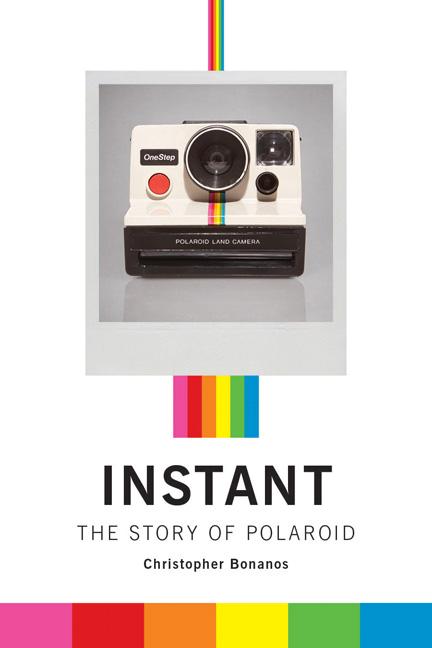
Instant: The Story of Polaroid

Led by the visionary Edwin Land, Polaroid grew from a 1937 garage start-up into a billion-dollar pop-culture phenomenon. Instant by New York magazine editor Christopher Bonanos tells the story of Land’s unique invention, Polaroid’s first instant camera, its meteoric rise in popularity and adoption by artists such as Andy Warhol, and the company’s eventual decline into bankruptcy and its unlikely resurrection in the digital age:

(I should, of course, make clear that as much as I am fascinated by Polaroid cameras, Instant is published by Princeton Architectural Press, who are also distributed in Canada by my employer Raincoast Books. But while I am on the shill, I might as well mention Balthazar Korab: Architect of Photography another P A Press titlewhich was published this earlier month. Korab was Eero Saarinen’s on-staff photographer. Fast Company has a slideshow of some of the stunning images from the book. You should take a look).

Comments closed