Skip to content

The Casual Optimist Posts

Midweek Miscellany

Look Closer — Adrian Tomine talks about moving to New York, and his new book of drawings with The New Yorker:

I’m not one of those artists with an incredible imagination who can just make things up out of nothing, and I’m not the kind of person who would throw himself into some exciting or dangerous situation just to get material. So I tend to go about my normal, boring life, and just try to look at things a little more closely. And even though I’ve lived in New York for eight years now, I still feel like a recent transplant, and I think that’s a big influence on how I see and draw the city.

Invisible — Jeanette Winterson on Tove Jansson and the Moomins, for The Telegraph:

I keep the Moomin books in my study and if I am tinkering about preparing for work I will often open one at random and read a page – they are funny and subversive, (Hemulens of either gender only wear dresses). And playful. Whatever happened to playfulness? Why, as adults, is serious/superficial the boring binary of our lives?… Tove Jansson believed in happy endings… Not the Disney kind but more solid and ambiguous, which is a paradox, but more truthful than black-and-white solutions. Ever-after is what is invisible on the next page.

Approaching Zero — Michael Faber reviews How Music Works by David Byrne, for The Guardian:

Everyone knows that the music industry is in terminal decline. Unlike many doomsayers, however, Byrne feels the changed landscape is good for musicians. Even 20 years ago, any artist wishing to make a record needed a huge sum of money to pay for studio time (and thus needed a large corporation to loan it to him). A lucky few shifted the millions of units necessary to repay the industry’s investment, but the majority got hopelessly into debt. Nowadays, recording costs are “approaching zero”. Distribution costs in the digital era are also negligible compared to the days of physical warehousing. As long as artists can find ways of holding on to a fair percentage of their income (an impossible challenge in the heyday of the record companies), even modest sales can sustain a career. Indeed, says Byrne, “there have never been more opportunities for a musician to reach an audience.”

And finally…

A Short Lesson in Perspective — A fantastic essay by Linds Redding. First published in March of this year, this seems to have taken on a life of its own. If you work in a ‘creative industry’ and haven’t read it yet, make sure you read the whole thing:

The compulsion to create is unstoppable. It’s a need that has to be filled. I’ve barely ‘worked’ in any meaningful way for half a year, but every day I find myself driven to ‘make’ something. Take photographs. Draw. Write. Make bad music. It’s just an itch than needs to be scratched. Apart from the occasional severed ear or descent into fecal-eating dementia the creative impulse is mostly little more than a quaint eccentricity. But introduce this mostly benign neurosis into a commercial context.. well that way, my friends lies misery and madness.


Comments closed

Lip Service

The most recent cover of Playboy is, as some have been quick to point out, reminiscent of John Gall’s original cover design for the Vintage edition of Lolita by Vladimir Nabokov, reissued in 2005. John’s design is more subtle than the Playboy cover and more effective for it (but then Lolita is not Playboy after all):

Were Playboy inspired by the book cover? It seems unlikely. The image in John’s design was actually rotated for the final cover and looks quite different:

If I remember correctly the change was made because original orientation was too suggestive. For Lolita. (Just think about that for a minute.)

Is it also seems unlikely that they were inspired by Georgia O’Keeffe (Black Iris III pictured above) although there are some obvious similarities. Has anyone used O’Keeffe for the cover of Lolita?

Interestingly, the cover for the current Penguin edition of Lolita uses a similar colour palette to the Vintage edition and (to a lesser extent Playboy). The head is upright in this version as well. The vertical line of the nose is broken the horizontal features of the eyes and mouth, as well as by the title. Disconcertingly, the photograph and the round sans-serif font are suggestive of a YA novel. Perhaps that unsettling thought is the desired effect?

John’s design for Vintage replaced an earlier photographic cover by Megan Wilson which took an altogether different approach,  placing the book firmly in a historical context. It’s interesting, however, that John’s unused design echoes the crooked vertical line created by the legs in Wilson’s image:

While maintaining a vertical line, David Gee’s unpublished cover cuts to the chase in a far more clinical fashion…*

Inadvertently referencing spatialist painter Lucio Fontana

And one cannot talk about vertical lines and vaginas without mentioning Barnett Newman and his infamous “zip”. Or at least I can’t. But surely Mr Newman wasn’t thinking smutty thoughts was he?

Somehow I doubt Playboy was influenced by either Fontana or Newman. However, here is a 2003 poster for the Vagina Monologues designed by Chermayeff & Geismar that pre-dates both Playboy and Gall. The message is different, I think, but the photograph is clearly being used in a similar way. I’m sorry I don’t have a better image:

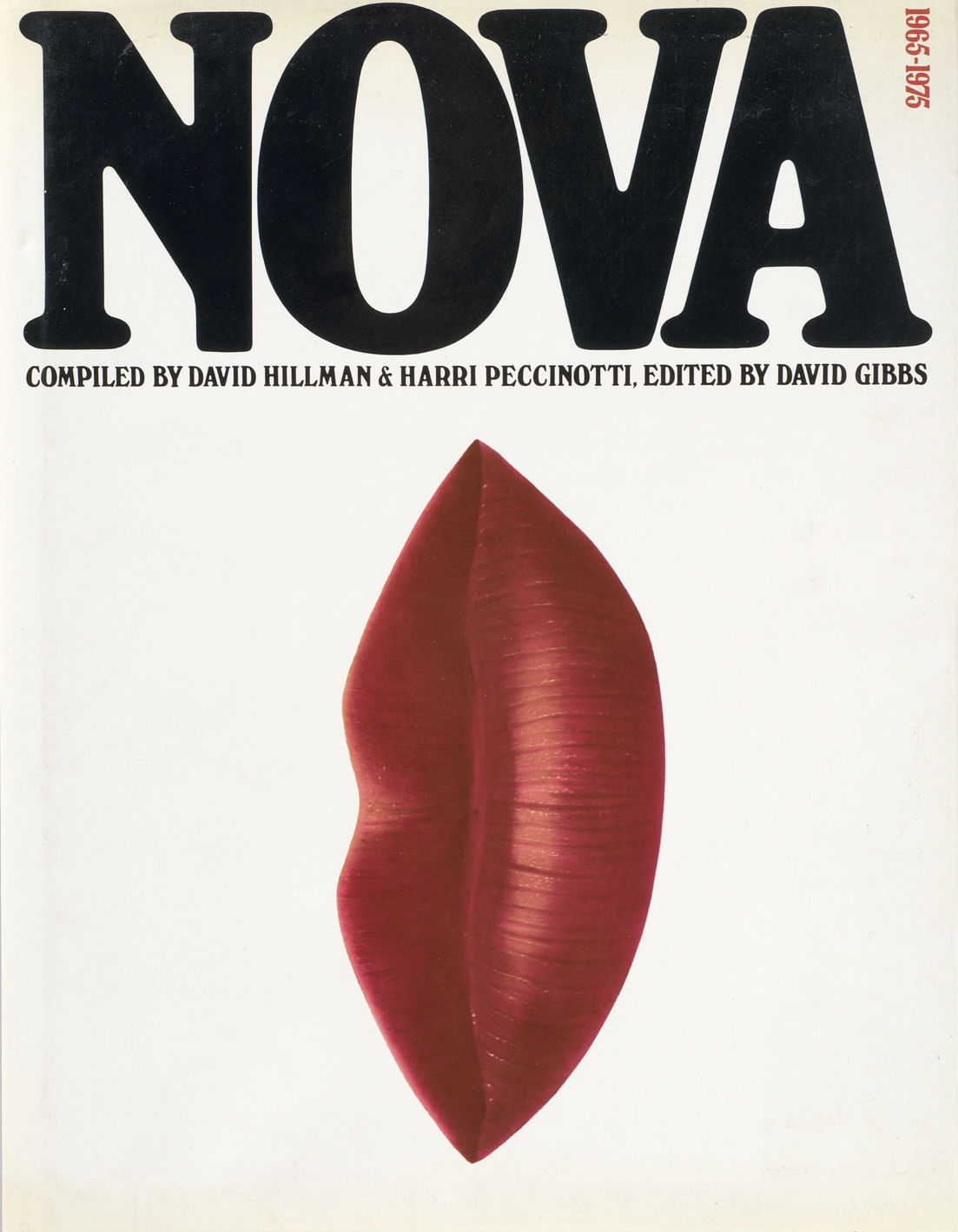
And finally, here is the cover of Nova 1965-1975, which utilizes an original cover from the innovative women’s magazine where Harry Peccinotti was art director. Is this the design that started it all?

*You can see many (many) more Lolita book covers here, and read Print magazine’s article ‘Recovering Lolita’ about John Bertram’s cover competition, here. The mighty Peter Mendelsund also weighs in on covering Nabokov here.

Comments closed

Meeting John Berger

A beautifully shot portrait of English art critic, writer, artist and philosopher John Berger by filmmaker Jos de Putter:

Berger is probably best known for his BBC TV series and book, Ways of Seeing.

3 Comments

Chris Ware on Bookworm

Cartoonist Chris Ware discusses Building Stories with Michael Silverblatt on KCRW’s Bookworm:

KCRW BOOKWORM: Chris Ware Building Stories mp3

Ware will be at the Brooklyn Comics and Graphics Festival tomorrow (November 10) and the Librairie D+Q fifth anniversary party with Charles Burns and Adrian Tomine in Montreal on Sunday (November 11).

Comments closed

Something for the Weekend

Comics Without Borders — a long interview with cartoonist Joost Swarte at The Comics Journal:

In the graphic field of comics I was inspired by Will Eisner’s Spirit. If I see these title pages, the constructions in his title pages, and what he does with the lettering, that was very interesting. And then another thing is, I love the older comics like Little Nemo and Lyonel Feininger. And I was interested also, because I studied industrial design… about the Dada people in Holland and Germany, and Bauhaus architecture and design world, in which there are almost no borders. I mean, people do whatever they like. Then you have the older artists like Tatlin. They designed their own clothes, they do architecture, they do flying machines, they do painting, they do everything. I mean, it was always nice to know that if you want to do different things, that you’re not standing alone. That somebody else did it, and they survived.

Losing Their Grip — Peter Aspen reviews three new books on cinema — The Big Screen by David Thomson, Do the Movies Have a Future? by David Denby, and Film After Film by J Hoberman — for the FT:

It is one of the most famous one-liners in the history of cinema, which also turned out to be an inadvertent prophecy. “I am big,” says the slighted Norma Desmond in Sunset Boulevard (1950). “It’s the pictures that got small.”

She had no idea. The past half-century has seen the pictures get smaller and smaller, to the point that we wonder if they can ever be big again. From television screen, to laptop, to smartphone, the ever-shrinking movies reach a greater part of the world than ever before. But what have we lost along the way?

Holberman’s book is given more in-depth consideration at the LA Review of Books.

And finally…

In the shit — book shopping with Michael Dirda at The Paris Review:

So this is how a man acquires 10,000-odd books, more than he could ever display or read. It’s a combination of maniacal persistence and utter nostalgic whimsy. You have to be willing to search high and low for a potential beauty, but most of the time you’ll take a Book Club hardcover of a book you don’t like if it reminds you of something from your past.

As if to illustrate the point, Dirda found a mass-market paperback of Black Alice, by Thomas Disch and John Sladek. Dirda was a friend of Disch until the sci-fi author killed himself in 2008. “He was a wonderfully cynical man,” Dirda said. “I have a first edition of this but I’ll get it anyway.”


Comments closed

Retromedia

Digital formats are really convenient, but they are easily forgotten as well. If you ask anyone what was their first vinyl they bought they’ll probably remember that, but I don’t think a lot of people will remember what was their first mp3 download.

When you play a vinyl record it demands your attention and this is a way to connect to the music.  You have to take it out, you have to put it on the turntable, you have to put the needle on… These are all actions that demand attention from you and then you have to keep your attention and wait until the side is done and then you have to flip the record…

Photographer Eilon Paz, Dust and Grooves

A new short documentary from PBS Off Book on the attraction of physical formats in the digital age:

Eilon Paz successfully raised funding for a Dust and Grooves book with Kickstarter early this year.

See more of Eilon’s photos here.

Comments closed

Midweek Miscellany

Designer Jon Gray (AKA Gray318) has launched a new website.

Jon has also been interviewed by We Love This Book:

A book cover only becomes iconic because the book that it covers becomes iconic. The cover is just a face for the content. I have been lucky to work on some really great books and have benefitted from their success. People often assume that by copying the cover of a successful book it will help their book sell, and are always surprised when it doesn’t work. It always has to start with the content.

The Browser — Author Anthony Daniels on the digital challenges faced by books, at The New Criterion:

An intellectual might be defined as someone who elaborates justifications for his own tastes and preferences, as metaphysics was once defined as the finding of bad reasons for what we all believe on instinct. And so the reader of books soon finds reasons for the supposed superiority of the printed page over the screen of the electronic device: for nothing stimulates the brain quite like the need for rationalization. The dullest of minds, I have found, works at the speed of light when a rationalization is needed…

Whether the book survives or not, I am firmly of the opinion that it ought to survive, and nothing will convince me otherwise. The heart has its beliefs that evidence knows not of. For me, to browse in a bookshop, especially a second-hand one, will forever be superior to browsing on the internet precisely because chance plays a much larger part in it. There are few greater delights than entirely by chance to come across something not only fascinating in itself, but that establishes a quite unexpected connection with something else. The imagination is stimulated in a way that the more logical connections of the Internet cannot match; the Internet will make people literal-minded.

And finally…

As am I, as am I — Edward Docx on the Sherlock Holmes ‘pilgrims’ and a re-enactment of The Final Problem organised by The Sherlock Holmes Society of London:

I have come to like the pilgrims a good deal. They’re warm-hearted, engaging and amusing people, which is more than can be said for the moped brethren. There are many from the legal profession—Moriarty is a practising barrister; Cardinal Tosca and Queen Victoria (who are married) are retired from the bar. Sherlock Holmes, I learn, is an ex-head teacher—and is (disconcertingly) married to Mrs Hudson. Watson works for Lloyd’s of London. The strangest and most impressive folk are those who have come the furthest—not least the two ladies from the aforementioned Japan Sherlock Holmes Club (founded in 1977; about 1000 members), who do not, I think, speak English and who are posing as “Baritsu Assistants”—this being some kind of martial art that Holmes knew and that saved  him in his struggle with Moriarty on the falls. There are also policemen, toxicologists, bookmakers, engineers, historians, and many who—nobly—refuse to admit to any other existence save that of their character. If these people have anything in common, beyond the obvious, it is that they are all comfortable with a very elastic sense of reality… As am I, as am I.

Comments closed

Cruel Britannia

An astonishing short film for what looks to be a very important book:

Ian Cobain’s exposure of Britain’s secret history of torture Cruel Britannia is published by Portobello Books. The starkly brilliant cover (on which the video is based) was designed by FUEL.

Comments closed

Jamie Hewlett

A beautifully shot interview with British illustrator Jamie Hewlett:

It would be lovely to see Hewlett — co-creator of Tank Girl and Gorillaz (if you must) — draw some new full-length comics again.

(via Coudal)

Comments closed

William Klein: In Pictures

In this interview for Tate Media, William Klein, one of the 20th century’s most important artists, photographers and film-makers, discusses his experience photographing on the streets of New York, the challenges of publishing his first book and how he working with filmmaker Federico Fellini:

Klein’s work is featured in the exhibition William Klein + Daido Moriyama at Tate Modern, 10 October 2012–20 January 2013. You can watch a Tate interview with Daido Moriyama here.

Comments closed

Something for the Weekend

A rather brilliant cover for The Yellow World by Albert Espinosa, reminiscent of a Matisse cut-out or a Paul Rand illustration, designed by Jon Gray.

The Sickly Glow — John Banville, author most recently of Ancient Light, reviews The Big Screen by David Thomson, for The Guardian:

Thomson worries that something happened to the cinema around the time of Jaws, something cynical, sinister and perhaps even fatal. Part of the fun of Jaws and the other mindless thrills-and-spills imitations that it spawned, he says, “is that the commotion meant nothing. The sensation eclipsed sensibility”. This is the contentious heart of The Big Screen. The deadening process that, according to Thomson, set in the 1970s has now spread across the billions of tiny screens that infest the world, the combined sickly glow of which must be visible from outer space. Watching has become mere gaping, open-mouthed and slow-breathing. “Facebook already takes our earnest admissions about ourselves and trades them for advertising.”

You can read a short interview with Thomson about the book at The Arts Desk:

I went through a stage, particularly when I was teaching, of saying, “Well, these are the great filmmakers, let us explore them as if they were Charles Dickens or Van Gogh or someone like that.” The auteur theory. And now I’ve got to a stage where I sort of feel that every film is more like other films than anything else. Films are all alike, because the technology is more important. The director is fading away – you don’t think to ask who directs television, and yet television today in America is at a very good stage. So I’ve become increasingly interested in the technology, and what that has done to shape the format.

And on a somewhat glummer note… David Denby, movie critic at The New Yorker and author of Do the Movies Have a Future?, on the economics of Hollywood, at The New Republic:

Most of the great directors of the past—Griffith, Chaplin, Murnau, Renoir, Lang, Ford, Hawks, Hitchcock, Welles, Rossellini, De Sica, Mizoguchi, Kurosawa, Bergman, the young Coppola, Scorsese, and Altman, and many others—did not imagine that they were making films for a tiny audience, and they did not imagine they were making “art” movies, even though they worked with a high degree of conscious artistry. (The truculent John Ford would have glared at you with his unpatched eye if you used the word “art” in his presence.) They thought that they were making films for everyone, or at least everyone with spirit, which is a lot of people. But over the past twenty-five years, if you step back and look at the American movie scene, you see the mass-culture juggernauts, increasingly triumphs of heavy-duty digital craft, tempered by self-mockery and filling up every available corner of public space; and the tiny, morally inquiring “relationship” movies, making their modest way to a limited audience. The ironic cinema, and the earnest cinema; the mall cinema, and the art house cinema.

Viva Hate — Keith Gessen, founding editor of n+1, on Kingsley Amis and Philip Larkin, at The New Statesman:

They had been brought together by their mutual hatred of the universe, which for a while did a fine job of confirming their feelings about it by rejecting and ignoring them. As they began to find their way in the world it became a little harder to hate it, at least with the same intensity. And so their letters to each other dwindled: What was there to say?

They were rescued by the 1960s. Amis and Larkin managed to greet the transformations, disturbances and new thinking with shared hostility. It brought them a whole gamut of things to hate.

And finally…

Lunch with painter Frank Auerbach, at the Financial Times:

It’s funny, this business of a vocation. One starts from a motive one hardly comprehends. In the school holidays I was an office boy – I found the idea of going into an office horrifying. As a painter, I thought there would be bohemianism, freedom, and there was, but gradually the practice of art took over. As Auden says, in any crisis, the break-up of a relationship, the response is to flee to the arms of the muse. At art school you know at least as many talented students as those who became painters, but they get off the train at some point. I met Stephen Spender once, I expected a poet with a vocation but I found a civilised man, gregarious, leading a varied, entertaining, virtuous life – for whom poetry was only one of the facets. He said one of his dreams was to be a poet, the other to have a lovely life, go to France, know lots of people.

Comments closed

New Work from Seb Lester

A lovely new video featuring the work of British type designer, illustrator and artist Seb Lester:

Comments closed