Skip to content

The Casual Optimist Posts

Midweek Miscellany

Work / Life — An interview with the brilliant Louise Fili, designer and former art director of Pantheon Books, at The Great Discontent:

Everybody wanted to use standard fonts, but I just wasn’t satisfied doing that. I didn’t realize this until years later, but what I was really doing was developing type treatments for the title of the book and approaching it more like a logo. I wanted each book to have its own personality and that couldn’t be achieved with standard fonts. Again, I was lucky because it was appropriate to do that for the types of books I was working on. The other thing to note is that I was collaborating with a lot of really talented illustrators and made a concerted effort to combine the type and image together. I also tried to encourage illustrators to create their own type. I would sketch it out for them and then ask them to actually draw it so it would become part of the illustration, which makes for a stronger design, whether it’s a book cover or logo.

Colour and Intention — Claire Cameron interviews Sam Garrett about his translation of The Dinner by Herman Koch, for the LA Review of Books:

The words a writer uses not only have a dictionary definition, but also a color and an intention. To pin those down, the translator has to sniff around. From the first to the final word of a translation, you’re leading the reader along a path to a destination. The color is what keeps the reader hopping; the intention is the scent that keeps the translator on the right path.


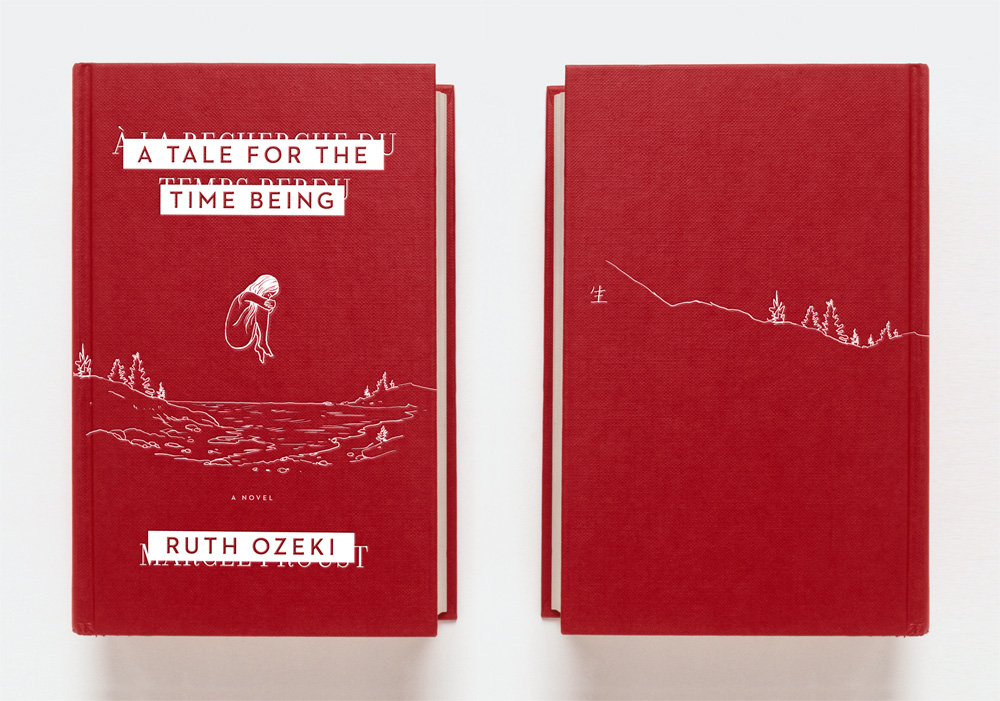
Negotiations — Jim Tierney explains his design process for the cover of Ruth Ozeki’s A Tale for the Time Being:

I decided to run with the first concept that popped into my head: a very simple and tactile facsimile of the red Proust notebook, embossed with an illustration of Nao, floating spectrally above the rocky coast of British Columbia. I think this design is all about questions: How did this book get here? Was it lost intentionally, or by accident? Is Nao alive or dead? Is she even real?

Minimal designs like this is always a hard sell in cover meetings, and it was immediately rejected as too quiet and precious-looking. Loud, colorful, and commercial are popular adjectives in modern book marketing, but it’s always fun to start off negotiations with something a little more obscure.

And finally…

Welcome back from near-death Dan Mogford. Please don’t do that again.

Comments closed

Out of Print

Out of Print, a documentary by Vivienne Roumani about “the turbulent and exciting journey from the book through the digital revolution,” will première at  the Tribeca Film Festival on April 25th:

[vimeo http://vimeo.com/54234607 w=480]

The film features interviews with Scott Turow, Ray Bradbury, and Amazon.com founder and CEO Jeff Bezos among others.

Comments closed

Bert Stern: The Original Mad Man

A new documentary about American photographer Bert Stern:   

The movie has been playing across the US and will open in New York next week. There are no Canadian dates that I could see.

(via Coudal)

2 Comments

Midweek Miscellany

The Creative Review interviews Richard Littler, the man behind the absolutely bloody terrifying Scarfolk:

For me, the desired effect can only be achieved if the images are visually authentic. The seriousness of presentation and form is absolutely crucial. It lulls the viewer into a false sense of security so that the gap between expectation and reality – the juxtaposition of staidness and absurdity – is as wide as it can be.

The fictional authors, designers and archivists of Scarfolk’s public information material must sincerely believe in the gravity of the message that the subject matter wants to convey and deserves, such as rabies. In addition, the whole concept of Scarfolk has to be internally consistent. There has to be a credible, believable identity.

Greatly Exaggerated — Salon’s Laura Miller on technology, self-publishing, and why publishers and bookstores are still matter:

If print could talk, it would surely be telling the world, Mark Twain-style, that reports of its demise have been greatly exaggerated… New self-publishing enterprises are a godsend for traditional publishers because they can take much of the uncertainty out of signing a new author. By the time a self-published author has made a success of his or her book, all the hard stuff is done, not just writing the manuscript but editing and the all-important marketing. Instead of investing their money in unknown authors, then collaborating to make their books better and find them an audience, publishers can swoop in and pluck the juiciest fruits at the moment of maximum ripeness…. [That’s] exactly what happened with erotica blockbuster E.L. James.

Epitaph — A smart take on the end of Google Reader by Paul Ford for The Financial Times:

This is the downside to apps: when everything is online your ability to labour along in familiar ways is contingent upon money coming to the app provider. This works when we remain consumers, for example of media objects such as paywalled newspapers, Netflix and Spotify. We lease access to the databases, own nothing, and the access makes it worthwhile. But when we work inside these systems we increase our levels of risk. When Google Reader goes away, it will not be like a television show being cancelled – much work is lost, and the ability to access that work is also lost.

The Exploded Mind — A big interview with artist, illustrator and picture book maker Oliver Jeffers at The Great Discontent:

Balancing integrity versus income is tricky; when I make decisions, sometimes I know that I might not be as well off the next year, but I’ll certainly be making the best work. I figured out early on that there are certain things I don’t want to do when it comes to how I’m perceived. I try to stay away from advertising, even though that’s where the big money is. In the visual arts, you are often only as good as your reputation and associations, so you have to think ahead and be smart. As far as commercial commissions, I’m not just a gun for hire; I actually have something I’m trying to accomplish and a way of making work that I want to continue and be known for. Although some lucrative offers came in for illustration work, I realized that taking them would be shortsighted and could possibly stunt other aspects of my practice.

See also: ‘Maurice Sendak’s Jumper and Me‘ by Jeffers at The Guardian:

Sendak was trying to satisfy himself. He was telling these stories, as much a way to make sense of the world around him as anything else. He was using them as a poet uses poetry and a painter uses paint. He was making art that ultimately transcended himself and neat classification. Perhaps as a result he was one of the first contemporary picture-book makers to discover the power of picture book as a way of storytelling for everyone. Perhaps this might go some way to explain why his books have won over so many, regardless of geography or decade – because he is putting himself, and the way he views the world on paper, darkness and all.

And finally…

Dr. Jazz — James Hughes on Stanley Kubrick’s unmade film about jazz in the Third Reich, at The Atlantic:

Kubrick’s interest in jazz-loving Nazis… represents his most fascinating unrealized war film. The book that Kubrick was handed, and one he considered adapting soon after wrapping Full Metal Jacket, was Swing Under the Nazis, published in 1985 and written by Mike Zwerin, a trombonist from Queens who had performed with Miles Davis and Eric Dolphy before turning to journalism. The officer in that Strangelovian snapshot was Dietrich Schulz-Koehn, a fanatic for “hot swing” and other variations of jazz outlawed as “jungle music” by his superiors. Schulz-Koehn published an illegal underground newsletter, euphemistically referred to as “travel letters,” which flaunted his unique ability to jaunt across Western Europe and report back on the jazz scenes in cities conquered by the Fatherland. Kubrick’s title for the project was derived from the pen name Schulz-Koehn published under: Dr. Jazz.

Comments closed

The Film Before The Film

The Film Before The Film is a documentary short by the Berliner Technische Kunsthochschule about the history of opening titles. Although the narration is a little flat, the film itself is a visual treat:

Comments closed

Something (Late) for the Weekend

Enjoy Your Cigarette — Tom Cox reviews Penguin’s Underground Lines boxed set for The Guardian:

Underground Lines often matches its writers to its tracks very well, in terms of temperament as well as personal history. The Jubilee line, so often associated with capitalism and the Docklands development, is a good match for John O’Farrell, a writer whose wit was marinated in the political 1980s. The nervy prose of William Leith could not be more apt for the rather fraught Northern line, and his manic, anxious account of being evacuated from a train that was filling with smoke is probably the most addictively readable thing here. “People never tell you to have a pleasant journey on the underground, just as people will say, ‘Enjoy your meal,’ but never ‘Enjoy your cigarette,'” he writes.

Dirty Lit — Edward Jay Epstein at the NYRB Blog on being taught literature by Nabokov:

He made it clear from the first lecture that he had little interest in fraternizing with students, who would be known not by their name but by their seat number. Mine was 121. He said his only rule was that we could not leave his lecture, even to use the bathroom, without a doctor’s note.

He then described his requisites for reading the assigned books. He said we did not need to know anything about their historical context, and that we should under no circumstance identify with any of the characters in them, since novels are works of pure invention. The authors, he continued, had one and only one purpose: to enchant the reader. So all we needed to appreciate them, aside from a pocket dictionary and a good memory, was our own spines. He assured us that the authors he had selected—Leo Tolstoy, Nikolai Gogol, Marcel Proust, James Joyce, Jane Austen, Franz Kafka, Gustave Flaubert, and Robert Louis Stevenson—would produce tingling we could detect in our spines.

Exploded Hearts — Melville House’s Christopher King on his cover design for How to Keep Your Volkswagen Alive by Christopher Boucher, at Talking Covers:

In the end, I did what I usually do, which is to steal an idea for the cover directly from the manuscript. In this case, the narrator’s son—who, again, is a car—has a heart in place of an engine, so I printed off an image I found online and showed it to our publishers:

“It’ll be like this exploded diagram of a car, but with a heart in place of the engine.”

“OK!”

And finally…

The Wall Street Journal looks at ‘The Improbable Rise of NPR Music‘ which, for all of the WSJ’s obvious churlishness, manages to be fascinating despite itself:

NPR Music’s breadth, depth and ability to break new material are its main strengths. The site offers music that appeals to rock, jazz and classical lovers—all under one roof. Still another advantage is NPR Music’s ties to “All Things Considered” and “Morning Edition,” which, even if Washington-centric, have music woven into their fabric and provide news for the site as well as a familiar storytelling style.

NPR Music in its present form just turned five. “It’s the closest thing we have to a pure startup inside what is now a 40-plus-year-old institution,” says Kinsey Wilson, NPR’s executive vice president and chief content officer. “This group of now roughly 20 people has had an opportunity to invent something from scratch.”

(via Largehearted Boy)

Comments closed

Distortion is Character

Brian Eno talks about art, music and his creative process in this video for Alfred Dunhill:

(via David Pearson on Twitter)

Comments closed

Books Are Amazing, Guys


Books. Will. Never. Be. Cool.

The latest Supermutant Magic Academy webcomic by Jillian Tamaki.

Between this, Richard Nash, Evan Hughes, and Mike Shatkin, books have been having a rough time this week. (But I’m still keeping the faith).

Comments closed

Midweek Miscellany

WHAAM! — Comics historian Paul Gravett on Roy Lichtenstein’s appropriation from comics:

Lichtenstein’s… success, his getting away with turning supposedly anonymous ‘found’ comic art into high-priced paintings, continues to directly encourage others to do the same. But there is a difference—comics are no longer uncredited, trashy mass culture, and what worked as a lucrative schtick back in the Sixties art world is now largely drained and devoid of any shock value or irony… Five decades on… it is high time for the comics world and the art world to properly debate these issues, and to celebrate these hugely talented but still largely ignored visual storytellers.

(Pictured above: a page from ‘The Star Jockey’ drawn by Irv Novick, from All-American Men of War #89 February 1962)

See also: David Barsalou’s Deconstructing Lichtenstein project

(If Gravett underestimate’s Lichtenstein’s ingenuity in recontextualizing comic book panels, and his lasting influence on art AND comics, it is truly astonishing to see how poor Lichtenstein’s paintings are in direct comparison to the work he borrowed from.)

Blowing Shit Up — A long essay by Richard Nash on the business of literature at the VQR:

Selling a book, print or digital, turns out to be far from the only way to generate revenue from all the remarkable cultural activity that goes into the creation and dissemination of literature and ideas. Recall again all the schmoozing, learning, practice, hustling, reading upon reading upon reading that goes into the various editorial components of publishing; the pattern recognition; the storytelling that editors do, that sales reps do, that publicists do, that the bookstore staff does. Recall the average feted poet who makes more money at a weekend visiting-writer gig than her royalties are likely to earn her in an entire year. You begin to realize that the business of literature is the business of making culture, not just the business of manufacturing bound books. This, in turn, means that the increased difficulty of selling bound books in a traditional manner (and the lower price point in selling digital books) is not going to be a significant challenge over the long run, except to free the business of literature from the limitations imposed when one is producing things rather than ideas and stories. Book culture is not print fetishism; it is the swirl and gurgle of idea and style in the expression of stories and concepts—the conversation, polemic, narrative force that goes on within and between texts, within and between people as they write, revise, discover, and respond to those texts.

See Also: Book Publishers Scramble to Rewrite Their Future by Evan Hughes for Wired.

And finally…

The New Statesman has posted five classic book reviews from their archive, including V. S. Pritchett’s review of 1984 by George Orwell:

Nineteen Eighty-Four is a book that goes through the reader like an east wind, cracking the skin, opening the sores; hope has died in Mr Orwell’s wintry mind, and only pain is known. I do not think I have ever read a novel more frightening and depressing; and yet, such are the originality, the suspense, the speed of writing and withering indignation that it is impossible to put the book down. The faults of Orwell as a writer – monotony, nagging, the lonely schoolboy shambling down the one dispiriting track – are transformed now he rises to a large subject. He is the most devastating pamphleteer alive because he is the plainest and most individual…


Comments closed

Webcomics on Off Book

The latest episode of PBS Off Book on webcomics features interviews with Nick Gurewitch (The Perry Bible Fellowship), the fabulous Lucy Knisley (Stop Paying Attention pictured above), and others:

Comments closed

Stanley Kubrick Filmography

A new Stanley Kubrick filmography, designed and animated by Hyejin June Hong:

You can watch Martin Woutisseth‘s animated Kubrick filmography from a couple of years ago here.

(via Coudal, source of all things Kubrick)

Comments closed

Something for the Weekend

Typgraphica’s favourite typefaces of 2012. There’s a lot to love about Balkan Sans by Nikola Djurek and Marija Juza. But check out the ligatures on Levato by Felix Bonge:


Chasing the White Rabbit — Francine Prose on dreams and literature, at the New York Review of Books blog:

Literature is full of dreams that we remember more clearly than our own. Jacob’s ladder of angels. Joseph saving Egypt and himself by interpreting the Pharoah’s vision of the seven fat and lean cows. The dreams in Shakespeare’s plays range as widely as our own, and the evil are often punished in their sleep before they pay for their crimes in life. Kafka never tells us what Gregor Samsa was dreaming when he awakens as a giant insect, except that the dreams were “uneasy.” Likely they were not as uneasy as the morning he wakes into. By the end of the first paragraph of “The Metamorphosis,” Gregor has noticed his arched, dome-like brown belly, his numerous waving legs. “What has happened to me? he thought. It was no dream.”

Krautrock on the Underground — An excerpt from Earthbound by Paul Morley, part of the Penguin Lines series for the 50th anniversary of the London Underground, at The New Statesman:

“Krautrock” was the convenient collective name given in a slightly jokey, slightly wary and affectionately patronising way to an eclectic collection of radicalised German groups from very different parts of the country that contained musicians who were born in the few years before, during or just after the Second World War. Another collective name for these groups, still frivolous but more descriptive of their mission to create sound never heard before on our planet and invent music that could make you feel you were leaving the earth behind, was “kosmische”. As well as Can, these groups included Kraftwerk, Tangerine Dream, Amon Düül II, Cluster, Popol Vuh, Harmonia, Neu! and Faust, and they were looking for ways to repair their traumatic recent history, remove the crippling infection of fascism, break free of totalitarian artistic repression, negotiate turbulent social and emotional currents, and radically, romantically reinstate the positive, progressive elements of their mortified national psyche.

See also: Jonathan Gibbs looks at the design of the Penguin Lines series at The Independent.

And finally…

Fact-Checking at the New Yorker, an excerpt from a new book called The Art of Making Magazines:

When the new, remade The New Yorker of the last decade was gearing up and we started getting all these late-breaking stories, issues such as logic and fairness and balance—which previously had been the responsibility of the editors—began to fall on the checkers. This wasn’t by anybody’s design. It was because the editors were really busy putting these stories together and they wanted us to look at things from the outside and see how they were framed, and look at them from the inside and look at the logic and the way they were reported and the way quotes were used and many other such things.

That responsibility came to us not in the way of anybody saying suddenly, “You’re doing that.” It just became that when a problem arose, they would come to us and say, “Why didn’t you warn us?” And so it just became clear that there was this gap between editing and checking that had opened up under the pressure of later-breaking stories, and it just seemed logical that we should fill it. It made our job more challenging, and more fun.

(via Kottke)

1 Comment