The tale of rediscovering Sherman, a typeface designed by American type designer Frederic Goudy in 1910 and revived by Chester Jenkins for Pentagram in 2016 for Syracuse University:
Comments closed
Published February 9, 2017
Books, Design and Culture
The tale of rediscovering Sherman, a typeface designed by American type designer Frederic Goudy in 1910 and revived by Chester Jenkins for Pentagram in 2016 for Syracuse University:
Comments closed
Hilton Als on James Baldwin, movies, and Raoul Peck’s documentary I Am Not Your Negro, for The New Yorker:
Comments closedOne has the sense, in the sections of “I Am Not Your Negro” that are devoted to Baldwin’s relationship to film, that Peck is stepping in to make the film that Baldwin couldn’t make. From the beginning of his career, Baldwin longed to make movies. In the introduction to his 1955 landmark collection, “Notes of a Native Son,” he wrote, “About my interests: I don’t know if I have any, unless the morbid desire to own a sixteen-millimeter camera and make experimental movies can be so classified.” To my knowledge, Baldwin never satisfied that desire (morbid, perhaps, because he knew of the herculean effort that goes into getting any movie made), but he never stopped yearning to be a filmmaker. Like a number of other significant twentieth-century authors—James Agee, Truman Capote, Susan Sontag, and his friend Norman Mailer—he knew that the page was not enough in the modern world; cinema was a powerful medium with many more “readers.” What would his life as an artist have been like, and what would American cinema be like now, had it opened itself up to him?

The New York Review of Books has an essay by cartoonist Chris Ware on George Herriman the creator Krazy Kat, one of the most beautiful, poetic and inventive comic strips ever created:
Krazy Kat has been described as a parable of love, a metaphor for democracy, a “surrealistic” poem, unfolding over years and years. It is all of these, but so much more: it is a portrait of America, a self-portrait of Herriman, and, I believe, the first attempt to paint the full range of human consciousness in the language of the comic strip. Like the America it portrays, Herriman’s identity has been poised for a revision for many decades now. Michael Tisserand’s new biography Krazy does just that, clearing the shifting sands and shadows of Herriman’s ancestry, the discovery in the early 1970s of a birth certificate which described Herriman as “colored” sending up a flag among comics researchers and aficionados. Tisserand confirms what for years was hiding in plain sight in the tangled brush of Coconino County, Arizona, where Krazy Kat is supposedly set: Herriman, of mixed African-American ancestry, spent his entire adult life passing as white. He had been born in the African-American neighborhood of racially mixed, culturally polyglot 1880s New Orleans, but within a decade Herriman’s parents moved George and his three siblings to the small but growing town of Los Angeles to escape the increasing bigotry and racial animosity of postbellum Louisiana. The Herrimans melted into California life, and it was there that George, with brief professional spates in New York, would remain for the rest of his life.
But imagine knowing something about yourself that’s considered so damning, so dire, so disgusting, that you must, at all cost, never tell anyone. Imagine leaving behind a life to which you cannot claim allegiance or affection. Imagine suddenly gaining advantages and opportunity while you see others like you, who have not followed in the footsteps of your deception, suffering. Herriman, once he was considered white, didn’t even have a way of voicing this identity. Until he started drawing Krazy Kat.

Krazy, the new biography of Herriman by Michael Tisserand that Chris Ware mentions, was also recently reviewed for New York Times Book Review by Nelson George:
Though Herriman’s “Krazy Kat” comic strip was admired in his lifetime, it wasn’t until years after his death in 1944 that his vast influence received widespread critical respect. Herriman’s depiction of the tangled relationships among the black cat Krazy, his white mouse tormentor and sometime love interest Ignatz and the bulldog Officer Pupp, set against a desert backdrop in fictional Coconino County (taken from a real area of Arizona), inspired several generations of cartoonists. Charles M. Schulz’s “Peanuts,” Ralph Bakshi’s “Fritz the Cat” and Art Spiegelman’s “Maus” all owe a debt to Herriman’s draftsmanship and poetic sense.
Schulz got turned on to “Krazy Kat” right after World War II, he said, and it “did much to inspire me to create a feature that went beyond the mere actions of ordinary children.” Theodor Geisel (Dr. Seuss), whose animal characters strongly resemble Herriman’s, told a biographer, “At its best, the comic strip is an art form of such terrific wumpf! that I’d much rather spend any evening of any week rereading the beautifully insane sanities of George Herriman’s Krazy Kat than to sit myself down in some opera house to hear some smiling Irish tenor murdering Pagliacci.” The iconoclastic Robert Crumb called Herriman the “Leonardo da Vinci of comics,” while the ambitious Spiegelman argued that “Krazy Kat” “crossed all kinds of boundaries, between high and low, between vulgar and genteel.” All this alone would have made Herriman worth serious study.
But then in the early 1970s, a quarter-century after his death, a birth certificate was found stating that Herriman was born “colored” to Creole parents in that 19th-century hotbed of miscegenation, New Orleans. Clearly his work had to be re-examined. Not to question its genius, but to see how much of it dealt with hiding a huge part of himself in plain sight.
If you haven’t read any Krazy Kat, seek it out. The strange language, the small, inky art, and the repetitiousness of the strips — collected together into numerous, beautifully designed, paperbacks by Fantagraphics — can seem a little intimidating at first, but it really pays off if you stick with it.


The dystopia described in George Orwell’s nearly 70-year-old novel “1984” suddenly feels all too familiar. A world in which Big Brother (or maybe the National Security Agency) is always listening in, and high-tech devices can eavesdrop in people’s homes. (Hey, Alexa, what’s up?) A world of endless war, where fear and hate are drummed up against foreigners, and movies show boatloads of refugees dying at sea. A world in which the government insists that reality is not “something objective, external, existing in its own right” — but rather, “whatever the Party holds to be truth is truth.”
“1984” shot to No. 1 on Amazon’s best-seller list this week, after Kellyanne Conway, an adviser to President Trump, described demonstrable falsehoods told by the White House press secretary Sean Spicer — regarding the size of inaugural crowds — as “alternative facts.” It was a phrase chillingly reminiscent, for many readers, of the Ministry of Truth’s efforts in “1984” at “reality control.” To Big Brother and the Party, Orwell wrote, “the very existence of external reality was tacitly denied by their philosophy. The heresy of heresies was common sense.” Regardless of the facts, “Big Brother is omnipotent” and “the Party is infallible.”
Michiko Kakutani, New York Times
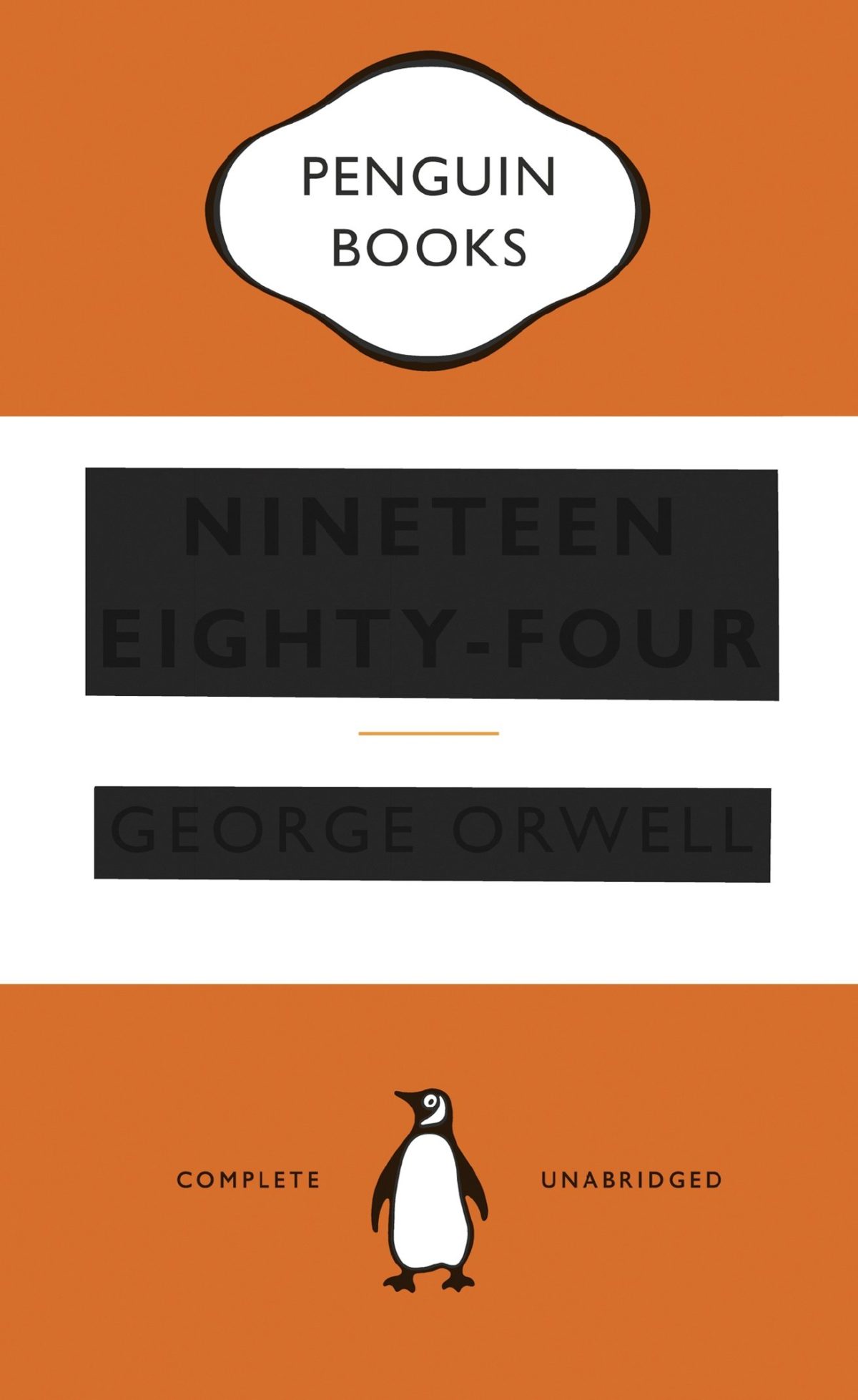
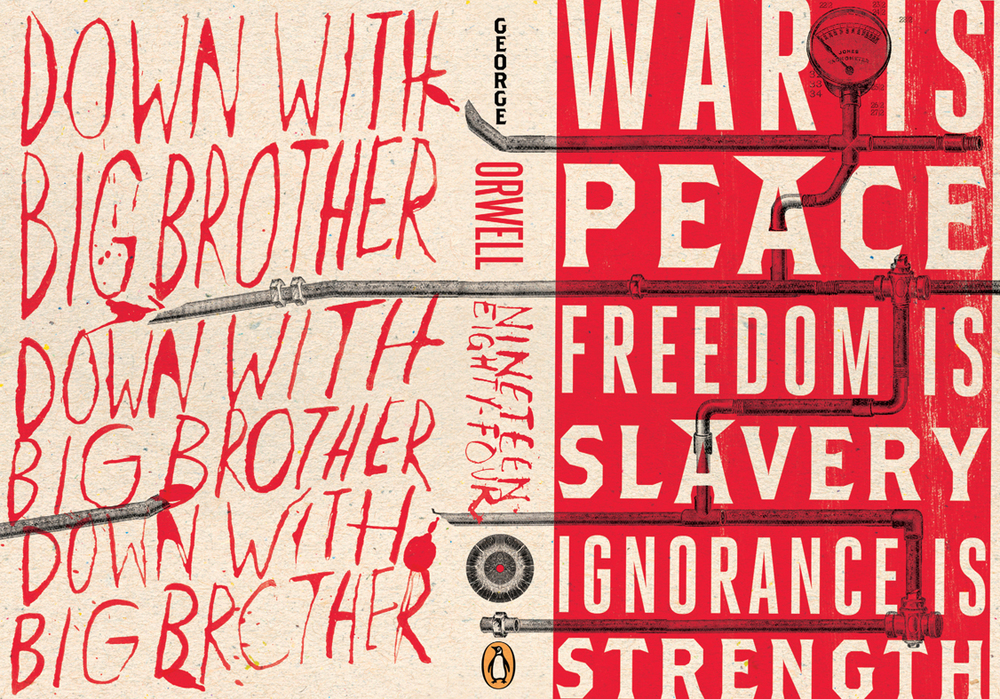
As Nineteen Eighty-Four is suddenly more relevant than ever, I thought I would share a few of the recent covers for Orwell’s classic novel…



2 Comments

I have to confess that I haven’t seen the TV adaptation of Philip K. Dick’s The Man in the High Castle, but I found Aaron Bady’s discussion of the series — and how it differs from the book — at The New Yorker, quite interesting:
In another year, the show’s insistence on humanizing fascists might have seemed like a provocative choice—an effort, like Arendt’s, to understand how normal people can find it in themselves to commit the worst atrocities. In 2017, however—when it is more urgent than ever to distinguish right from wrong, real news from fake, and differences of political opinion from the dangerous undermining of democracy—it feels instead like a pernicious cynicism. At the same time, the series depicts the ideological excesses of the Resistance in the most unforgiving light. More like Al Qaeda than French partisans of the nineteen-forties, they are grim, unsympathetic zealots, who use scattershot terror tactics and have no qualms about causing the suffering of innocent bystanders…
…This nihilism would have been alien to Philip K. Dick… Dick’s “The Man in the High Castle” focussed on how everyday people struggle to carve out lives of integrity in the face of evil, even while knowing—perhaps especially while knowing—that their actions will not ultimately change the course of history. In the novel, Frank Frink’s primary struggle is how to be an artist, not how to overthrow the Reich. In Dick’s view, this, too, was a form of resistance: his major theme as a novelist was the unavoidable complicity of living “normally” under empire; he believed in evil because he saw it everywhere. But if there wasn’t much hope in Dick’s fiction, that was exactly the point of writing it: even in the midst of a triumphant fascist dystopia, the quest for intellectual autonomy lived on in the dissident imaginations of those who could envision a different kind of world. It is telling, too, that the “man in the high castle” was in Dick’s novel not a collector of film reels but a novelist—an eccentric inventor of alt-histories who served as a stand-in for Dick himself. The character was, above all, a tribute to artists who dare to resist power in dark times.
The cover of the Penguin Modern Classic edition (pictured above) was design by Jim Stoddart.
Comments closed
Adrian Shaughnessy talks to Erik Spiekermann about his typeface FF Meta, the corporate font of Herman Miller, for the company magazine WHY:
FF Meta was not designed with Herman Miller in mind, however. It was designed for the German Post Office (Deutsche Bundespost), which hired Spiekermann to rethink the entire graphic design system for the organization—everything from order forms to the once ubiquitous telephone directories. Deutsche Bundespost’s previous font? Like Herman Miller, it was Helvetica. With typical forthrightness, the then 38-year-old Spiekermann urged them to drop it, announcing that it was “unfit for purpose” and “overused.”
Spiekermann recognized that it was the Bundespost’s phone books that offered the greatest potential to benefit from a new typeface: “With just a change of typeface you could save a million trees and be a hero,” he recalls. And so he set about designing FF Meta (then called PT55), a process that involved meticulous research into the proportions of classic letterforms and analysis of developments in printing technology. “We have a great German word, ‘Kopfgeburt’—it means something that springs from your brain. The design of Meta wasn’t like that at all. The process was very theoretical. It wasn’t emotional. This was because at that time I had no experience and couldn’t rely on talent or practice. Everything had to be deducted.”
So thorough was Spiekermann’s process that he arranged to have his new letterforms tested for legibility by perception scientists at Braunschweig University of Technology. “There was a guy there who looked at it, and in his view, there was a little too much ‘noise,’ which you can see in my early drawings. So, I toned down the contrast. There were a couple of numerals that he said were a little too in love with themselves—mannered, in other words.”
Comments closed

The New York Times visits Dutch designer and bookmaker Irma Boom‘s new library of experimental books:
Comments closedIrma Boom pays careful attention to word choice. The Dutch designer, one of the world’s pre-eminent bookmakers, is loath to say “client” and refers to her projects as “commissions.” She also doesn’t call herself an artist.
Never mind that Ms. Boom, 56, was once in a group exhibition at the Pompidou Center, or that many of her books are in the Museum of Modern Art’s collection. Her belief that she is not an artist could be a matter of culture — a product of her “Dutch rigor,” as the architect Rem Koolhaas, a close friend and collaborator, said.
But there are many who would at least consider Ms. Boom’s books works of art. Among them were the jurors of the Johannes Vermeer Award, the Dutch state prize for the arts, which she won in 2014. “Her books transcend the level of mere information carriers,” the jury’s report stated. “They are small or larger objects to admire, tempting us to read them with close attention.” She received 100,000 euros to put toward a “special project,” as the prize stipulates. “I cannot simply go and shop at Prada,” Ms. Boom said.
So Ms. Boom has used the prize for the quixotic, endless undertaking of creating a library of what she called “only the books that are experimental.” Above her studio here, the recently opened library is made up almost entirely of books from the 1600s and 1700s, and the 1960s and ’70s.
Those eras are when bookmaking wasn’t held back by conventions, Ms. Boom said, and when books “breathed freedom” in content and form. (Many of today’s e-books, by contrast, represent a “provisional low point” in the art of bookmaking, writes Mr. Koolhaas in the catalog “Irma Boom: The Architecture of the Book.”) Her library includes poetry collections, as well as exhibition catalogs that experimented with form — a book bound with bolts, for example, or contained within what seems like a three-ring binder.
The New York Times has published a transcript of Michiko Kakutani’s recent conversation with US President Barak Obama about books:
Some of the craft of writing a good speech is identical to any other good writing: Is that word necessary? Is it the right word? Is there a rhythm to it that feels good? How does it sound aloud?
I actually think that one of the useful things about speechwriting is reminding yourself that the original words are spoken, and that there is a sound, a feel to words that, even if you’re reading silently, transmits itself.
So in that sense, I think there will be some consistency.
But this is part of why it was important to pick up the occasional novel during the presidency, because most of my reading every day was briefing books and memos and proposals. And so working that very analytical side of the brain all the time sometimes meant you lost track of not just the poetry of fiction, but also the depth of fiction.
Fiction was useful as a reminder of the truths under the surface of what we argue about every day and was a way of seeing and hearing the voices, the multitudes of this country.
You can read the article that resulted from this conversation here.
Surely there are few other politicians — let alone world leaders — who could speak so intelligently and at such length about contemporary literature.

And, on a somewhat related note, I just wanted to mention the Women’s March on Washington on January 21. The official logo for march — reminiscent (in a good way) of Saul Bass’s 1978 logo for the Girl Scouts of America (revamped in 2010 by Original Champions of Design) — was designed by Nicole LaRue. There are sister marches around the world — find your local event here — and you can download typographic posters for occasion from Counter Type.

Resist.
Comments closed
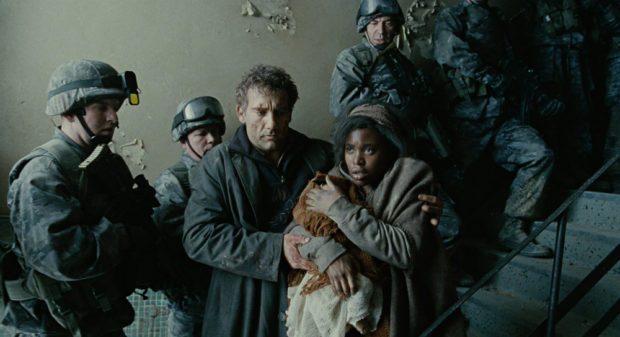
A decade after its first release, Vulture looks back at the terrifying new relevance of Alfonso Cuarón’s 2006 film (based loosely on a novel by P. D. James), Children of Men:
Comments closedChildren of Men is having a remarkable resurgence — not just because of its tenth anniversary but because of its unsettling relevance at the conclusion of this annus horribilis. There have been glowing reappraisals on grounds both sociopolitical (Children of Men is “obviously something that should be on people’s minds after Brexit and after the rise of Donald Trump,” political scientist Francis Fukuyama declared in September) and artistic (“Children of Men, like no other film this century, and perhaps no other movie ever, solves the meaning of life,” wrote Vanity Fair columnist Richard Lawson in August). It’s getting the kind of online attention it sorely lacked ten years ago, generating recent headlines like “The Syrian Refugee Crisis Is Our Children of Men Moment” and “Are We Living in the Dawning of Alfonso Cuarón’s Children of Men?” As critic David Ehrlich put it in November, “Children of Men may be set in 2027,” but in 2016, “it suddenly became clear that its time had come.”
Cuarón, however, is not feeling like taking an overdue victory lap. Curled over a table in an upscale Mexico City restaurant recently, the 55-year-old director gets a little irritated when I laud the film’s imaginative prescience. “This thing was not imagination,” he says, jabbing his index finger into the tablecloth. By Cuarón’s estimation, anyone surprised at the accuracy of his movie’s predictions was either uninformed or willfully ignorant about the way the world already was by 2006. “People were talking about those things, just not in the mainstream!” he says. He was reading about refugees, know-nothing reactionaries, and eerie disruptions in biological processes during the early ’00s. If Children of Men can be said to have a message, Cuarón encapsulates it: “What’s really relevant now,” he tells me, “is to stop being complacent.”

At the New York Review of Books, American architecture critic Martin Filler casts a critical eye over a slew of new books on Brutalist architecture:
In addition to its echoes of art brut—Jean Dubuffet’s name for outsider art—New Brutalism was also an oblique riposte to New Humanism, a set of beliefs inspired by Geoffrey Scott’s hugely influential book ‘The Architecture of Humanism’ (1914). But Scott’s call for a return to Arts and Crafts design principles was scorned as escapist nostalgia by many young midcentury modernists. Among them was the period’s foremost British architecture critic, Reyner Banham, who with his scant empathy for the Arts and Crafts Movement’s focus on social reform issues belittlingly described New Humanism as “brickwork, segmental arches, pitched roofs, small windows (or small panes at any rate)—picturesque detailing without picturesque planning. It was, in fact, the so-called ‘William Morris Revival,’ now happily defunct….”
Yet it was not a utopian nineteenth-century dreamland that Brutalism countered as much as the thin, commercialized version of the International Style that after World War II gained ascendance through economic expediency. Brutalism’s striking departure from the steel-skeleton-and-glass-skin conformity of this routine, profit-oriented modernism was defined by its contrary emphasis on raw concrete (‘béton brut’ in French) in massive forms of imposing scale, idiosyncratic shape, rough finish, and uncompromising forcefulness, with a building’s inner workings and services—structure, plumbing, electricity, heating, and ventilation—unabashedly exposed. Brutalism soon became a worldwide craze, as this comparatively economical means of fabrication offered a cost-effective alternative to hand-riveted metal construction and allowed a broader array of sculptural effects than those obtainable with rectilinear frameworks.
One gets the sense Filler is no fan of Brutalism — at least its bleak British incarnation — so there is, inevitably, a reference to J.G. Ballard’s dystopian novel High-Rise:
This was never a style that attempted to convey warmth, comfort, intimacy, or other qualities we tend to associate with an enjoyable way of life, and thus it never won much love except from architectural specialists. Brutalism posited an unsentimental, not to say harsh, view of the modern world, and however heroic its unflinching embodiment of hard realities may have been, most people do not enjoy a daily diet of architectural anxiety and alienation, especially in northern climates under cloudy skies.
One of the first signs of rejection came in J.G. Ballard’s dystopian novel ‘High-Rise‘ (1975), which is set in a thinly fictionalized version of Ernő Goldfinger’s Trellick Tower in London’s North Kensington (1966–1972). (It is one of fifty-four sites highlighted in the ‘Brutalist London Map’, a useful guide to landmarks of the style in the British capital.) This thirty-one-story apartment block, commissioned by the Greater London Council, was based on Le Corbusier’s original Unité in Marseilles, although Goldfinger’s scheme is nearly twice as high as its prototype. Trellick Tower was well received by its first inhabitants, but as was also true of contemporaneous public housing projects in the United States, it quickly went to pot as funds for its upkeep and security were slashed, which resulted in a rapid descent into crime and squalor.
Neoconservative critics blamed the architecture, but as sociological studies have since proven, the claim that tall residential complexes breed social malaise is groundless. After Trellick Tower was privatized in the 1980s, when Margaret Thatcher got the British government out of the public housing business, the building’s owner-residents increased protection from intruders, paid for long-delayed repairs, and it is now a highly desirable property rightly appreciated for its design quality.
If anyone can point me to a review of these books by someone a little more sympathetic to Brutalism, I’d be much obliged.
Comments closed