Skip to content

The Casual Optimist Posts

Tschichold: Titan of Typography

The Brillance of Jan Tschichold — Richard Hollis at The Guardian looks at the career of the man who perfected Penguin’s classic paperback:

Tschichold tidied up the horizontally banded covers of the standard Penguins and refined the Penguin emblem. Each of these adjustments hardly changed what we now think of as the “classic” Penguin designs, but the effect was to set new standards for book production in England.

The Guardian also has a slide show of Tschichold’s poster and paperback designs

If you’d like to know more about Tschichold, Thames and Hudson have just  published Jan Tschichold Master Typographer by Cees W. de Jong,  and Raincoast are distributing Hyphen’s Active Literature: Jan Tschichold and New Typography by Christopher Burke — published in March 2008 — here in Canada.

Comments closed

Whiskey Tango Foxtrot?*

There has been relentless torrent of grim publishing news coming out of New York the last few days.

It has, at times, been hard to keep up with it all, and I don’t know the people involved well enough or understand the machinations sufficiently to offer much in the way of trenchant analysis. I hope that a summary of ‘Black Wednesday’ and the rest of this week’s events — with appropriate links — will, at least, offer some kind of context.

The details are sketchy, but Houghton Mifflin Harcourt acknowledged that there would be further changes at the company, including job-cuts. According to Publishers Weekly, at least eight people have been let go including executive editor Ann Patty, senior editor Anjali Singh and legendary editor Drenka Willen. GalleyCat has spokesman Josef Blumenfeld’s full statement about the changes.

Personally I’m stunned that the recipient of the 2007 Maxwell E. Perkins Award Drenka Willen, the US editor of Günter Grass, José Saramago and Umberto Eco, has been let go by HMH. PW profiled Willen in 2002, and, after pointing out that she has edited four Nobel Prize winners, MobyLives asked, pertinently, “do the proprietors of Houghton Mifflin Harcourt really know what they’re doing?”

I think my favourite quote, however, came from an unnamed ‘publishing veteran’ who told GalleyCat:

“Those fuckers have destroyed two venerable publishing houses in less than a fucking year.”

Elsewhere things are not much better.

Earlier in the week, Christian publisher Thomas Nelson announced it would be laying off 54 employees, or about 10% of its workforce. CEO Michael Hyatt said in a statement on his corporate blog From Where I Sit :

This was the second round of reductions this year. Unfortunately, this one was no less painful. We did the first round after significantly cutting our SKU count. However, this second round was purely a result of the slowdown in the economy.

According to GalleyCat , Hyatt apparently first made the announcement by Twitter. Stay classy Michael, stay classy…

After Doubleday cut 16 jobs in October, the “long anticipated” restructuring of Random House was announced on Wednesday. Maud Newton offered some bleak analysis and reprinted the full memo from Random House CEO Markus Dohle. Sarah Weinman has questions. Kassia Krozser at BookSquare thinks it’s all irrelevant:

“Who really cares if Crown or Knopf or Ballantine or Bantam Dell survives? I’m serious. Who. Cares… Focusing on imprints is focusing on the wrong problem.

The hyperbole-prone New York Observer called it “The End of an Era”.

In addition to the upheaval at Random House, Simon & Schuster announced it was eliminating 35 positions on Wednesday. Publishers Weekly reported that the Rick Richter, the president of the company’s children’s book division, and Rubin Pfeffer, senior v-p and publisher of the children’s group, would also be leaving.

On Thursday, Penguin Group chairman and CEO John Makinson announced the company will not give pay raises to anyone earning more than $50,000 in the new year. PW quoted Makinson as saying: “I cannot of course guarantee that there will be no job losses in Penguin in 2009. In this financial climate that would be plain foolhardy.”

And, according to a recent wire story from the AP on this week’s events in publishing, pay raises at HarperCollins have been delayed until next July. Spokeswoman Erin Crum says that “no decisions had been made” on job cuts, whatever that means…

All in all, it’s been quite a week. Thursday’s New York Times had a thorough summary and postmortem, and Andrew Wheeler has been keeping a running tab of the changes on his blog if you want more details.

Do I see a silver lining? Well, my hope is that all the talented, smart people who got unceremously dumped this week will stay in publishing (but who could blame them if they don’t?) and take their brilliance and vast experience to smaller more flexible companies and deliver a resurgence of creativity in New York. That would be nice wouldn’t it?

UPDATE:

Ron Hogan has posted some that trenchant analysis that I was talking about over at GalleyCat.

Also, what are the implications of all this, if any, for Canadian publishers? Anyone…?

*Thanks to Pete for the best blog post title ever.

Comments closed

Goodbye, Globe

According The Quill & Quire, The Globe & Mail will be folding it’s weekly standalone Books tabloid into the Focus section of its Saturday paper in the new year:

Globe editor-in-chief Edward Greenspon argued that the move is aimed at bringing more eyes to the books pages, and is not an attempt to reduce books coverage. “The Books section itself is a little bit of a ghetto, and the Focus section is one of the best-read sections of the paper,” he said. “There should be more traffic, more eyeballs going through it, both in print and online.”

In the new, combined print section, the number of pages devoted to books will ultimately depend on advertising revenue, Greenspon said, which he admits has been suffering of late. But he said the ramped-up books website should pick up any of the slack in coverage.

After the precipitous decline of book coverage in newspapers across North America in recent years, the Globe‘s decision is hardly unexpected. Standalone book sections have been dropping like flies in the US, and here in Canada the Toronto Star halved its books coverage to two pages in the summer, and the Montreal Gazette has turned its weekly standalone books section into a monthly. The writing was on the wall for the Globe‘s Book section, especially after its unexpected two week ‘hiatus’ in August.

So, no surprise. But the thought occurred to me that what advertisers now want from the Globe & Mail is clearly very different from what I want as a subscriber to the newspaper. And the Globe is — rightly or wrongly — going with the ad revenue. Thus they can maintain a weekly standalone Auto section — bloated with ads — that I don’t read, and scrap their prestigious standalone Books tabloid — with very little advertising — that I read cover to cover.

For newspapers, there is surely a tension between the interests of advertisers and the interests of readers, and whilst trying to strike a balance, the temptation, inevitably, is to follow the money. The question is though, when newspaper readers like me decide that you’re no longer reflecting our interests and cancel our subscriptions, what are the advertisers and, in turn, the newspapers going to do then?

1 Comment

Don’t Panic

The news heard ‘round the publishing world” is how Sarah Weinman described  the decision of Houghton Mifflin Harcourt (HMH) — the US publisher of Philip Roth, Gunter Grass and José Saramago — to temporarily stop acquiring manuscripts.

Certainly the story has been ricocheting around the book blogs — and beyond — for the last week as everyone tried to figure out what the wider implications were.

GalleyCat, Sarah’s former stomping ground, quoted Janet Reid of FinePrint Literary Management :

“I think it’s smoke and mirrors,” she said of the announcement. “If they want something, they’re going to get it.” She pointed out that some HMH editors were known, even before yesterday’s freeze, for extremely judicious buying practices, and questioned how much less they could acquire (other than, of course, nothing)… “This is a whirlwind blown out of proportion to what it really is,” Reid continued, calling yesterday’s buzz a consequence of “the first huge economic downturn in the age of transparency.”

And, as the dust settled, HMH themselves tried to played things down.

According to The New York Times,  Jeremy Dickens, president of Education Media (HMH’s owners),  simply wanted HMH to be “extremely prudent about the way that we allocate our capital and where we make our investment decisions.” And HMH’s distinctly chipper-sounding spokesman Josef Rosenfeld described the new policy as “freeze-lite”  to the Associated Press:

“A headline about a freeze is very appealing, but in reality all we’re doing is taking a good, hard look at everything that comes in, much the way this company is watching all expenses and expenditures… It’s just a higher degree of scrutiny.”

Back at Confessions of an Idiosyncratic Mind, Sarah cited literary agent Colleen Lindsay’s advice not to over-react (“publishers do this kind of thing all the time”), but sounded unconvinced:

“So no, we’re not in panic mode, not yet. But as long as… HMH’s parent company… continues to take a bath and the economy stays moribund (or worsens in the first quarter of ’09), the gloom feels rather warranted, even if it’s only a metaphorical sign of what may well come in other places.”

Personally, I was reserving judgment on the whole situation. But, I have to admit, Sarah was looking bloody prescient this afternoon when AP reported  HMH senior vp and publisher Becky Saletin had resigned, and The New York Observer began speculation that “the C.E.O. of HMH’s parent company, a man named Barry O’Callaghan whose core business in K-12 textbooks is not generating enough money to offset his massive debt, will sell the trade division and its illustrious backlist.”

Yikes.

Comments closed

This Is Where We Live

This Is Where We Live is a wonderfully rich stop-animation video celebrating the 25th anniversary of HarperCollins imprint 4th Estate. The entire video is made from books–or parts of books–published by 4th Estate:


This Is Where We Live from 4th Estate on Vimeo.

A high-definition version of the film (recommended), production stills, and other behind the scenes footage, can be found at the special ’25th Estate’ website. Apt Studio’s Times Emit blog also has details about their involvement in the project.

Link

Comments closed

Book Design Links, Dec. 1st, 2008

It is very cold, wet and wintry in Toronto today, so here’s some book design related eye-candy to cheer you (me!) up…

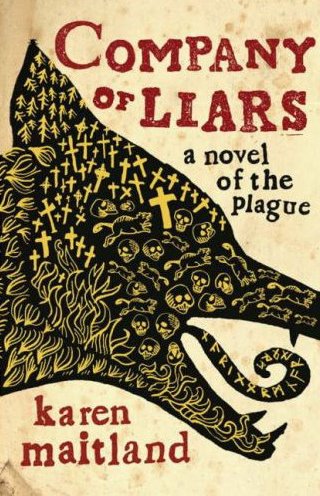
Company of Liars by Karen Maitland

Favourite Book Covers of 2008: Joseph Sullivan has published his annual list at the excellent The Book Design Review (BDR). If your new to the BDR make sure you also check out his archived favourites for 2007, 2006, and 2005!

Funnily enough, Fwis’ Covers website has just posted The Microscope and the Eye (pictured) designed by Isaac Tobin who also did the amazing cover for Obsession which is in the BDR list for 2008.

Jacket Mechanical: A nice design blog featuring great book cover designs. Lots of super-cool modernism if you like that sort of thing (which I do).

Speaking of modernism, take a look at Mid-Century Children’s Books a gorgeous retro Flickr set by The Ward-O-Matic (AKA Ward Jenkins).

1 Comment

Midweek Miscellany, Nov 26th, 2008

The Royal Mail British Design Classics: A set of first class stamps issued in January 2009 will commemorate ten icons of British design  including the Penguin paperback (pictured above).

“I wanted to put my money where my mouth is”booktwo’s James Bridle discusses Bookkake at 3:AM Magazine:

“I’m a huge fan of ebooks, and read this way regularly, but I don’t feel the reading experience they offer is yet on a sufficient par with traditional books to offer them at any great price, and I also don’t feel there’s much overlap between those looking for ebooks and those who’d pay for the paper edition.”

Risk has its rewards: Barney Rosset — US publisher of Beckett and Chekhov — discusses Grove Press and his struggles against censorship in a rebroadcast interview from 1991 on NPR’s Fresh Air. Rosset received the Literarian Award for his service to the literary community at the National Book Awards ceremony last week.

“The Best Business Books of 2008” — A slideshow of Fast Company‘s picks of the year:

“The titles that follow run the gamut of what Fast Company covers: Innovation, creativity, design, sustainability, technology, advertising and marketing, global business, and entertainment.”

It’s a cutely eclectic list for sure — including travel books and a novel (and mercifully there’s no Godin or Gladwell) — but it’s not, perhaps, quite as imaginative as they think it is…

30 Inspiring Flickr Groups on Typography: A wonderful list for type geeks compiled by designer David Airey (pictured: “Big Yellow Bookshop” by ultrasparky seen in the Typography and Lettering Flickr pool).

Comments closed

Midweek Miscellany, Nov 19th, 2008

“We’re from Kodak, Apple, Google, Yahoo”: The Guardian profiles Blurb — a publishing company with nobody from mainstream publishing — that specialises in high-quality, print-on-demand, photography books. Very, very, cool.

Good news and bad news for online retailers: Statcan found that more Canadians are shopping on the internet, placing almost $12.8 billion worth of orders in 2007, up 61% from 2005. ComScore, on the other hand, have just released their monthly retail e-commerce sales estimates, showing that online spending in October 2008 grew by only 1 percent over October 2007–the lowest monthly growth rate since they began tracking e-commerce in 2001.

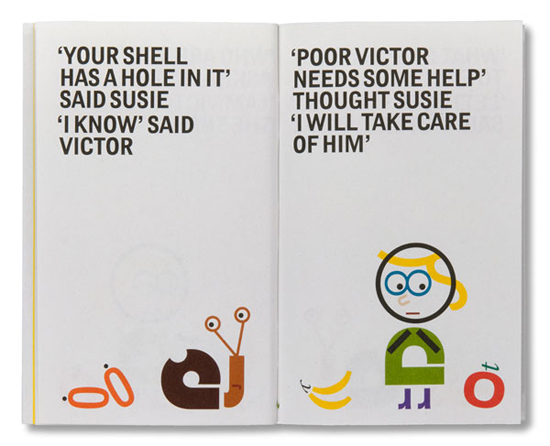
Victor & Susie: A brightly coloured “children’s book for adults” about Susie and Victor the snail, all drawn with letters and punctuation marks, published by Brighten The Corners (pictured). (via drawn)

“A kind of slow-motion suicide”: David Carr’s column for the New York Times looks at why firing their the most talented, experienced employees to cut costs backfired for Circuit City and will do the same for newspapers too:

“Right now, the consumer has all manner of text to choose from on platforms that range from a cellphone to broadsheet. The critical point of difference journalism offers is that it can reduce the signal-to-noise ratio and provide trusted, branded information. That will be a business into the future, perhaps less paper-bound and smaller, but a very real business.”

My take on this for book publishers (as it normally is): Publish less, publish better — quality matters. (via reveries)

Comments closed

Waterstone’s Hardback Classics

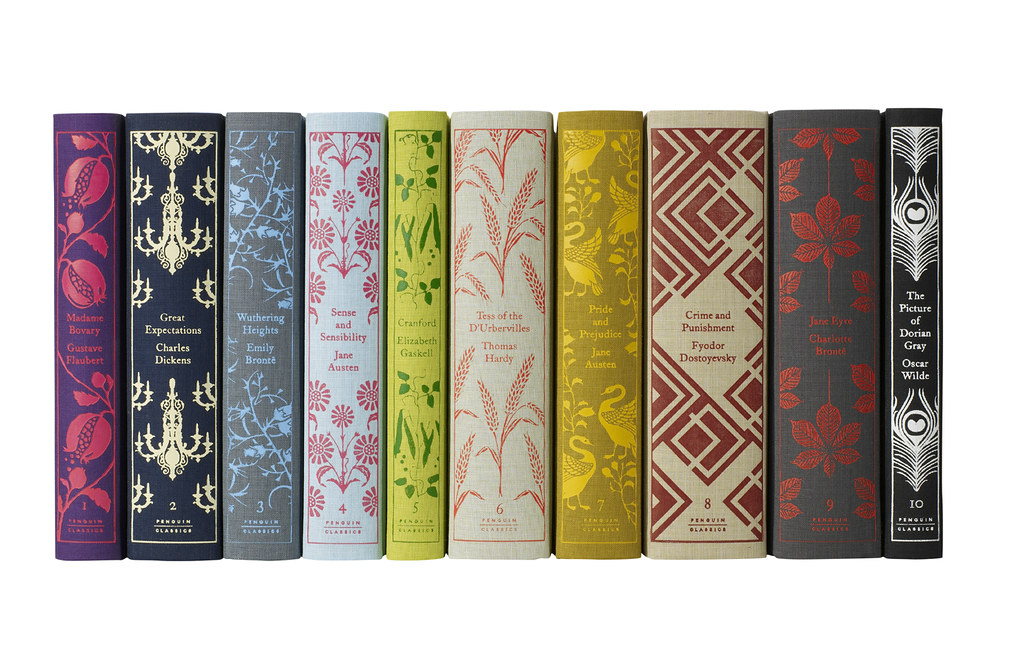
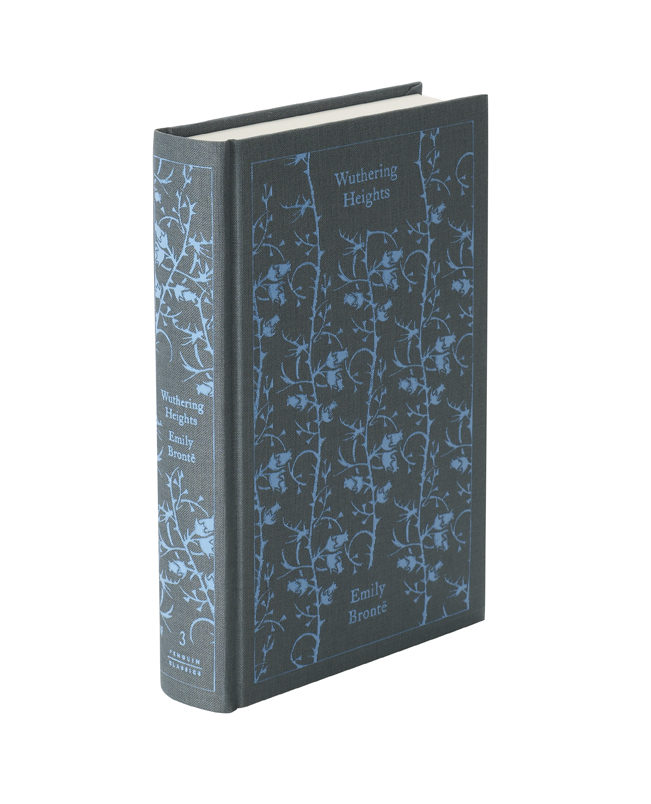
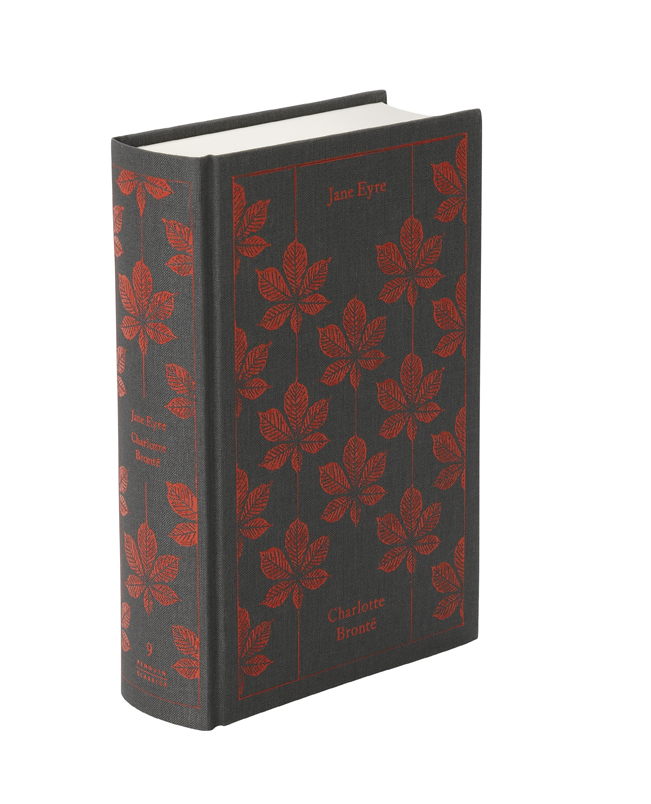
More lovely book designs by the very talented Coralie Bickford-Smith at Penguin UK (mentioned here previously for her work on the Gothic Reds series) for a collection of classics available at British book retailer,  Waterstone’s:

“All the books in this series have patterns that adhere to a strict grid… I have a real enthusiasm for pattern design so I was obsessed with this project. I wanted to create sumptuous books for people to enjoy, cherish and pass on.”


Penguin have very kindly put all of the covers for the Waterstone’s Hardback Classics on their Flickr photostream. It really is a beautiful set.

Coralie recently won an award for best ‘Brand or Series Identity’ at the British Book Design and Production Awards, for her work on the Classic Boys’ Adventures series, which is brilliant too.

Link

2 Comments

Penguin on Design

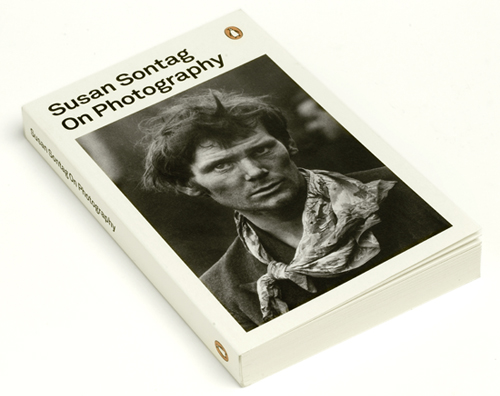
Refreshing classic creative texts: Creative Review talks to Penguin’s art director Jim Stoddart about the redesigned and reissued books in the ‘Penguin on Design’ series. The books include Bruno Munari’s 1965 book, Design As Art; Marshall McLuhan’s 1967 The Medium is the Massage; John Berger’s Ways Of Seeing from 1972; and Susan Sontag’s 1977 essay, On Photography.

I do like these covers — Susan Sontag’s On Photography (pictured) is particularly striking — but, again, what is with all the white? Surely someone at Penguin has  worked in a bookshop. I mean these are clearly meant to be looked at and not touched.

Link

Comments closed

Monday Miscellany

A bolt of electricity: PW polls publishers on the challenges and opportunities facing their digital publishing programs. It’s a fascinating glimpse of where the likes of Random House, Simon & Schuster, and Penguin are heading… A must read I would say…

Narrative medicine: Exposure to literature can influence how young doctors approach their clinical work according to the New York Times (via Guy Kawasaki):

“The idea of combining literature and medicine — or narrative medicine as it is sometimes called — has played a part in medical education for over 40 years. Studies have repeatedly shown that such literary training can strengthen and support the compassionate instincts of doctors.”

In need of a good editor: Book Lover Cynthia Crossen laments the decline of editorial rigour in the WSJ:

“Editors are the invisible heroes of the publishing industry, and as publishing companies cut corners, they cut editors… But without strong editors, writers are like cars with accelerators but no brakes”

Comments closed

Faber: Looking Back, Going Forward

Not some dusty, elbow-patched publisher: The Bookseller talks to CEO and publisher Stephen Page about Faber & Faber’s legacy and their plans for the future:

“We are in a moment of major, major change. Which from a brand like Faber is not threatening, only exciting, stimulating and interesting… The happy residue of the past 80 years is that we have this great history with six Booker winners and 11 Nobel laureates. Yet if we sit still and admire ourselves, this will only have a half-life and it will cool.”

Founded by Geoffrey Faber and T S Eliot, Faber published some of the defining books of the 20th Century including James Joyce’s Finnegans Wake, Sylvia Plath’s The Bell Jar, William Golding’s Lord of the Flies, and Samuel Beckett’s Waiting for Godot. They celebrate their 80th anniversary next year.

Link

Comments closed