A few years ago when I still worked at Pages, one of the creative/media executives who frequented the bookstore sent his assistant to exchange a copy of comic book by award-winning Norwegian cartoonist Jason that he’d bought from us earlier that day. The book, she said, was faulty. Apparently there were pages missing so the story didn’t make sense and her boss wanted a new copy. She had a receipt so I swapped the book without much thought. It wasn’t until after she’d left and I looked through the returned book that I realised there was nothing wrong with it. The pages were all there, her boss just hadn’t got it. She would be back later for a refund.
In a sense, the confusion was understandable: Jason’s anthropomorphic comics are surreal and require concentration to follow.
In another sense, the dude was simply an idiot because Jason is awesome.
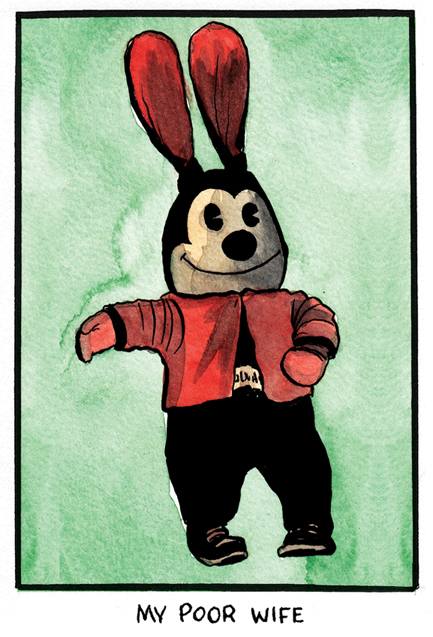
Jason is perhaps the most unique visual stylists working in comics today. Each individual panel is a work of ligne claire pop art: flat, beautifully coloured and amplified for effect.
The deceptively simple stories — often thrillers and off-beat romances — feature anti-heroes, guns, girls, historical figures, b-movie monsters, robots, and aliens. They’re a brilliant mix of silent pictures, film noir, La Nouvelle Vague, classic literature, crime fiction, sci-fi and pulp magazines. There are obvious elements of Hergé, but strange, deadpan, and imbued with ennui and loneliness, Jason’s comics also evoke Hitchcock, Godard, Jarmusch, and Lynch.
In I Killed Adolf Hitlerahit mangoes back in time to assassinate Adolf Hitler with unexpected personal consequences. In The Left Bank GangFitzgerald, Hemingway, Pound, and Joyce are graphic novelists planning a heist in 1920’s Paris. In Why Are You Doing This?Alex is framed for the murder of his best-friend.
Published in North America by Fantagraphics, Jason’s most recent book, Werewolves of Montpellier, features a thief who disguises himself as a werewolf. A 6 page preview is available on the Fantagraphics blog. If you haven’t checked out Jason’s work already, now’s a great time…
More of Jason’s artwork can be seen on the Fantagraphics’ on Flickr photostream.
The Betamax of Printing — A lovely post on medieval block books posted at The Catologuer’s Desk:
Block books were a sideline in the world of early printing, appearing concurrently with Gutenberg’s invention in the 1450s and 60s. Movable type and the printing press had their origins in metalworking and wine pressing. Block books, on the other hand, developed from the use of wood engravings to cheaply and quickly print fabrics, devotional items, and playing cards. Each block book was composed of individual prints that were produced by rubbing a wood engraving against paper, and they were often hand-coloured. What little text was included was usually incorporated directly into the engraving, a delicate and time-consuming process, but worthwhile because the prints could be mass produced without the capital outlay required for type.
(Is that actually a relevant, non-spurious mention of Gutenberg in a post about books and publishing? That must be a first!)
What’s most striking… about the many, many conversations I’ve had about e-books, innovations in self-publishing and the emergence of publicity venues like social networking is how difficult it is to stayed focused on what all of this means for readers. No matter how hard you try, within five minutes the talk turns inexorably back to how agents, editors and publishers will suffer in the coming cataclysmic change — and, above all, how gloriously liberating it will be for authors… How readers feel about all this usually gets lost in the fanfare and the hand-wringing… Readers themselves rarely complain that there isn’t enough of a selection on Amazon or in their local superstore; they’re more likely to ask for help in narrowing down their choices. So for anyone who has, however briefly, played that reviled gatekeeper role, a darker question arises: What happens once the self-publishing revolution really gets going…?
The interesting clash to me is between you and say, Sonny Mehta… You’re both in the same industry, but from his point of view if he can just hold it together 10 more years, he’s fine. He can retire. But you know that if you stay in the book industry 30 more years, there’s no way that things will be anything like today. Sonny Mehta’s incentive is to postpone—even if it makes things worse—the moment of shock to right after he retires. But you don’t have that option. I’m interested in young writers and editors entering a system that is plainly structured around the vestiges of a world fast draining away.
The Web is now about 20 years old. Up until recently, we’ve been dazzled by its riches and conveniences – for good reason. Now, though, I think we’re becoming more aware of the costs that go along with the benefits, of what we lose when we spend so much time staring into screens. I sense that people, or at least some people, are beginning to sense the limits of online life. They’re craving to be more in control of their attention and their time.
Nicholas Carr also discusses his new book with Norah Young on this week’s Sparkon CBC Radio.
And finally (just in case you’re wondering)…
Here’s the latest from cartoonist James Sturm on life without the internet at Slate:
In the two months since I’ve been unplugged, I have been experiencing more and more moments of synchronicity—coincidental events that seem to be meaningfully related. Today, after finishing the first phase of a graphic-novel project that is based on the life of a fictional member of the Weather Underground, I received in the mail an unsolicited copy of a graphic novel about teaching written by William Ayers. Earlier in the week, at the exact moment I started working on a drawing of a monkey (see above), Michael Chabon started talking about Planet of the Apes…I know this type of magical thinking is easily dismissed, but I keep having moments like this. So how do I explain it? Are meaningful connections easier to recognize when the fog of the Internet is lifted? Does it have to do with the difference between searching and waiting? Searching (which is what you do a lot of online) seems like an act of individual will. When things come to you while you’re waiting it feels more like fate. Instant gratification feels unearned. That random song, perfectly attuned to your mood, seems more profound when heard on a car radio than if you had called up the same tune via YouTube.
[T]he critic James Wood wrote: “José Saramago was both an avant-gardist and a traditionalist. His long blocks of unbroken prose, lacking conventional markers like paragraph breaks and quotation marks, could look forbidding and modernist; but his frequent habit of handing over the narration in his novels to a kind of ‘village chorus’ and what seem like peasant simplicities allowed Saramago great flexibility.”
On the one hand, Mr. Wood wrote, it allowed the writer to “revel in sheer storytelling,” and on the other to “undermine, ironically, the very ‘truths’ and simplicities his apparently unsophisticated narrators traded in.”
On the Record — Jamie Byng has signed a deal to create a “living archive” of Canongate Book’s records at Dundee University:
For Byng, the attraction of the project is that it will be rooted in the present as much as the past. While Canongate promises to respect the privacy of those with whom it is in contact, the overall dream is to create an archive “that will show the company as a living, organic thing. I hope it won’t just give people insights into one publishing house but publishing in general. Or even how – because I want to give access to all the financial stuff – how an independent business can grow. This business is constantly evolving, never sitting still: every day there’s a huge amount going on not just within Canongate but with all the writers we’re dealing with.”
I could go on, about how I left Publishing House X for Publishing House Y because I was still scared of Editor F, and how at Publishing House Y I managed to get three books written there working with Editor G—who assured me that he would never leave, and this was almost true, except for a brief period when he did, in fact, leave, but then he came back—and then the head of Publisher Y got fired, and eventually I left and then Editor F left, and then I was working with Publisher Z, and then the head of Publisher Z left, and then I left Publisher Z to go back to Publisher W, because the person now running it was an old friend from the magazine world, who I knew would never leave, but you might think I was exaggerating. But I’m not.
I just think it takes a couple decades to kind of clear your brain now. So it makes more sense to me that I could find my footing when I was 30 instead of when I was 19. It seems a little more clear. You know, novelists are older now. Things are happening later in people’s lives. They’re kind of living lives and then creating things about the lives they’ve lived. Rather than being an artiste at an early age and coming out with a ball of fire. That energy has been co-opted because you haven’t immunized yourself yet against media. It’s easier to get swept up things then take a couple of years to get over your, like, indie rock hangover.
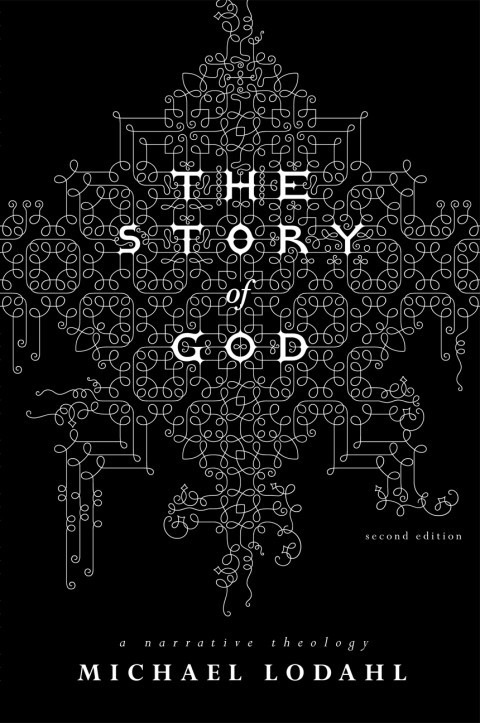
An Ethics of Interrogation — Another stunning cover design by Isaac Tobin (via This Isn’t Happiness). My Q & A with Isaac here, if you missed it.
Isaac also has at least two covers in AIGA’s 2009 selections for 50 Books/50 Covers.
Reader Despair Syndrome — An unintentionally Onion-esque post about RSS anxiety (something we can all relate to I’m sure) by Leon Neyfakh for the New York Observer (via Sarah Weinman):
Legions of jittery, media-conscious New Yorkers are eating themselves alive signing up for feeds they never end up reading in hopes of becoming better people—more knowledgeable, more fun to talk to, more in control of their Internet consumption. They subscribe to dozens, sometimes hundreds of news sources, each of them added to the list with the best of intentions…
Hark! — Dave Howard interviews artist Kate Beaton about her comic Hark! A Vagrant for The Torontoist:
It’s very calculated, it takes me a long time to write a strip, but when you read it, part of the delivery is that timing, that kind of bouncyness of flow, getting a punch-line in without being obvious about it. Or getting the slip on someone, to make them laugh.To make somebody laugh is a difficult thing, it takes a lot of precise steps.
And speaking of comic strips…More Chris Ware posters seen at OMG Posters!
Thriller writer Jason Pinter recently rattled some publishing china by suggesting that a stubborn belief that Men Don’t Read is alienating male readers:
I’m tired of people saying Men Don’t Read. Men LOVE to read… But the more publishing repeats the empty mantra that Men Don’t Read the less they’re going to try to appeal to men, which is where this vicious cycle begins.
Publish more books for men and boys. Trust editors who try to buy these books, and work on the marketing campaigns to hit those audiences. The readers are there, waiting, eager just under the surface… They’ve been alienated for a long time and might need to be roused from their slumber. But as I’ve always said the biggest problems facing the publishing industry are not ebooks, or returns, but the number of people reading. This is a way to bring back a lot of readers who have essentially been forgotten about.
Pinter is right in a sense. The idea that men don’t read books is a glib generalization and publishers really should be worried about literacy and declining readerships. But are men really turning away from reading because the book trade isn’t trying to reach them?
The scandal engulfing former Penguin Canada CEO David Davidar is a prickly reminder that the upper echelon of publishing is still largely a boy’s club. And even if you accept Pinter’s assertion that “that most editorial meetings tend to be dominated by women”, Rebecca Smart, Managing Director at Osprey Publishing, ably demonstrates that women can publish effectively for a predominantly male readership.
And even if you ignore all the books on football mentioned last week (not to mention the endless number of books on baseball and cricket), and the entire output of writers like Cormac McCarthy, George Pelecanos and the late (but still in print) Patrick O’Brian, the New York Times best seller lists reveal more than a few new books have been successfully published for men.
The perception that publishers are marginalizing men is just as much an illusion as Men Don’t Read. At least if men read the NY Times and like books on economics, war and expletives. (And who doesn’t?)
But this is, of course, completely subjective. The New York Times bestsellers — war, history, politics, and angry (funny) old men — may not be the kind of books Pinter had in mind. I certainly didn’t read the book that caused Pinter so much angst, A Lion’s Tale by pro-wrestler Chris Jericho, but then I don’t read much Roth, Amis, or Coetzee either, though I suppose plenty of men do. Perhaps the real problem is publishing along stereotypical gender lines? Not all men (or women) want to read the same books…
I was thinking about this because of two books I finished recently: War by Sebastian Junger (Twelve 2010) and Colony by Hugo Wilcken (Harper Perennial, 2007). Both are books by men about men — and I enjoyed them both — but otherwise they have almost nothing in common.
Full of piss, vinegar, and shit blowing up, War is a nonfiction account of Junger’s time embedded with the Second Platoon of Battle Company in the Korengal Valley, eastern Afghanistan.
At one level, Junger’s book is a chronicle of Second Platoon’s days. He takes us up the mountains, along the valley floor, on helo-lifts, into firefights. We sit with the men in their bunks — infested with fleas and tarantulas — and we listen to their low-grade (and sometimes hilarious) philosophizing as they pass the hours… But Junger is aiming for more than just a boots-on-the-ground narrative of the travails of American fighting men. As the book’s grandiose title suggests… “War” strives to offer not just a picture of American fighting men but a discourse on the nature of war itself.
With it’s acronyms, hot military hardwareand bunker philosophizing War is, without question, a compelling read. But it is also a deeply troubling book. Junger’s intimate dependence on this closely knit platoon clearly affects his journalistic perspective, and Junger’s narcissism aside, I was left wondering whether there is a psychological condition in embedded journalists similar to Stockholm Syndrome.
Lewis Manalo, a former sapper in 82nd Airborne Division, describes Junger as a “war tourist” in a scathing review of the book for Publishing Perspectives:
[W]hat a fantasy it is. All the thrill of being in combat with none of the responsibility of knowing what to do. He endows the different engagements with the excitement and clarity of a Hollywood action film… As Junger paints them, these fights are where all those big words like “heroism” and “courage” and “sacrifice” come into play, where men achieve amazing things and where they die dramatic deaths. Over and over, Junger and the men he depicts rave about how exciting battle is. In Junger’s world, war is a glorious thing where everyone should want to be.
“Fantasy” is an interesting choice of words. Certainly, the phrase ‘war-porn’ came to mind when I was reading it. Perhaps not surprisingly then, Junger’s experiences in Korengal are also the basis for a feature-length film called Restrepo co-directed with photographer/filmmaker Tim Hetherington:
If War is a dirty nonfiction hypemachine, Colony by Hugo Wilcken is a beautifully constructed — if largely ignored — literary novel.
With echoes of Conrad and Camus, Colony is a sophisticated post-modern adventure story. Sabir — a war veteran and petty criminal — finds himself on a boat to a brutal penal colony in French Guiana. He escapes the camp, but as his plans unravel, the book takes an unexpected tack, throwing the previous narrative into doubt. The past, present, and future mix in memory and imagination.
John Self, who has long championed the novel, had this to say about it:
The book’s sometimes elusive nature seems to be reflected in the references to Poe’s Narrative of Arthur Gordon Pym. But what impresses most is Wilcken’s unwillingness to try to impress the reader: the prose is unfussy, the scenes uncluttered. There is no ‘fine writing’. Instead, there is very fine writing indeed.
The theme of Colony is escape: from captivity to freedom, and vice versa; from reality into dreams and memories; from one identity to another; from life to elsewhere.
Colony is simply an extraordinary book. It also feels like an old-fashioned one, especially compared to War‘sheadymultimedia blend of insider reportage and violence stuck together by hasty research and memoir. My sense is that itis War‘s template that will be imitated by publishers trying to capture Pinter’s elusive male reader. But personally it will be Colony that endures, and lives long in my mind.
The past, present, and future mix in memory and imagination. The prose is simple and uncluttered. Familiar characters become surprising and complex.
Zingers — Film critic and blogger Roger Ebert, who has lost the ability to speak unaided, on Twitter:
Twitter for me performs the function of a running conversation. For someone who cannot speak, it allows a way to unload my zingers and one-liners… This has become addictive. I tweet too often. I actually go looking for stuff to tweet. I have good friends who suggest things… I was doing this daily, but have scaled back because it was keeping me up too late.
I’ve made a change recently. After writing my blog, “The quest for frisson” and reading two recent articles about internet addiction, I have looked hard at my own behavior. For some days now I have physically left the room with the computer in it, and settled down somewhere to read. All the old joy came back, and I realized the internet was stealing the reading of books away from me. Reading is calming, absorbing, and refreshing for the mind after hectic surfing… I like the internet, but I don’t want to become its love slave.
Pelham’s covers featured a crepuscular sky above a barren expanse of water, sand or sunbaked earth as the backdrop for an artefact of twentieth-century industrial or military technology. According to the September 1974 issue of Science Fiction Monthly, these machines depict ‘the debris of our society’. Pelham, the article explained, ‘finds romance in seeing the future as if it were already the past – in visualizing ruins created from the artifacts we are manufacturing now’. But the paradox of Pelham’s artifacts is that they are not in ruins. His are pristine machines at odds with their apocalyptic settings. Half buried or submerged, they stand as tombstones to ostentation and brutality. They are icons, but only of man’s arrogance.
Drawing inspiration from the iconic Blue Note LP covers from the 1950’s and 60’s designed by American modernist designer Reid Miles, Hi-Fi is an amazing music video directed by Bante for last year’s concert season at the Bellavista Social Pub, in Sienna, Italy (how great does that sound?).
It’s beautifully done. In fact, the whole video just made me smile…
Somehow I managed to miss most of the hype leading up to the World Cup, but now that things are about to kick off I’m actually genuinely excited (not least by England vs. The U.S. on Saturday) and have spent the last couple of days catching up. Here are a few literary, typographical, and just plain interesting things that I’ve stumbled across…
Soccer Aid — A typographic poster for the World Cup designed by Treble Seven | 777 in aid of UNICEF.
The very same Simon Kuper reviews four books about the World Cup and African football for The Financial Times:
Great claims are often made for football’s significance. In fact it’s almost always a mirror rather than a gun: it reflects society, rather than changing it. Usually the sport has just one significant effect on real life: it makes people happier. At least, it usually does.
According to sources only peripherally aware of the World Cup, Janovich’s infuriating behavior first became apparent during a Super Bowl viewing party last February when he repeatedly used the phrase “American football” to describe the action on the field. In recent weeks, Janovich has also begun referring to the supposed suspense involved in choosing the players for the U.S. “side,” and has struck up several extended but one-sided conversations concerning figures such as “Kaka” and “Ronaldinho,” generally mystifying and alienating everyone he has come into contact with.
If the hype is extraordinary, so is the ambient presence. The last World Cup was all around us, on billboards, drink cans and cereal packets, on garage forecourts and millions of flag-bearing cars, in the windows of Boots the chemist and McDonald’s the burger joint (“Want tickets? Win tickets! Buy any large meal to play”). The cup-winning captain from 1966, Bobby Moore, was on every KitKat wrapper, despite having died 13 years earlier; his team-mate Geoff Hurst, now Sir Geoff, was appointed director of football for McDonald’s and had columns in two newspapers. The boys of 1966 were bigger in 2006 than they were in 1966.
Footballers as Film Stars — In a related item at the Intelligent Life blog looks at the Nike’s slick World Cup commercial created by Oscar-winning director Alejandro González Iñárritu (Babel):
And, not to be outdone, here’s a list of 10 football books worth your time (in no particular order) compiled at great haste for The Casual Optimist by my good friend and recovering sportswriter Nick Clifford who is a great source of useless facts about the beautiful game:
(full disclosure: this list has a couple of late additions from me, so if you disagree, it will probably be with my selections — Nick has impeccable taste).
Update: Flavorwire also has a list of 6 books to read during the World Cup.
[Recommendation engines] introduce us to new things, which is good, but those new things tend to be a lot like the old things, and they tend to be drawn from the shallow pool of things other people have already liked. As a result, they create a blockbuster culture in which the same few runaway hits get recommended over and over again. It’s the backlash against the “long tail,” the idea that shopping online is all about near infinite selection and cultural diversity. It has a bad habit of eating its own tail and leaving you back where you started.
Thompson was a man of the left, a lifelong alcoholic and became closely acquainted with the dark underside of American life, the lonely crowd where petty criminals, low-level cops, conmen and prostitutes rub shoulders… One of Thompson’s critics has called him without disparagement “a dime novel Dostoevsky”…
And finally… Popville, a super stylish pop-up book by Anouck Boisrobert and Louis Rigaud, published by Macmillan (thanks Sio!):
Born in Chicago, April 1, 1949, poet and musician Gil Scott-Heron is perhaps best known for the politically infused bluesy soul and proto-hip-hop he created with Brian Jackson in the early 1970’s.
Although recently troubled by drug addiction and in and out of prison for drug possession, an apparently resurgent Scott-Heron released his first studio album in 16 years, I’m New Here(XL Recordings), in February, and two of his novels — The Vulture (1970) and The Nigger Factory (1972) — were reissued (for a second time) by Canongate Books with new cover designs by talented UK designer Stuart Bache.
I recently talked to Stuart about Gil Scott-Heron and the redesign…
How did you get into book design?
I fell upon book cover design by shear luck. In late 2005, after a stint of travelling, I decided it was time to think about my career. I found, applied and was surprised (and ecstatic) to be given the job of Junior at Hodder & Stoughton and moved to London.
When did you discover the work of Gil Scott-Heron?
I first discovered Gil Scott-Heron way back in school. We had been reading and discussing To Kill a Mocking Bird in English Class and I remember taking a real interest in the subject, which my teacher at the time picked up on and loaned me both The Vulture and The Nigger Factory.
How did you come to design the covers of his books?
It was a great pleasure to be asked to design the covers for the reissues. I had already been doing some work for Canongate and so when the Art Director asked if I had time to come up with ideas for the reissues I jumped at the chance. It was a fairly short deadline, but I believe those to be the best kind, great for creativity (and a few extra grey hairs).
Could you describe your design process for the covers?
The brief asked for them to be fresh, streetwise, graphic and contemporary. I designed a few covers for each title, with different images and branding styles, which were then passed on to Canongate for their prefered direction.
The final The Vulture cover centred around John Lee (the young lad who is murdered) and the title cried out to be used in some sort of graphic function. The Nigger Factory relied heavily on an image that both showed and did justice to that moment in US history. It also needed a graphic so I added the stripes to represent the flag, but the use of red paint strokes shows the heat and anger involved too.
What is the typeface?
The typeface I used is Futura, probably light. I have a thing about Futura, Century Gothic and the like. It’s the perfect circles of the ‘O’ and ‘C’.
Are they a departure from your usual design work?
These covers stand out for me, especially compared to my usual style. I take a lot of pride in my work but I’m never usually proud of it — I always see something I could have done better. But the Gil Scott-Heron’s showed I could do something completely different…and in a short timescale too.
What are you working on currently?
At the moment I’m working on another title for Canongate called Super Cooperators and Aline Templeton’s new thriller Cradle to Grave for Hodder & Stoughton. This time of year tends to be quiet, too quiet really, but these are nice titles to be getting along with. Cradle to Grave gives me the opportunity to play with my homemade textures and brushes in Photoshop, and Super Cooperators is, once again, going to be something very different from the rest of portfolio.
Where do look for inspiration and who are some of your design heroes?
Ever since I’ve been freelance I have had a renewed enthusiasm for design, I notice everything and I’m hardly out of bookshops — I see books all the time that I think ‘I wish I’d designed that’. It really keeps you on your toes and gives you the incentive and the push to do better.
I owe a lot to Hodder & Stoughton, their Art Department has some of the best designers in the industry and I learned an awful lot during my time there — and if they had never given me the chance I wouldn’t be writing this now.
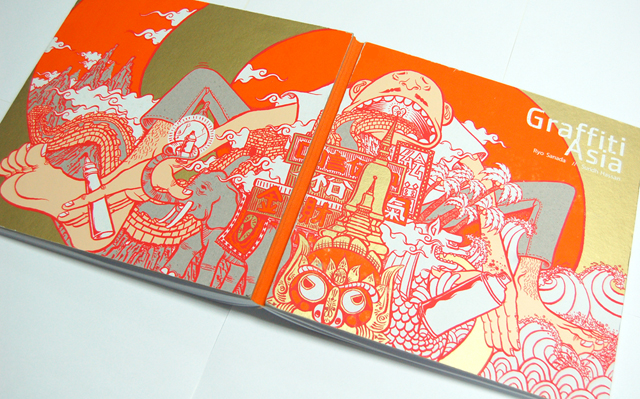
The stunning cover of Graffiti Asia by The SRK‘s Ryo Sanada and Suridh Hassan. The image doesn’t entirely do it justice as the ‘brown’ is actually spot metallic gold (I think it’s ink, but correct me if I am wrong):
(FULL DISCLOSURE: Graffiti Asia is published by Laurence King, who are distributed in Canada by my employer Raincoast Books).
The Death and Life of the Book Review — Despite being a well-ploughed furrow (and the predictable nostalgia for print reviews/skepticism about the web) this essay by John Paletta in The Nation is an interesting read, not least because he recognises that the culture of newspapers has downgraded book review sections:
The book beat has been gutted primarily by cultural forces, not economic ones, and the most implacable of those forces lies within rather than outside the newsroom. It is not iPads or the Internet but the anti-intellectual ethos of newspapers themselves… In a news context, “anti-intellectual” does not necessarily mean an antipathy to ideas, though it can be that too. I use the word “anti-intellectual” to describe a suspicion of ideas not gleaned from reporting and a lack of interest in ideas that are not utterly topical.
The Host — KCRW’s Bookworm Michael Silverblatt interviewed in The Believer:
I’ve read all of the work, or in some cases as much of the work as is humanly possible. We all have time and deadlines, accidents, emergencies, but I read as much of it as I can. I’m very against interviewers who do not have time to read the work, who accept jobs knowing that they don’t have time to do the preparation. And that is almost everyone who has a daily interview program. How could you read, or see, or watch, or hear as much as you need to? So, you wing it. And it’s not going to stop. Winging it is going to be the American way.





 Hark!
Hark!