Skip to content

The Casual Optimist Posts

Rework

Co-founder of 37 Signals and author of Rework Jason Fried talks to Peter Hopkins, co-founder of Big Think, in this hour-long interview for HP’s Input| Output series:

It all seems like good advice, especially if you run a small business (or thinking of starting one), and while it’s hard to pin down any specific relevance for the book industry,  it got me thinking about this post again, and the idea we should always focus on making stuff.

1 Comment

Midweek Miscellany

The elegant new cover design for The Secret of Contentment by William B. Barclay, designed by Christopher Tobias.

Melancholy Technology — Tom McCarthy, whose novel C is on the long-list for the Man Booker Prize, on technology and the novel:

Technology and melancholia: an odd coupling, you might think. Yet it’s one that has deep conceptual roots. For Freud, all technology is a prosthesis: the telephone (originally conceived as a hearing aid) an artificial ear, the camera an artificial eye, and so on. Strapping his prosthetic organs on, as Freud writes in Civilisation and its Discontents, man becomes magnificent, “a kind of god with artificial limbs” – “but” (he continues) “those organs have not grown on to him and they still give him much trouble at times”. To put it another way: each technological appendage, to a large degree, embodies an absence, a loss.

There Might Be Typos On The Internet — Lori Fradkin on life as a copy editor for The Awl :

Once you train yourself to spot errors, you can’t not spot them. You can’t simply shut off the careful reading when you leave the office. You notice typos in novels, missing words in other magazines, incorrect punctuation on billboards… Another downside of the job is that only your mistakes are apparent. The catches are basically invisible. No one will look at an edited article and think, I am certain that, once upon a time, there was a double quote where there should have been a single, and a wise person fixed the issue for my benefit. But if you let a “their” slip through in the place of a “there,” you are a complete moron. And if you are working online, commenters will let you know so.

For Sur — The folks at We Made This on their contribution to the Penguin Great Ideas V series:

We did a bit of research into Borges’ writings, and learnt that he’d been one of the founding contributors to the Argentine literary journal Sur, which was published regularly from 1931 until around 1966… he magazine has a very distinctive (and typographically bonkers) masthead, and fortunately the name ‘Sur’ isn’t a million miles from the name ‘Borges’, so basing our design on it felt like a rather tasty solution.

Design Space — Design consultant Theo Rosendorf, author of  The Typographic Desk Reference, talks about his work and his office space with Herman Miller:

Typography plays a major role in the practice beyond simply picking a font or knowing a particular brand’s guidelines. Every typeface has unique requirements in that it has to be set just so. It’s up to the graphic designer to understand what a particular typeface wants. We work within those bounds to let type communicate as it was intended. Everything else follows.

And speaking of typography…

Brockmann in Motion —  Vít Zemčík animates a print design masterpiece. Zemčík made this beautiful 12 second short during the International Typography Workshop in Czieszyn.

Comments closed

Eggs and Sausage

A student project for a class at New York’s School of Visual ArtsJackie Lay’s neat typographic video is set to Tom Waits’ Eggs and Sausage:

In a recent interview with Jeffrey Hyatt at DesignCrave, Lay said:

“I didn’t want to be too literal with the imagery… but I did follow the loose narrative arc in the song of a man going to a late-night diner, ordering his meal off the menu and then lamenting over his unrequited love on napkins, finished off with the waitress bringing the check.”

The video was awarded a Certificate of Typographic Excellence by the Type Directors Club.

Comments closed

TypoElements 2010

A motion graphics tribute to Robert Bringhurst’s book The Elements of Typographic Style by Toronto-based Chris Kim, who is currently studying Radio & Television Arts at Ryerson University:

TypoElements 2010 won an Applied Arts 2010 Student Award.

4 Comments

Something for the Weekend

The cover for The Disappearing Spoon designed by the amazing Will Staehle. To quote Tal Goretsky at Book Covers Anonymous:  “Holy Mother God!”. Apparently it’s printed on uncoated paper.

You can see some of Tal’s own rather nice design work here.

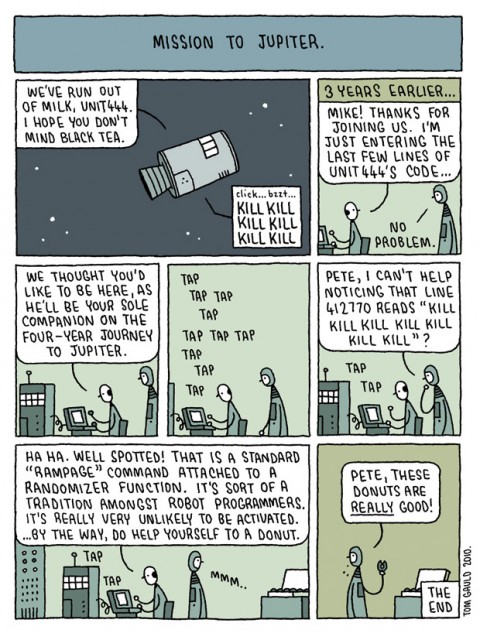
And speaking of designer’s blogs… Designer Joanna Rieke has started a new blog called UnCovered about book and magazine covers. She recently interviewed illustrator (and Casual Op. hero) Tom Gauld:

I think most literature works perfectly well without illustrations and I have seen some truly awful images put on the cover (used as illustrations) of great books. As for comics, I’m more often frustrated by comics which are too wordy than too visual. I think the balance between words and pictures is very important in a comic and though the ratio doesn’t always have to be the same, my heart sinks when I see a page which is filled with writing.

Taking a summer break from his regular illustration gig at The Guardian, Tom is currently producing a weekly comic and posting it to Flickr:

Real Editors Ship — I linked this on Twitter already, but it’s kind of great so what the hell… Paul Ford on getting stuff out the door and the value of editors (and I would suggest Production Managers):

People often think that editors are there to read things and tell people “no.” Saying “no” is a tiny part of the job. Editors are first and foremost there to ship the product without getting sued… This is not to imply that you hit every sub-deadline, that certain projects don’t fail, that things don’t suck. I failed plenty, myself. It just means that you ship…

Editors are really valuable, and, the way things are going, undervalued. These are people who are good at process. They think about calendars, schedules, checklists, and get freaked out when schedules slip. Their jobs are to aggregate information, parse it, restructure it, and make sure it meets standards. They are basically QA for language and meaning.

The Fine art of Recommending Books — Laura Miller at Salon:

Amazon and other online merchants have harnessed mighty algorithms to run their “If you enjoyed that, you might like this…” suggestion engines, but these are still crude instruments. Practically any novel you plug into Amazon’s search engines at the moment returns the robotic announcement that people who bought it also bought one of Stieg Larsson’s “Girl” thrillers — because seemingly everybody in America is buying those books. It’s not like you need the world’s most sophisticate e-commerce servers to tell you that.

And finally…

Steranko! — Jonathan Ross interviews comics legend Jim Steranko, inspiration for Josef Kavalier in Michael Chabon’s The Amazing Adventures of Kavalier and Clay,  for The Guardian:

Spend an hour with Jim Steranko and, if he’s in the mood, he’ll regale you with the most extraordinary tales. Are they true, I have asked myself more than once, or is he a fantasist? Has his love of storytelling and the creation of modern myths bled into his own life story until he can no longer tell the two apart? Well, now that I’ve met him, I believe them all to be true, just as I believe it when he tells me he still runs miles every day, pumps iron, and fornicates blissfully like a man a third his age. He is unique. He is Steranko. He is the greatest.

A slideshow of Steranko’s work is here.

Have a good weekend…

1 Comment

Great Ideas Volume V

Penguin Great Ideas V David Pearson is posting the covers for the new Penguin Great Ideas series to Flickr. As you can see, they are stunning.

You can read my interview with David Pearson here.

1 Comment

Pass the Gestalt, Please

An interesting post by the whip-smart Evan Schnittman, Managing Director of Group Sales and Marketing at Bloomsbury, about e-book rights and royalties at his blog Black Plastic Glasses:

[A] successful and coherent publishing is not the sum of individual publishing rights, but rather the gestalt work presented coherently to a global audience. Viewing the ebook out of the context of the rest of the work gets us nowhere. We must understand how ebooks fit into the publishing ecosphere and only then can we determine what the right royalty should be… The whole work has FAR greater value than the sum of the individual rights. Allowing each individual part, or right, to be disaggregated and auctioned to the highest bidder serves only those who make profit from short-term gain.

(via MobyLives)

Comments closed

What Is There In Life If You Do Not Work?

A winsome post by William Zinsser, author of On Writing Well, on work and writing for The American Scholar:

I’ve never defined myself as a writer, or, God forbid, an author. I’m a person–someone who goes to work every morning, like the plumber or the television repairman, and who goes home at the end of the day to think about other things. I can’t imagine not going to work as long as I can…

…It may seem perverse that I compare my writing to plumbing, an occupation not regarded as high-end. But to me all work is equally honorable, all crafts an astonishment when they are performed with skill and self-respect. Just as I go to work every day with my tools, which are words, the plumber arrives with his kit of wrenches and washers, and afterward the pipes have been so adroitly fitted together that they don’t leak. I don’t want any of my sentences to leak. The fact that someone can make water come out of a faucet on the 10th floor strikes me as a feat no less remarkable than the construction of a clear declarative sentence.

(via  Coudal)

2 Comments

Midweek Miscellany

Finding a Cover for The Girl With the Dragon Tattoo — A WSJ article and slideshow on the cover design process for the bestselling novel by Steig Larsson:

For three months, Peter Mendelsund, a senior designer at Knopf, prepared nearly 50 distinct designs…  Mr. [Sonny] Mehta ultimately endorsed the vivid yellow jacket with the swirling dragon design: “It was striking and it was different.”

Peter Mendelsund has some further thoughts about the cover, Wittgenstein, David Foster Wallace, and design in a great post on his blog JACKET MECHANICAL:

Due to many factors (the mechanisms of the approval process; design’s fundamentally commercial aspects…) when one examines the field of design, one cannot help but come to the conclusion that good design must be, above all, likeable.

Design is too intimately entangled with matters of taste (to use Wittgenstein’s word) to be demanding enough to be Art. I have to say that in my years in the field, I’ve yet to be made to cry by a work of design. I’ve yet to be forced to view the world differently due to a work of design. I’ve yet to be really, truly gripped by a work of design. I know it’s deeply self-defeating to say this, yet, the best design has only ever evoked in me the feeling of “that’s cool.”

And on the subject of book cover design…

Creative Problem Solving — Macmillan Designers and art directors Susan Mitchell, Charlotte Strick, and Henry Sene Yee discuss the state of book cover design at FSG‘s new Work in Progress blog:

We’re interpreting or packaging other people’s ideas. If someone gives me a manuscript, I interpret it. That’s problem solving… I’m not just here to create something beautiful. Sometimes I’m here to be a plumber. I love that aspect—I can fix things. I’ll make it balance, whatever it is.

Still Reading? — Patrick Kingsley on the art of slow reading for The Guardian:

Still reading? You’re probably in a dwindling minority. But no matter: a literary revolution is at hand. First we had slow food, then slow travel. Now, those campaigns are joined by a slow-reading movement – a disparate bunch of academics and intellectuals who want us to take our time while reading, and re-reading. They ask us to switch off our computers every so often and rediscover both the joy of personal engagement with physical texts, and the ability to process them fully.

Also in The Guardian

Unwanted — A 12-page comic strip tale of unwanted immigrants by Joe Sacco, author of Safe Area Gorazde, Footnotes in Gaza, and Palestine

…And on a not unrelated note: Publishing Perspectives looks at comics and graphic novels in the Middle East and how they are pushing at cultural boundaries.

And finally…

Bob Stein of The Institute for the Future of the Book interviewed by On The Media:

The western version of the printing press is invented in 1454. It takes 50 years for page numbers to emerge. It took humans that long to figure out that it might be useful to put numbers onto the pages.

What is slightly curious about this interview is that Stein acknowledges the essentially unpredictable messiness of the future, and yet it doesn’t seem to stop him…

Comments closed

The Pleasures and Sorrows of Work

Jamie Keenan’s inspired cover for The Pleasures and Sorrows of Work by Alain de Botton, published by Vintage:

Image courtesy of Vintage and Anchor Books Art Director John Gall.

(Via @Pieratt and Book Cover Archive)

Comments closed

Finding the Unique Visual Story

The latest Gestalten.tv video podcast is a conversation with New York Times Graphics Director Steven Duenes and Graphics Editor Archie Tse. Duanes and Tse talk about creating daily images, diagrams, charts, and interactive media for the newspaper, and providing the clearest possible visualization of data:

Comments closed

Something for the Weekend

The Trouble With Amazon — Colin Robinson, co-publisher at OR Books (so perhaps not entirely neutral), on the internet retailer for The Nation:

The accumulated effect of Amazon’s pricing policy, its massive volume and its metric-based recommendations system is, in fact, to diminish real choice for the consumer. Though the overall number of titles published each year has risen sharply, the under-resourcing of mid-list books is producing a pattern that joins an enormously attenuated tail (a tiny number of customers buying from a huge range of titles) to a Brobdingnagian head (an increasing number of purchasers buying the same few lead titles), with less and less in between.

And, on a not unrelated note…

What’s Wrong With Music Business — A fascinating  interview with Tom Silverman, founder of Tommy Boy Records, at Wired. I’m usually really skeptical about comparisons between the music industry and book publishing, but there’s lots of good stuff here for book folks:

[T]he premise of technology being the great democratizer and allowing more artists to break through than before — actually, we’ve seen the opposite effect. Fewer artists are breaking than ever before, and fewer artists who are doing it themselves are breaking through than ever before. Back in the early ’80s, when the cellphone was first invented, there were more artists breaking on their own, with no technology, than they are now, with technology. Why is that the case? And what can change to open the gates again, to allow artists to break through, whether on their own or with help?… [S]ocial networks have been a really big disappointment in terms of moving the needle in either exposure or sales in any meaningful way. There are a lot of myths in technology that everybody wants to believe, because everybody wants things to get better.

The Little Coincidence That Haunt Your Life — An interview with Alan Moore, author of From Hell, V for Vendetta, Watchmen et al,  at The Quietus:

One of the academics at this conference was saying that he was working on a book which was about Watchmen as a post-9/11 text. I can see what he means to a degree. One of my friends over there… said he’d been talking to some people on Ground Zero on September 12, 2001 and he was asking them if they were alright and what it had been like. Two of them, independently of each other, said that they were just waiting for the authorities to find a giant alien sticking half way out of a wall…

…There was that atmosphere of a cataclysmic event happening in New York, which I don’t think had been depicted previously… even in science fiction terms it was perhaps unimaginable! Yes, you do find that a lot of odd, little coincidences like that haunt your life.

Double Take — Tom McCarthy, author of Remainder, Tintin and the Secret of Literature, and C, discusses Hitchcock, his preoccupation with doubles and the exact meaning of “MacGuffin”, with BBC Radio 4’s The Film Programme (via Lee Rourke).

And finally…

Blogs are dying says The Economist. Oh no they’re not, says Cory Doctorow in The Guardian.

The real question, however, is whether Publishers Weekly starting their own blog, PWxyz, is evidence for the prosecution or the defense… (Sorry, that’s a little mean-spirited. It’s great PW have started a blog even if it feels a somewhat belated)…

Have a great weekend.

2 Comments