Skip to content

The Casual Optimist Posts

Images and Words

Photographer Steve McCurry, best known for his iconic National Geographic portrait ‘Afghan Girl’, recently posted two sets of beautiful photographs on his blog of people reading books. Publishing Perspectives spoke to McCurry about the ongoing project:

As a photographer, McCurry is always on the hunt for the “unguarded moment,” that slice of time that reveals something personal and honest. “I have another gallery of people sleeping and of couples interacting. There’s an intimacy people have with a book and its author that is similar,” he says, adding. “We’re all different and we’re all the same. It amuses me that whether you’re fabulously rich and sophisticated or you happen to be someone on the street in the third world or a classroom in some remote area, reading is all the same act. It’s a common link in our shared humanity, a thing we all do that is regardless of where we are economically or socially.”

The first selection of McCurry’s photographs of readers, titled ‘Fusion: The Synergy of Images and Words’, can be seen here. The second set is here.

Comments closed

Something for the Weekend

Hornby Cover Versions — Some rather beautiful student work by Barcelona-based graphic designer Lucía Castro (although my inner-bookseller gets very twitchy at the thought of those soft off-white covers!). (via Cosa Visuales)

Full of Refusals — Tom McCarthy interviewed for More Intelligent Life:

[C]ontemporary literature has to deal with the challenges laid down by modernism. The most exhilarating and unsettling upheavals took place in the early 20th century, and to ignore them and go back to writing some kitsch version of the 19th-century novel is ostrich-like… I’m suspicious of the term ‘avant-garde’. I think it should be restricted to its strict historical designation: Futurists, Dadaists, Surrealists etc. “Tristram Shandy” and “Motherless Brooklyn” aren’t avant-garde novels; they’re novels.

C by Tom McCarthy will finally available in the US and Canada on September 7th.

A stunningly simple Malevich-like book cover design by Jason Booher and Helen Yentus for the paperback edition Inside the Stalin Archives by Jonathan Brent. First seen at the Book Cover Archive who have just posted a slew of Jason’s covers.

On the subject of the BCA, co-curator Ben Pieratt has recently updated his own design portfolio.

Agile Content — Marny Smith interviews Brian O’Leary of publishing consultants Magellan Media Partners:

[P]ublishers are competing against both established players and new entrants at the same time.  The newer players often have much lower costs than we’re used to, making them potentially tough competitors… I’ve been thinking lately that publishers need to work more aggressively on creating agile content that can be discovered and easily reused or recombined.  Creating content that is sold in one format just won’t be cost-effective in the future.

And finally…

The cute book trailer for OH NO! Or How My Science Project Destroyed the World written by Mac Barnett illustrated by Dan Santat:

You can find more of Dan’s awesome illustrations on his Flickr:

(via The Ward-O-Matic)

Comments closed

The Beauty of Data Visualization

David McCandless, author of Information is Beautiful / The Visual Miscellaneum (same book different title), explains how simple diagrams can reveal unexpected patterns and connections in complex data sets at TED:

http://www.theatlantic.com/science/archive/2010/08/10-reading-revolutions-before-e-books/62004/
Comments closed

Midweek Miscellany

Jardin de la Connaissance —  Berlin-based landscape architect Thilo Folkerts and artist Rodney Latourelle used 40,000 reclaimed books to create a ‘Garden of Knowledge’ for the 11th International Garden Festival in Grand-Métis, Quebec (via Kitsune Noir).

A History of Print Culture — Assistant Professor of Media Culture,  C.W. Anderson,  provides his annotated syllabus for a print history course at CUNY in The Atlantic (thx Jamie):

The primary goal of this class is to teach students about the culture of “print media” in an era when that culture is being joined (and in some cases, overtaken) by a culture that we might variously call digital culture, online culture, or the culture of the web. What does “print” mean in our digital age? And what does “culture,” mean, for that matter? By culture I mean something that is not reducible to “economics,” “technology,” “politics,” or “organizations” — although culture emerges out of the nexus of these different factors, and others.  In other words, I want to disabuse my students of the notion that new technologies or new economic arrangements can create digital or print culture in the same way that a cue ball hits a billiard ball on a pool table.

Also in The Atlantic10 Reading Revolutions Before E-Books by Timothy Carmody.

Knowledgeable Criticism — An interesting interview with Fred Brooks, computer scientist and author of The Mythical Man-Month, for Wired magazine:

Great design does not come from great processes; it comes from great designers… The critical thing about the design process is to identify your scarcest resource. Despite what you may think, that very often is not money.

And finally…

When You Don’t Know You Are Breaking the Rules… Eli Horowitz, managing editor of McSweeney’s, interviewed for Scotland on Sunday (via the indefatigable  Largehearted Boy):

At the heart of McSweeney’s success is the huge amount of care and attention which goes into producing each book, ensuring that the jacket design and layout complement the words inside the covers. Though Horowitz believes there is a McSweeney’s aesthetic he is struggling to put into words what it is. “There’s a notion of old-fashioned story-telling and a compelling plot combined with an innovative literary impulse – when we’ve had those ingredients that’s when we’ve done our best works.”

Comments closed

The Ark

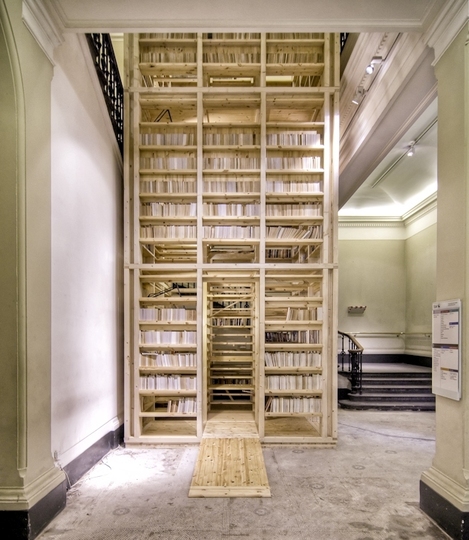
Created by Rintala Eggertsson Architects, Ark is a free-standing wooden tower accessed by a spiral case that connects two floors of the Victoria and Albert Museum in London. The façades of the tower consist of hundreds of shelves, holding thousands of books, which visitors can browse. The books can be read in private chambers within in the structure.

The tower is part of the ‘1:1 — Architects Build Small Spaces’ exhibition at the V&A, which runs until the end of this month. In this V&A video, the architects talk about their practice, the book tower and its installation:

(via Apartment Therapy)

1 Comment

The Typographical Terror

A great new Wondermark comic by David Malki. You really need to see it full size to appreciate the horror…

Comments closed

Something for the Weekend

Psycho Cover — Penguin art director Paul Buckley discusses his new book Penguin 75 with Imprint:

I am very aware of how much product gets put out there that is completely unnecessary, be it music, movies, books, whatever—it seems that for every good piece of culture we experience, we are bombarded with 99 pieces of redundant crap. I’ve been in the industry for awhile, and of course want to show off the great work we do here, but was not going to put out yet another design book and take your money—you can get that in any annual. To me, often more interesting than the covers are the stories, the psychology that created all the variables that led to this cover over the 20 other proposed covers.

Paul has recently updated his Flickr with new covers from the Penguin Ink series, which utilizes art by tattoo artists, as well as the latest additions to the excellent Penguin Graphic Classics series, which have art by contemporary cartoonists.

My interview with Paul and Penguin 75 designer Christopher Brand is here.

Also at Imprint Thurston Moore of Sonic Youth and book editor Eva Prinz (formerly of Abrams and Rizzoli)  talk about their new publishing venture Ecstatic Peace Library.

Writing on the Wall — Andrew Franklin, publisher and managing director of Profile Books,  offers an overview of the current state of the book business in the UK (via Dan Mogford):

Bookshops enliven high streets, create communities of readers and stage author events, while good booksellers encourage reading and shape taste. For most readers, browsing is a key part of deciding what to read, and publishers put huge effort into packaging and presenting their books. Of course many of these activities can migrate online with Facebook groups, online forums, feeds and websites helping to steer readers to the books they will most enjoy. For some online shoppers bookshops are part of this process: they browse in bookshops, write shopping lists and then buy (perhaps more cheaply) online. But no bookshop can be in business as a shop window for other retailers. You don’t have to be hopelessly nostalgic or sentimental to believe something very precious is lost with every bookshop that closes.

And at the other of the spectrum…

Another Reading Revolution — Historian Andrew Pettegree talks about his new book The Book in the Renaissance with The Atlantic (via Shelf Awareness):

The situation really is that the first generation of printers, encouraged by scholars, naturally produced the sort of books these people wanted. But it’s hard to apply this sort of commercial model—this small, bespoke model used for manuscripts—to a new process that produces 300 or more identical items. The irony is that there were plenty of other readers out there. The first printers ignored the groups that we might call pragmatic readers. Literacy was already widely-disseminated in the fifteenth century. There were lots of people who could read but did not habitually buy books, so the trick was to discover how to reach them.

Comments closed

Midweek Miscellany

The Eyes Have It — An interview with gentleman book cover designer and advertising copywriter David Gee about his design for Jim Hanas’s e-book short story collection Why They Cried. You can find my interview with David here.

Writers on Process — Writers of every stripe talking about how they write (via Largehearted Boy).

In Their Own Words — A BBC archive of television and radio interviews with modern British novelists including Virginia Woolf, Daphne du Maurier, Anthony Burgess, J.G. Ballard,  and Muriel Spark. One could quibble about about selection of some of  contemporary novelists, but otherwise this is pretty amazing collection.

And speaking of archives…

Design is History is an expanding reference for graphic design history created by designer Dominic Flask.

And finally…

The only page of Jason’s silent and sadly aborted adaptation of Edgar Allan Poe’s The Black Cat.

e-book short story collection, Why They Cried

3 Comments

TELEPHONEME

Inspired by The Alphabet Conspiracy and other educational films from the 1950’s and 1960’s, TELEPHONEME is a hybrid live-action and animated short created by design collective MK12 about the science of the alphabet and sinister hidden messages carried by language:

MK12 also developed a special typeface for the film that can be downloaded from the TELEPHONEME website.

Comments closed

Permanent Beta

Blogging is a learning experience. At least it is for me. Every day I discover a new way to make things better and I tinker with things. I don’t usually mention all the minor changes I make, but I’ve recently made three significant changes to the blog that I wanted to draw your attention to:

  1. Permalinks:  For reasons really too tedious to get into, I have changed the permalink structure of the blog. Theoretically anyone visiting here via an old link will be redirected to the new URL, but I have no faith in technology so I thought I’d better let you know about it. I’m sorry if I’ve broken anything important.
  2. Comment Guidelines:  I’ve not felt the need to have a comments policy before — and I’m still not 100% certain I really need one now — but I have found myself deleting more comments than usual recently and so this is an attempt to explain why I do and don’t post certain comments. The short version of the guidelines is “keep it constructive; don’t be a dick.” You can find the full version here.
  3. Twitter: I’ve been feeling self-conscious about repeatedly tweeting everything I blog, so I have created a dedicated Twitter feed for The Casual Optimist that will automatically update with links to new posts. I will occasionally post links to the blog from my personal twitter, but I plan to do that less and less.

Thanks for your patience.

Comments closed

The Books That Made Me: China Miéville

China Miéville, author of one of my favourite novels this past year The City and the City, talks to Claire Armitstead about the six books that inspired him for a new Guardian Books podcast series ‘The Books That Made Me’. The books range from Beatrix Potter’s Tale of Jeremy Fisher to Max Ernst’s surrealist Une Semaine de Bonté:

The Books That Made Me: China Mieville

Miéville latest novel is Kraken.

4 Comments

Something for the Weekend

Illustrator and designer Dale Edwin Murray’s proposed cover for the Reservoir Dogs Original Screenplay. Is it just me, or is there something of artist and erstwhile Penguin designer Alan Aldridge about this?

You can see more of Dale Edwin Murray’s work on his blog and his Flickr (via Cosas Visuales).

The Library Project — A photographic installation by Swiss artist Nicolas Grospierre inspired by the infinite library in Jorge Luis Borges’ novel short story The Library of Babel (via This Isn’t Happiness).

And finally…

Author David Mitchell talks to Michael Silverblatt about his new novel The Thousand Autumns of Jacob de Zoet on this week’s KCRW’s Bookworm.

I have a truly bad track record with David Mitchell novels, but I should probably give him another go  (although that title isn’t doing a lot to encourage me).

The BBC World Service also interviewed David Mitchell recently about his earlier novel Cloud Atlas.

2 Comments