Skip to content

The Casual Optimist Posts

Spirit City Toronto

Combining  illustration and photography to depict homeless nature spirits who inhabit the forgotten corners of the city, there are shades of Hayao Miyazaki and Studio Ghibli in freelance illustrator Aaron Leighton’s lovely debut book Spirit City Toronto:
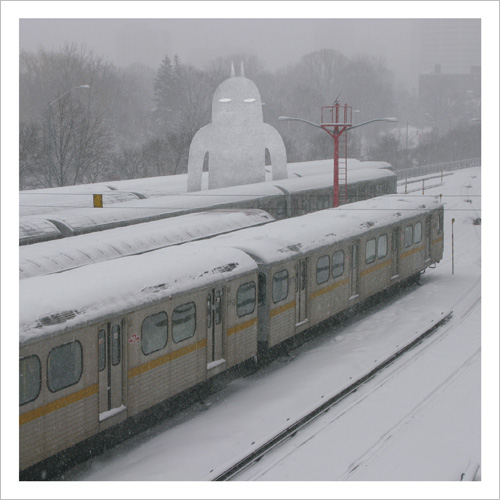
Spirit City Toronto is published by Koyama Press, and Books@Torontoist have just posted a two part interview with Aaron about the book.
(via Drawn!)

Comments closed

Midweek Miscellany

Killing Her Softly — Joseph O’Neil reviews Martin Stannard’s biography of Muriel Spark for The Atlantic (thx Ben):

In one of her memoirs, [Doris] Lessing suggests: “Writers, and particularly female writers, have to fight for the conditions they need to work.” This sounds like an understatement, particularly in relation to the last pre-feminist generation, to which she belonged. Dipping into it, we see that Penelope Fitzgerald, a mother of three, did not publish until the age of 58, that Iris Murdoch and Flannery O’Connor and Patricia Highsmith were childless. Spark may not have been alone in associating motherhood with artistic and personal annihilation. (Other patterns emerge. Highsmith, Lessing, and Spark all loved cats, and in fact Spark received a cat from Highsmith, with whom she also shared itinerancy and a gleefully vicious imagination. If you took scoops of the temperaments of Doris Lessing and Patricia Highsmith and added a dollop of Flannery O’Connor—for the cold Catholicism—the resulting gelato would taste a lot like Muriel Spark.)

Sensory Deprivation — The ubiquitous Jonathan Franzen, author of Freedom,  interviewed at the A.V. Club:

Where does this stuff come from? It comes from sensory deprivation. It comes from turning down all the volume knobs to the one setting—or somewhere between zero and one—on everything, so I can actually hear myself think and I can actually poke around inside myself. We’re all so used to cultural noise being played at full volume. It can come as a surprise, even to myself, how much you can know about what’s going on by listening to almost nothing. It’s important, because if you have it up at full volume, you can’t hear yourself think, and all you want to do is chase after the stuff that’s going on.

And if you think Mr Franzen might have got a little too big for his boots, then following Emperor Franzen on Twitter might be for you (“I was on the cover of TIME. That’s TIME magazine, bitches…”).

Fighting the Last War — John Le Carré talks to the BBC Radio 4 Today Programme about his new novel Our Kind of Traitor (released next month):

“I was laughed at, in a way, when the Cold War ended and the wall came down… ‘Poor old Le Carre, what will become of him? Nobody’s spying anymore.’ The reality is, the budgets have never been bigger, the recruitment has never been more wholesale.”

Boredom — Lee Rourke, author of The Canal, interviewed for 100th issue Bookslut:

We’re in constant thrall, either waiting to be used by technology or desperately trying to catch up with it. Boredom is the realization of an acute emptiness caused by this widening void… There’s nowhere for us to go now. We are stranded. We have been marooned. My novel, The Canal, is a summation of this sense of dread: this slow realization that things, everything, is speeding up and moving away from us. We have been left with the inability to deal with what this distance creates within us…

And finally…

Living in Conservative Times — Tom McCarthy reviews What Ever Happened to Modernism? by Gabriel Josipovici for The Guardian:

In cultural terms, we live in deeply conservative times… We shouldn’t imagine, though, that things were that different in the golden age of modernism. Ulysses was printed, in 1922, on a small, private press in Paris, in a run of 1,000; Kafka’s Metamorphosis, on its small-press publication in 1915, sold 11 copies – of which 10 were bought by Kafka. Yet can anyone, now, name the successful middlebrow writers of 1922 or 1915? Of course not.

(And, as this is a blog for people who like to live under rocks, Tom’s novel C was shortlisted for the 2010 Man Booker Prize yesterday.)

3 Comments

Moshun

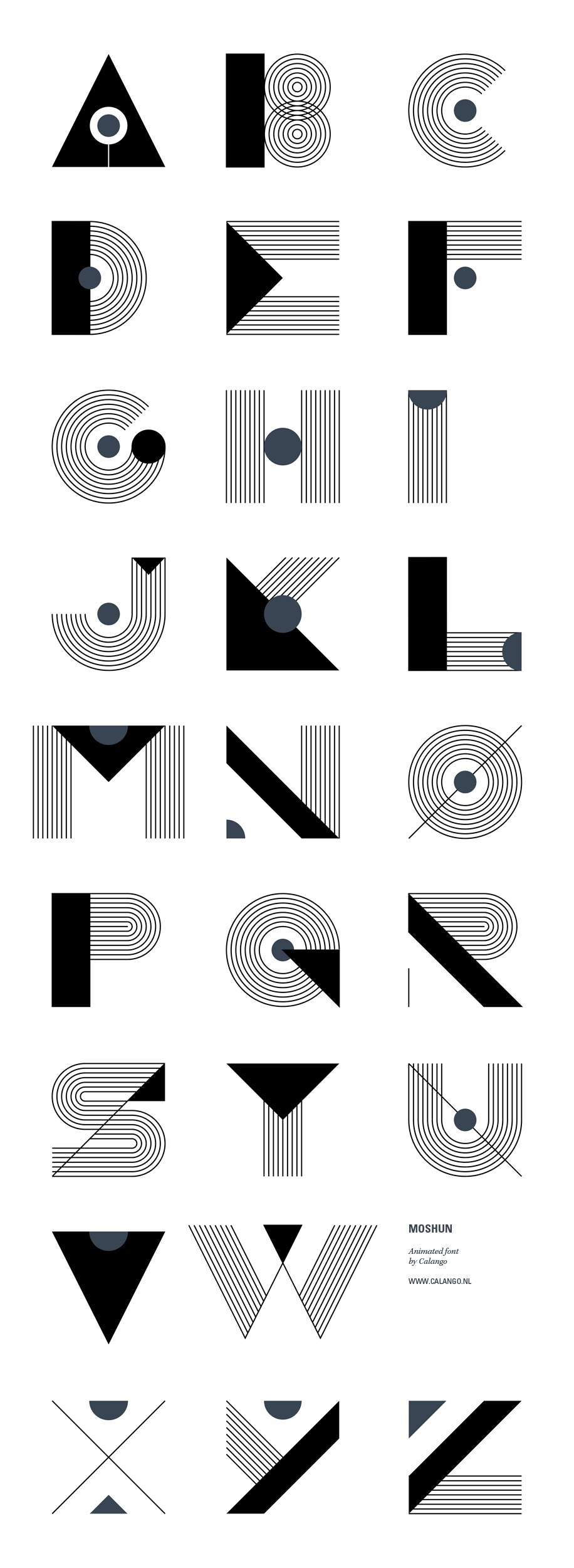
Moshun is an animated geometric typeface by Calango:

(via Coudal / Graphic Hug)

1 Comment

Something for the Weekend

What Do You Do With These Things? — Andrew Pettegree, author of The Book in the Renaissance, interviewed at the Boston Globe (via The Second Pass):

What you’ve got to do once you’ve got 300 identical copies of a book is you’ve got to sell it to people who don’t even yet know they want it. And that’s a very, very different way of selling…

It’s this classic example of how you get technological innovation without people really being aware of the commercial implications, of how you can make money from it. There’s quite a little similarity in the first generation of print with the dot-com boom and bust of the ’90s, where people have this fantastic new innovation, a lot of creative energy is put into it, a lot of development capital is put into it, and then people say, “Well, yeah, but how are we going to make money…?”

Your Brain on Gadgets — NPR looks at digital overload:

The average person today consumes almost three times as much information as what the typical person consumed in 1960, according to research at the University of California, San Diego.

And The New York Times reports that the average computer user checks 40 websites a day and can switch programs 36 times an hour.

“It’s an onslaught of information coming in today,” says Times technology journalist Matt Richtel.

Digital Horde — Fast Company on the launch of The Mongoliad, Neal Stephenson’s experiment with digital storytelling and social media:

The innovation in The Mongoliad… [is] in the entire concept of a serialized, dynamic, digital “book” that includes video, imagery, music, and background articles among the text of the storyline and comes with a social media companion, with which fans/readers can comment and interact. The social aspect even goes so far as including badges, the new digital “reward” phenomenon, which readers can earn for taking part in particular activities. The book will be available online via a browser, and also through dedicated apps for Apple iDevices and Android phones.

There’s more about the venture at The New York Times. At what point, however, does this stop being a novel and start being a game? Can we tell anymore…?

This Is Our Niche — Steven Heller talks to Sonic Youth’s Thurston Moore and editor Eva Prinz about Ecstatic Peace Library for the The New York Times:

Moore and Prinz believe that the analog and digital are more distinct in books than in other media. “To say that an art book can be an e-book is ignorant of the tradition and art of color separations, printing and binding,” Prinz said. “Likewise, to suspect that a digital storytelling experience is simply a pdf downloaded on your iPad or Kindle platform is disrespectful to the interactive arts and artists.” She has been experimenting with video game technology to create their first e-book. “In similar processes to those employed by the 1960s experimental subcommittee of the College de Pataphysique, a group of French writers and poets who called themselves OuLiPo (Ouvroir de litterature potentielle),” Prinz continued, “Ecstatic Peace Library is creating new ways to ‘escape’ into literature and art.”

The Wolf Hall EffectIntelligent Life looks at the growing respectability of  historical fiction in the wake of Hilary Mantel’s Booker Prize winning novel.

And finally…

Little Acts of Civil Disobedience — A profile of book designer Peter Mendelsund by Stefan Kamph from 2009 that I hadn’t seen previously (thx Jacob):

Moments of humor and surprise in a cover are a designer’s “little acts of civil disobedience,” says Mendelsund, and he “would like to think that if you’re a good reader there are little exegetical clues you can sneak in.” The court artist hides his private mark in the appointed painting.

Peter also recently posted his beautiful designs for the Steig Larsson deluxe boxed set at his blog JACKET MECHANICAL.

Comments closed

English

In spite of the hardcover’s beautiful jacket design (by Paola Ecchavaria), it was a citation in Nicholas Carr’s recent book The Shallows that finally got me to read Proust and The Squid by Maryanne Wolfe.

It is a fascinating if, at times, academic book that examines the history of written language and the corresponding development of our ‘reading brain’. In a chapter on reading development, Wolfe includes a charming, witty poem on the vagaries of English pronunciation that I wanted to share. Wolfe says the poem is anonymous, but I have subsequently seen it attributed to T.S. Watt. Please let me know if you have any further details…

I take it you already know
Of tough and bough and cough and dough.
Others may stumble but not you,
On hiccough, through, lough and through.
Well done! And now you wish, perhaps,
To learn of less familiar traps.

Beware of heard, a dreadful word
That looks like beard and sounds like bird,

And dead; it’s said like bed, not bead;
For goodness’s sake, don’t call it deed!
Watch out for meat and great and threat,
(They rhyme with suite and straight and debt).
A moth is not a moth in mother,
Nor both in bother, broth in brother,

And here is not a match for there,
Nor dear and fear for bear and pear,
And then there’s dose and rose and lose–
Just look them up–and goose and choose,
And cork and work and card and ward,
And font and front and word and sword,
And do and go and thwart and cart.
Come, come, I’ve hardly made a start.

A dreadful language? Man alive,
I’d mastered it when I was five.
And yet to read it, the more I tried,
I hadn’t learned it at fifty-five.

2 Comments

Raymond Hawkey 1930-2010

The dapper graphic designer Raymond Hawkey, whose innovative work at The Daily Express and The Observer changed the face of British newspapers in the post-war era, died last week aged of 80.

Hawkey’s modern graphic style also revolutionized British book cover design.

His stark black and white cover for Len Deighton’s 1962 Harry Palmer novel, The Ipcress File, which — with its chipped teacup, stubbed out cigarette and Smith & Wesson revolver — mixed violence with the everyday, became iconic despite initial opposition from the book’s horrified publisher Hodder & Stoughton.

Designer Mike Dempsey, who profiled Hawkey for Design Week in 2001, noted:

What Hawkey did with [The Ipcress File] was one of the key moments in design history. It is important to view this piece of work within the context of the period. Hawkey’s photographic use of inanimate objects to give a narrative dimension to the cover was startlingly new and made a dramatic impact on the publishing scene. The publisher, Hodder, found the design too spartan with its black and white photography, plain background and small undifferentiated typography, but both Deighton and Hawkey held firm. They were right, because on publication in 1962, The lpcress File sold out within 24 hours.

After the success of The Ipcress File, Hawkey became a sought-after book cover designer, working on more jackets for Deighton, as well as covers for Ian Fleming, Kingsley Amis and Frederick Forsyth amongst others.

According to his obituary in The Guardian, Hawkey was  a shy and quietly spoken man:

But in spite of his gentle voice and manner, once engaged in an assignment he was indefatigable, working 16 hours at a stretch, before sleeping briefly and putting in another 16-hour day in the flat where he lived for five decades. He was wonderfully generous, especially with his time, to young people who sought his advice, whether it was on design or writing – he wrote four very fine thrillers, including It (1983), regarded by many as the first truly modern ghost story.

A fastidious and private man, he had a dread of dying in hospital; and after a long illness he died in his own bed – with his beloved wife, Mary, reading his favourite poem to him.

Comments closed

Midweek Miscellany

The mighty George Lois at home in New York City at The Selby.

Start the Press — Robert Pinsky reviews The Book in the Renaissance by Andrew Pettegree for the New York Times:

The story begins with money. Johannes Gutenberg did not find a way to profit from his technical achievements. The Gutenberg Bible, a gigantic project, required large amounts of capital that needed replenishing over time, long before there was any hope of profit. The finished product inspired awe, but the print run was 180 copies. Gutenberg “died bankrupt and disappointed.”

Nor was he alone. Apparently, it took decades before some people figured out how to make money from this remarkable invention. For decades after Gutenberg, it was not even clear that print would become a success. How do you market books? How many should you run off at one time? Piracy was a problem, as were texts changed, mutilated or combined in unauthorized editions. Many printers were ruined, trying to exploit the new medium.

And at the other end of the spectrum (or, at least, the other side of the Atlantic)…

Seeing Things Flat — Jenny Turner reviews Tom McCarthy’s C for the London Review of Books:

Remainder works as an allegory of a certain flâneurish model of artistic production, in which a gentleman’s independence of income and education loom pretty big. That, we might say, is Remainder’s material remainder; and it is that of C also, though C moves the argument on a little, investigating the conditions, as it were, of its own existence: family inheritance, war, imperialism, technology; spreading information, spreading death. It’s this core of historical and philosophical seriousness that separates McCarthy’s work completely from the current fashion for baroque narratological cleverness in fiction… There are differences between cleverness and intellect. McCarthy has many things he’s trying to do in his novels, none of which have much to do with pleasing producers or publishers or even an audience, unless by pleasing one means leaving purged.

The Googleable Future — Author William Gibson, whose new novel Zero History is published next week, on Google for the New York Times (via MDash):

We never imagined that artificial intelligence would be like this. We imagined discrete entities. Genies. We also seldom imagined (in spite of ample evidence) that emergent technologies would leave legislation in the dust, yet they do. In a world characterized by technologically driven change, we necessarily legislate after the fact, perpetually scrambling to catch up, while the core architectures of the future, increasingly, are erected by entities like Google.

Cyberspace, not so long ago, was a specific elsewhere, one we visited periodically, peering into it from the familiar physical world. Now cyberspace has everted. Turned itself inside out. Colonized the physical. Making Google a central and evolving structural unit not only of the architecture of cyberspace, but of the world.

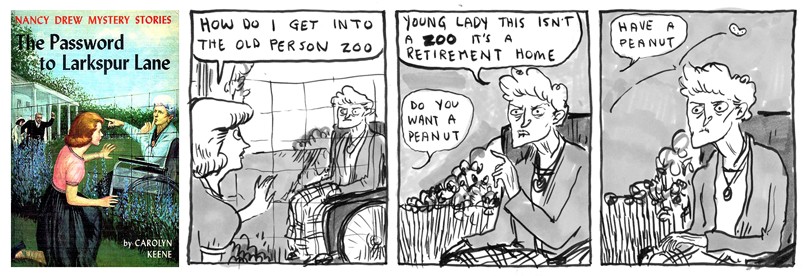
Kate Beaton interprets Nancy Drew book covers in her own unique way at Hark! A Vagrant.

And finally…

Kevin Huizenga has posted his head-spinning Glenn Ganges comic ‘Time Travelling’ at What Things Do.

1 Comment

Jay Rosen on the Media

The Economist’s Democracy in America blog has an interesting Q & A with Jay Rosen, professor of journalism at NYU and author of What Are Journalists For?, about the American news media. The focus is largely on politics (Democracy in America is a blog about American politics after all), but Rosen’s insights into the future of the news media in general are also pertinent to the book industry:

The cost of changing settled routines seems too high, but the cost of not changing is, in the long term, even higher. A good example is the predicament of the newspaper press: the print edition provides most of the revenues, but it cannot provide a future. I know of no evidence to show that young people are picking up the print habit. So if the cost of abandoning print is too high, the cost of sticking with it may be even higher, though slower to reveal itself. That’s a problem…

…[T]he alternative to chasing clicks is building trust and an editorial brand. “What people want” arguments don’t impress me. I think anyone with a half a brain knows that you have to listen to demand and give people what they have no way to demand. You have to listen to them, and assert your authority from time to time, because listening well is what gives you the authority to recommend what is not immediately in demand.

Link

Comments closed

Images and Words

Photographer Steve McCurry, best known for his iconic National Geographic portrait ‘Afghan Girl’, recently posted two sets of beautiful photographs on his blog of people reading books. Publishing Perspectives spoke to McCurry about the ongoing project:

As a photographer, McCurry is always on the hunt for the “unguarded moment,” that slice of time that reveals something personal and honest. “I have another gallery of people sleeping and of couples interacting. There’s an intimacy people have with a book and its author that is similar,” he says, adding. “We’re all different and we’re all the same. It amuses me that whether you’re fabulously rich and sophisticated or you happen to be someone on the street in the third world or a classroom in some remote area, reading is all the same act. It’s a common link in our shared humanity, a thing we all do that is regardless of where we are economically or socially.”

The first selection of McCurry’s photographs of readers, titled ‘Fusion: The Synergy of Images and Words’, can be seen here. The second set is here.

Comments closed

Something for the Weekend

Hornby Cover Versions — Some rather beautiful student work by Barcelona-based graphic designer Lucía Castro (although my inner-bookseller gets very twitchy at the thought of those soft off-white covers!). (via Cosa Visuales)

Full of Refusals — Tom McCarthy interviewed for More Intelligent Life:

[C]ontemporary literature has to deal with the challenges laid down by modernism. The most exhilarating and unsettling upheavals took place in the early 20th century, and to ignore them and go back to writing some kitsch version of the 19th-century novel is ostrich-like… I’m suspicious of the term ‘avant-garde’. I think it should be restricted to its strict historical designation: Futurists, Dadaists, Surrealists etc. “Tristram Shandy” and “Motherless Brooklyn” aren’t avant-garde novels; they’re novels.

C by Tom McCarthy will finally available in the US and Canada on September 7th.

A stunningly simple Malevich-like book cover design by Jason Booher and Helen Yentus for the paperback edition Inside the Stalin Archives by Jonathan Brent. First seen at the Book Cover Archive who have just posted a slew of Jason’s covers.

On the subject of the BCA, co-curator Ben Pieratt has recently updated his own design portfolio.

Agile Content — Marny Smith interviews Brian O’Leary of publishing consultants Magellan Media Partners:

[P]ublishers are competing against both established players and new entrants at the same time.  The newer players often have much lower costs than we’re used to, making them potentially tough competitors… I’ve been thinking lately that publishers need to work more aggressively on creating agile content that can be discovered and easily reused or recombined.  Creating content that is sold in one format just won’t be cost-effective in the future.

And finally…

The cute book trailer for OH NO! Or How My Science Project Destroyed the World written by Mac Barnett illustrated by Dan Santat:

You can find more of Dan’s awesome illustrations on his Flickr:

(via The Ward-O-Matic)

Comments closed

The Beauty of Data Visualization

David McCandless, author of Information is Beautiful / The Visual Miscellaneum (same book different title), explains how simple diagrams can reveal unexpected patterns and connections in complex data sets at TED:

http://www.theatlantic.com/science/archive/2010/08/10-reading-revolutions-before-e-books/62004/
Comments closed

Midweek Miscellany

Jardin de la Connaissance —  Berlin-based landscape architect Thilo Folkerts and artist Rodney Latourelle used 40,000 reclaimed books to create a ‘Garden of Knowledge’ for the 11th International Garden Festival in Grand-Métis, Quebec (via Kitsune Noir).

A History of Print Culture — Assistant Professor of Media Culture,  C.W. Anderson,  provides his annotated syllabus for a print history course at CUNY in The Atlantic (thx Jamie):

The primary goal of this class is to teach students about the culture of “print media” in an era when that culture is being joined (and in some cases, overtaken) by a culture that we might variously call digital culture, online culture, or the culture of the web. What does “print” mean in our digital age? And what does “culture,” mean, for that matter? By culture I mean something that is not reducible to “economics,” “technology,” “politics,” or “organizations” — although culture emerges out of the nexus of these different factors, and others.  In other words, I want to disabuse my students of the notion that new technologies or new economic arrangements can create digital or print culture in the same way that a cue ball hits a billiard ball on a pool table.

Also in The Atlantic10 Reading Revolutions Before E-Books by Timothy Carmody.

Knowledgeable Criticism — An interesting interview with Fred Brooks, computer scientist and author of The Mythical Man-Month, for Wired magazine:

Great design does not come from great processes; it comes from great designers… The critical thing about the design process is to identify your scarcest resource. Despite what you may think, that very often is not money.

And finally…

When You Don’t Know You Are Breaking the Rules… Eli Horowitz, managing editor of McSweeney’s, interviewed for Scotland on Sunday (via the indefatigable  Largehearted Boy):

At the heart of McSweeney’s success is the huge amount of care and attention which goes into producing each book, ensuring that the jacket design and layout complement the words inside the covers. Though Horowitz believes there is a McSweeney’s aesthetic he is struggling to put into words what it is. “There’s a notion of old-fashioned story-telling and a compelling plot combined with an innovative literary impulse – when we’ve had those ingredients that’s when we’ve done our best works.”

Comments closed