Skip to content

The Casual Optimist Posts

Midweek Miscellany

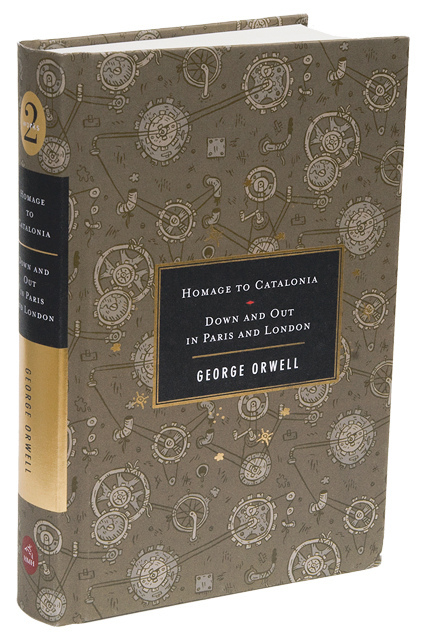
Pattern covers by Ray Fenwick for Houghton Mifflin Harcourt (thx Sio).

A look inside Graphic: Inside the Sketchbooks of the World’s Great Graphic Designers by Steven Heller and Lita Talarico at Fast Company.

Link Drop — A nice list of design blogs to sink your teeth into compiled by David Airey, author of Logo Design Love.

Photographs from Kevin Cumminsbook about Joy Division at Flavorwire.

Show Me The Money — Kevin Kelly, author of What Technology Wants and co-founder of Wired, talks to PW:

For readers, this is the best time in history. There’s never been more selection, more media types, or quality books. There’s never been more backlist books available. This is a high point for readers. For publishers, though, it is a low point, as their businesses are in transition. But I’m very optimistic, because in my research, money follows attention. Wherever attention flows, money follows.

And finally…

Telling Stories About Superweapons — In an awesome  (if slightly sprawling clearly-has-too-much-time-on-his-hands-and-might-be-bonkers) post, Christian Thorne, associate professor of English at Williams College, discusses Godzilla, Iron Man II and weapons of mass destruction (via Coudal):

Tony Stark is the Japanese scientist of the American Empire, the inventor who will not share his invention, the engineer who withholds the newest technology of death so that only he can command it: “You can’t have the suit. … I’m not giving you the suit. … You’re not getting the suit.” What the new movie shares with Godzilla is the notion that the perfect and ethical weapon would have to be entirely singular—there would literally only be one of them—and so would not be available for manufacture: a permanent prototype, forever in beta. By investing the killer armor with artisanal qualities, as though ICBMs could be blacksmithed, they suggest that the weapon’s uniqueness could be maintained into the future, since it is the hallmark of any handcrafted object that it is in some strict sense unrepeatable. That’s a fantasy, yes, but it’s an unsettled one; unease is simply built into its scenario. The conceit of an unshareable weapon comes with a worry automatically attached, which is simply that one will become two. Arms proliferate, and then so do anxieties, in their wake.

3 Comments

His Face All Red

A bit late in the day on this — it would have been a perfect post for Halloween — but Emily Carroll’s chilling short-story comic His Face All Red is still pretty darn great.

(via The Ephemerist)

1 Comment

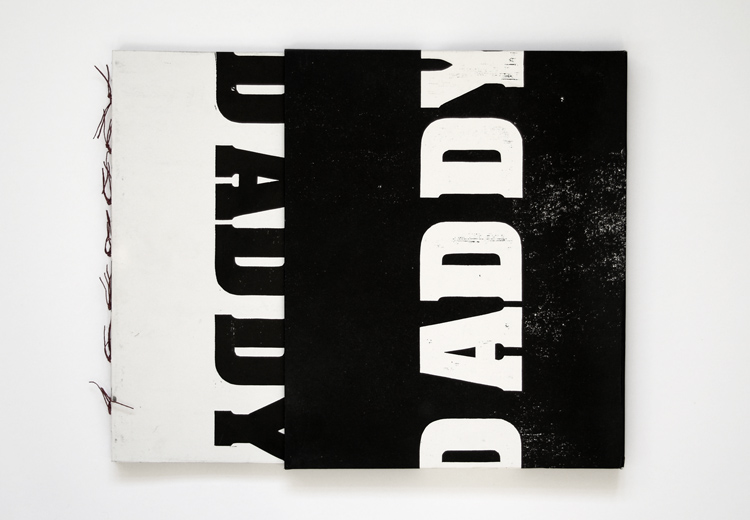
Daddy

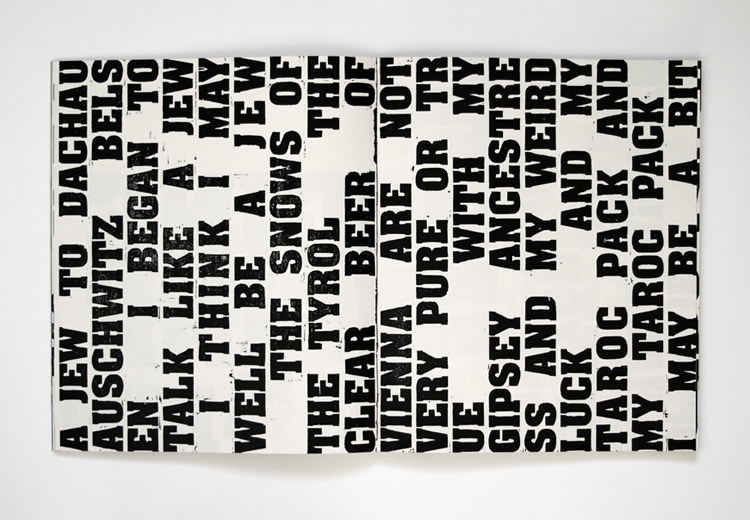
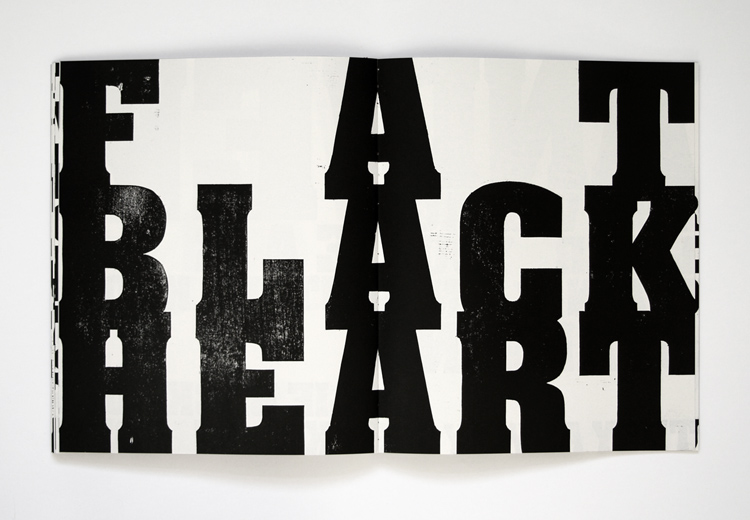
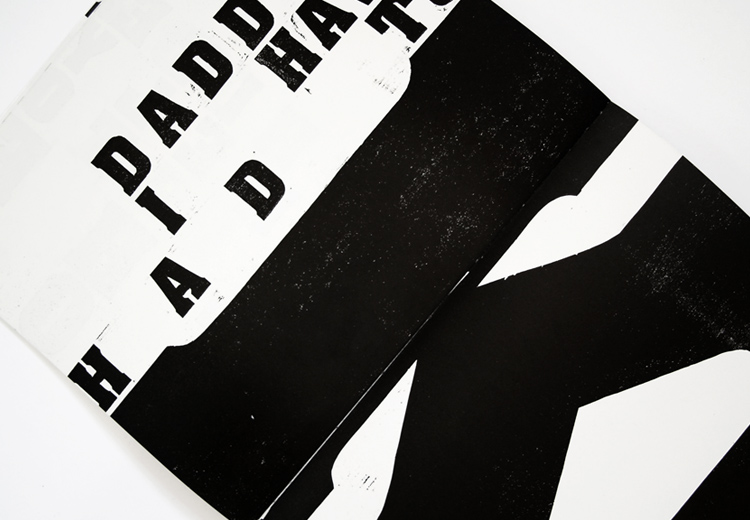
A typographic interpretation of the poem Daddy by Sylvia Plath, printed from 80 hand-carved woodblocks by Copenhagen-based design studio Daddy.

The book “seeks to capture and express the emotions and atmosphere of the text through the typographic treatment and woodblock printing.” Beautiful stuff:

(via Inspiration Lab)

Comments closed

Thomas Allen AV

An AV introduction to the work of artist Thomas Allen who takes vintage paperbacks and cuts, creases, and crimps them into incredible pulp pop-ups:

(thx Jacob)

(And Small World of Happy Coincidences:  The remix of Sarah Vaughan that accompanies the video is by Max Sedgley an old pal from university)

2 Comments

Type Case

Martin Bircher’s oddly hypnotic art installation Type Case uses a printers’ type case and 125 LED lights to display the latest headlines:

There’s more about the project here.

1 Comment

Don’t Go To The Castle

Kate Beaton’s Dracula at Hark, a Vagrant!:

Comments closed

Midweek Miscellany

Bespoke — Richard Weston, AKA Ace Jet 170, on the book designs for the soon-to-be-launched Bespoke Editions:

Bespoke Editions is a one-off edition press; offering beautiful custom-made classic books, printed on demand and hand-finished to order. Personalised and unique, each edition will be made using specially selected cover papers and finishes… The editions will be in a Demy format and the page layouts will be based on the Van de Graaf Canon. After a set of tests, we’ve settled on the beautiful Hoefler Text for the typesetting and each title page will feature a carefully chosen typographic ornament that has some relevance to the particular book.

All Programs Considered — Bill McKibben on the new public radio for The New York Review of Books (via the always astute Edward Nawotka at Publishing Perspectives):

[I]n one sense this is the perfect moment to be a young radiohead. It’s like 1960s and 1970s cinema, with auteurs rewriting the rules. New technology lets you make radio programs cheaply: Pro Tools sound-editing software has now replaced much of the equipment used in big, expensive studios. Listening is even cheaper: the iTunes store has thousands of podcasts… available for free download in a matter of seconds. “It’s a transformative and exciting moment, a huge revolution,” says Sue Schardt, executive director of the Association of Independents in Radio.

But there’s one problem, and that’s the economics of this new world. Radio is now cheap to make, true, but the people who make it still need to live. And it’s very hard to get paid anything at all…

Sounds awfully familiar…

The beautiful Ligature Loop and Stem poster at For Print Only:

Aside from being a purely creative outlet devoid of typical restrictions… one of the goals for anything produced under the Ligature, Loop & Stem moniker is that it educates as well as inspires. This piece scratched an itch for us in wanting to have a quick reference for letterform characteristics — in essence, so we can all speak the same language when talking about type.

A Pointy Tool — David Carr  talks to the founders of The Awl for The New York Times (via Kottke):

“My friends keep talking to me about how they want to start a Web site, but they need to get some backing, and I look at them and ask them what they are waiting for,” Mr. Sicha said. “All it takes is some WordPress and a lot of typing. Sure, I went broke trying to start it, it trashed my life and I work all the time, but other than that, it wasn’t that hard to figure out.”

And finally…

Tintin Gets Scalped — An annotated page from Charles Burn’s new graphic novel X’ed Out at New York Magazine (via Bookslut):

Nitnit’s name—and shock of hair—betray his origins. “Golden Books put out six of the Tintin books in English. This was before I could read, but I was looking at them very carefully. The books’ endpapers were filled with images from other Tintin stories that hadn’t been translated. I studied these endlessly. There was a little sentence on the back of each book that said, ‘Look for future titles.’ I kept looking but they never came.”

Comments closed

Something for the Weekend

EquationsLauren Panepinto’s stunning op-art covers for a new trilogy of novels by Simon Morden, published by Orbit. From the Orbit blog:

These online cover images truly don’t do the packages justice — each book has a single bright colour and in the printed version that will actually be a fluorescent ink. Spot gloss lamination and subtle embossing will heighten the effect of the illusions and make them very nice objects to pick up and stare at — they really draw you in when you see them in person. Here they are separately, and larger, to really start to mess with your eyes…

I immediately thought of Bridget Riley when I saw these…

In Praise of Big Cities — Typographer Erik Spiekermann, author of Stop Stealing Sheep, on cities for blueprint Magazine:

I hardly ever go out; I love to eat at home and can think of nothing worse than a weekend house in the country somewhere. All I would ever need to take my mind off things is right outside. It’s actually a long time since I’ve been to a theatre or the opera, but I wouldn’t want to live in a place that has neither. The thought of all this activity happening outside my front door makes living here attractive. There are lots of cafes, and they always seem to be busy, full of people who seem to neither have a home nor an office to go to. Coffee shops have been described as the perfect place to be out in public while on your own and a good reason to leave your house while avoiding fresh air. I don’t need to go there, but the thought that I could at anytime is enough to avoid feeling lonely.

Iambik — Hugh McGuire walks the talk and launches a new audiobook company with an eclectic collection of literary fiction from independent presses.

And finally…

Good Ideas — Nora Young interviews Steven Johnson, author of Where Good Ideas Come From, for CBC Radio’s Spark:

CBC Radio Spark: Steven Johnson

1 Comment

Tom McCarthy on Bookworm

Tom McCarthy, author of Remainder and C, interviewed on KCRW’s Bookworm:

Comments closed

From My Desk…

I’ve mention Kate Donnelly’s blog a couple of times here previously, but now you can take a look at my office space on From The Desks Of should you be so inclined.

Other (more interesting) recent contributors to From The Desk Of… include book designers Peter Mendelsund and Coralie Bickford-Smith, and New Yorker critic Alex Ross. I’m honoured to be in their esteemed company.

6 Comments

Gastrotypographicalassemblage

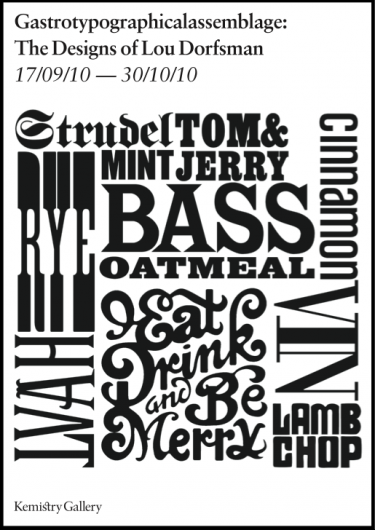
Over the last month, Kemistry Gallery in London has been exhibiting the work of legendary designer Lou Dorfsman, art director for the CBS network. The exhibition, which closes at the end of the October, centres on Dorfman’s most famous creation, the 11 metre wide handmade wooden typographic wall Gastrotypographicalassemblage. With custom type created by Herb Lubalin and Tom Carnase, it contains almost 1500 individual characters:

Comments closed

Midweek Miscellany

Mode of Transportation by VSA Partners for Mohawk Fine Papers, seen at For Print Only.

Convergence — Richard Nash on the Frankfurt Book Fair, the book business, and enhanced e-books:

The reality is that the lack of audio and video in book is a feature, not a bug. All art forms are defined as much by what they exclude as by what they include, by what is left out as much as what is put in, by performing addition by subtraction, by less being more. The rules of haiku, of villanelle, of science fiction all exist to describe what is disallowed so as to give the freedom of not-everything-being-possible to the artist. Which, again, is not to say artists ought not create transmedia works. They should, and will. It is instead to say that when frightened publishers start scheming to create them in cahoots with third-party vendors we can safely say that this is a policy designed not to create desirable consumer products nor to create art but to create a survival pod for the publisher. What problem does the enhanced eBook solve?

(While not exactly a fan of enhanced e-books myself, I have no doubt that some people would be equally critical if publishers weren’t experimenting in this area).

Daniel Justi’s new font Ataxia is now available from You Work from and MyFonts. My interview with Daniel is here.

And finally…

A neat book trailer for John Lanchester’s Whoops! Why Everyone Owes Everyone and No One Can Pay (I.O.U. in Canada and the US) with animated segments by Yum Yum London (who made the wonderful short Parallel Parking):

(h/t the funniest man who-used-to-work-at-Penguin, Alan Trotter)

Comments closed