Skip to content

The Casual Optimist Posts

Mendelsund vs. Kafka

Amerika | Peter Mendelsund

Peter Mendelsund on his remarkable (and unexpectedly Paul Rand-like) Kafka redesigns for Knopf imprint Schocken:

After all, what is it that makes Kafka, Kafka? The economy; the dark humor; the teasing inscrutability; the brilliance of the thought-experiments; the hieratic and esoteric flavor of the constructions; the disorienting cadence of the prose; the impeccable, internal, magical logic that drives the mechanical toy theaters of his work; the much discussed Jewishness (as if this was easy to parse); the “concrete abstractions” (in the words of Zadie Smith)…. I suppose what some find most relevant and compelling in Kafka is his ability to inspire in them that paradoxical feeling that great literature always aspires to arouse in readers—the feeling of the universality of their own alienation. Kafka is the ne plus ultra of alienation– alienation being arguably the defining emotional condition of the 20th century.

There is more at Peter’s blog JACKET MECHANICAL.

4 Comments

Midweek Miscellany

A shiny new (and somewhat unsettling) cover for Joyland’s next e-book, How I Came to Haunt My Parents by Natalee Caple, designed by the shiny (and somewhat unsettling) David A Gee.

Holden Caulfield’s Goddam WarVanity Fair excerpts J. D. Salinger: A Life by Kenneth Slawenski:

Tuesday, June 6, 1944, was the turning point of J. D. Salinger’s life. It is difficult to overstate the impact of D-day and the 11 months of combat that followed. The war, its horrors and lessons, would brand itself upon every aspect of Salinger’s personality and reverberate through his work. As a young writer before entering the army, Salinger had had stories published in various magazines, including Collier’s and Story, and he had begun to conjure members of the Caulfield family, including the famous Holden. On D-day he had six unpublished Caulfield stories in his possession, stories that would form the spine of The Catcher in the Rye. The experience of war gave his writing a depth and maturity it had lacked; the legacy of that experience is present even in work that is not about war at all. In later life, Salinger frequently mentioned Normandy, but he never spoke of the details—“as if,” his daughter later recalled, “I understood the implications, the unspoken.”

An excerpt from Jason Epstein’s review Merchants of Culture: The Publishing Business in the Twenty-First Century by John B. Thompson for the latest NYRB:

Digital enthusiasts should… consider that as the embrace of other electronic media has widened, the average quality of their product has declined: from Masterpiece Theatre to Jersey Shore, from Franklin Roosevelt and Adlai Stevenson to Sarah Palin, from Julia Child to Rachael Ray. My own guess is that the digital future in which anyone can become a published writer will separate along the usual two paths, a narrow path toward more multilingual variety, specificity, and higher average quality and a broader path downward toward greater banality and incoherence, while the collective wisdom of the species, the infallible critic, will continue to preserve what is essential and over time discard the rest.

(The full review requires a subscription)

Best Online Comics Criticism 2010 chosen by contributors to The Comics Journal. And from that list, film scholar David Bordwell on Tintin (via Robot6):

Most commentators on Hergé mention that he was a film fan and drew many situations from movies of the 1920s and 1930s. Like Hollywood studio cinema, his tales put striking technique in the service of fluent storytelling. Pause to study the narrative and you’ll find a surprising richness to the imagery; start by looking at the pictures as pictures, and you’ll see how composition, color, and detail smoothly advance the action. Hergé was well aware that his polished imagery could stand scrutiny in its own right, but he saw it as serving a larger narrative dynamic.

(Out of curiosity, does anyone compile annual list of the best online literary criticism?)

Montaigne and Monkeys — Saul Frampton, author of the ridiculously titled  When I Am Playing With My Cat, How Do I Know She Is Not Playing With Me?: Montaigne and Being in Touch With Life, on 16th Century French philosopher Michel-de-Montaigne and neuroscience in The Guardian:

For Montaigne, as for contemporary neuroscientists, humans… have an inbuilt imitative, sympathetic capacity. Moreover, he does not see it as species-dependent… In one of his most famous aphorisms he asks: “When I am playing with my cat, how do I know she is not playing with me?” And he tells how animals themselves form “a certain acquaintance with one another” and greet each other “with joy and demonstrations of goodwill”. Then, in a lengthy comment added to the final edition of his essays, he completes the circle from animal-to-human to human-to-human again, concluding that we cannot help but communicate ourselves in some way… even if it is something to which we are habitually blind…

And finally  (in the unlikely case anyone missed it)…

Caustic Cover Critic interviews Christopher King, the new Art Director at Melville House Publishing.

1 Comment

Mavis Staples | Tapestry

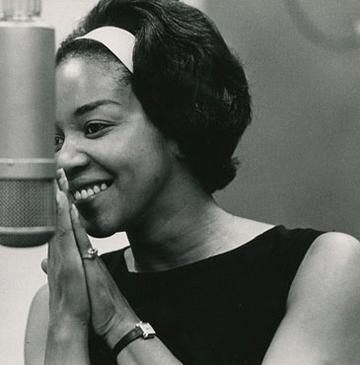
Completely unrelated to books, but too good to miss nevertheless… An hour-long interview with legendary singer and civil rights activist Mavis Staples for CBC Radio’s Tapestry:

Mavis Staples Tapestry Interview Mp3

Staples recently released a new album, You Are Not Alone, produced by Jeff Tweedy of Wilco.

Comments closed

Something for the Weekend

Mark Lamster on Gerd Arntz, designer of the Isotype pictographs, at Design Observer.

A new book on Arntz — Gerd Arntz: Graphic Designer — has just been published by Dutch publisher 010. A preview of the book can be seen here. (And, yes, my Twitter avatar is a Gerd Arntz Isotype. #nerd)

Barnes & Noble: The Last, Best Hope for American Bookselling? — Editor Edward Nawotka in Publishing Perspectives:

B&N still has enough consolidated power to “make” books. Its buying power makes it indispensable to publishers who need advance orders to justify print runs and the various other knock on effects that entails. They are providing –- via their Nook device –- the biggest rival to Amazon’s e-reader hegemony. And, let’s face it, if they –- along with Borders -– disappeared, how many communities would suddenly be underserved or not served at all? This is the reason small towns lobby B&N to open stores in their community: people are now, like it or not, accustomed to the selection available at big box retailers. True, perhaps half of those who shop at B&N’s aren’t there for the books, but what better chance is there to entice a not-so-avid reader into picking up a book?

The Man with Two Brains — Psychiatrist and author Iain McGilchrist talks about his book The Master and His Emissary with Natasha Mitchell for ABC radio show All in the Mind:

[T]he idea was that the brain was like a machine that carried out certain functions, and because there were two hemispheres there was twice as much computing power as it were, but we would compartmentalise things. So there was a story that language was in the left hemisphere, reason was in the left hemisphere and something like creativity and emotion were in the right hemisphere. That’s a complete and utter….misconception of things. Every single brain function is carried out by both hemispheres. Reason and emotion and imagination depend on the coming together of what both hemispheres contribute. So that particular dichotomy is incredibly unhelpful and misleading and I keep trying to steer away from it, but there is still, nonetheless, fairly obviously a dichotomy.

(If, like me, you completely missed this book when it was published, author A.C. Grayling reviewed it for the Literary Review).

Jason Kernevich and Dustin Summers of The Heads of State interviewed at From the Desks Of

And finally…

The Gamification of Everything — NPR’s On The Media looks at the future of gaming and creating social change through game design:

3 Comments

Technologies That Changed Our Brains

I think what the book… gave us a more attentive way of thinking. What the book does as a technology is shield us from distraction. The only thing going on is the, you know, the progression of words and sentences across page after page and so suddenly we see this immersive kind of very attentive thinking whether you are paying attention to a story or to an argument, or whatever. And what we know about the brain is the brain adapts to these types of tools.

And so the ways of thinking that we learned from the tools we can then apply in other areas of our lives. So we become, after the arrival of the printing press in general, more attentive more attuned to contemplative ways of thinking. And that’s a very unnatural way of using our mind. You know, paying attention, filtering out distractions. So the book, I think, like the map before it, like the clock, created or help create a revolution in the human mind in the way our habits of mind and ultimately the way we use our brains.

Nicholas Carr, author of The Shallows, discusses how the map, the mechanical clock, and the printed book have shaped human thought, and how the human brain adapts to new technology at The Big Think:

1 Comment

Midweek Miscellany

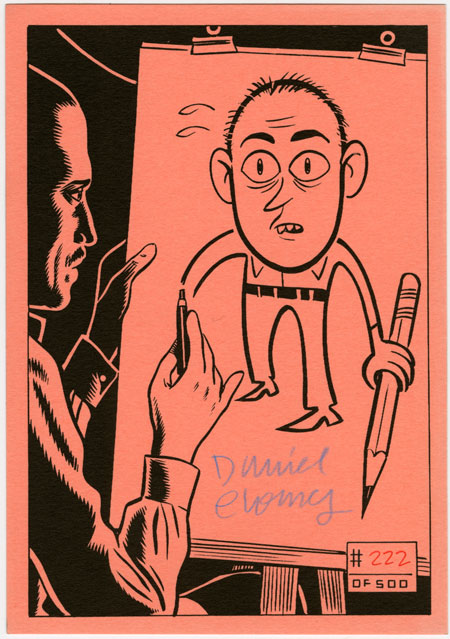
Fantagraphics find a cache of signed, limited-edition bookplates by artists including Dan Clowes, Jaime Hernandez and Gilbert Hernandez.

The Case & Point — A new website showcasing the best in custom type design and lettering curated by Vancouver-based design studio Working Format.

Designer, educator and author Ellen Lupton interviewed at From the Desks Of… (My Q & A with Ellen from 2009 is here).

And finally…

The New Thing — William Gibson, author most recently of Zero History, interviewed at Jack Move Magazine (via the man himself @GreatDismal):

The genuinely new things are really hard to imagine. When you do imagine them, they’re very hard to relay in anything like a sense in which the people who are totally used to them would use them. There’s always this factor in future-tech science fiction where somebody, be it the characters or the narrative voice, is really kind of wowed by future tech. It’s a powerful impulse. You want the reader to get a wowie. But there’s a way in which it’s not naturalistic; it’s not a genuinely naturalistic vision of the future, because that would be one in which people take it utterly for granted.

2 Comments

Intellectual Messiness

Embracing…messiness and understanding its contribution to the creative process is something that writers and creative types, artists, whatever have got to cultivate, have to learn to be comfortable with. Because it goes against a lot of our kind of instincts and training as kind of educated people.

Writer Malcolm Gladwell at The Big Think:

Comments closed

Q & A with John Williams, The Second Pass

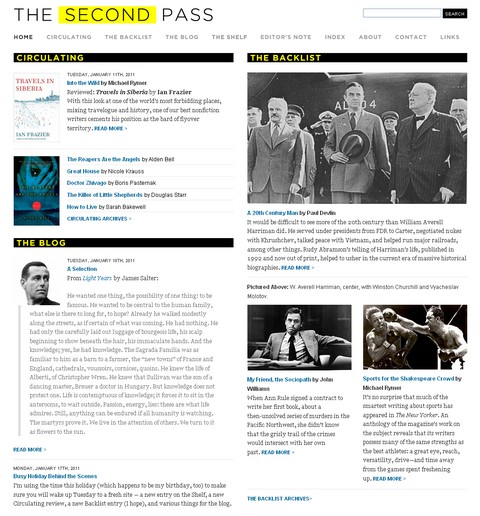
I feel a special admiration for The Second Pass. Launched almost two years ago — shortly after first tentative posts at The Casual Optimist — and with a list of whip-smart contributors, it seemed to signify a second wave online literary journals that built on the success of groundbreaking sites like  Bookslut and ReadySteadyBlog. Well-designed and appropriately eclectic, it had wider horizons than ailing newspaper review pages, and yet Brooklyn-based founder John Williams — who previously worked in publishing — seemed less prone to the snark so commonplace among some of the more established online literary set.

I was, needless to say, surprised when I first received an email from John. The idea that he had even heard of the less-than whip-smart The Casual Optimist seemed so… unlikely. And yet, John and I have remained in touch on and off for the past year and half, and I have even contributed to The Second Pass, so I thought it was high time I talked to him about the site and its recent book party in Brooklyn.

We corresponded by email…

For those people unfamiliar with the site, could you describe The Second Pass?

The site is an online magazine devoted to books new and old. It features reviews of new books, essays about older and more obscure books, and a blog about books of all stripes. That’s the basics. It’s a place where serious readers of all kinds can enjoy themselves and, from time to time, maybe learn about a book or author they might not otherwise learn about.

What makes The Second Pass unique?

Unique is a strong word. There are other sites and publications that pay attention to obscure books, but I think the site’s regular devotion to it — including out-of-print books — is rare, if not entirely unique. I also like to think the writing is generally at a level that separates it from many other online-only enterprises.

What lessons have you learned in the first 20 months of editing the site?

Plan ahead. And have contingency plans. I’ve learned those lessons, though I’m still learning to act on them.

Appearance and readability often seem to be an afterthought for websites about books, but that doesn’t seem to be the case with The Second Pass. Did a lot of planning go into the design of the site?

Yes, my friend Strath Shepard spent time coming up with several visual ideas for the site, and I chose from among them — any one of which I would have been thrilled with. I wanted to make sure the site looked good, because I think design is as important online as anywhere else. It should be strong and inviting without being an obstruction or a distraction, in my opinion.

Is it easier or more difficult for independent online literary journals to find an audience today?

Easier than it was in the past online? I’m not sure about that. My unscientific sense is that many more people are spending time online, but that the idea of a big audience for niche blogs or journals is more or less a dead dream. Reaching a certain core number of readers is easy enough online, if you’re patient and steady in your production, but I think the audience for serious books coverage is inherently limited in a way that can be hard to admit. I would rather try to reach the maximum of that particular audience (and I have no idea what that number would be; my site’s traffic is surely a tiny sliver of it) than start throwing too many things at the wall to try to reach a more general audience. I think the pressing need for lots of traffic is reflected at a place like The Huffington Post, where the books coverage is a hodgepodge of too-frequently-published pieces that don’t feel unified in any satisfying way. But those people who work for places where increasing traffic is paramount — to paraphrase David Letterman, I wouldn’t give their troubles to a monkey on a rock. I’m happy there’s no one above me worrying about traffic.

What other book sites do you read regularly?

Maud Newton, The Book Bench, Paris Review Daily, Bookslut, The Millions, John Self, Levi Stahl’s I’ve Been Reading Lately, the Barnes & Noble Review, Mark Athitakis, Novel Readings, and yours. Those might be the ones I check most regularly, off the top of my head, but I drop in on many more, most or all of them on the links page at The Second Pass.

Where does the name of your blog, A Special Way of Being Afraid, come from?

It comes from a Philip Larkin poem called “Aubade,” which is a terrifying and beautiful confrontation of the fear of death. It begins: “I work all day, and get half-drunk at night. / Waking at four to soundless dark, I stare.” And a bit later: “This is a special way of being afraid / No trick dispels. Religion used to try…” It’s always been one of my favorite poems, and I thought that phrase would make a good blog name, back in 2005, when I started it. I still like the name.

How has the experience as founder and editor of The Second Pass been different from blogging?

I started the older blog while working for a big publishing house, partly as a way to maintain the habit of writing and to develop my own voice while in a job that made it difficult to find time for those things. Especially in the beginning, I felt it was important to keep the blog regularly updated, for the exercise of it and for building readership, however modest. I feel that pressure more keenly with The Second Pass, since I have more ambitions for it. Ideally, I would update it far more often than I do. I also work with other people on The Second Pass. I wear all the hats, but I rely on reviews and essays from other writers, a social part of the experience that I really enjoy but that makes it different from the more dictatorial nature of the blog.

The blog is also more wide-ranging. I’m probably a reader first and foremost, but I’m also a longtime fan of music, movies, and sports, among other things. Not to mention the more personal things I might ruminate about over there. I still consider the blog a useful outlet for those things, though I’ve been terribly neglecting it for the past several months, if not longer.

The Second Pass held its first event in November. What made you decide to throw a party?

I had been meaning to have a party ever since last March, when the site celebrated its one-year anniversary, but was stymied by various obstacles that wouldn’t have stymied someone with more resolve. I thought it would be fun to have a party, and figured it couldn’t hurt the site’s visibility. Plus, I wanted to showcase some of the fantastic people who have written for the site.

Who read at the event?

Carlene Bauer, Will Blythe, and Maud Newton read from works of fiction in progress. Jason Zinoman read from his book about horror movies in the 1960s and ’70s, which is being published here next summer. And Lauren Kaminsky read an excerpt from a terrifically weird book called Listen, Little Man by Wilhelm Reich, a screed written by an Austrian psychoanalyst who worked with Freud and later seemed to have cracked up pretty good. I’m hoping Lauren will write about the book (and him) for the site at some point.

Do you think the evening was a success? And will you be organizing more events in future?

I thought it was a big success. I’m biased, of course, but the readers couldn’t have done a better job, there was plenty of wine and food, and everyone seemed to have a good time. Melville House, an independent publisher and bookstore in Brooklyn, was a gracious host. And yes, I’m certainly hoping to do it again, perhaps in Manhattan next time, when the site turns two (which happens March 10) or soon after.

Do you think interest in live book events will see the same kind of revival that live music events have in recent years?

I think live book events, at least in New York, have been thriving in recent years. My dirty little secret is that I find many traditional readings dull. Not all, but many. Lots of good writers just aren’t good readers, which is no knock on them. It’s not their job, and they’re very different skills. Only a few lucky people have both. I think it’s also asking a lot of a text to keep people interested for a long stretch of time while it’s read aloud. (I’m not a big fan of audio books for that reason, though this is probably saying much more about my aural attention span than about the worth of audio books.)

Who are some of your other favourite authors?

William Trevor, Richard Russo (especially pre-Pulitzer), Marilynne Robinson, David James Duncan, Dostoevsky, Lorrie Moore, Wilfrid Sheed, Nabokov, William James, Martin Amis (back when), Iris Murdoch, Richard Ford (the Bascombe books, particularly), to name a few.

What were your favourite books of 2010?

I recently finished The Killer of Little Shepherds by Douglas Starr, a nonfiction story set in late-19th-century France, which tells the parallel stories of a serial killer on the loose and a criminologist who was doing a lot to introduce the set of forensic techniques that we now, thanks to TV, simply refer to as “CSI.” It’s a gripping story, smartly told. I also enjoyed Brady Udall’s The Lonely Polygamist. He’s an old-fashioned storyteller, sweeping and just the right amount of sentimental, and this novel is about a Mormon with four wives and 28 children.

What books are you looking forward to reading in 2011?

I’m glad you asked this, because it reminded me that I’m behind in figuring out what the site will cover this year. I’m a fan of Jonathan Coe’s work, and his new novel, The Terrible Privacy of Maxwell Sim, is coming in March. Just today, I received a galley of House of Exile by Evelyn Juers, a biography of Heinrich Mann, his wife Nelly, and their circle of famous friends. I’ve been looking forward to its U.S. publication since I read a terrific review in the TLS. And of course, there’s David Foster Wallace’s novel in April. Though I’m skeptical of posthumous releases, including this one, I’m as curious as every other fan of his.

Thanks John!

Photo credit: Justin Lane

credit Justin LaneJ
Comments closed

There’s More to Life Than Reading…

With library closures threatening in the UK, here’s Tom Gauld’s comic ‘Withdrawn‘ for The Guardian‘s Saturday Review:

Comments closed

Something for the Weekend

Blinders — Charles Burns, author of Black Hole and X’ed Out, interviewed at Full Stop:

I’ve never really – and this sounds stupid because I’m working in a commercial medium – but I’ve never thought about an audience, or written for a specific audience, per se. I’m just trying to pull together my ideas in the best possible way, and I’ve never tailored those ideas for a particular audience. I bet I could do a pretty good teenage vampire story, for example. It would have plenty of romance, and just the right amount of titillating sex, but I think I’d wind up out on the Ben Franklin Bridge looking down at that water and thinking it looked pretty good down there [laughs]. I’ve really tried to put blinders on and just tell my stories the best way I can.

Book designer Stefanie Posavec at 10 Answers.

And thanks to MobyLives for pointing me to this 2008 article from The FontFeed: Top Ten Typefaces Used by Book Design Winners.

A Step Behind Where They Needed To Be — Peter Osnos on what went wrong at Borders for The Atlantic:

Borders stores took on a generic quality as executives and investors lacked the knowledge and patience to address the chains’ mounting problems. I’m sure there is more to this story (especially in the financial and real estate areas) than I know, but what really hurt Borders from the perspective of a book person like me was that the chain was no longer in the hands of true book retailers… Whatever else Borders does in the months ahead, it needs to recover its belief that real book-selling is an art (with all the peculiarities that entails), as well as a viable business.

And finally…

A look inside Seasons, the new book by the amazing French illustrator Blexbolex, published by Enchanted Lion Books:

(via Printeresting)

Comments closed

True Grit

Filmmakers Joel and Ethan Coen recently discussed their movie adaptation of Charles Portis’ novel True Grit with Terry Gross on NPR’s Fresh Air:

Most of the dialogue is taken from the book, direct from the book. And in places where it wasn’t, where we were kind of, where we were aping the language of the book because the scenes didn’t derive from the original book, it wasn’t a question of learning to – you know, it wasn’t a foreign language. It is a strikingly different use of the English language, but it was more a question of kind of aping the tone, as opposed to anything more of an exercise than that… [We] didn’t go back to the Bible, although clearly in the book, the character is steeped in the Bible. Actually, all the characters, you kind of assume that part of their speech derives from either having learned to read from the Bible or, in that probably a lot of them are illiterate, just having heard a lot of Scripture.

Meanwhile, Jeff Bridges, the dude who plays US Marshall Reuben “Rooster” Cogburn in the Coen brothers’ film, is the subject of a new PBS American Masters documentary:

[UPDATE: The full PBS documentary can be seen here]

And, if you haven’t seen the movie yet, here’s the trailer:

Comments closed

Midweek Miscellany

Canadian illustrator and typographer Darren Booth at From The Desks Of

There’s on more on Darren’s cover for An Object of Beauty on his blog.

Misery — Editor and author Diana Athill profiled at The Telegraph (via PD Smith):

‘I have always been a watcher,’ she says. ‘Of myself in particular. Even at times of acute unhappiness I’ve watched myself being unhappy. I also think I’m one of those people who has never been wholly involved in an emotion, but then I think a lot of writers are like that.’

Is Modernism Boring? — Rhys Tranter at The Spectator Book Blog:

If modernism means anything in Woolf or Joyce, it is the struggle for what it means to be modern. Both present us with an array of fascinatingly complex characters, seeking to question their identity and their place in the modern age. Language becomes a character, too, an all-pervading texture that sets the mood of each story, and playfully subverts the ABC plots of yesteryear. Amid a proliferation of new technologies, of political upheaval and social change, Joyce, Woolf and the literary modernists actively interrogate the way we perceive the world around us, in ways still relevant today. In this way, modernism is not something we leave on our shelves and neglect to pick up. Modernism is that which speaks to modern life.

What’s the Worst that can Happen? — Gary Shteyngart, author of the dystopian Super Sad True Love Story, interviewed at the new and great looking book blog Full Stop:

Most people don’t care anymore because they’re beyond caring. The endless cult of self-expression that makes people stream or write about themselves day in and day out without any kind of filter. If you write a novel, you’re often writing about yourself as well, but you’re clearly filtering it through a bunch of things, not least of which is technique. So it’s not an entirely plausible future, but in some ways it could be. What if all the worst things happen politically, socially, and in terms of our literacy?

Top 10 fonts of 2010 lists from You Work For Them and Fontwerk (Google Translate version here).

And finally…

The 50 best comic book covers of 2010 as chosen by Robot 6

4 Comments