Skip to content

The Casual Optimist Posts

Edward Gorey

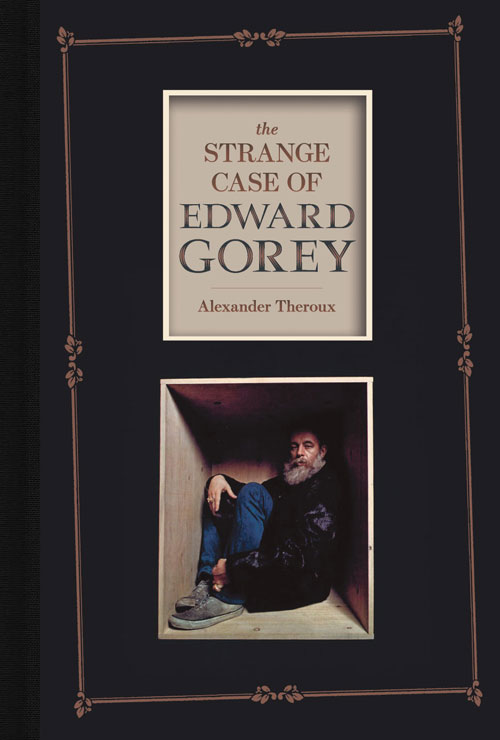
Alexander Theroux, author of The Strange Case of Edward Gorey (recently revised and republished by Fantagraphics), talks to NPR’s Weekend Edition Sunday about the writer and illustrator Edward Gorey, who would have been 86 years old today:

Violence is the essential Gorey ingredient. It is used in his books with such off-hand wit and inevitability that, having become his signature, if it were suddenly missing, you would begin to worry or at least feel you are being fobbed off by work not of the master’s hand.

NPR THE WEEKEND EDITION: THE LIFE OF EDWARD GOREY

Theroux also talks about his peculiar friend with Tom Spurgeon at The Comics Reporter:

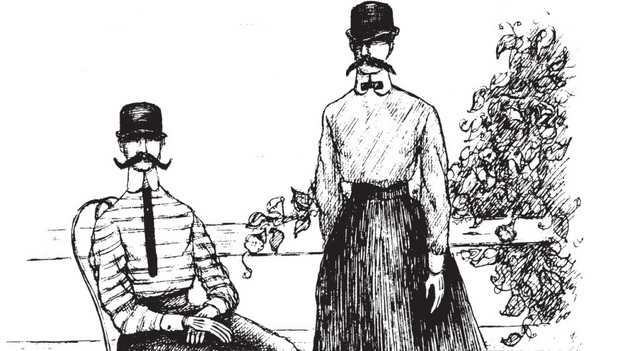
I was telling someone the other day, there a division in the 20s and post WWI era, especially growing up in England. I think Gorey inherited this. There were the athletes, the muscular types — on one side of the tennis court, as it were. Then there were these kind of fey, bright young things on the other side of the tennis court. There has always been a kind of mocking, derisive look that they took regarding each other. I think Gorey grew out of that kind of gay interest, that fascination with ’20s movies, ’20s styles; there’s a tradition, I think. He was unhappy in the military and when he was at Harvard he was always in an artsy world. He went to the ballet every night in New York. He was almost a caricature of that Ronald Firbank type of character. He was very fey. He didn’t hide any of that.

Comments closed

Penguin Great Food | Coralie Bickford-Smith

The Creative Review has an early look at three of the covers for Penguin’s Great Food paperback series to be released in April.

Designed by the wonderful Coralie Bickford-Smith, each cover draws on a decorative ceramic style relevant to the period of the writing.

Meanwhile, in new article for Fast Company Coralie talks about the inspiration behind her book covers:

“I want these books to be cherished like the literature inside,” says Bickford-Smith of her obsessive attention to detail. “If something is well considered, it will entice. People want to explore it, feel it. That design shines through and connects.”

And, if you missed it, my Q & A with Coralie from 2009 is here.

2 Comments

Something for the Weekend

Punching Through the Din — designer Jim Northover on the exhibition of Saul Bass movie posters at Kemistry in London.

This is the End — Sarah Weinman on chronicling the end of the chain bookstore era:

But maybe what really happened was as simple as this: chain bookstores were never supposed to last as long as they did, and have reached their natural end point after twenty years. Publishing in general has enough struggle with scale, either being too small and prone to great risk and failure, or too big and beholden to larger entities who want greater and greater annual profits. Whatever possessed us to think bookstores could operate this way? Why is the art of bookselling supposed to be conflagrated with abundance, with excess and with millions of square feet?

And on a somewhat related note…

The Cost of Keeping Authors Alive –Boyd Tonkin for The Independent (via MobyLives):

Dirt-cheap e-books benefit the very rich – and the very dead. They might also help new authors to find a foothold and win an audience – although, on that logic, newcomers should think about showcasing their work for nothing. Many do. But the almost-free digital novel hammers another nail into the coffin of a long-term literary career. Who cares? Readers should, if they cherish full-time authors who craft not safe genre pieces but distinctive book after distinctive book that build into a unique body of work.

(see also: Margaret Atwood at TOC)

Kick Ass Annie — An interview with Anne Koyama, the founder and operator of Toronto-based Koyama Press, at Design Feaster:

I look at all kinds of artwork, films, architecture, photography and typography. I subscribe to a lot of art/artist’s blogs. I like to walk around cities and try to really see the details of things around me (which is more difficult than you may think for someone possessed of a short attention span). I carry a little point-and-shoot camera often. Of course, all of the artists I work with inspire me and I seem to find a few artists each week that I’d like to work with if I had the funds.

And lastly…

Meet the Classics — A Brazilian ad campaign to promote Penguin Classic Books (via This Isn’t Happiness).

1 Comment

Margaret Atwood : The Publishing Pie

Author Margaret Atwood used to come by the bookstore where I worked in Toronto. It was always slightly surreal selling books to her, but certainly no more so than watching her on YouTube (YouTube!) deliver a great keynote speech at O’Reilly’s recent TOC Conference:

Atwood expands on her talk in this interview with Gretchen Giles:

3 Comments

Midweek Miscellany

Risky Business — Cartoonist Adrian Tomine talks about his new book Scenes From An Impending Marriage, which originally started life as a mini-comic for his wedding guests, with More Intelligent Life:

I probably first started thinking about publishing it when a copy appeared on eBay. I assumed that since it was only given to close friends and family, that would never happen, but I was wrong. And like I said, since I was slowly adding pages to the book, I eventually found myself with 50 or 60 pages worth of material, and I just proposed the idea to my publisher. If he had declined, I would’ve happily filed it away…

AND Adrian and his wife Sarah Brennan talk about the new book with NPR’s All Things Considered.

(For the record, Scenes From An Impending Marriage is distributed in Canada by my employer Raincoast Books).

Sunny-Side — Jonathan Lethem talks to Carolyn Kellogg at The LA Times about decamping from Brooklyn to Southern California. There is more of their conversation at TimesJacket Copy blog:

I’ve only probably reviewed seven or eight novels. It’s really problematic. I’m gregarious with writers; I like novelists. I don’t want my sympathies to cause me to write a review that’s in any kind of bad faith, nor do I want to destroy some pleasant, even if it’s slight, collegial feeling. I try to review the dead guy — Bolaño — or the biography of the dead guy, because I like being in the conversation. Sometimes I look at what Updike did at the New Yorker. I don’t know if many people have the temperament, let alone the incredible set of skills he brought to that, the versatility, the endless curiosity, to identify with so many different kinds of novelists who were not doing what he does.

The Price of Zero — David Carr on media companies and unpaid contributors for The New York Times:

For those of us who make a living typing, it’s all very scary, of course. It’s less about the diminution of authority and expertise, although there is that, and more about the growing perception that content is a commodity, and one that can be had for the price of zero… For the media, this is a Tom Sawyer moment. “Does a boy get a chance to whitewash a fence every day?” he says to his friends, and sure enough, they are soon lined up for the privilege of doing his chores. That’s a bit like how social networks get built. (Just imagine if Tom had also schooled them in the networking opportunities of the user-generated endeavor: “You’re not just painting a fence. You’re building an audience around your personal brand.”)

And finally…

In the Age of Screens — A serialized essay about contemporary book discovery and reading by Chad W. Post, publisher of Open Letter Books, editor of  the Three Percent blog:

[W]e’ve stripped away all the institutions that supported the ways in which most outsiders found their literature, leaving texts to float untethered in the ether, there to be found… There is no serendipity… And yet, for the long-term benefit of society, we need people to have—and be exposed to— ideas from the out-of-­nowhere.

The complete essay is available as a PDF.

we’ve
stripped
away
all
the
institutions
that
supported
the
ways
in
which
most
outsiders
found
their
literature,
leaving
texts
to
float
untethered
in
the
ether,
there
to
be
found
.
.
.
Comments closed

James Gallager | Cutting Edges

Here’s an interview with the New York-based artist James Gallagher, curator of an exhibition of contemporary collage called Cutters (currently on display at the West Cork Arts Centre in Ireland, February 7th-March 12th) and co-editor of the book  Cutting Edges published by Gestalten:

The book include collages by John Gall, Art Director at Vintage and Anchor Books, who actually mentioned the work of James Gallagher in our recent Q & A.

1 Comment

Edmund de Waal | Writers and Company

The Hare with Amber Eyes: A Hidden Inheritance, Edmund de Waal’s memoir about his extraordinary Jewish family and an inherited collection of ornamental Japanese carvings called netsuke, was on many of last year’s “best-of” lists and is high on my current ‘to-read’ list. The author talks about the book with Eleanor Wachtel on CBC Radio’s Writers & Company:

CBC Radio Writer’s & Co: Edmund de Waal Mp3

Edmund de Waal, who is also a successful ceramicist, is also profiled in The Guardian:

De Waal and his netsuke have been much discussed over the past seven or eight months, but even now he is “completely taken aback” by the success of a book which is an “odd matrix of personal obsessions”. (We talk in the upstairs room of his south London studio – downstairs are three kilns, his wheel and a bag of clay, ready for him to get to work in the afternoon.) Yet that it is so personal and springs from these obsessions (Japan, objects, memory), drawing on his expertise as a potter, is surely a clue to its enormous appeal. How things are made and handled, he writes, and what happens to them “has been central to my life for more than 30 years”.

Comments closed

Something for the Weekend

Steven Heller, editor of I Heart Design and author/editor of countless other books about design, at 10 Answers.

And Steven Heller is one of the designers featured in BBC Radio documentary I Heart Milton Glaser about the iconic I (Heart) NY logo and the designer who created it (go listen now because it’s only available for a few more days).

Print and the City –a fascinating look at whether movable type printing presses were the drivers of economic growth in cities by Jeremiah Dittmar (via The Browser):

[C]ities in which printing presses were established 1450-1500 had no prior growth advantage, but subsequently grew far faster than similar cities without printing presses… Cities that adopted print media benefitted from positive spillovers in human capital accumulation and technological change broadly defined. These spillovers exerted an upward pressure on the returns to labour, made cities culturally dynamic, and attracted migrants.

In the pre-industrial era, commerce was a more important source of urban wealth and income than tradable industrial production. Print media played a key role in the development of skills that were valuable to merchants. Following the invention printing, European presses produced a stream of math textbooks used by students preparing for careers in business.

The Savage Marketplace — A really interesting and thoughtful survey of the current state of book editing in the UK by Alex Clark , with contributions from Diana Athill, Blake Morrison, Jeannette Winterson and others, for The Guardian:

[W]hat saps the spirit are the manuscripts that leave you with the question: why did no one sit down with the writer and point out where this isn’t working? Why didn’t a red pen mark the hackneyed phrase, or the stock character, or the creaky dialogue? And, sometimes, why didn’t someone deliver the unfortunate verdict: this simply isn’t ready yet, and may never be?

And finally, if you’re in London… Kemistry Gallery have an exhibition of film posters by Saul Bass from the BFI archive, February 17th to March 17th:

SOME GOOD NEWS FROM THE WORLD OF BOOKS.

Comments closed

Le Carré | Stuart Bache

I’m a big fan John Le Carré’s spy stories, so I was really pleased to see these wonderfully stark redesigns for Sceptre by British designer Stuart Bache, who I interviewed last year about his cover designs for the Canongate editions of Gil Scott-Heron.

You can see all 14 covers in the series here.

Comments closed

Midweek Miscellany

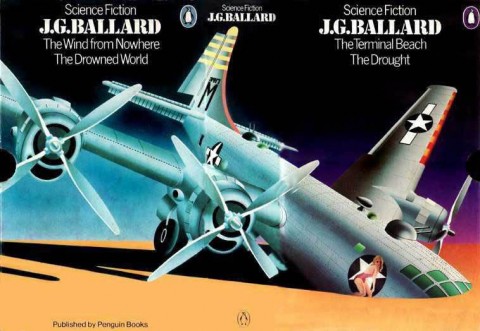
Atrocity Exhibition — Rick Poynor on the book covers  and other visual interpretations of J.G. Ballard at Design Observer:

The repeated failure of editors, designers and illustrators to engage intellectually with The Atrocity Exhibition is all the more remarkable because the book offers a litany of Ballardian images: bunkers, concrete causeways, jutting balconies, crashed bombers, a drained sculpture fountain, a deserted beach resort, rubber mannequins and plastic dummies, as well as more ambiguous images such as a “conceptual auto disaster” or a “spinal landscape” — quite apart from its erotic content.

See also: James Pardey’s essay on David Pelham’s Ballard covers for Penguin.

Cock of the Walk — Publisher Benedikt Taschen profiled in The Wall Street Journal:

Mr. Taschen admits he puts too much love and attention into his creations to ever go into the orbit of mass publishing, adding that he wants to make collectibles, not disposables. “Most books look so s— and dispassionately done; they are disposable from the beginning,” says the publisher. “Their books are not designed to become significant objects, so most books have no identity, no soul. I’m not saying all, but the vast majority [of publishing houses], with a few exceptions, have lost their profile and personality. It doesn’t look like they have spent a lot of care and love.”

(Says the publisher of The Big Butt Book book…)

A wonderful gallery of book trade labels.

See also: Book trade labels in the collection of Crossett Library Bennington College (via @shelfappeal).

The Lure of Lists — Literature professor Jeremy Dauber on the attraction of literary lists for More Intelligent Life:

Looking at the books double-stacked on shelves in my office, I can check off their provenance one by one: New York Times 10 Best Books of 2010; 500 Essential Graphic Novels; Harold Bloom’s guide at the end of The Western Canon; the awards list at the Locus Index to Science Fiction Awards; and the National Yiddish Book Centre’s 100 Greatest Works of Modern Jewish Literature. The stacks include the occasional recommendation of a friend or an impulse buy, but those are the exceptions to the list-derived rule.

And finally…

…On the list of all things awesome, BLDGBLOG interviewing Hellboy creator Mike Mignola ranks pretty highly (thanks @derekmurr):

I have never done a story in a shopping mall because, even if I’m not drawing it myself, I don’t want to see somebody draw a shopping mall. In the Hellboy world, and in other things I’ve done, those places almost don’t exist. When I do Eastern Europe—and I’ve been to Eastern Europe, and I’ve seen the shopping malls and the god-awful housing projects and things, and there are horror stories that take place in there, I have no doubt—but I gravitate toward the classic, clichéd, spooky places, whether they truly exist in this world or not.

See also: Hellboy: The Whittier Legacy in USA Today.

Comments closed

Too Much Information

That the reality of machines can outpace the imagination of magic, and in so short a time, does tend to lend weight to the claim that the technological shifts in communication we’re living with are unprecedented… The scale of the transformation is such that an ever-expanding literature has emerged to censure or celebrate it. A series of books explaining why books no longer matter is a paradox that Chesterton would have found implausible, yet there they are, and they come in the typical flavors: the eulogistic, the alarmed, the sober, and the gleeful.

The New Yorker‘s critic-at-large Adam Gopnik reviews the recent spate of books about the internet and our minds — including Cognitive Surplus by Clay Shirky, The Shallows by Nicholas Carr, and Hamlet’s Blackberry by William Powers — neatly dividing them into the categories “Never-Betters”, the “Better-Nevers”, and the “Ever-Wasers”:

The Never-Betters believe that we’re on the brink of a new utopia, where information will be free and democratic, news will be made from the bottom up, love will reign, and cookies will bake themselves. The Better-Nevers think that we would have been better off if the whole thing had never happened, that the world that is coming to an end is superior to the one that is taking its place, and that, at a minimum, books and magazines create private space for minds in ways that twenty-second bursts of information don’t. The Ever-Wasers insist that at any moment in modernity something like this is going on, and that a new way of organizing data and connecting users is always thrilling to some and chilling to others—that something like this is going on is exactly what makes it a modern moment. One’s hopes rest with the Never-Betters; one’s head with the Ever-Wasers; and one’s heart? Well, twenty or so books in, one’s heart tends to move toward the Better-Nevers, and then bounce back toward someplace that looks more like home.

It is an article unlikely to satisfy either the evangelists or doom-mongers, but it sounds about right to me in a smart-alecky sort of way…
Comments closed

Richard Ford | Writer’s & Co.

An interview with Richard Ford, recorded onstage at a special PEN benefit at the International Festival of Authors in Toronto, on CBC Radio’s Writers & Company:

CBC Radio Writer’s & Co. Richard Ford Mp3

Comments closed