Skip to content

Tag: work

Why Stop?

Every. Day. (Cartoon by Asher Perlman)

Comments closed

Better Luck Next Month

Apologies — I don’t know who the designer for Businessweek Europe is (let me know if you do!), but the cover of the August 30th edition touched a nerve. I am sure anyone who intended to go back to the office at some point will relate… (via Ian Birch, author of Uncovered: Revolutionary Magazine Covers).

2 Comments

Tom Gauld The Future of Work

Tom Gauld has illustrated the cover of this week’s New York Times Magazine on the subject of “The Future of Work”.

Here’s a short video about the process behind the cover posted by the design director of NYT Magazine, Gail Bichler (it can also be found here):

Comments closed

Talking Coffee

I related to Twisted Doodles comics about talking coffee a little too much… 

Comments closed

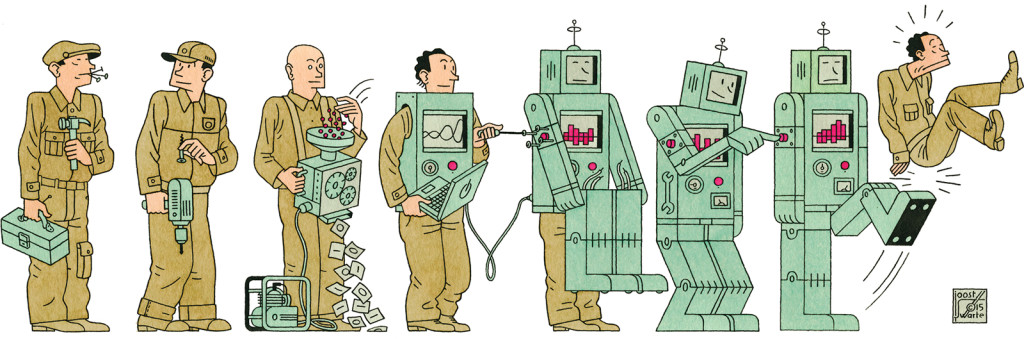
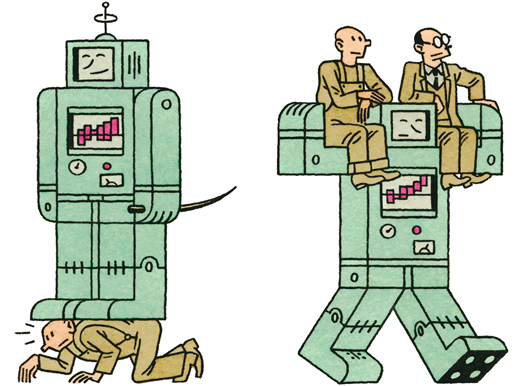
Rise of the Robots

jobs.1x1600

Writing at the MIT Technology Review, David Rotman looks at the impact of automation and digital technology on jobs with reference to a number of recent books related to the subject including Rise of the Robots: Technology and the Threat of a Jobless Future by Martin Ford, The Great Divide by Joseph Stiglitz, and The Second Machine Age by Erik Brynjolfsson and Andrew McAfee. But if you find that all too depressing to contemplate — and who doesn’t? — you can at least enjoy the wonderful Joost Swarte illustrations that accompany article …

jobs.6x519

Comments closed

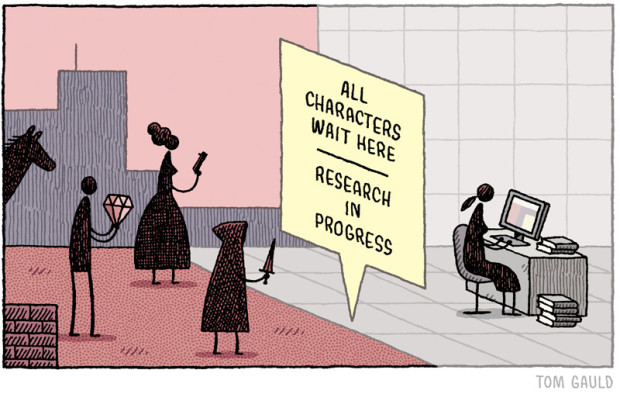
All Characters Wait Here

characters wait here tom gauld

Mr. Tom Gauld

Comments closed

Midweek Miscellany

Look Closer — Adrian Tomine talks about moving to New York, and his new book of drawings with The New Yorker:

I’m not one of those artists with an incredible imagination who can just make things up out of nothing, and I’m not the kind of person who would throw himself into some exciting or dangerous situation just to get material. So I tend to go about my normal, boring life, and just try to look at things a little more closely. And even though I’ve lived in New York for eight years now, I still feel like a recent transplant, and I think that’s a big influence on how I see and draw the city.

Invisible — Jeanette Winterson on Tove Jansson and the Moomins, for The Telegraph:

I keep the Moomin books in my study and if I am tinkering about preparing for work I will often open one at random and read a page – they are funny and subversive, (Hemulens of either gender only wear dresses). And playful. Whatever happened to playfulness? Why, as adults, is serious/superficial the boring binary of our lives?… Tove Jansson believed in happy endings… Not the Disney kind but more solid and ambiguous, which is a paradox, but more truthful than black-and-white solutions. Ever-after is what is invisible on the next page.

Approaching Zero — Michael Faber reviews How Music Works by David Byrne, for The Guardian:

Everyone knows that the music industry is in terminal decline. Unlike many doomsayers, however, Byrne feels the changed landscape is good for musicians. Even 20 years ago, any artist wishing to make a record needed a huge sum of money to pay for studio time (and thus needed a large corporation to loan it to him). A lucky few shifted the millions of units necessary to repay the industry’s investment, but the majority got hopelessly into debt. Nowadays, recording costs are “approaching zero”. Distribution costs in the digital era are also negligible compared to the days of physical warehousing. As long as artists can find ways of holding on to a fair percentage of their income (an impossible challenge in the heyday of the record companies), even modest sales can sustain a career. Indeed, says Byrne, “there have never been more opportunities for a musician to reach an audience.”

And finally…

A Short Lesson in Perspective — A fantastic essay by Linds Redding. First published in March of this year, this seems to have taken on a life of its own. If you work in a ‘creative industry’ and haven’t read it yet, make sure you read the whole thing:

The compulsion to create is unstoppable. It’s a need that has to be filled. I’ve barely ‘worked’ in any meaningful way for half a year, but every day I find myself driven to ‘make’ something. Take photographs. Draw. Write. Make bad music. It’s just an itch than needs to be scratched. Apart from the occasional severed ear or descent into fecal-eating dementia the creative impulse is mostly little more than a quaint eccentricity. But introduce this mostly benign neurosis into a commercial context.. well that way, my friends lies misery and madness.


Comments closed

Something for the Weekend

Short and sweet today…

“All they do is show you’ve been to college” — Ben Dolnick on his love of the semicolon, at the New York Times:

And so, far from being pretentious, semicolons can be positively democratic. To use a semicolon properly can be an act of faith. It’s a way of saying to the reader, who is already holding one bag of groceries, here, I know it’s a lot, but can you take another? And then (in the case of William James) another? And another? And one more? Which sounds, of course, dreadful, and like just the sort of discourtesy a writer ought strenuously to avoid. But the truth is that there can be something wonderful in being festooned in carefully balanced bags; there’s a kind of exquisite tension, a feeling of delicious responsibility, in being so loaded up that you seem to have half a grocery store suspended from your body.

(You’ve surely read this by now, but…) Also in the NYT Tim Kreider on the ‘Busy’ trap:

Busyness serves as a kind of existential reassurance, a hedge against emptiness; obviously your life cannot possibly be silly or trivial or meaningless if you are so busy, completely booked, in demand every hour of the day… More and more people in this country no longer make or do anything tangible; if your job wasn’t performed by a cat or a boa constrictor in a Richard Scarry book I’m not sure I believe it’s necessary. I can’t help but wonder whether all this histrionic exhaustion isn’t a way of covering up the fact that most of what we do doesn’t matter.

And finally…

Busted — Leah Price, author of How to Do Things with Books in Victorian Britain, on the history of reading at The Browser:

Ernest Hemingway had this to say about James Joyce: “I like him very much as a friend and think no one can write better, technically. I learned much from him.” But if you look at Hemingway’s copy of Ulysses, which is kept today in a library in Boston, you see that the first and last pages are the only ones that have been cut. So you can’t always trust people to tell the truth about their own reading. What makes it fascinating and also frustrating to study is that reading is one of the most private things we do.

1 Comment

Address Change

If you’re in the habit of sending me catalogues or review copies, it is time to update your address books — please drop me a line  and I will send you the details.

And, yes, sadly I am losing the view.

Comments closed

Milton Glaser: Embrace the Failure

To promote their graduation exhibition in May, students from Berghs School of Communication in Stockholm asked prominent creative figures to discuss their ‘fear of failure.’ In this video veteran designer Milton Glaser offers his insights into creative failure (which apply as much to writing as much as design, I would think):

(via Creative Review)

4 Comments

A Taxonomy of Office Chairs

A Taxonomy of Office Chairs by Jonathan Olivares and published by Phaidon is a visual overview of the evolution of the modern office chair and detailing the most innovative chairs designed and built from the 1840s to the present.

In this video, Olivares talks about the book and the importance of the office chair in design history:

(via Daily Icon)

Comments closed

Jason Fried on Rework

In a recent interview for CBC Radio show Spark, Jason Fried, the founder of 37signals, talked with Nora Young about his book Rework:

CBC RADIO SPARK: JASON FRIED | REWORK

Also doing the rounds is Fried’s article ‘How to Get Good at Making Money’:

People are happy to pay for things that work well. Never be afraid to put a price on something. If you pour your heart into something and make it great, sell it. For real money. Even if there are free options, even if the market is flooded with free. People will pay for things they love.

This lesson is at the core of 37signals. There are plenty of free project management tools. There are plenty of free contact managers and customer relationship management tools. There are plenty of free chat tools and organization tools. There are plenty of free conferences and workshops. Free is everywhere. But we charge for our products. And our customers are happy to pay for them… Charging for something makes you want to make it better. I’ve found this to be really important. It’s a great lesson if you want to learn how to make money.

What I didn’t know, but learnt today, was that Jeff Bezos is the sole investor in 37Signals. Make of that what you will.

Comments closed