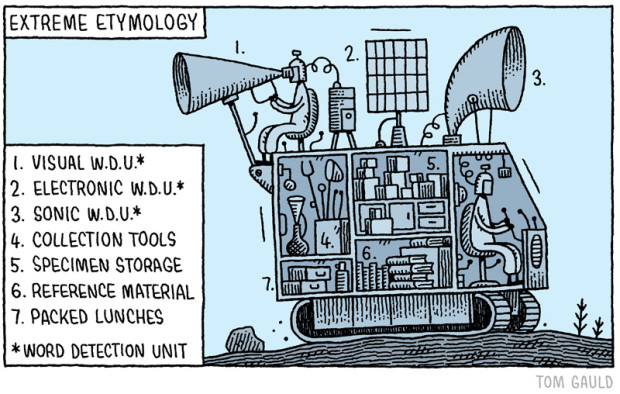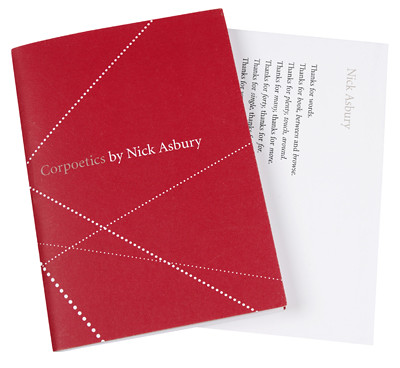
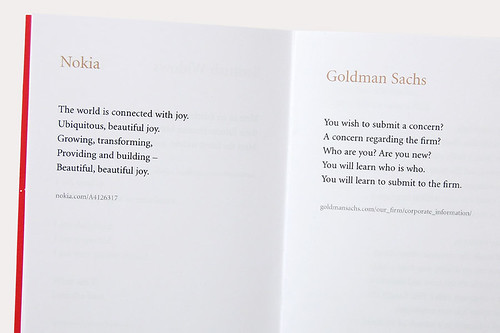
I was quite taken with the lovely design and gentle subversion of Corpoetics — a chapbook collection of ‘found’ poetry taken from the ‘Corporate Overviews’ of well-known brands and corporations — when I first saw it at Ace Jet 170 in February.
Author Nick Asbury was kind enough to get in touch after I mentioned the project here, so when Corpoetics recently won a Yellow Pencil for Writing for Design at the 2009 D&AD Awards, it seemed like a perfect excuse to talk to Nick a bit more about the project, the corporate use of language, and interesting not-for-profit work…
What inspired Corpoetics?
My day job is as a writer for businesses and brands, so I’ve long been immersed in the corporate world. I’ve often sought refuge in reading and occasionally writing poetry, so I guess it was inevitable that the two would cross over at some point.
How would you describe ‘found’ poetry?
I came across a good quote by Annie Dillard, talking about the ‘doubling effect’ you get in found poems. ‘The original meaning remains intact, but now it swings between two poles.’ I think that’s about right. You get an interplay between the original meaning and where you’ve taken it — and there’s a lot of potential for humour and subversion, particularly when the source material is from the corporate world.
The language of several of the poems is almost Orwellian. Do you have a sense that corporations (deliberately or otherwise) dehumanise language?
Yes, dehumanise is exactly the word. A lot of corporate language is designed to erase any sense of individual responsibility. It’s much safer to talk about how ‘a decision was taken’ rather than saying ‘I took a decision’. So you get this very passive, depersonalised way of talking. Then there’s the widespread tendency to hide behind jargon and non-committal abstractions. In some cases, it’s deliberately intended to conceal or exclude. But a lot of businesses drift into it without realising — it just becomes the norm for writing in a business context.
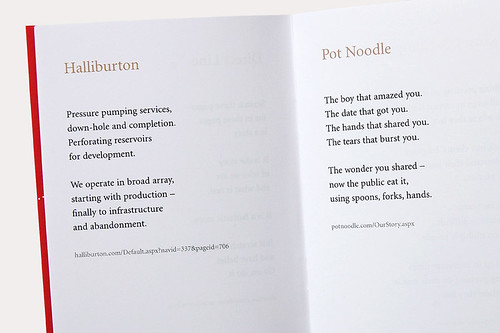
The poem I wrote about Halliburton is probably the most Orwellian in tone. It takes their words and lets their emptiness ring out in this very eerie way. But it didn’t take a lot of rearranging — it’s more like a condensed version of the original.
As a copywriter and consultant, do you feel a certain irony in the subversion of corporate language in Corpoetics?
Definitely. When I first had the idea, I was very aware of biting the hand that feeds me. But then the aim is not just to subvert corporate language and hold it up to ridicule (although some poems do). I also wanted to pick brands that I liked. People like Greggs The Baker — a fixture on British high streets — or Pot Noodle, a famously throwaway junk food here in the UK. It was interesting taking their words and seeing where they went. Pot Noodle became a story of a relationship that begins in furtive excitement and ends in squalor, much like the experience of the product itself.
Is it possible for business writing to have warmth and wit, or is it inherently evil?
That depends whether you think all businesses are inherently evil. I don’t. We all need to earn money and make a living — and work is a noble and necessary thing. Whether it’s the local bakery or a multinational giant, plenty of businesses make an honest living and do good things. Those businesses have a good story to tell — and there’s room for warmth and wit in the telling. Of course, the unfortunate truth is that a lot of ‘good’ business writing is a matter of spin — making companies seem better than they are. But the very best writing will always be for good companies with something truthful to say.

Have you had any response from the companies featured in Corpoetics?
Yes, KPMG got in touch. I took a deep breath when the email arrived, expecting a stern ultimatum from the legal team. But it was very positive. They said they wanted to feature it in their internal company newsletter and run a competition to get people to send in their own poems. I’d like to have seen the results, but still haven’t managed to track them down.
Why did you decide to publish Corpoetics as a book rather than make it a web-based project?
It seemed a very natural thing to do. Poetry just feels more satisfying when it’s in print. I work as one of a partnership (Asbury & Asbury) alongside my wife Sue, who is a graphic designer. So we thought about turning it into a design project as well as a writing project — taking graphic elements from the companies featured and rearranging them in some way. But we decided it was overkill. It’s ultimately a project about language and we wanted to let the words do the work.
Is the visual presentation of written language important to your work?
Yes — ever since I started out in business writing (about 12 years ago), I’ve worked closely alongside graphic designers. In fact, most of my work is commissioned by design and branding companies, so it’s a natural fact of life. I’d find it hard to write anything without having some sense of the way it will be presented visually. It’s never just about the words or the design, but the overall act of communication.
So good writing and good design go hand-in-hand?
Yes, ideally. I find a lot of the best designers are pretty good with words. Both professions have the same base skills. You need to analyse a brief, empathise with an audience, spot lateral connections, tell a story, make an imaginative leap. The disciplines only separate out right at the end, when the designer goes off to do the pictures and the writer gets typing.
What other projects are you currently working on?
I usually have three or four paying projects at any one time. At the moment, I’m writing an annual review for a British charity, some marketing literature for a hotel operator, and an advertising campaign for an Austrian law firm. Alongside all that, as Asbury & Asbury, we continue to work on our own projects. The latest is a collection of children’s poetry called ‘Songs For Animals‘, but it may not see the light of day for a while yet.
Can you tell me about 26?
It’s a not-for-profit collective of writers, editors, journalists, designers, publishers — anyone with an interest in language, both in a business context and more generally. As you might have guessed, the name comes from the letters of the alphabet, the DNA of language — and naturally, it costs £26 a year to be a member. I got involved shortly after it started up in 2002 and am now one of the directors responsible for running the whole thing — or trying to. It’s operated entirely on voluntary time and can be quite chaotic, but they have produced some really interesting collaborations, resulting in books, exhibitions and a whole series of public talks and events. It’s principally UK-based, but there are chapters springing up in South Africa, Sweden and elsewhere. I’d urge anyone with an interest in the subject to join. You’ve got nothing to lose. Except maybe £26.
Thanks Nick. Corpoetics is available for £5 plus p&p from Asbury & Asbury , with proceeds going to the National Literacy Trust, a UK charity dedicated to changing lives through literacy.
Like this:
Like Loading...