Skip to content

Tag: women

Women and Critics: Roxane Gay and Michelle Dean

Michelle Dean talks about her new book, Sharp:The Women Who Made an Art of Having an Opinion, and the nature of criticism with Roxane Gay for The Cut

I tend to judge a piece of criticism by how smart I find the argument… I don’t mean, how much I agree with it, exactly, but more: how much does this open up the subject at hand? Does it show me things about it I didn’t already know? I like debate and argument, so I’m usually all right with disagreement, and I’m even all right if the critic doesn’t come to a clear thumbs up or thumbs down. But I need the disagreement to have some kind of line I can follow on the map. I like following an interesting mind along it.

Bad criticism recites rote arguments. The shame of rote arguments isn’t just that they’re clichés, though they are, but that they tend to hide from us why a critic is actually thinking what they’re thinking. In which case there’s no point in reading the review at all. I don’t care about the bare fact that anyone liked or didn’t like a book or movie; they can only interest me in that bare fact by writing an intelligent review.

Comments closed

Obama and Books

The New York Times has published a transcript of Michiko Kakutani’s recent conversation with US President Barak Obama about books:

Some of the craft of writing a good speech is identical to any other good writing: Is that word necessary? Is it the right word? Is there a rhythm to it that feels good? How does it sound aloud?

I actually think that one of the useful things about speechwriting is reminding yourself that the original words are spoken, and that there is a sound, a feel to words that, even if you’re reading silently, transmits itself.

So in that sense, I think there will be some consistency.

But this is part of why it was important to pick up the occasional novel during the presidency, because most of my reading every day was briefing books and memos and proposals. And so working that very analytical side of the brain all the time sometimes meant you lost track of not just the poetry of fiction, but also the depth of fiction.

Fiction was useful as a reminder of the truths under the surface of what we argue about every day and was a way of seeing and hearing the voices, the multitudes of this country.

You can read the article that resulted from this conversation here.

Surely there are few other politicians — let alone world leaders — who could speak so intelligently and at such length about contemporary literature. 

And, on a somewhat related note, I just wanted to mention the Women’s March on Washington on January 21. The official logo for march — reminiscent (in a good way) of Saul Bass’s 1978 logo for the Girl Scouts of America (revamped in 2010 by Original Champions of Design) — was designed by Nicole LaRue. There are sister marches around the world — find your local event here — and you can download typographic posters for occasion from Counter Type.


Resist.


Comments closed

Jennifer Heuer on Gendered Covers and Being a Woman Designer

Love Love design Jennifer Heuer

At The Literary Hub, the talented Jennifer Heuer on gendered book covers and being a woman designer:

I love what I do and I’ve been fortunate enough to work with a lot of amazing art directors on a lot of great projects. I’m always grateful for the work I get. But I’ve talked to a lot of women in the industry over the years, and there is a clear pattern we’ve all experienced. One day a few months ago, I was commissioned to work on the backlist of a prolific women’s lit author. Minutes later, an art director called about a memoir in which the author was “always the bridesmaid.” Later that day: a novel about a wife dealing with her husband’s indifference while balancing her new career and motherhood. Three projects from three different art directors. All aimed directly at women readers.

I doubt that many of my male colleagues have had the same experience. And that day wasn’t an anomaly.

The talented art director and cover designer Catherine Casalino has told me, “When you’re on the receiving end of a project, it’s hard to say no, and even harder to explain why you don’t want to work exclusively on women’s fiction,” and continued with, “I think if we mixed things up a little more—hired women to design sports books and hired men to design cookbooks—we’d get some fresh and unexpected designs. And that would benefit all of us in the industry.” Another female designer has written to me saying, “It’s no surprise that women are assigned these topics—being women, it’s natural to assume we are interested in these things—but sometimes the associations are so tenuous that you start wondering if the gender bias is actually a form of laziness.”

1 Comment

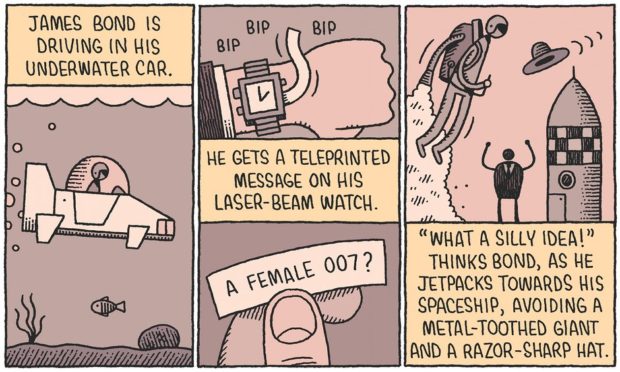
“What a Silly Idea”

James Bond Tom Gauld

Tom Gauld on women leads in spy fiction for The Guardian. See also, people of colour in fantasy films.

Comments closed

Miriam Markowitz: ‘Here Comes Everybody’

I am very late to this, but Miriam Markowitz’s article for The NationHere Comes Everybody‘, on women and book publishing in 2013, is well worth reading:

More nuanced fiction that isn’t of an obvious commercial genre—much of which is written by women—often brushes up against the literary. Publishers have various terms for the books that straddle this line. One of the ugliest and yet most useful is “upmarket.” The writers who may be lumped in this category are diverse in their output and their ambitions.

One commercial editor told me that many of her writers once cherished literary aspirations, but that they’re comfortable in the “upmarket” category, in part because it’s more lucrative. “If you cash in on the monetary market, you won’t get prestige. A lot of writers are OK with that.” Few writers have control over their covers, let alone the way their books are marketed, but if an agent or publisher says that this lacy dress or that whispery veil might entice more readers, who are they to object? Readers of literary fiction, especially women, will buy commercial titles as well. But the phenomenal popularity of Fifty Shades of Grey or the Twilight series or Nora Roberts among women who do not specifically identify as “readers” suggests that the reverse is less true. It’s hard to blame women writers for trying their hand at the commercial market when the literary one is so inhospitable.

For writers of work that is unambiguously ambitious, this choice is more difficult in that it may not be an option at all.

Comments closed