Skip to content

Tag: wim crouwel

Midweek Miscellany

Superhybridity — Tom Payne reviews Retromania by Simon Reynolds for The New York Times:

It’s not so much the selling-­out that saddens Reynolds. Rather, it’s our ready acceptance that the past is our only future: that after postmodernism, with its weary, overinformed view that there is nothing new to say, comes something called “superhybridity.” Superhybridity, a concept borrowed from an art magazine, exists because the Internet can bring whatever we want into our hard drives, so that we can sample it or mash it up: no culture, from any time or place, can be remote from us.

Anger — In light of the recent riots in Britain, Chris Arnot looks at the legacy of Alan Sillitoe (Saturday Night and Sunday Morning) with the author’s son David:

Something about the sudden switch from menace to charm, coupled with that jack-the-lad swagger, briefly brings to mind Arthur Seaton, the antihero of Saturday Night and Sunday Morning… Arthur had already shrugged off the collectivist values of the postwar years. He was “trying to screw the world … because it’s trying to screw me.”

“Currently my head is empty. I am on holiday.” — Wim Crouwel at Designers & Books.

The Weird Outsider — A long profile of Jared Lanier, author of You Are Not A Gadget, in the New Yorker:

Like an innovative painter who alternately courts and scorns the establishment, Lanier often seems torn between embracing and repudiating his newly influential status. As we drove, he mentioned, with some pride, that he had been “banned” from the TED conferences last year, after publishing an essay about the narcissistic nature of the event in a London magazine. (A spokesperson for TED said that Lanier is welcome at the conferences.) He purported to be similarly unimpressed by Davos, the economic conference, which he has attended “a billion times.” “At one point, I was in an elevator with Newt Gingrich and Hamid Karzai,” he said. “There are really only so many times you want to be in that situation.”

And finally…

Writer Chuck Klosterman interviews Bill James, inventor of sabermetrics — the “ideological engine” behind MoneyballMichael Lewis’ book on baseball — and author of a new book Popular Crime: Reflections on the Celebration of Violence, for Grantland:

This line is fascinating if you’re interested in crime fiction:

The whole idea of Sherlock Holmes is dangerous because it encourages people to think that — if they’re intelligent enough — they could put all the pieces together in absolute terms. But the human mind is not sophisticated enough to do that. People are not that smart. It’s not that Sherlock Holmes would need to be twice as smart as the average person; he’d have to be a billion times as smart as the average person.

But this is just great:

There were so many terrible things done by kings and emperors and everyday normal people that are just incomprehensible today. The historian Suetonius writes about how Nero — beyond the many thousands of people he killed in his official duties— liked to sneak out of the palace at night and murder people in the streets, purely for entertainment. Now, whatever you may think of our recent presidents, it’s pretty safe to say they didn’t do that.

Comments closed

Wim Crouwel | Dutch Profiles

Designer Wim Crouwel talks about his career, his use of the grid and the creation of the New Alphabet in this interesting 10-minute documentary for Dutch Profiles:

Dutch Profiles is a series of short documentaries about architects, graphic, product and fashion designers working in the Netherlands. The series is new to me, but past films that caught my eye include profiles of architect Rem Koolhaas, graphic designer Irma Boom, and cartoonist Joost Swarte.

(via iloveboeken)

Comments closed

Wim Crouwel: A Graphic Odyssey

Phaidon Books has posted a short profile of the original “Gridnik”, graphic designer Wim Crouwel:

Crouwel, who appeared in Gary Hustwit’s documentary Helvetica, is famous for his innovative approach to typography and his 1967 ‘New Alphabet’. The New Alphabet font was adapted by designer Peter Saville for the cover of Joy Division’s album Substance, released by Factory Records in 1988.

An exhibition of celebrating Crouwel’s work, Wim Crouwel: A Graphic Odyssey, is at The Design Museum in London from March 30th – July 3rd.

UPDATE: Wim Crouwel: A Graphic Odyssey – Catalogue is published by Unit Editions with three different cover photographs to choose from.

4 Comments

Something for the Weekend, June 5th, 2009

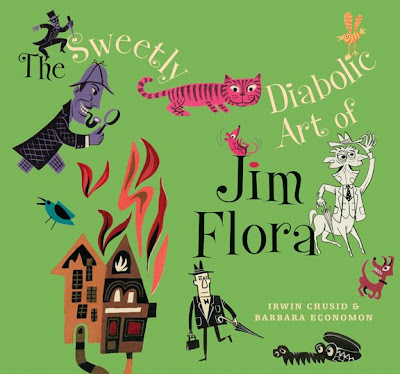
Sweetly Diabolic — A new Jim Flora compendium from Fantagraphics.

I really, truly, wasn’t going to link to any BEA autopsies — and there are plenty out there — but on the eve of BookCamp Toronto I thought Brian O’Leary’s post seem pertinent:

It would be more than nice, more than fun, more than illuminating, if we as an industry could use events like BEA as less an opportunity to predict the future and more a forum in which to examine the options. Okay, piracy is bad, but.. what if it helped sell books? Okay, we love long-form fiction and we think it should survive, but what if the people who read it now just stopped? Okay, a trade publisher provides value in choosing and curating content, but what if the world turned upside down and everyone were a writer, a publisher, a reader… Wouldn’t that be really cool?

Fingers crossed for tomorrow… Follow along on Twitter. The event account is @BookCampTO. The hash-tag is #bcto09.

Access of Evil — More on Google’s big e-book adventure at Business Week. The ‘news’ is that Google will be offering online access to e-books rather than downloads. Which, if I understand it correctly, is what Shortcovers does already. Not that anyone is giving them credit for it.

The ALPHABET chest of drawers by Kent and London, inspired by vintage printing blocks: “The perfect place to file everything from A-Z!” (via source of all good things swissmiss).

The George Orwell Archive at the BBC (via The Book Depository blog):

For two years, between 1941 and 1943, George Orwell – real name Eric Blair – was BBC staff member 9889, hired as a Talks Producer for the Eastern Service to write what was essentially propaganda for broadcast to India.

From recruitment to resignation, this collection of documents reveals the high regard in which Orwell was held by his colleagues and superiors and his own uncompromising integrity and honesty.

The Wickedest Man in the World — Jake Arnott, author of The Long Firm, on how the very real Aleister Crowley became the archetypal fictional 20th century villain. Sadly Arnott doesn’t mention that Oliver Haddo, W. Somerset Maugham’s literary Crowley, appears in the latest League of Extraordinary Gentlemen adventure.

The Future of Mainstream Media — a fascinating article about the success of National Public Radio (NPR) by Josh Catone for Mashable:

NPR’s amazing growth over the past 10 years prompted FastCompany magazine in March to call NPR the “most successful hybrid of old and new media,” and wonder if NPR could be the savior of the news industry. [T]hey owe that success to the culture of open access and audience participation that they’ve cultivated over the past decade.

And… OK I just can’t not link to Design Assembly‘s post about design-hero Wim Crouwel’s ISTD lecture.

Note: if you want me to link to your site, you just need to include a brilliant photograph of Wim Crouwel looking cool as f*ck and then use a genius soccer analogy:

“(For me) a grid is like a football pitch. You see a beautiful game of football, and then you see a not so beautiful one, but it all takes place on the same pitch”.

Yes. I am a cheap date.

4 Comments