Skip to content

Tag: william gibson

William Gibson on Authenticity

gibsonlabel

I’d be the first to admit that I didn’t really get on with William Gibson’s latest novel The Peripheral, but I really enjoyed his ‘Blue Ant’ trilogy — Pattern Recognition, Spook Country, and Zero History.

Interestingly, the (fictional) Buzz Rickson MA-1 flight jacket worn by Cayce Pollard, the protagonist in Pattern Recognition, led to the Japanese clothing company working with Gibson to manufacture a line of clothes (including the aforementioned black MA-1) inspired by the author. In this fascinating interview with Rawr Denim, the author discusses Buzz Rickson, Japanese pop culture, workwear, authenticity and more:

“Authenticity” doesn’t mean much to me. I just want “good”, in the sense of well-designed, well-constructed, long-lasting garments. My interest in military clothing stems from that. It’s not about macho, playing soldiers, anything militaristic. It’s the functionality, the design-solutions, the durability. Likewise workwear.

Military clothing is built to strict contract, but with the manufacturer cutting ever corner they can without violating the specifications. The finishing on a Rickson reproduction is exponentially superior to the finishing on most of the originals, and I’d much rather have a brand-new exact copy that’s more carefully assembled…

…[In] 1947 a lot of American workingmen wore shirts that were better made than most people’s shirts are today. Union-made, in the United States. Better fabric, better stitching. There were work shirts that retailed for fifty cents that were closer to today’s Prada than to today’s J.Crew. Fifty cents was an actual amount of money, though. We live in an age of seriously crap mass clothing. They’ve made a science of it.

Comments closed

Something for the Weekend

James Victore shares his workspace with From The Desk Of.

Burn Unit — At the New York Times ‘Bits’ blog, David Streitfeld writes on Amazon’s recent image problems:

[Take] the cover of Bloomberg Businessweek two weeks ago. It shows a book in flames with the headline, “Amazon wants to burn the book business.” What was remarkable was not just the overt Nazi iconography but the fact that it did not cause any particular uproar. In the struggle over the future of intellectual commerce in the United States, apparently even evocations of Joseph Goebbels and the Brown Shirts are considered fair game.

Witheringly Obscure — Wired Magazine talks to William Gibson about Distrust That Particular Flavor and collecting antique watches:

[It] was really about pursuing a totally unnecessary and gratuitous body of really, really esoteric knowledge. It wasn’t about accumulating a bunch of objects. It was about getting into something utterly, witheringly obscure, but getting into it at the level of, like, an extreme sport. I met some extraordinarily weird people. I met guys who could say, “Well, I’ve got this really rare watch, and it’s missing this little piece. Where might I find one?” Then the guy would kind of stare into space for a while, and then he’d say this address in Cairo, and he’d say, “It’s in the back room. The guy’s name is Alif, and he won’t sell, but he would trade it to you if you had this or this.” And it wasn’t bullshit. It was kind of like a magical universe. It was very interesting. But once I’d gotten that far … I got to a certain point, and there was just nowhere else to go with it. The journey was complete.

Magic Journalism — Writer Geoff Dyer chooses five unusual histories for The Browser:

[T]ypically, I guess, you read history books for the content – that sounds an unbelievably stupid comment – and you’re drawn to certain works of history rather than others because you’re interested in the period. You read Stalingrad by Antony Beevor because you’re interested in the Second World War, or Russia or whatever. Whereas it seemed to me that the thing about these books was that you might be interested in the subject, but it’s the way that the subject is dealt with that is the distinguishing feature of each one.

And finally…

A long article for Intelligent Life  on ceramicist Edmund de Waal and the double-edged success of his memoir The Hare with Amber Eyes:

In the 18 months since the book came out, de Waal has completed six overseas book tours, given dozens of talks, answered hundreds if not thousands of questions. He has also kept his porcelain-making studio busy and has plans for a subsequent book, about the history of porcelain around the world, which will take him from 18th-century Plymouth to the hillsides outside Jingdezhen where porcelain was first made in China, via Dresden, Marco Polo’s Venice, Istanbul and Yemen. “Porcelain”, he says, “is light when most things are heavy. It rings clear when you tap it. You can see the sunlight shine through. It is in the category of materials that turn objects into something else. It is alchemy. Porcelain starts elsewhere, takes you elsewhere. Who could not be obsessed?”

Comments closed

Something for the Weekend

Typographica’s favourite typefaces of 2011 (pictured above: A2 Beckett designed by Henrik Kubel for A2-TYPE).

The Coroner`s Report — John Banville reviews The Complete Poems by Philip Larkin for The Guardian:

A “Complete Poems” is a death certificate and memorial combined. After the Selected and the Collected, the Complete marks the poet’s official demise and at the same time erects a carven monument designed to outlast the ages. In the case of this mighty volume of the all of Larkin, there is something too of the coroner’s report.

A twopart interview with William Gibson, author of Distrust That Particular Flavor, in the Wall Street Journal.

And finally…

Go Outside — Ian Leslie responds to criticism of his essay on serendipity:

The inherent limits of older formats like newspapers or bookstores are a feature as well as a bug. They make things a bit difficult for us, and because of that they often push us towards unsought-for discoveries.The modern internet makes each of us like a rich man in his mansion who has the finest food flown in from every corner of the world and whose favourite singers and artists come and perform for him in his bedroom at a moment’s notice. He has a nagging feeling that he ought to go outside and experience the city and its manifold surprises first-hand. Nothing is stopping him from doing so. But it feels like such an effort.


Comments closed

Midweek Miscellany


Everyday Epic — Tom Spurgeon interviews Tom Gauld at The Comics Reporter:

I find that when I’m drawing I’m quite happy to come up with larger than life, epic things but when I write things tend to be more down to earth. The contrast between greatness and everyday reality is something which interests me.

You can find my interview with Tom here. His new book Goliath is out in March.

I Am Lousy Copywriter — A list by legendary adman David Ogilvy, author of Confessions of an Advertising Man, at Letter of Note:

If all else fails, I drink half a bottle of rum and play a Handel oratorio on the gramophone. This generally produces an uncontrollable gush of copy.

My Name is Tyranny — Mike Doherty interviews William Gibson about his new book, Distrust That Particular Flavor, for Salon:

I very seldom compose anything in my head which later finds its way into text, except character names sometimes – I’m often very much inspired by things that I misunderstand. Have you ever seen Brian Eno’s deck of Oblique Strategies? One of them is “Honor thy error as a hidden intention.” That’s my favorite. [At a] hotel in New York a couple of days ago, the young woman who checked me in said what sounded to me like, “Thank you, sir; my name is Tyranny. If there’s anything you need …” For the rest of the day, I was thinking of young, benevolent female characters with the first name “Tyranny.”

And finally…

Tiptoeing Through a Sickroom — Luc Sante on Patti Smith for The New York Review of Books:

Her memoir Just Kids (2010), the account of her friendship with the photographer Robert Mapplethorpe, has been justly celebrated. It is delicate and affectionate as it tells of their adventures in a New York City bohemia that now seems a century removed, of the endurance of their relationship despite his realization that he was gay, of their separate pursuits of fame, of his illness and death. It is almost too literary for its own good, since her choices of word and phrase always come down on the genteel side of the ledger: “perhaps” rather than “maybe,” “rise” rather than “stand,” “yet” rather than “but,” “one” rather than “you.” There’s hardly a contraction, outside the dialogue, in the entire book. But despite the fact that this sort of talk is patently not the way she expressed herself at the time, and that it sounds more effortful than natural on the page, it does cover the book with an appropriate hush—it sounds like someone tiptoeing through a sickroom.


Comments closed

Midweek Miscellany

Psycho-Drama — Pat Kirkham reassesses the collaboration between Saul Bass and Alfred Hitchcock for Design Observer:

The entire Bass/Hitchcock collaboration deserves to be better known, partly because of the sheer quality of the work, partly because it offers an interesting case study of the complex interchange between film and design, and partly because of the controversy surrounding Bass’s contribution to what is arguably the most famous scene in U.S. cinema — the shower scene in Psycho. Serious discussion of Bass’s contribution to the shower scene — a fascinating collaboration, from novel and script to musical score — remains problematic, not least because issues of authorship are far from dead in many academic disciplines, design history and film studies included.

Portmanteau — William Gibson’s new collection of non-fiction, Distrust That Particular Flavorreviewed in The New York Times:

Everything he notices seems to be a this grafted onto a that. In these essays, we see a man fascinated by objects and places containing their own contradictions. It makes sense, then, that Gibson’s novels have helped promote several portmanteau words and neologisms, like “cyberspace,” into widespread English use. This is the essence of Gibson-think — anything can be a kind of portmanteau, a glued-­together paradox.

See also: Gibson interviewed in The National Post (who get bonus points for their “Neuromantic” headline) and The Globe and Mail.

And finally…

What You Want, But Not What You Need — An interesting article by Ian Leslie, author of Born Liars, on serendipity:

[T]here is a reason why Amazon is successful and bookshops are closing: in a world of infinite choice, efficiency is hard to resist. The pleasures of the bookshop or the library are easily outgunned by the knowledge that we can order or download a book instantly, or find the information we’re looking for within seconds. Serendipity, on the other hand, is, as Zuckerman says,  “necessarily inefficient”. It is a fragile quality, vulnerable to our desire for convenience and speed. It also requires a kind of planned vagueness. Digital systems don’t do vagueness very well, and our patience with it seems to be fading.

Comments closed

Midweek Miscellany

Buzzwords of the Incurious — Evgeny Morozov, author of The Net Delusion: The Dark Side of Internet Freedom, delivers a searing review of Public Parts: How Sharing in the Digital Age Improves the Way We Work and Live by Jeff Jarvis.  A must-read:

The ubiquitous references to Gutenberg are designed to lend some historical gravitas to wildly ahistorical notions. The failure of Internet intellectuals actually to grapple with the intervening centuries of momentous technological, social, and cultural development is glaring. For all their grandiosity about technology as the key to all of life’s riddles, they cannot see further than their iPads. And even their iPad is of interest to them only as a “platform”—another buzzword of the incurious—and not as an artifact that is assembled in dubious conditions somewhere in East Asian workshops so as to produce cultic devotion in its more fortunate owners. This lack of elementary intellectual curiosity is the defining feature of the Internet intellectual. History, after all, is about details, but no Internet intellectual wants to be accused of thinking small. And so they think big—sloppily, ignorantly, pretentiously, and without the slightest appreciation of the difference between critical thought and market propaganda.

Swimming Out of Guilt — David Ulin talks to Art Spiegelman about MetaMaus at the LA Times:

“I didn’t predict this for myself,” Spiegelman admits, firing up another cigarette. “I thought ‘Maus’ was going to take two years and I’d move on with my life. But it’s an ongoing wrestling match. Basically ‘Breakdowns’ ” — the 2008 collection that recontextualized his early work, including the first three-page “Maus” strip, from 1972 — “and ‘MetaMaus’ are the great retrospections, the period of my life I’m still swimming out of. Then I get to find out if there’s any other stuff in my pockets to make bets with.”

The World We Live In — Author William Gibson interviewed at the A.V. Club:

I don’t actually think of science fiction as primarily a predictive form. That’s its cultural reputation and that’s what lots of people believe it is, but my approach has always been that it’s invariably about the day it was written in. Regardless of what the author tells us, it can’t really be anything else. There’s no way it can be about the future, except it pretends to be the future. It’s like reading 1984. What it’s actually about is 1948, the year it was written. You see Orwell responding to various aspects of the world he lived in, which was changing, since the world always is.

See also: Margaret Atwood talks about speculative fiction and her new collection of essays Other Worlds with CBC Radio (audio) and The Globe and Mail.

And finally…

Trash — Nathan Heller on film critic Pauline Kael, a new collection of her work, The Age of Movies: Selected Writings of Pauline Kael, and Brian Kellow’s new biography Pauline Kael: A Life in the Dark:

Kael realized that the pictures had a chance to succeed where classic books, painting, and art music had been shunted from the mainstream; she thought a tolerance for “trash” was key to maintaining this openness and innovation. Still, she was no fugitive from the old arts. Kael once said that she’d rather live in a world without movies than in a world without books, and she resented the decline of public literary dialogue. She saw the movies as American art’s second chance.

Also at The New Yorker, Richard Brody looks back Kael’s book 5001 Nights at the Movies.


Comments closed

Something for the Weekend

Peirene Press is small independent publisher in the UK specializing in previously untranslated contemporary European novellas. Their most recent series of books, designed by Sacha Davison Lunt, has been short-listed for the 2011 British Book Design and Production Awards in the Brand/Series Identity category.

Txt — Thomas Jones looks back at the work of author William Gibson at The Guardian:

The most striking feature of cyberspace in Neuromancer, however, the most radical way in which it differs from the modern internet, is its textlessness. Case is, or may as well be, illiterate: his skills as a cyberspace “cowboy” don’t depend on being able to read. He wouldn’t get very far as a hacker these days. The internet, as we now know it, even in the era of YouTube and podcasts, is still heavily text-based and text-dependent. Tweeting not only looks about as low-tech as you can get, it’s also all about language.

One Way or Another — Marjane Satrapi and Vincent Paronnaud talk about the film adaptation of Chicken with Plums with New York Magazine:

When you draw, you don’t have any limits; it kind of transforms our brain. Also, we had not [gone to] any cinema school, so we don’t have these techniques. Like when we started the project they were telling us things like, “Voice-over? Nobody does that any more” and “Cross-dissolve is out.” This notion of “out” and “in,” it depends on what you are saying. You don’t have one way of doing things.

Also at New York Magazine, Scott Snyder talks about the Batman #1 relaunch and rewriting Batman:

Gotham is almost a nightmare generator, filled with villains that seem to represent an extension of Batman’s greatest fears. A lot of his greatest villains feel like mirrors: the Joker is who Batman would be if he broke his rule and fell into madness; Two Face is a mockery of the duality of his life. But what I love about Bruce in particular, and the reason I’m so excited to be doing Batman, is he’s a superhero that has no powers. He takes it upon himself to go out every night, punish himself, and be the best out there. To me, that is both incredibly heroic and exciting, but also really pathological and obsessive.

Related: Scott Snyder interviewed about the same (but at greater nerdiness) at The Huffington Post.

And finally…

Here’s a short documentary about the making of the Vitsœ shelving system, originally designed by Dieter Rams in 1960 and still going strong:

Comments closed

Midweek Miscellany

Book designer and all-round good chap David Pearson on phillumeny at We Made This:

It’s no coincidence that a book designer should be drawn to matchbox labels. Their shape is intrinsically book-like, their method of communication instantaneous and spare, and they provide a dizzying range of illustrative styles. Their uncluttered compositions ensure communication across language barriers, and designs appear cohesive as a result of type and image being rendered by the same hand. But perhaps most alluring of all is their uncompromised clarity of purpose, an attribute that most modern designers can only dream about.

You can see more of David’s ephemera collection on Flickr, there’s another amazing collection of match-box covers here.

An Invisible Rightness — Six graphic designers, including Derek Birdsall and Peter Saville, discuss designers they admire in The Guardian.

A Repurposeful Life — Author William Gibson on cities and fiction in The Scientific American:

Necessity being one of invention’s many mothers, I have a certain faith in our ability to repurpose almost anything, provided it becomes sufficiently necessary. Then again, I suspect we’ve abandoned cities in the past because they were too thoroughly built to do some specific something that’s no longer required.

Let Us Tweet! — An epic-length rant by Jared Lanier, author of You Are Not a Gadget, at Edge:

I’m astonished at how readily a great many people I know, young people, have accepted a reduced economic prospect and limited freedoms in any substantial sense, and basically traded them for being able to screw around online… What that leads to is the world that Wells and Kurt Vonnegut and many others wrote about, where there just is enough virtual bread and circuses, just barely enough to keep the poor in check, and perhaps somehow not breeding, and they just kind of either wither away through attrition or something.

The A.V. Club offer a nice primer on newspaper comics.

Meanwhile… Robot 6 lists six great superhero comics from unlikely sources.

And finally…

An Act of Vengeance Against Former PleasuresThe Comics Journal reviews The League of Extraordinary Gentlemen: Century 1969, neatly summing up my own reservations about the direction of the series:

What’s disconcerting about 1969 is how joyless the exercise has become, and how wan and stretched the story feels. Like its predecessor, 1969 comes off as glum and a bit rancid. It feels like the story of characters who have outlived their time, which may indeed be the point… I don’t need to itemize the various bits of cleverness in 1969, or to point out the screamingly obvious, that 1969 is more intelligent and insinuating than most comic books. It is, after all, a book by Alan Moore and Kevin O’Neill. But the taste of it sits like battery acid on the tongue, and, like 1910 before it, it reads like an act of vengeance against former pleasures.

Comments closed

Midweek Miscellany

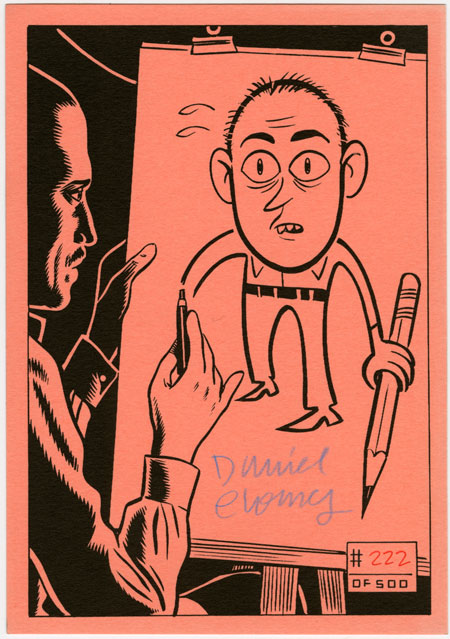
Fantagraphics find a cache of signed, limited-edition bookplates by artists including Dan Clowes, Jaime Hernandez and Gilbert Hernandez.

The Case & Point — A new website showcasing the best in custom type design and lettering curated by Vancouver-based design studio Working Format.

Designer, educator and author Ellen Lupton interviewed at From the Desks Of… (My Q & A with Ellen from 2009 is here).

And finally…

The New Thing — William Gibson, author most recently of Zero History, interviewed at Jack Move Magazine (via the man himself @GreatDismal):

The genuinely new things are really hard to imagine. When you do imagine them, they’re very hard to relay in anything like a sense in which the people who are totally used to them would use them. There’s always this factor in future-tech science fiction where somebody, be it the characters or the narrative voice, is really kind of wowed by future tech. It’s a powerful impulse. You want the reader to get a wowie. But there’s a way in which it’s not naturalistic; it’s not a genuinely naturalistic vision of the future, because that would be one in which people take it utterly for granted.

2 Comments

Something for the Weekend

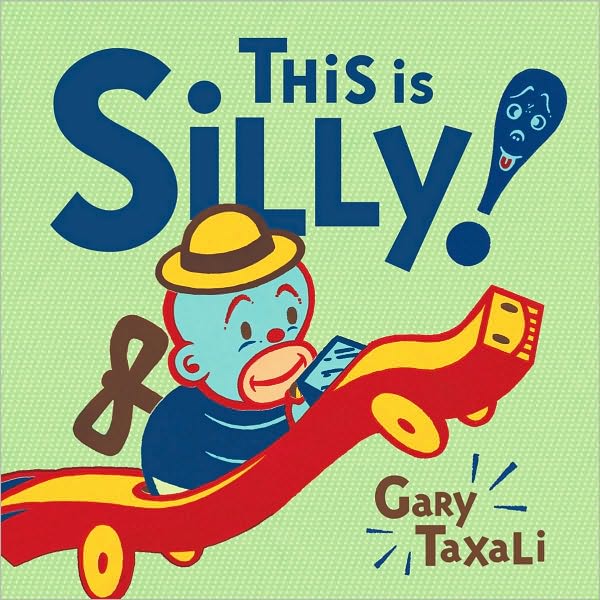
Sadly I missed the book launch earlier this week, but Toronto-based artist and illustrator Gary Taxali talked to the Torontoist and The National Post about his new kids book This is Silly!. You can see more of Taxali’s amazing book covers here.

ArtifactsMaximus Clarke has a fascinating conversation with William Gibson about his new novel Zero History :

I reach instinctively for something without knowing why, and place it in the narrative, and if it strikes a resonant chord with me, I’ll leave it there… But I myself have wondered why I do that — why I depict a universe of man-made objects, with people walking among them (laughs). My best answer is that it’s the way I perceive things. And I also suspect that the narratives of objects are more available to us when the objects themselves have become slightly decrepit. So I think my interest in old things, and worn things, isn’t about nostalgia in any conventional sense; it’s about the revelation of the narrative of how that object came to be in the world, and what it once might have meant to someone.

And on a somewhat related note, an interview with J.G. Ballard from the Winter 1984(!) issue of The Paris Review:

I would say that I quite consciously rely on my obsessions in all my work, that I deliberately set up an obsessional frame of mind. In a paradoxical way, this leaves one free of the subject of the obsession. It’s like picking up an ashtray and staring so hard at it that one becomes obsessed by its contours, angles, texture, et cetera, and forgets that it is an ashtray—a glass dish for stubbing out cigarettes.

The Black Arts — Book cover designers discuss their devious techniques for winning a clients approval with Peter Mendelsund and Peter Terzian:

Yes, a good design should speak for itself—but what if the client isn’t listening? Well, that’s when designers employ methods that are not taught in design school. Psychological methods. Machiavellian methods. Used-car-dealer methods. Manipulation. Intimidation. Seduction.

The PDF is here.

And Peter T has clearly been busy. The editor of Heavy Rotation: Twenty Writers on the Albums That Changed Their Lives has an article on books about album cover art at BookForum.

And finally (and on the subject of music)…

Finding Our WayRadiohead bassist Colin Greenwood reflects on the digital “pay what you think it’s worth” release of their album In Rainbows in 2007  and the band’s distribution options for their new songs:

I buy hardly any CDs now and get my music from many different sources: Spotify, iTunes, blog playlists, podcasts, online streaming – reviewing this makes me realise that my appetite for music now is just as strong as when I was 13, and how dependent I am upon digital delivery. At the same time, I find a lot of the technology very frustrating and counter-intuitive. I spend a lot of time using music production software, but iTunes feels clunky. I wish it was as simple and elegant as Apple’s hardware. I understand that we have become our own broadcasters and distributors, but I miss the editorialisation of music, the curatorial influences of people like John Peel or a good record label. I liked being on a record label that had us on it, along with Blur, the Beastie Boys and the Beatles.

(via Subtraction)

Comments closed

Something for the Weekend

Thanks for the CBC Books blog for including The Casual Optimist in their list of 10 ‘Book Blogs We Appreciate’ earlier this week. It is always nice to be appreciated — I only hope I can live up to the billing… :-)

The Story of Eames Furniture — Written and designed by Marilyn Neuhart together with her husband John, who both worked with the Eames Office from the 1950’s until 1978, the year Charles Eames’s died. Published later this month by Gestalten, the book comes in two full-colour volumes with a slipcase.

The Future of the Future — William Gibson interviewed in The Atlantic:

I think that our future has lost that capital F we used to spell it with. The science fiction future of my childhood has had a capital F—it was assumed to be an American Future because America was the future. The Future was assumed to be inherently heroic, and a lot of other things, as well… I’m not going all Sex Pistols, shouting No Future!—I’m suggesting that we’re becoming more like Europeans, who have always retrofitted their ruins, who’ve always known that everyone lives in someone else’s future and someone else’s past.

Respect for the UsersJay Rosen‘s inaugural lecture to incoming students at Sciences Po école du journalisme in Paris earlier this month:

The Web effortlessly records what people do with it. Therefore it is easy to measure user behavior: what people are interested in, what they are searching for, clicking on, turning to… right now. What should a smart journalists do with this “live” information?… [Y]ou should listen to demand, but also give people what they have no way to demand because they don’t know about it yet. In fact, there is a relationship between these things.  The better you are at listening to demand, the more likely it is that the users will listen to you when you say to them: you may not think this is important or interesting, but trust me… it matters. Or: “this is good.” Ignoring what the users want is dumb in one way; editing by click rate is dumb in a different way. Respect for the users lies in between these two.

And finally…

Graphic designer James Patrick Gibson talks to Babelgum about his photoblog New Type York , an archive of images of typographic artifacts — signs, directions and building inscriptions — around New York City (via DesignRelated):

Comments closed

Midweek Miscellany

The mighty George Lois at home in New York City at The Selby.

Start the Press — Robert Pinsky reviews The Book in the Renaissance by Andrew Pettegree for the New York Times:

The story begins with money. Johannes Gutenberg did not find a way to profit from his technical achievements. The Gutenberg Bible, a gigantic project, required large amounts of capital that needed replenishing over time, long before there was any hope of profit. The finished product inspired awe, but the print run was 180 copies. Gutenberg “died bankrupt and disappointed.”

Nor was he alone. Apparently, it took decades before some people figured out how to make money from this remarkable invention. For decades after Gutenberg, it was not even clear that print would become a success. How do you market books? How many should you run off at one time? Piracy was a problem, as were texts changed, mutilated or combined in unauthorized editions. Many printers were ruined, trying to exploit the new medium.

And at the other end of the spectrum (or, at least, the other side of the Atlantic)…

Seeing Things Flat — Jenny Turner reviews Tom McCarthy’s C for the London Review of Books:

Remainder works as an allegory of a certain flâneurish model of artistic production, in which a gentleman’s independence of income and education loom pretty big. That, we might say, is Remainder’s material remainder; and it is that of C also, though C moves the argument on a little, investigating the conditions, as it were, of its own existence: family inheritance, war, imperialism, technology; spreading information, spreading death. It’s this core of historical and philosophical seriousness that separates McCarthy’s work completely from the current fashion for baroque narratological cleverness in fiction… There are differences between cleverness and intellect. McCarthy has many things he’s trying to do in his novels, none of which have much to do with pleasing producers or publishers or even an audience, unless by pleasing one means leaving purged.

The Googleable Future — Author William Gibson, whose new novel Zero History is published next week, on Google for the New York Times (via MDash):

We never imagined that artificial intelligence would be like this. We imagined discrete entities. Genies. We also seldom imagined (in spite of ample evidence) that emergent technologies would leave legislation in the dust, yet they do. In a world characterized by technologically driven change, we necessarily legislate after the fact, perpetually scrambling to catch up, while the core architectures of the future, increasingly, are erected by entities like Google.

Cyberspace, not so long ago, was a specific elsewhere, one we visited periodically, peering into it from the familiar physical world. Now cyberspace has everted. Turned itself inside out. Colonized the physical. Making Google a central and evolving structural unit not only of the architecture of cyberspace, but of the world.

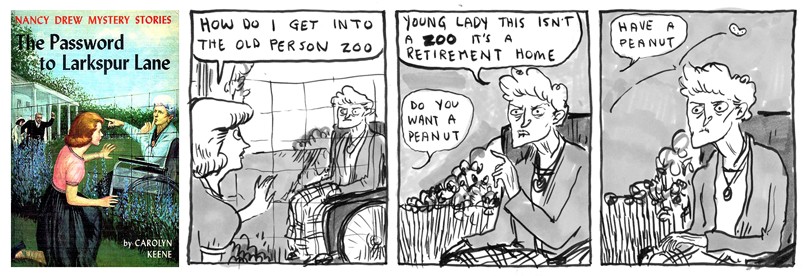
Kate Beaton interprets Nancy Drew book covers in her own unique way at Hark! A Vagrant.

And finally…

Kevin Huizenga has posted his head-spinning Glenn Ganges comic ‘Time Travelling’ at What Things Do.

1 Comment