Skip to content

Tag: ursula k le guin

The Fantastic Ursula K. Le Guin

illustration Essy May

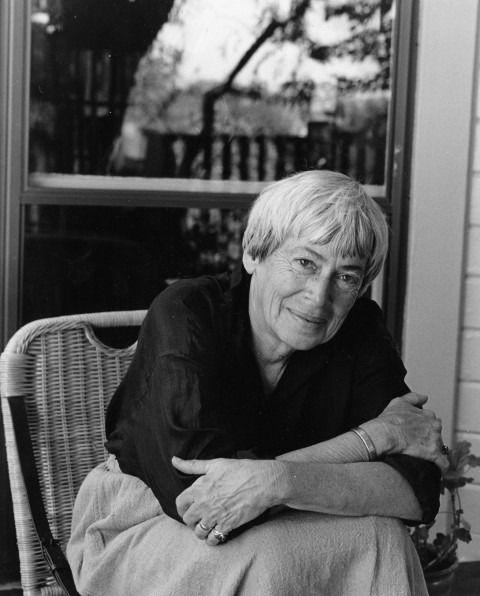
Julie Phillips long profile of author Ursula K. Le Guin for The New Yorker is wonderful:

Starting in the nineteen-eighties, [Le Guin] published some of her most accomplished work—fiction that was realist, magic realist, postmodernist, and sui generis. She wrote the Borgesian feminist parable “She Unnames Them,” and in 1985 an experimental tour de force of a novel, “Always Coming Home.” She produced “Sur,” the epic tale of an all-female Antarctic exploring party that may be her greatest and funniest feminist statement. Her short stories began appearing in The New Yorker, where her editor, Charles McGrath, saw in her an ability to “transform genre fiction into something higher.”

In fact, it was the mainstream that ended up transformed. By breaking down the walls of genre, Le Guin handed new tools to twenty-first-century writers working in what Chabon calls the “borderlands,” the place where the fantastic enters literature. A group of writers as unlike as Chabon, Molly Gloss, Kelly Link, Karen Joy Fowler, Junot Díaz, Jonathan Lethem, Victor LaValle, Zadie Smith, and David Mitchell began to explore what’s possible when they combine elements of realism and fantasy. The fantasy and science-fiction scholar Brian Attebery has noted that “every writer I know who talks about Ursula talks about a sense of having been invited or empowered to do something.” Given that many of Le Guin’s protagonists have dark skin, the science-fiction writer N. K. Jemisin speaks of the importance to her and others of encountering in fantasy someone who looked like them. Karen Joy Fowler, a friend of Le Guin’s whose novel “We Are All Completely Beside Ourselves” questions the nature of the human-animal bond, says that Le Guin offered her alternatives to realism by bringing the fantastic out of its “underdog position.” For writers, she says, Le Guin “makes you think many things are possible that you maybe didn’t think were possible.”
Comments closed

Ursula K. Le Guin | Writers & Co.

Author Ursula K. Le Guin talks to Eleanor Wachtel about writing, science fiction and short stories in this archive interview for CBC Radio show Writers & Co. from 1993:

CBC Radio Writers & Co: Ursula K. Le Guin 

At the end of the interview, Le Guin reads her short story ‘Crosswords’ from the collection Searoad.

(image: Copyright © by Marian Wood Kolisch)

Comments closed

Something for the Weekend

A two-part interview with Chris Ware, author of Jimmy Corrigan: The Smartest Kid on Earth,  in The Comics Journal:

I just wanted to make a comic book that had a bit of density to it, and build on the cartoonists whose work I really deeply admire. I could list hundreds of cartoonists whose work I’ve stolen from, and I try to acknowledge them all, so I just wanted to make a book that didn’t lie, as much as I could.

Part One | Part Two.

And, designer Eric Heiman on Chris Ware for Eye Magazine:

Ware’s aims are literary, not pragmatic. But his work is still a subtle reminder that no amount of order we – as designers or otherwise – impose on our lives can ever eliminate the unexpected twists and turns they take. Quantitative data, no matter how clearly and beautifully presented, is not always the know-all, end-all answer, even in this age of Google analytics.

The Literarian — The new online journal for The Center for Fiction.

Science Fiction Lesson – Author Ursula K. Leguin talks about writing and science fiction with Owen Bennett Jones for the BBC World Service.

Split Personality — Author John Banville on author Benjamin Black in The Boston Globe:

I do a Benjamin Black in the spring and early summer. I hate summer so this is a wonderful excuse to sit in my room and pound away at a crime book. I write those quickly on the computer, in three to four months. What I want from Benjamin Black is spontaneity; John Banville writes in longhand with a fountain pen. I can’t do them both at the same time. Banville was never much interested in character, dialogue, and plot, and Black is entirely character and dialogue and plot. With the crime novels, it’s delightful to have protagonists I can revisit in book after book. It’s like having a fictitious family.

And finally…

A neat animated trailer for the documentary Waiting for “Superman”:

Comments closed

Midweek Miscellany

Designers & Books — A beautiful new site compiling lists of books that designers identify as “personally important, meaningful, and formative.” Nice.

Rules Are What Make You — Michael Bierut at Designer Observer on his modernist upbringing at Vignelli Associates:

The rules weren’t written down anywhere or even explicitly communicated. They were more like unspoken taboos. Using Cooper Black, like human cannibalism or having sex with your sister, simply wasn’t done. For many young designers in the studio, the rules were too much. They resisted (futilely), grew restless (eventually), and left. By staying, I learned to go beyond the easy-to-imitate style of Helvetica-on-a-grid. I learned the virtues of modernism.

Thoughts on Design — The legendary George Lois at 10 Answers

When I was 14, aspiring to be a designer, 26 year-old Paul Rand published his iconic book, THOUGHTS ON DESIGN. My copy of it, bought, dime by dime with tip money delivering flowers all over the five boroughs for my fathers florist shop, remains the most important book in my library of over 10,000 art books. It’s thread-bare condition is witness to my reading, and memorizing, his revolutionary approach to the creation of communicative design.

Autodestruct — Author Ursula K. Le Guin reviews Monsieur Pain by Roberto Bolaño for The Guardian:

Surrealist narrative is a literary form at war with itself; disconnection is a primary tactic of surrealism, and story is a process of making connections, however unexpected. Readers open to the autodestructive element of modern art may find the surrealist devices in Monsieur Pain more deeply engaging than coherent narrative. I find them curiously old-fashioned, overly cinematic, and all too close to self-parody. But this early Bolaño novel has a moral and political urgency that obliges me to accept its noir banalities. Its tortuous method of approaching the unspeakable reveals the face of evil without glamorising it, as popular literature and film so often do. By indirection it avoids collusion.

And finally…

A stop motion digital magazine cover by Adam Voorhes and Will Bryant for Bluetooth’s publication Signature:

(via DesignWorkLife)

Comments closed

Monday Miscellany

Kitsune Noir Poster Club — Artists Frank Chimero, Mark Weaver, Jez Burrows, Cody Hoyt and Garrett Vander Leun reinterpret their favourite books as prints for Kitsune Noir . (Frank Chimero’s Slaughterhouse Five is pictured above).

And on the subject of posters…

Penguin US have made the jacket art from Graphic Classic Editions of Moby Dick and White Noise, designed by Tony Millionaire and Michael Cho respectively, available as posters.

From Trolls to Truth — Author Ursula K Le Guin reviews Tove Jansson’s The True Deceivers (available in the US from NYRB Books) for The Guardian:

On the patronising assumption that books for children are nice, ie morally bland and stylistically infantile, critics, reviewers and prize juries often dismiss those who write them as incapable of writing seriously for adults… Anyone familiar with Jansson knows it would be unwise to dismiss her or patronise her work on any grounds. Her books for children are complex, subtle, psychologically tricky, funny and unnerving; their morality, though never compromised, is never simple. Thus her transition to adult fiction involved no great change. Her everyday Swedes are quite as strange as trolls…

Quote/Unquote Bookends designed by Eric Janssen (via SwissMiss).

And lastly…

In my total blogging tardiness, Bookslut (inevitably) beat to the punch on this, but Simon Reynolds column on the music of the decade for The Guardian has so much resonance for books and the book industry:

“The fragmentation of rock/pop has been going on as long as I can remember, but it seemed to cross a threshold this decade. There was just so much music to be into and check out. No genres faded away, they all just carried on, pumping out product, proliferating offshoot sounds. Nor did musicians, seemingly, cease and desist as they grew older; those that didn’t die kept churning stuff out, jostling alongside younger artists thrusting forward to the light. It’s tempting to compare noughties music to a garden choked with weeds. Except it’s more like a flower bed choked with too many flowers, because so much of the output was good. The problem wasn’t just quantity, it was quantity x quality. Then there was the past too, available like never before, competing for our attention and affection. The cheapness of home studio and digital audio workstation recording, combined with the wealth of history that musicians can draw on and recombine, fuelled a mushrooming of quality music-making. But the result of all this overproduction was that “we” were spread thin across a vast terrain of sound.”

(Update: links to Tove Jansson’s The True Deceiver added)

Comments closed