Skip to content

Tag: Toronto

Bruce Mau and the Problems of Success

“Most of the problems we are facing are the problems of success, not failure.”

Canadian designer Bruce Mau, author of Massive Change, talks about sustainability and framing the issue positively with Jeanne Park of the PBS show Need to Know.

When asked which approach — carrot or stick — is more the effective way to change people’s habits,  Mau replies, “I think you have to paint the stick orange”:

(via Bookslut)

Comments closed

Something for the Weekend

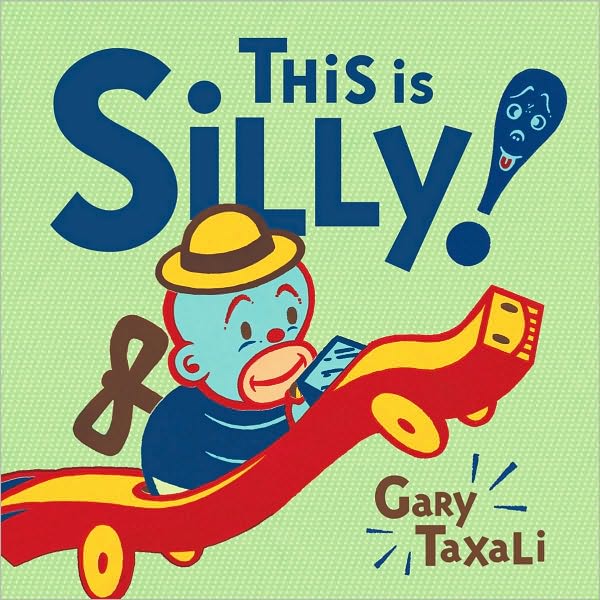
Sadly I missed the book launch earlier this week, but Toronto-based artist and illustrator Gary Taxali talked to the Torontoist and The National Post about his new kids book This is Silly!. You can see more of Taxali’s amazing book covers here.

ArtifactsMaximus Clarke has a fascinating conversation with William Gibson about his new novel Zero History :

I reach instinctively for something without knowing why, and place it in the narrative, and if it strikes a resonant chord with me, I’ll leave it there… But I myself have wondered why I do that — why I depict a universe of man-made objects, with people walking among them (laughs). My best answer is that it’s the way I perceive things. And I also suspect that the narratives of objects are more available to us when the objects themselves have become slightly decrepit. So I think my interest in old things, and worn things, isn’t about nostalgia in any conventional sense; it’s about the revelation of the narrative of how that object came to be in the world, and what it once might have meant to someone.

And on a somewhat related note, an interview with J.G. Ballard from the Winter 1984(!) issue of The Paris Review:

I would say that I quite consciously rely on my obsessions in all my work, that I deliberately set up an obsessional frame of mind. In a paradoxical way, this leaves one free of the subject of the obsession. It’s like picking up an ashtray and staring so hard at it that one becomes obsessed by its contours, angles, texture, et cetera, and forgets that it is an ashtray—a glass dish for stubbing out cigarettes.

The Black Arts — Book cover designers discuss their devious techniques for winning a clients approval with Peter Mendelsund and Peter Terzian:

Yes, a good design should speak for itself—but what if the client isn’t listening? Well, that’s when designers employ methods that are not taught in design school. Psychological methods. Machiavellian methods. Used-car-dealer methods. Manipulation. Intimidation. Seduction.

The PDF is here.

And Peter T has clearly been busy. The editor of Heavy Rotation: Twenty Writers on the Albums That Changed Their Lives has an article on books about album cover art at BookForum.

And finally (and on the subject of music)…

Finding Our WayRadiohead bassist Colin Greenwood reflects on the digital “pay what you think it’s worth” release of their album In Rainbows in 2007  and the band’s distribution options for their new songs:

I buy hardly any CDs now and get my music from many different sources: Spotify, iTunes, blog playlists, podcasts, online streaming – reviewing this makes me realise that my appetite for music now is just as strong as when I was 13, and how dependent I am upon digital delivery. At the same time, I find a lot of the technology very frustrating and counter-intuitive. I spend a lot of time using music production software, but iTunes feels clunky. I wish it was as simple and elegant as Apple’s hardware. I understand that we have become our own broadcasters and distributors, but I miss the editorialisation of music, the curatorial influences of people like John Peel or a good record label. I liked being on a record label that had us on it, along with Blur, the Beastie Boys and the Beatles.

(via Subtraction)

Comments closed

Spirit City Toronto

Combining  illustration and photography to depict homeless nature spirits who inhabit the forgotten corners of the city, there are shades of Hayao Miyazaki and Studio Ghibli in freelance illustrator Aaron Leighton’s lovely debut book Spirit City Toronto:

Spirit City Toronto is published by Koyama Press, and Books@Torontoist have just posted a two part interview with Aaron about the book.

(via Drawn!)

Comments closed

TypoElements 2010

A motion graphics tribute to Robert Bringhurst’s book The Elements of Typographic Style by Toronto-based Chris Kim, who is currently studying Radio & Television Arts at Ryerson University:

TypoElements 2010 won an Applied Arts 2010 Student Award.

4 Comments

Proust

Open Book Toronto recently asked me to complete their version of the Proust Questionnaire. They have posted my answers — which include recommendations for Memories of the Future by Sigizmund Krzhizhanovsky and Colony by Hugo Wilcken (more of which at a later date I think) — today.  Thank you OBTO!

Comments closed

Interview at Books@Torontoist

I was recently interviewed by James Grainger, book columnist and author of The Long Slide, as part of the Books@Torontoist Litblog Spotlight series. Assuming that you don’t have anything better to do, you can read it here.

Comments closed

Under the Covers: Reviewing the Covers of 2009

Tonight is the BPPA‘s annual review of the best and worst book covers of the year.

Sadly Alan Jones, Senior Designer at HarperCollins Canada, had to drop out at the last minute and is being replaced by Boy Wonder David A. Gee (interviewed here) and umm… me. No, I’m not quite sure what they were thinking either (about asking me — David is obviously a great choice)…

The other panellists are freelance designer Ingrid Paulson (also interviewed here), Terri Nimmo Senior Designer at Random House Canada, and Steven Beattie Review Editor at The Quill & Quire.

Panel moderator David Ward of McClelland & Stewart has promised me Jaffa Cakes.

The event is 6:30-8:30 pm at The Arts and Letters Club (3rd Floor) in Toronto. It’s free for BPPA Members, $20.00 for non-members apparently.

There’s more information on the BPPA’s event page.

3 Comments

BEC DOA

Book Expo Canada is in trouble.

The Canadian publishing trade show has been dogged by industry apathy and persistent complaints about high costs, low attendance, and a lack of paying customers for years. But the immediate need to cut costs in the face of the economic downturn — or, at least, see some kind of measurable return on investment —  has been the final straw for dissatisfied publishers.

Random House, Canada’s largest trade publisher, unilaterally withdrew from the event in November, and last week HarperCollins and Penguin — closely followed by  Scholastic Canada and H.B. Fenn & Co.  — announced that they would not be attending BEC in 2009 either.

Scheduled for June 19th-22nd at the Metro Toronto Convention Centre, organizers Reed Exhibitions initially said that it was still their intention to hold the annual convention even though Simon & Schuster was the only one of the “Big Four” multinational publishers committed to the ailing event.

Now it seems Reed may be reconsidering that decision after Random House’s recent announcement that they would be launching a new Toronto “literary and cultural” festival with the Globe and Mail in May —  one month before BEC.

With a high-profile media sponsor, and including events with crowd-pleasing luminaries such as Naomi Klein, Margaret MacMillan, Richard Florida, Pulitzer Prize nominee Ha Jin, and New Yorker columnist Adam Gopnik, the two day “Open House Festival” is clearly aimed at doing precisely what BEC has seemed so incapable of – bringing in paying customers and driving book sales.

More troubling for Reed is that the new festival means their latest initiative, the Toronto Book Fair, planned for the first weekend in October, will almost certainly be stillborn.

Details of the fair were unveiled earlier this month by John McGeary, Reed’s general manager for Canada.

Hoping to win over critics of Book Expo, McGeary outlined an “inclusive celebration of reading and literacy” akin to Salon du Livre. But hampered by a venue (the Direct Energy Centre) on the fringes of public transit, and scheduled for one of the busiest months in the publishing calendar, Reed’s plans disappointed the vast majority of the invited audience of independent booksellers and industry-types.

McGeary, relying heavily on his PowerPoint slides, struggled to articulate a coherent vision for a fair that nobody seemed to want, and was unable to substantially differentiate it from Word on the Street, the popular not-for-profit book festival taking place in downtown Toronto one week before the Reed event.

“We consider ourselves extremely different” was about the best McGeary could manage. “Yes”, a wag in the audience said, “Word on the Street is free and in Queen’s Park!” Touché .

The poor timing and location, combined with a breath-taking dearth of both imagination and logistical detail, makes it unsurprising that Random House and Penguin have already announced they will not be attending the new fair. And more publishers are sure to follow suit.

Reed — who are now, according to PW, reviewing all their dealings with the book industry in Canada — will no doubt blame the combined failure of BEC and the Toronto Book Fair on the crumbling economy and the mixed messages sent by fickle, selfish and duplicitous book industry players.

But Reed cannot entirely escape responsibility for their situation. They have consistently put the cart before the horse, planning events before they have identified a real need or purpose. This ‘build it and they will come’ attitude may have worked in the past, or perhaps elsewhere. Unfortunately Reed’s abortive attempt to make BEC more inclusive two years ago, the now infamous the Booked!, and the shortcomings of the trade show itself have seriously damaged their credibility in Toronto.

And Reed is guilty of simply trying too hard. Their efforts to be inclusive are laudable, and yet in trying please everyone, they inevitably please no one.

The book community in Toronto consists of authors, publishers, distributors, bookstores, libraries, readers, publicists, journalists, bloggers and more. Their interests conflict at least as often as they overlap, and one only needs to look at the finger-pointing and handbag-swinging caused by the high Canadian dollar last year to see that relations between publishers and booksellers, and booksellers and their customers, (not to mention the industry and the media), are fragile at best. People get upset. And they get over it. Reed has never quite seemed to grasp that to organise an effective event they will need to risk offending some people.

It is simply not fair to expect Reed to organise an event like BookCamp, or even Word on the Street. It would be impossible. But Reed could – and probably should – have organised an event like the Open House Festival. It should’ve been possible to work, initially at least, with one or all of the Big Four and a single retailer to kickstart something bigger and more inclusive. Random House’s understandable impatience has slammed that door  in Reed’s face, and, to be honest, it is hard now to see where they have left to turn.
Comments closed

Something for the Weekend, Jan 23rd, 2009

Big Mouth Strikes Again — The Friday Project’s charming Scott Pack interviewed at North Meadow Media:

people who have dealt with me directly are pleasantly surprised that I am not the complete cunt I am sometimes made out to be. I am a bit of an arse but not quite as bad as my press would suggest.

Books Unbound — author Lev Grossman’s (much linked to) thoughts on the evolution of publishing for Time magazine. Meh.

Unhappily ever afterThe Guardian’s Nick Laird  reviews Richard Yates’ Revolutionary Road, and asks is it “too good a novel to make a great film”?:

It is a solid and noble effort that succumbs to what should be a moral of literary adaptation: bad books can make great movies, but a great book hardly ever does. And though you can see what tempted the movie men – that great dialogue! those poignant characters! – with Yates it’s the sentences themselves that are truly panoramic, and no matter what you do, they’re going to get left behind.

That may all be true, but to be honest, the wayward casting in Sam Mendes film adaptation is so catastrophically contrary to the characters in my mind that I can’t bring myself to see it anyway.

BlogTO profile one of Toronto’s best independent bookshops Ben McNally Books. Lovely bloke that Ben McNally . BlogTO have profiles of other Toronto bookstores here.

Toronto gets another new literary festival. I can hardly contain myself.

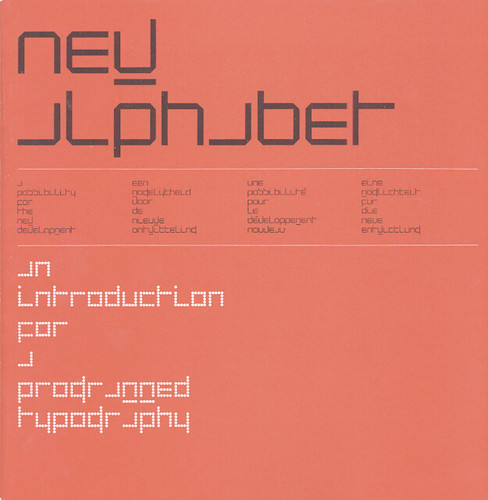
The message is the subject — Jenny Tondera interviews Dutch designer Wim Crouwel, creator of the ‘New Alphabet’ (pictured above and famously tea-leafed by Peter Saville for the album cover of Joy Division’s Substance), about the Bauhaus for Geotypografika. Jenny also interviews Michael Bierut, Experimental Jetset, Steven Heller, Paula Scher, Ellen Lupton, and Jessica Helfland.

2 Comments