Skip to content

Tag: tintin

Something for the Weekend

You’re All Just Jealous of My Jetpack — Tom Gauld has a Tumblr (The title is a reference to this of course).

Legacy Issues — Stephen Page, chief executive of Faber & Faber, writing at The Guardian:

Let’s deal with technological obsolescence. Media businesses are not technology businesses, but they can be particularly affected by technology shifts. I run a so-called legacy publishing house, Faber & Faber. Most of our business is based on licensing copyrights from writers and pursuing every avenue to find readers and create value for those writers. We are agnostic about how we do this. For our first 80 years, we could only do it through print formats (books); now we can do it through books, ebooks, online learning (through our Academy courses), digital publishing (such as the Waste Land app) and the web. Technology shifts have tended to result in greater opportunity, not less.

Bibliophiles in London — The Economist on The London International Antiquarian Book Fair:

Most interesting, perhaps, is the air of optimism—there is not the slightest whiff of gloom at the state of the book world. The internet, paradoxically, has made books “à la mode”, says Claude Blaizot of the Librarie August Blaizot in Paris, purveyor of first editions of “Tintin” and fantastically bound livres d’artiste. “It has brought people to books, and shown them booksellers they never would have known existed before,” he says. Clive Farahar, the Antiques Roadshow’s book specialist, agrees that technology has opened up the book trade, and made the world of books much more accessible to all. “It’s not just the dim little shop on the high street anymore,” he said. “We can learn so much now we never would have known before.”

Simplicity — A two-part interview with Apple designer Jonathan Ive at The Telegraph:

“Simplicity is not the absence of clutter, that’s a consequence of simplicity. Simplicity is somehow essentially describing the purpose and place of an object and product. The absence of clutter is just a clutter-free product. That’s not simple.”

(part two)

And finally…

Daniel Clowes at wired.com:

“Digital seems like such a step back from a printed book… For me, the whole process involves envisioning this book in my head as I’m working. That is what I’m trying to create. That’s the work of art. That’s the sculpture I’m chipping away at, and when I’m finally done, I will arrive at that perfect 3-D object. The iPad version would be like a picture of the book, which doesn’t hold any interest at all for me. Even if I only had 10 readers, I’d rather do the book for them than for a million readers online.”

Comments closed

Something for the Weekend

Adrift in the World — Tim Parks on fiction and place for the NYRB Blog:

If there is a problem with the novel, and I’m agreed with [David] Shields that there is, it is not because it doesn’t participate in modern technology, can’t talk about it or isn’t involved with it; I can download in seconds on my Kindle a novel made up entirely of emails or text messages. Perhaps the problem is rather a slow weakening of our sense of being inside a society with related and competing visions of the world to which we make our own urgent narrative contributions; this being replaced by the author who takes courses to learn how to create a product with universal appeal, something that can float in the world mix, rather than feed into the immediate experience of people in his own culture.

The Degree-Zero of Typeage — The “un-Google-able” Jenny Hendrix on Tintin for LA Review of Books:

Hergé himself described Tintin as the “degree-zero of typeage — a typographic vanishing point.” The formulation suggests Samuel Beckett, and there is indeed something Beckettian about Tintin. In French, appropriately, the phrase “faire tintin” means something approximating “to go without” or “to be frustrated.” Tintin may be a reporter, motivated, like any good journalist, by the hint of a good story, but only in his very first of his 24 adventures does he actually file copy. He was born 15, and supposedly stays that way, though it is hard to imagine he’s any age at all. He has no last name, no parentage and no past, no desires and no sexual identity. Even his appearance has little to say about him: his face is just a circle, with two black dots for eyes and a black, semi-circular wedge of mouth. He could be anyone, and frequently is…

Super-Punch — The New York Times reviews ‘Printing for Kingdom, Empire & Republic: Treasures From the Archives of the Imprimerie Nationale’, an exhibition of historical steel punches, copper matrices, and typefonts at the Grolier Club in New York:

[T]hese exquisite artifacts… offer a reminder, in the ethereal era of bitmapping, that type was once the tangible province of engravers and metal casters who labored in unforgiving but enduring media. To make a C with a cedilla, for example, involved a lot more effort and thought than holding down the Option key on your Mac. A comma-shaped steel appendage had to be lashed with string to the bottom of the C punch to produce a new matrix.

“People are practically printing books with their smartphones,” Mr. Fletcher said, in a tone suggesting that he did not think this was such a good idea. “It’s much more gratifying to be able to touch something and find out it’s real, rather than a matter of bits and bytes.”

Comments closed

Midweek Miscellany

Kate Beaton’s Wonder Woman returns.

Five-Pointed Stars of Pain — An excellent post on Dan Clowes and his latest book The Death- Ray at The Brooklyn Rail:

Clowes engaged themes consistent with those of literary fiction in visual terms and in bookstore-friendly formats, and he was not alone. By the turn of the millennium there emerged a critical mass of graphic novels ready to join Maus on the shelves of bookstores and libraries, and some far-sighted publishing insiders took notice. Chief among them was Chip Kidd, the acclaimed book designer for Knopf who also consulted on a handful of comics projects at Pantheon… Kidd perceptively encouraged Pantheon to make a stronger commitment to the comics form, and in late 2000 the publisher debuted two books: Chris Ware’s Jimmy Corrigan: The Smartest Kid on Earth and Clowes’s David Boring.

Ware’s critically lauded book, originally serialized in his Acme Novelty Library series, somewhat overshadowed Clowes’s deadpan investigation into lust and obsession. But the simultaneous publication of these two works by a major publisher made an unmistakable statement: a generation of cartoonists laboring in obscurity had come of age.

A Complicated Life — Los Angeles Times television critic Robert Lloyd on Tintin creator Hergé:

Hergé had left orders that, after his death, Tintin would go no more a-roving. That is not how it is with many fictional characters — or “properties” as they are sometimes called, perpetually prey to the whims of whoever holds the deed. James Bond has long outlived every thing Ian Fleming ever thought to do with him; a single comic-book hero may be the work of any number of cooks, prepared for a range of readers in a variety of flavors, from plain vanilla to something laced with rum, coke or Lithium. But Tintin without Hergé is as unthinkable — or if thinkable, still as wrong — as Charlie Brown without Charles Schulz.

Good Manners — Lorien Kite, the Financial Times’s books editor, has lunch with bookseller (and now managing director of Waterstone’s) James Daunt:

He was recently quoted as having referred to Amazon as “a ruthless money-making devil” that did not operate in the consumer’s interest – comments that generated an angry response in some quarters. Playing devil’s advocate, I ask: isn’t it up to consumers to decide what is more important, the price or a congenial experience? “I wouldn’t disagree with that at all,” he says. “Oddly enough, completely contrary to that headline, I genuinely don’t feel sorry for myself. As long as I deliver something that people enjoy, I’ll be fine.”

And finally…

Alice Rawsthorn on graphic designer Robert Brownjohn for The New York Times:

Talented though he was, Brownjohn’s contemporaries knew him as much for his decadent lifestyle as for his work. Charming and gregarious with a flair for grand gestures, he was haunted by drug addiction. As his friend, the British graphic designer Alan Fletcher, once wrote: “He had real charisma rather than character. You always knew he was about five jumps ahead of whatever you were thinking…”

A few years after his arrival in London, Fletcher arranged for him to talk to a group of designers. Brownjohn spoke lucidly but looked fragile and, at times, struggled to stay awake. An architect in the audience asked: “What is graphic design?” Brownjohn replied: “I am.”

(NB: Posting will probably be a bit sparse here from now until mid-January, so just reminder that there’s also The Accidental Optimist, The Casual Optimist Tumblr and Facebook which will be updated more frequently).

Comments closed

Jeet Heer on Tintin

Canadian cultural critic Jeet Heer had a great piece on Tintin in Saturday’s  Globe and Mail:

Hergé belongs to the noble line of boys’ books and thrillers that includes Robert Louis Stevenson’s Treasure Island, John Buchan’s The 39 Steps, Rudyard Kipling’s Kim and Anthony Hope’s The Prisoner of Zenda… This is largely a literary tradition, but Hergé brought to it his special skill set as a visual artist. More than any other cartoonist of his era, he was attuned to the modernist revolution in the arts. Once he was wealthy, he became a discriminating collector, buying works from Joan Miró, Serge Poliakoff and other painters. Trained to see by the great modernists, Hergé applied to his cartooning an aesthetic of purification: He struggled to distill each image to the bare minimum of lines needed to convey physical information.

Comments closed

Monday Miscellany

As mentioned earlier, I was in Vancouver last week and I wasn’t able to post as regularly as I would have liked to. So to make up for Friday’s missing links, here are a few things of interest to start the week off…

Adrian Tomine (Shortcomings) discusses his latest work, Optic Nerve #12, and an unfinished graphic novel with Comic Book Resources:

When I finally sat down to work on my next comics project, I felt obligated to attempt a real “graphic novel.” I was looking at these giant tomes that some of my peers were working on, and I felt really envious of that kind of achievement. It also just seemed like that was the direction everything was moving in, and my old habit of publishing short stories in the comic book format was already an anachronism. So I pursued that for awhile, doing a lot of the kind of preparatory work which is actually the hardest part for me, and the whole time I had these nagging thoughts like, “Do I really want to work on this for ten years? Do I want to draw and write in the same way for that long? Does the material really merit that much of an investment?”

Hard Won — Yet another review for MetaMaus in The New York Times:

Spiegelman recalls the struggles of researching “Maus” at a time before scholarship was widely available to a mass audience. Pre-Internet, he depended on his parents’ collection of pamphlets written and drawn by survivors, and on research visits to Poland. On his second trip to Birkenau, in 1987, Spiegelman was baffled to find a perfectly preserved barracks where once there had been only rubble; it turned out to be a re-creation built for a Holocaust movie, left standing by Polish authorities because it looked accurate. He admits he was jealous of the moviemakers’ unlimited resources, when “every scrap of information I needed for ‘Maus’ was so hard-won.”

With It — Michael Farr, author of Tintin: The Complete Companion, talks about Tintin and discusses five books related to Herge and his creation at The Browser:

If you didn’t meet Hergé, you wouldn’t realise how funny he was – he saw the humorous side of almost everything. He was visually terribly aware, he didn’t miss anything which he saw. He was in his seventies then and I was in my mid-twenties, and I think that’s the reason why he agreed to see me. Younger, a French-speaking British journalist, I was slightly exotic and that intrigued him. Hergé was terribly young for his age. To use an expression that was used more then than now, he was very “with it”. When we got talking about music, he asked me what my favourite Pink Floyd songs were.

You see all this in the books. In many respects, Hergé is Tintin himself.

See also: Hal Foster, art critic and author of The First Pop Age (i.e. not THAT Hal Foster), on pop art at The Browser.

And finally…

Art critic Robert Hughes on his first visit to Rome, excerpted from his new book about the city, in The WSJ:

It was being gradually borne in on me by Rome that one of the vital things that make a great city great is not mere raw size, but the amount of care, detail, observation and love precipitated in its contents, including, but not only, its buildings. And it goes without saying, or ought to, that one cannot pay that kind of attention to detail until one understands quite a bit about substance, about different stones, different metals, the variety of woods and other substances—ceramic, glass, brick, plaster and the rest—that go to make up the innards and outer skin of a building, how they age, how they wear: in sum, how they live, if they do live.

Comments closed

Midweek Miscellany

On Record — Rick Poynor at Design Obsever waxes all lyrical about Continuum’s 33 1/3 music series:

The best 33 1/3 titles… have an urgent personal mission, even obsession, and they tunnel deep down into an album’s defining moment and milieu: dark sixties Los Angeles in Forever Changes, isolated seventies Berlin in Low, creative nineties Athens, Georgia in In the Aeroplane over the Sea… Usually around 30,000 words, these detailed studies are hugely challenging to research and write. Continuum has let it be known that a batch of previously announced titles has been canceled after initial high hopes: the authors just couldn’t deliver.

Movies on Paper — Tom McCarthy, author of Tintin and the Secret of Literature (as well as Remainder and C), reviews Steven Spielberg’s The Adventures of Tintin: The Secret of the Unicorn:

Tintin was always premised on a set of implicit borrowings and relocations from one medium to another. Hergé’s earliest strip-cartoons were billed as “movies” on paper; creatively, he was as indebted to the films of Buster Keaton and Harold Lloyd as to the novels of Jules Verne or the illustrated poems of Benjamin Rabier (which, long forgotten now, featured a tuft-headed boy called Tintin-Lutin and his dog). Hergé’s remarkable achievement with the Tintin series was to pluck all these elements from their original contexts and join them together, holding them in perfect equilibrium, in a new, hybrid format whose conventions (speech-bubbles joined with left-to-right action, for example) he established in the very act of assembly.

McCarthy loathes the movie by the way.

See also: Nicholas Lezard getting really quite upset about it.

(If you’re wondering why the British are so bothered by the Speilberg’s movie, my take on it is that we view Tintin as an eccentric, quintessentially British hero — not unlike T.E. Lawrence — rather than a Belgium one, and Spielberg is well… just so American. Or it might just be a shit movie.)

And finally…

Gum-Chewers of the World (Unite and Take Over) — Canadian cartoonist Seth on being awarded the Harbourfront Festival Prize at the International Festival of Authors in Toronto:

I’ve always believed the comics medium was capable of genuine subtly and grace and complexity… and of telling stories that would appeal to an adult mind. Stories that reflect real human experience. That said, it didn’t look too likely that the literary world or the art world…or even the mainstream pop culture was likely to cut the comic book much slack. Comics were considered entertainment for the gum-chewers of the world. Kid junk at worst – nerd culture at best.

Comments closed

Q & A with Jason

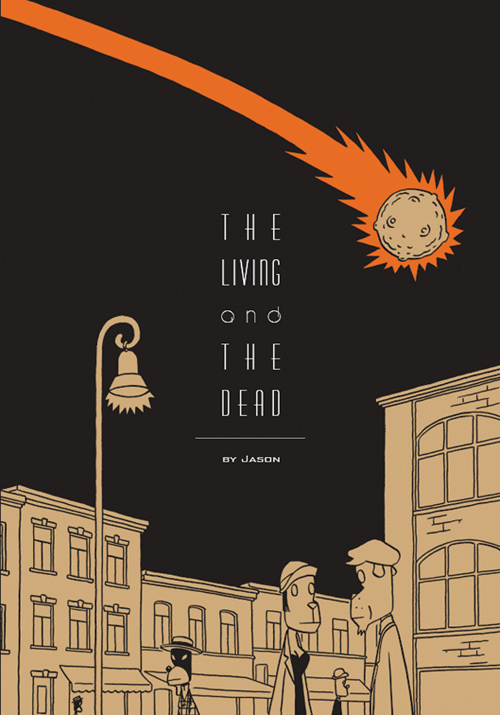
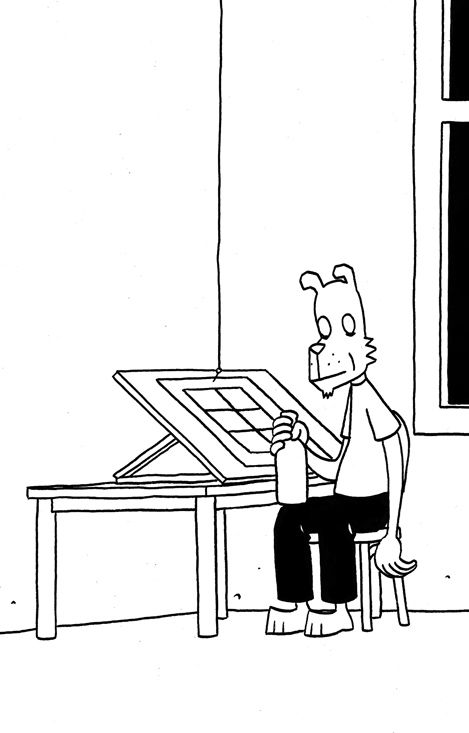
I’ve written about Norwegian cartoonist Jason for The Casual Optimist before and his work appears here with unerring regularity — if you are a frequent reader you are no doubt already familiar with it.

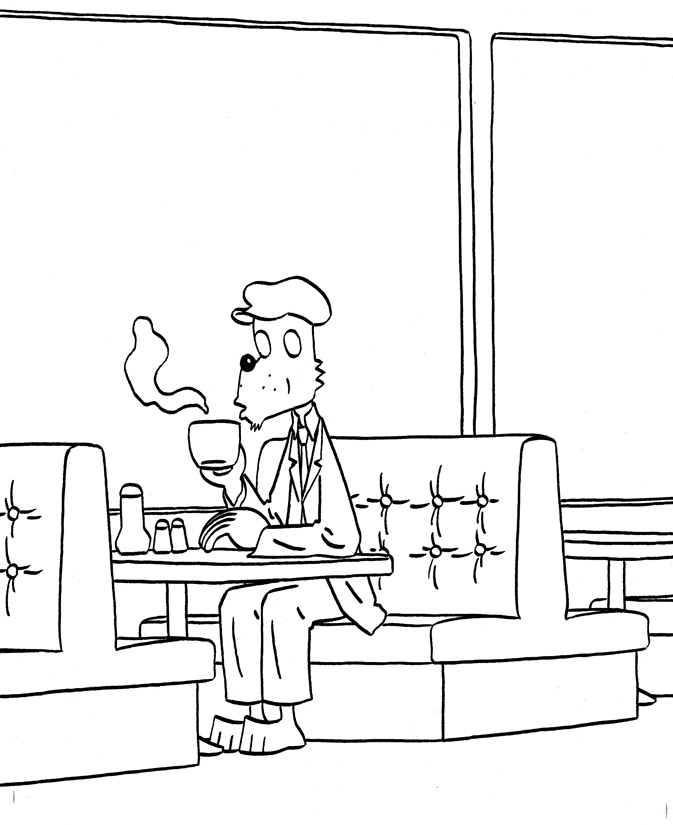
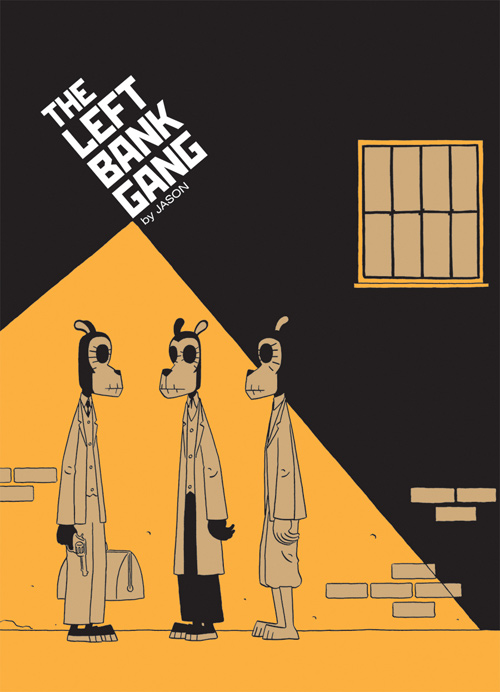
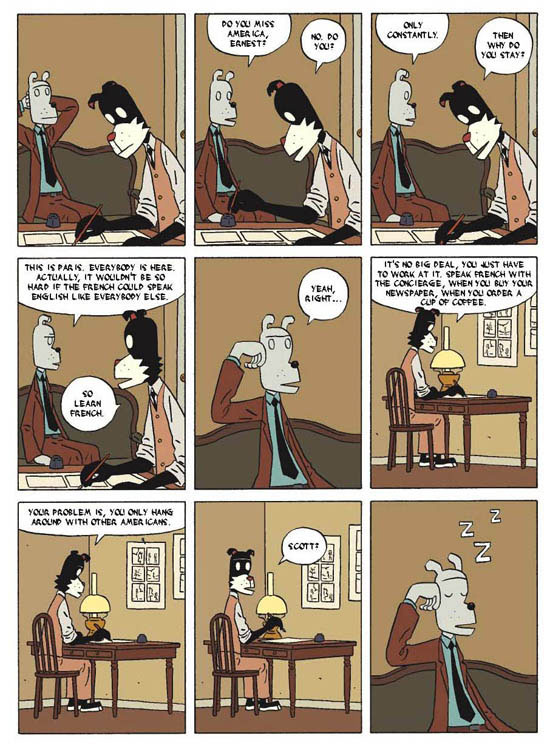
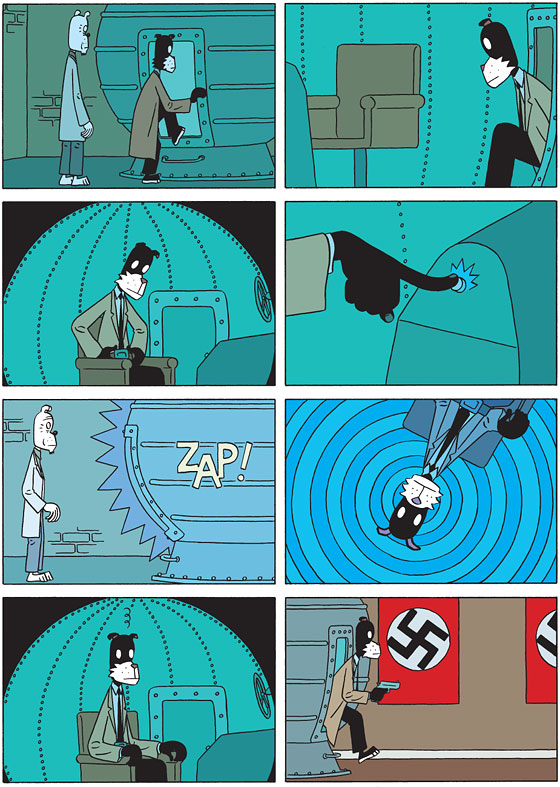
Like British cartoonist Tom Gauld who I interviewed early this year, Jason’s comics are immediately identifiable. You cannot mistake them for the work of someone else. And again, like Tom, Jason’s work references both the pop and the high-brow: zombies and werewolves on the one hand; Hemingway and the Beats on the other. The result is both original and off-beat. His protagonists are like renegades from a Max Fleischer cartoon who’ve inadvertently wandered into a Jim Jarmusch movie… Anthropomorphic animals smoking cigarettes, drinking coffee, talking about French actresses. Action and slapstick wrestle with ennui and loneliness.
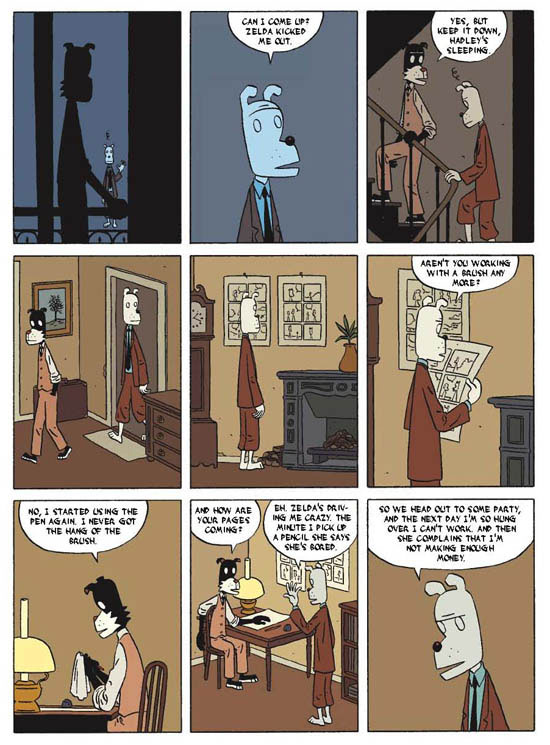
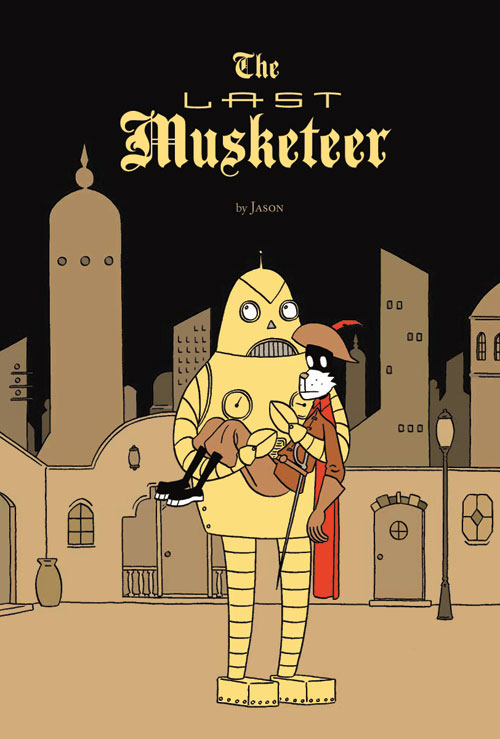
Jason, whose work has been translated into Swedish, Spanish, German, Italian and French, currently lives in Montpellier, France. He was kind enough to talk to me in English. His new short story collection Athos in America will be published in December by Fantagraphics.
 

When did you first start drawing cartoons?

Around age 13, I guess. And then at age 16 I started selling cartoons and one page strips to a Norwegian humour magazine. I did that through high school.

Did you always want to be a professional cartoonist?

No, it was a hobby. To become a cartoonist in Norway was not much of an option. I went to art school to become an illustrator, but my career never took off, so I kept doing comics. I met other cartoonists in Oslo, there was sort of a little scene. And then I moved to France to be closer to the French comic book industry. I did books that were translated into English, French plus some other languages, and the last seven or eight years I’ve been able to have an income almost exclusively from doing comics.
How did you become involved with your US publisher Fantagraphics?

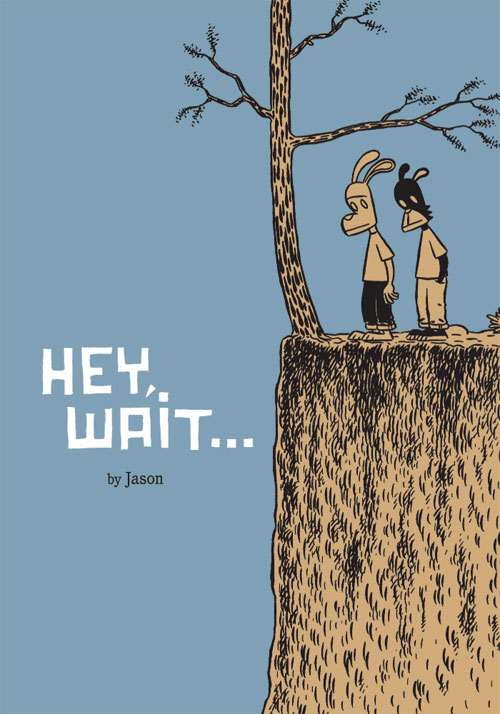
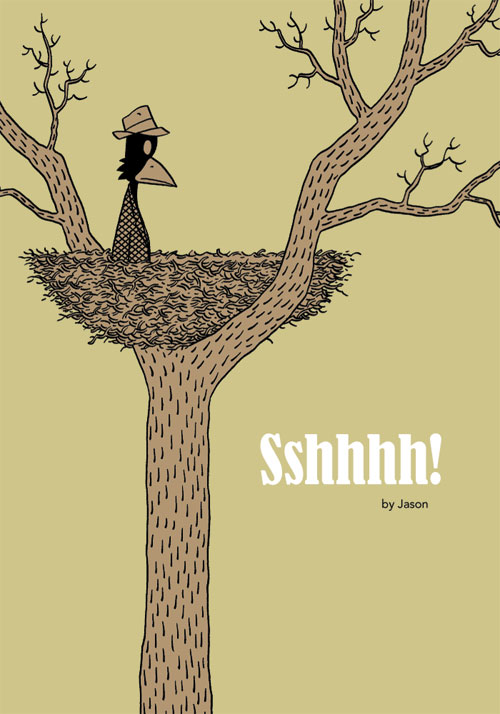
We sent — that is me and my Norwegian publisher, Jippi — we sent Hey, Wait… to Fantagraphics. I’m still not quite sure if Kim Thompson read our submission or if he had already read the French version, but anyhow, they decided to publish the book, and then later Shhh! And The Iron Wagon. And for some strange reason, the books seem to sell okay, so I’m still published by them. [Hey, Wait…, Shhh! and The Iron Wagon are collected in the book What I Did]
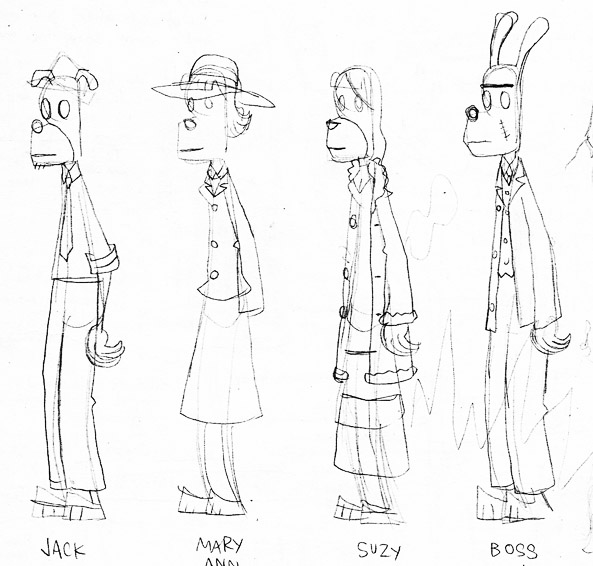
Briefly, could you describe your working process?

I have ideas in my brain, just lying there, that I sometimes think about. This can last years. Then suddenly I can get ideas for dialogues. I write this down. It’s maybe four or five pages. I can start working on those, and at the same time think about what’s going to happen next. I don’t write a full script. It’s based on improvisation. I write pieces of dialogue. Or sometimes I sketch out the pages first, the images, and write the dialogue after. I usually work on nine or ten pages at the same time, pencil a bit here , then ink it, and then pencil a bit there and ink that. It’s the completely wrong way of doing it, by the way, but it seems to be the only way I can work.
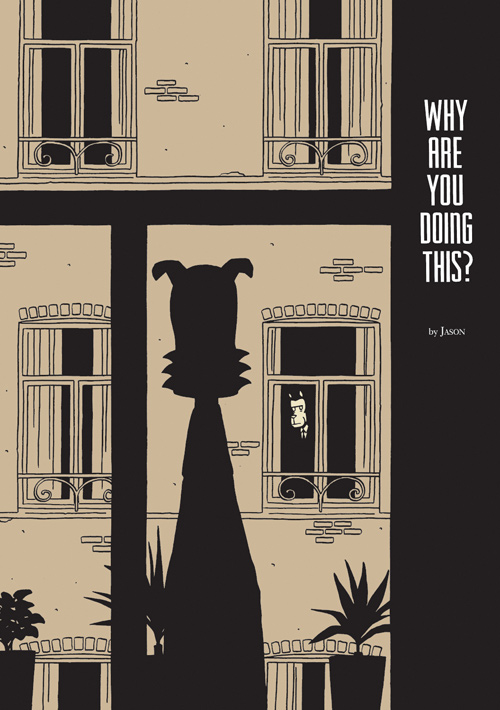
Your work often references classic movies. What are some of your favourite films?

How much room do you have? I like Fred Astaire and Ginger Rogers films, film noir, Brian De Palma, John Ford, especially The Searchers and Howard Hawks, especially Rio Bravo, Buster Keaton, Laurel and Hardy. Paris, Texas, Down by Law, Animal House, Blues Brothers, Fanny and Alexander, Five Easy Pieces, The Last Picture Show, Miller’s Crossing, Roman Holiday, On The Waterfront, Life of Brian. Days of Heaven by Terrence Malick is probably my favourite film.
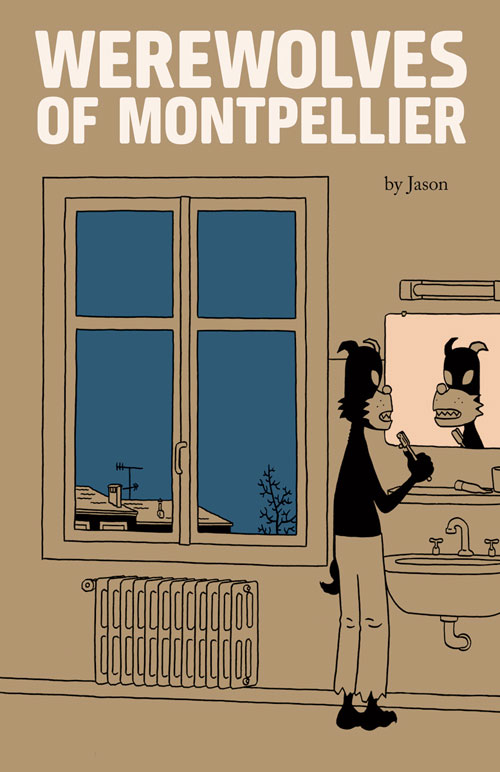
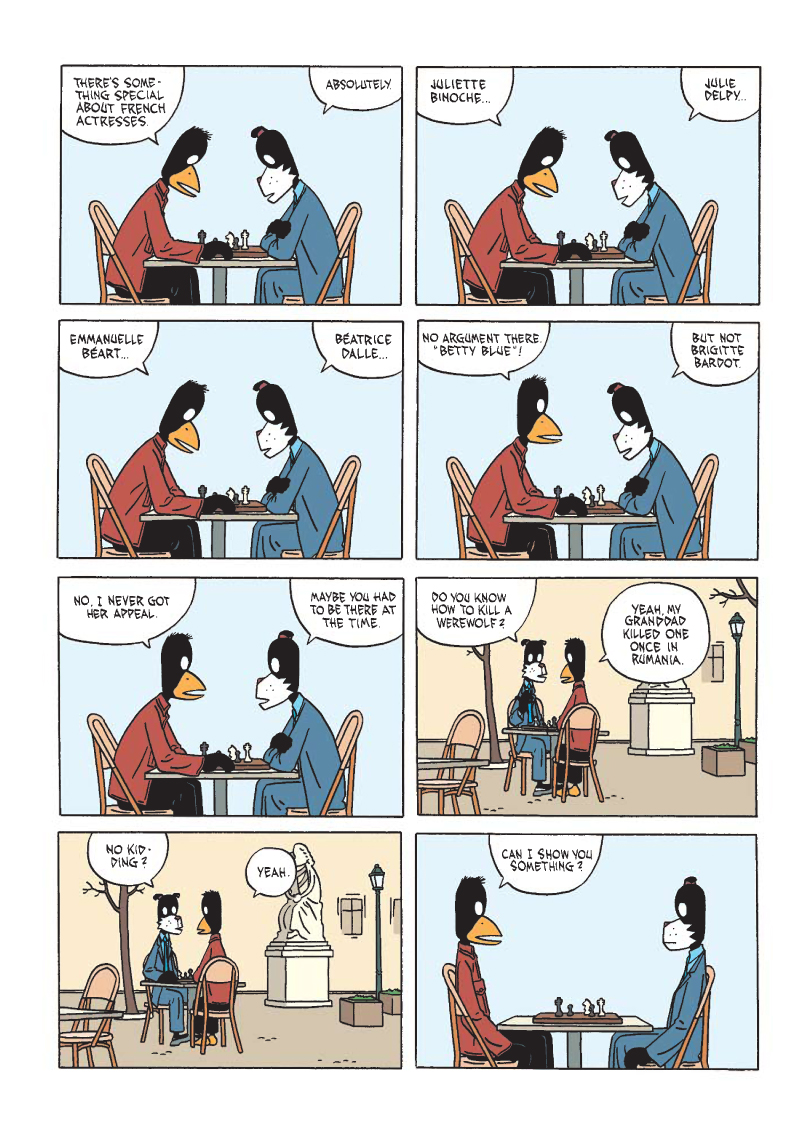
In your recent book Werewolves of Montpellier, one of the characters says they don’t understand the appeal of Brigitte Bardot. Really?

Yes, really! What, you like her? She just looked a little stupid to me. I find Catherine Deneuve a lot more appealing, or Emmanuelle Beart and Julie Delpy to stick with French actresses.
You recently post a list of your 5 favourite Tintin books. Has Hergé been an influence on your work?

Yes, very much so. It was one of the first cartoonists that appealed to me. I borrowed his albums at the library as a kid. I started drawing my own cartoons. And I think you can have a much worse teacher than Hergé. It’s not really the clear line that is the most important thing, even if that is part of what I like with him, it’s more the very clear storytelling that you find in his books. On page three you’re hooked. I think you can read his books in a foreign language, in Russian, and still understand the story and enjoy it. I don’t re-read the books that often, but I often take them out, my favourite albums like The Broken Ear and The Shooting Star, and just look at the drawings.

What do think about the new Steven Spielberg adaptation?

I’ve only seen the trailer. It doesn’t look that bad. I don’t want to just completely rule it out, like its a sacrilege and that Spielberg has no right to adapt Hergé. Not sure about the computer animation, but the original plan was apparently live action with a computer animated Terry [Milou/Snowy], and I think I really would have hated that. And the European animation films, based on each album, are just terrible. Everything that is exciting and funny in the albums are completely lost in the animation films. So I don’t think the Spielberg film can be any worse.
Who are some of your other creative heroes?

Jim Jarmusch, Hal Hartley, Wes Anderson, Aki Kaurismäki. Jaime Hernandez, Jim Woodring, Daniel Clowes, Chester Brown.

Who else do you think is doing interesting work right now?

There are two Argentinian cartoonists I like, Liniers and Pablo Holmberg. The French cartoonist Christophe Blain. Calef Brown’s children books. I like the Mutts books by Patrick McDonnell. I’m not sure if it’s necessarily «interesting», but I find them appealing. It’s like the last, good newspaper strip. I like the old newspaper strip collections: Captain Easy, Prince Valiant, Little Orphan Annie, Gasoline Alley.
What books have you read recently?

This summer I read The Selected Letters by Jack Kerouac, Off The Road by Carolyn Cassady. I tried to read The Subterraneans by Kerouac, but gave up. I read Chronicles by Bob Dylan, Positively 4th Street by David Hadju and A Freewheelin’ Time by Suze Rotolo. I also read Dave Van Ronk’s memoirs, The Mayor of MacDougal Street, so I look forward to the new film by the Coen brothers, based on his life. What else? Blood Meridian by Cormac McCarthy, Last Night in Twisted River by John Irving and Freedom by Jonathan Franzen. I’m currently reading Volume 1 in The Letters of Ernest Hemingway.
What are a few of your favourites books?

Well, Hemingway. The Sun Also Rises and A Farewell to Arms, his short stories. Bukowski, mostly his novels, but I’ve also started reading his poetry. Raymond Carver and Tobias Wolff. Lorrie Moore, her short stories. Kelly Link. There’s a British writer I like, Rupert Thomson. John Fante, especially Ask The Dust, John Steinbeck, especially East of Eden and Grapes of Wrath, Cormac McCarthy, especially The Road and No Country for Old Men. Raymond Chandler and other old pulp writers like Charles Willeford and David Goodis. I like Elmore Leonard. Paul Auster. John Irving. Every four or five years I re-read Cider House Rules, Garp and Hotel New Hampshire.

Are there any stories you would like to illustrate?

Yes, there are one or two books I’d like to adapt to comics. But I’ll probably wait until I’ve run out of ideas myself.
Do you worry about the future of books and print?

No. I don’t know. The bike didn’t disappear when the car came. There are hopefully room for both books and electronic media. Personally I’ll stick with paper. I’ve no interest in reading on a screen. And I’ll be dead in 40 years anyhow. How much can they screw it up by then?

Thanks Jason!
 

6 Comments

Midweek Miscellany

An Expressionist Newsreel of a Bad Dream — Guardian film critic Peter Bradshaw on the classic Martin Scorsese movie Raging Bull:

The effect is to combine stunning scenes of brutality and self-destruction with a lethal, even outrageous sentimentalism and self-pity. It’s all captured in dreamlike, pin-sharp monochrome cinematography, stark images reproduced like a Weegee crime scene. The result is operatic and mad and compelling.

The fight sequences themselves, with the camera swirling and swooping around the ring, and the soundtrack sometimes gulping out into silence and sometimes moaning with weird half-heard animal noises, are unforgettable: an inspired reportage recreation in the manner of a Life magazine shoot, which also looks like expressionist newsreel footage of a bad dream.

Also at The Guardian, Justin McGuirk reviews Gary Hustwit’s new documentary Urbanized:

Urbanized is a brave and timely movie that manages to strike almost exactly the right tone. For a sense of the scale of the urban problem, simply look at Mumbai, a city of 12 million people that is set to be the world’s biggest by 2050. Already, 60% of its population lives in slums with such poor sanitation that there is only one toilet seat for every 600 people. The municipality is reluctant to build toilets for fear that it will encourage more migrants to come. “As if people come to shit,” retorts the activist Sheela Patel in the movie. Quite.

The 10% — CNN looks at the business of women in comics and Womanthology, a comics anthology funded by Kickstarter:

“Think about it from the publisher’s point of view,” [former DC associate editor] Asselin said. “Say you sell 90% of your comics to men between 18 and 35, and 10% of your comics to women in the same age group.  Are you going to a) try to grow that 90% of your audience because you feel you already have the hook they want and you just need to get word out about it, or b) are you going to try to figure out what women want in their comics and do that to grow your line?”

(My advice: go with “b”)

And on the subject of comics… Art Spiegelman talks about MetaMaus (what else?) with The Observer:

In his ramshackle SoHo studio – a sort of comics library with a membership of just one, it consists of a dingy bathroom, a kitchenette, a drawing board, the odd dusty plant and about eight million quietly groaning books – Spiegelman lights yet another cigarette… He then gives himself over to crowing delightedly. “I’ve met a number of editors over the years,” he says, eyes rolling. “And all of them claim to have discovered Maus, when all they really have the right to claim is that they rejected it.”

And finally… While Toronto is busy drawing Tintin, Simon Kuper looks back at the life and work of Hergé for the Financial Times:

The war seems to have forced Hergé inward into his own imagination, and Haddock is one of the best things he found there. The captain’s alcoholism and swearing would be staple jokes of all subsequent Tintin books. Pretty much all writers on Tintin note that the main character is a cipher, a humourless two-dimensional boy scout. “A blank domino,” Hergé’s friend, the philosopher Michel Serres, called him. Tintin therefore requires company. Prewar, he only had his dog, Snowy. Haddock… was much more interesting. Even Hergé seems to have come to prefer him to Tintin.

Comments closed

The Unofficial Adventures of Tintin

Animator James Curran has created a wonderful unofficial title sequence for Steven Spielberg’s The Adventures of Tintin , featuring elements from each of the 24 books (love this):

(via Quipsologies)

1 Comment

Midweek Miscellany

A shiny new (and somewhat unsettling) cover for Joyland’s next e-book, How I Came to Haunt My Parents by Natalee Caple, designed by the shiny (and somewhat unsettling) David A Gee.

Holden Caulfield’s Goddam WarVanity Fair excerpts J. D. Salinger: A Life by Kenneth Slawenski:

Tuesday, June 6, 1944, was the turning point of J. D. Salinger’s life. It is difficult to overstate the impact of D-day and the 11 months of combat that followed. The war, its horrors and lessons, would brand itself upon every aspect of Salinger’s personality and reverberate through his work. As a young writer before entering the army, Salinger had had stories published in various magazines, including Collier’s and Story, and he had begun to conjure members of the Caulfield family, including the famous Holden. On D-day he had six unpublished Caulfield stories in his possession, stories that would form the spine of The Catcher in the Rye. The experience of war gave his writing a depth and maturity it had lacked; the legacy of that experience is present even in work that is not about war at all. In later life, Salinger frequently mentioned Normandy, but he never spoke of the details—“as if,” his daughter later recalled, “I understood the implications, the unspoken.”

An excerpt from Jason Epstein’s review Merchants of Culture: The Publishing Business in the Twenty-First Century by John B. Thompson for the latest NYRB:

Digital enthusiasts should… consider that as the embrace of other electronic media has widened, the average quality of their product has declined: from Masterpiece Theatre to Jersey Shore, from Franklin Roosevelt and Adlai Stevenson to Sarah Palin, from Julia Child to Rachael Ray. My own guess is that the digital future in which anyone can become a published writer will separate along the usual two paths, a narrow path toward more multilingual variety, specificity, and higher average quality and a broader path downward toward greater banality and incoherence, while the collective wisdom of the species, the infallible critic, will continue to preserve what is essential and over time discard the rest.

(The full review requires a subscription)

Best Online Comics Criticism 2010 chosen by contributors to The Comics Journal. And from that list, film scholar David Bordwell on Tintin (via Robot6):

Most commentators on Hergé mention that he was a film fan and drew many situations from movies of the 1920s and 1930s. Like Hollywood studio cinema, his tales put striking technique in the service of fluent storytelling. Pause to study the narrative and you’ll find a surprising richness to the imagery; start by looking at the pictures as pictures, and you’ll see how composition, color, and detail smoothly advance the action. Hergé was well aware that his polished imagery could stand scrutiny in its own right, but he saw it as serving a larger narrative dynamic.

(Out of curiosity, does anyone compile annual list of the best online literary criticism?)

Montaigne and Monkeys — Saul Frampton, author of the ridiculously titled  When I Am Playing With My Cat, How Do I Know She Is Not Playing With Me?: Montaigne and Being in Touch With Life, on 16th Century French philosopher Michel-de-Montaigne and neuroscience in The Guardian:

For Montaigne, as for contemporary neuroscientists, humans… have an inbuilt imitative, sympathetic capacity. Moreover, he does not see it as species-dependent… In one of his most famous aphorisms he asks: “When I am playing with my cat, how do I know she is not playing with me?” And he tells how animals themselves form “a certain acquaintance with one another” and greet each other “with joy and demonstrations of goodwill”. Then, in a lengthy comment added to the final edition of his essays, he completes the circle from animal-to-human to human-to-human again, concluding that we cannot help but communicate ourselves in some way… even if it is something to which we are habitually blind…

And finally  (in the unlikely case anyone missed it)…

Caustic Cover Critic interviews Christopher King, the new Art Director at Melville House Publishing.

1 Comment

Tintin and the Secret of Literature

A neat animated digital book cover by Charlie Orr for Tom McCarthy’s Tintin and the Secret of Literature:

[I have removed the video — for the time being at least — at the request of my web hosting service due to a complaint from Citel Video. The video is still available at Vimeo]

Does anyone have any more information on this? There’s more information about Charlie’s digital book cover project at The Hypothetical Library.

(via @HughMcGuire)

Comments closed

Midweek Miscellany, May 13th, 2009

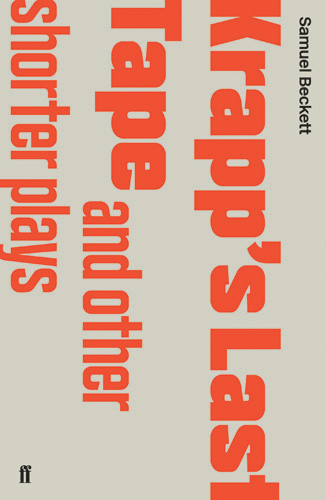
Any colour, so long as it’s grey” — New typographic covers for the Faber editions of Samuel Beckett,  designed by London-based studio A2/SW/HK. You can see more from the series at Faber’s Flickr photostream.

The Publishers’ Dilemma — Tobias Schirmer on publishing’s digital future:

[D]igitalization is not about a product moving from its analogue to a digital form. It is a revolution that changes everything. The old business models don’t work the way they used to. Inevitably, publishing needs to think about how it can still inject value somewhere in between the creation of content and its distribution. Not transition but change management is needed.  Acknowledging this is the first step in getting out of the publishers dilemma.

Now is the Winter of our Discontent — Peter Olson, the former chairman and CEO of Random House, is feeling gloomy in Publishers Weekly. I wonder how much of this only applies to bloated multinationals?:

With the recession accelerating changes that are already taking place in the market, the world after 2009 will likely begin to look very different for book publishers, and a likely return to the relative security of the last decade may be wishful thinking.

Tintin and the Broken Records600 lots associated with the cartoonist Hergé were sold at auction at the weekend:

The sale in Namur, southern Belgium, dominated by five large hand-drawn pages of original cartoon strips, raised 1,172,000 euros (1.57 million dollars), including charges, — a world record for Herge-associated items and a cartoon strip book record in Belgium, said Thibaut Van Houtte, an expert on hand for the Rops auction house sale.

Titles Designed by Saul Bass — A collection of Bass’ incredible film credit sequences at Not Coming To A Theater Near You (via Grain Edit on Twitter):

One is pressed to cite an example of an active, self-contained, and characteristic credits sequence in film prior to the work of Saul Bass. And…  in regard to innovation, renown, and influence, Bass’ impact in credits design remains virtually unparalleled, even to this day.

Comments closed