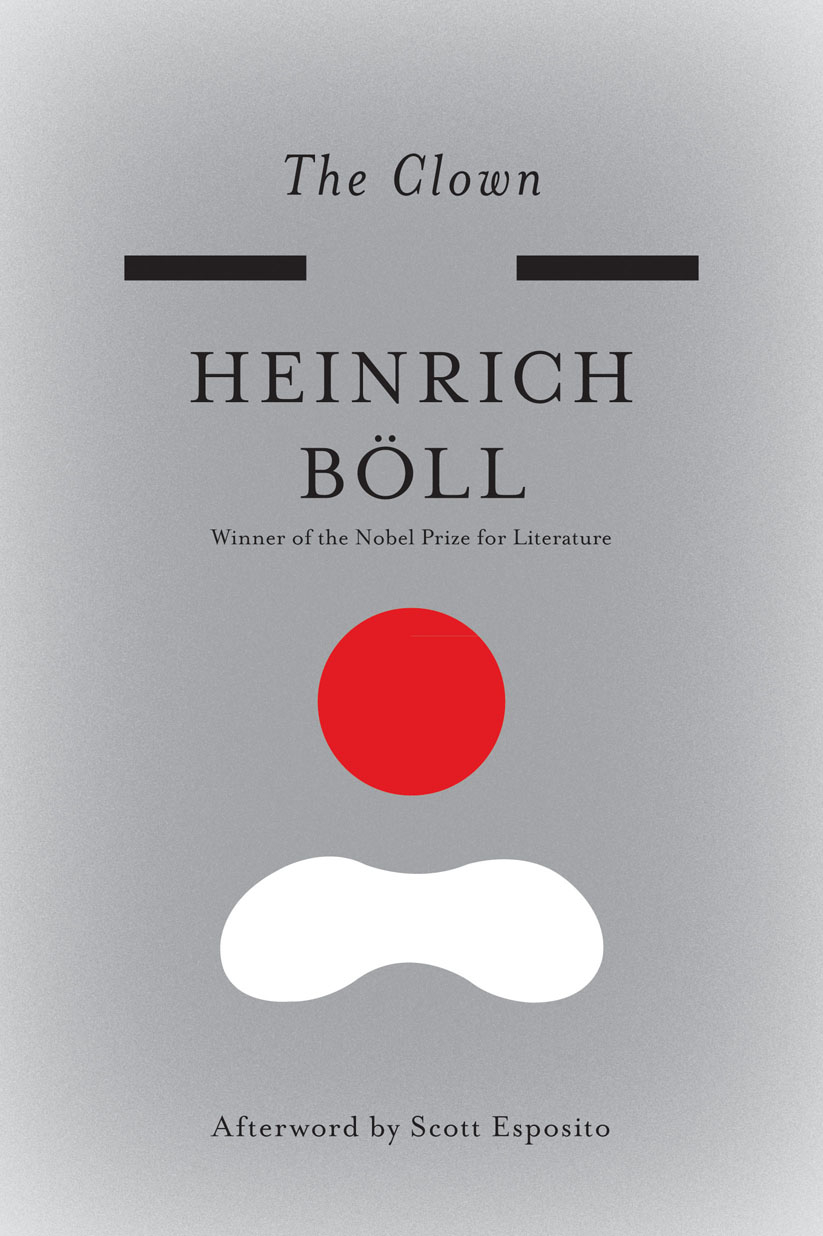
The Book Bench interviews designer Kelly Blair about her work and her Heinrich Böll redesigns for Melville House:
There are so many amazing and striking book covers out there, yet I am most often drawn to the simplest thing on the shelf. Perhaps it’s because I am so immersed in book design day-to-day, but sometimes going into the bookstore can feel visually overwhelming, like the cereal aisle at the grocery store. To that end, David Knopka’s series design for the Melville House novellas still stands as one of my favorites. For the same reason, walking into the Persephone book shop in London feels like a breath of fresh air.
And on the subject of book covers, I’ve been loving designer Andrew Henderson‘s Lovely Book Covers Tumblr.
You can find The Casual Optimist Tumblr here.
Cabaret — Author Hanif Kureishi on the art of writing for The Independent:
There’s no connection between being able to write and being able to explain your work in a rain-swept tent to an audience staring at you like hungry animals contemplating a suspect steak. Listening and reading are different experiences. Reading, writing for a reader, and being read, are intimate acts, and there’s something about trying to articulate what you’ve done that can flatten and reduce it, horrifyingly so.
Some writers choose the written word because they find it difficult to speak directly; many writers are in love with solitude. Whichever it is, good writing should resist interpretation, summary and the need for applause.
The Information — Michael Dirda reviews Too Much To Know: Managing Scholarly Information Before the Modern Age by Ann M. Blair for The Washington Post:
Just how to present information for easy use was a constant vexation. In late antiquity, one might simply find a list of authorities cited. Gradually, though, compilers began to employ categorical headings or to arrange entries alphabetically or according to elaborate branching diagrams of knowledge. “One historian has counted nineteen different systematic orders present in early modern encyclopedic works, including the order of creation, of the Decalogue, of the biblical narrative,” and various “chronological and geographical orders,” as well as others that follow “the chain of being.”
While people during the Middle Ages and later drew much of their learning from dictionaries and digests, the more ambitious also took extensive notes from whatever classics came their way. By the Renaissance one could even purchase the equivalent of “Reading for Dummies”: Francesco Sacchini’s 1614 “De ratione libros cum profectu legendi libellus,” i.e.,”A Little Book on How to Read With Profit.”
The Science of Making Decisions — Sharon Begley on how too much information impairs our ability to make decisions:
The problem has been creeping up on us for a long time. In the 17th century Leibniz bemoaned the “horrible mass of books which keeps on growing,” and in 1729 Alexander Pope warned of “a deluge of authors cover[ing] the land,” as James Gleick describes in his new book, The Information. But the consequences were thought to be emotional and psychological, chiefly anxiety about being unable to absorb even a small fraction of what’s out there. Indeed, the Oxford English Dictionary added “information fatigue” in 2009. But as information finds more ways to reach us, more often, more insistently than ever before, another consequence is becoming alarmingly clear: trying to drink from a firehose of information has harmful cognitive effects. And nowhere are those effects clearer, and more worrying, than in our ability to make smart, creative, successful decisions.
And related… Jonah Lehrer, contributing editor at Wired and the author of How We Decide and Proust Was a Neuroscientist, on why easy decisions seem so hard:
Comments closedThe problem, of course, is that the modern marketplace is a conspiracy to confuse, to trick the mind into believing that our most banal choices are actually extremely significant. Companies spend a fortune trying to convince us that only their toothpaste will clean our teeth, or that only their detergent will remove the stains from our clothes, or that every other cereal tastes like cardboard. And then there is the surreal abundance of the store shelf… While all these products are designed to cater to particular consumer niches, they end up duping the brain into believing that picking a floss is a high-stakes game, since it’s so damn hard. And so we get mired in decision-making quicksand.
