“As a procrastination tactic, I sometimes ask my fifteen-year-old daughter what the comic strip or drawing I’m working on should be about—not only because it gets me away from my drawing table but because, like most kids of her generation, she pays attention to the world. So, while sketching the cover of this Health Issue, I asked her.
“ ‘Make sure it’s about how most doctors have children and families of their own,’ she said.
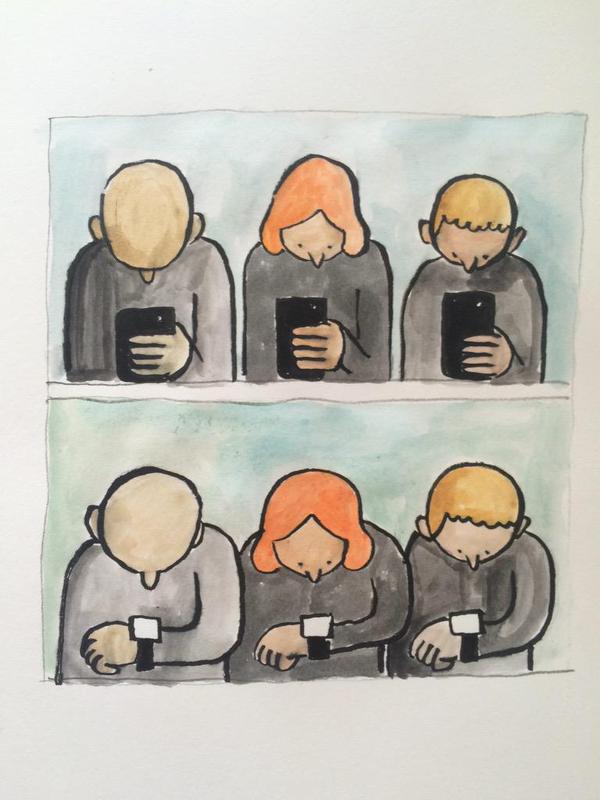
I was reminded of his 2009(!) cover for the New Yorker‘s from Halloween edition in which parents all look at their phones while their kids trick-or-treat. It’s an interesting contrast…
I haven’t posted anything about books and technology here for a while, but I thought this recent Wired piece by Craig Mod on the “Future Book” was quite interesting:
Physical books today look like physical books of last century. And digital books of today look, feel, and function almost identically to digital books of 10 years ago, when the Kindle launched… Yet here’s the surprise: We were looking for the Future Book in the wrong place. It’s not the form, necessarily, that needed to evolve—I think we can agree that, in an age of infinite distraction, one of the strongest assets of a “book” as a book is its singular, sustained, distraction-free, blissfully immutable voice. Instead, technology changed everything that enables a book, fomenting a quiet revolution. Funding, printing, fulfillment, community-building—everything leading up to and supporting a book has shifted meaningfully, even if the containers haven’t. Perhaps the form and interactivity of what we consider a “standard book” will change in the future, as screens become as cheap and durable as paper. But the books made today, held in our hands, digital or print, are Future Books, unfuturistic and inert may they seem.
The New York Times on the small independent bookstores making the most of social media and online sales:
Undoubtedly, the bookselling industry is still digging out of a deep trough. Sales of physical books in physical stores were just $11 billion in 2015, compared with $17 billion in 2007.
But owners like Mr. Makin are finding ways to gain customer loyalty with the aid of technology. He knew he could not compete with Amazon on price, but he believed that online buyers would flock to Brilliant Books if they experienced the same customer service that shoppers in his physical store do.
“I say, ‘We are your long-distance local bookstore,’” Mr. Makin said.
He began offering free shipping anywhere in the United States and hired a full-time social media manager, who promotes the store and has used Twitter and Facebook to talk to readers who would never find themselves near Traverse City.
One of his most successful ways of getting repeat business is his store’s version of a book-of-the-month program, which makes personalized recommendations for each of its nearly 2,000 subscribers every 30 days. Rather than use an online form to track preferences, Brilliant sends each new subscriber a customer card to fill out by hand and mail back.
Employees then scan the card into the system so that when it is book-selection time, they can see what the customers said they liked and how they said it.
“How we might write something might show an entirely different taste in books,” Mr. Malkin said. “People scribble things out. They draw arrows. We get a feel for who they are.”
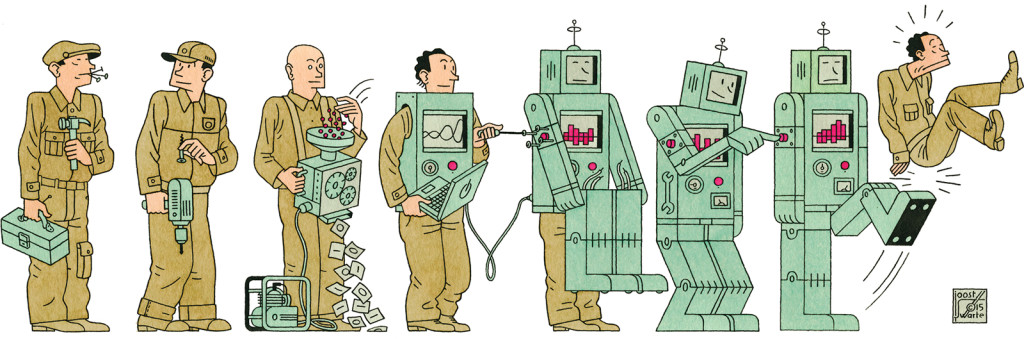
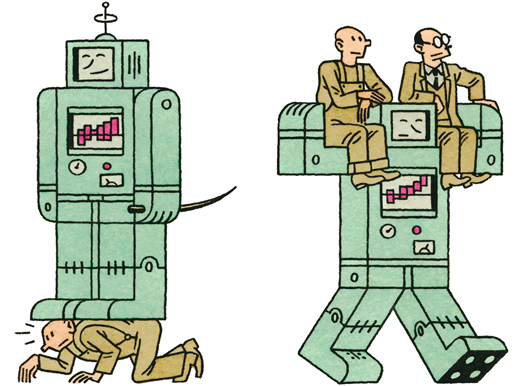
Writing at the MIT Technology Review, David Rotman looks at the impact of automation and digital technology on jobs with reference to a number of recent books related to the subject including Rise of the Robots: Technology and the Threat of a Jobless Futureby Martin Ford, The Great Divide by Joseph Stiglitz, and The Second Machine Age by Erik Brynjolfsson and Andrew McAfee. But if you find that all too depressing to contemplate — and who doesn’t? — you can at least enjoy the wonderful Joost Swarte illustrations that accompany article …
My ‘longreads’ to-read list is as bad, if not worse, than the pile of books I have to read right now, so it’s taken me until today to get to that very, very long New Yorker profile of Jonathan Ive, the senior vice-president of design at Apple.
Unfortunately, the whole thing is a bit disappointing and, I thought, even a little sad. By the end, Ive remains an enigma. What lingers is his famous friends, love of bland luxury brands, and just how remarkably wealthy he is (writer Ian Parker reminds you several times that Ive owns a private jet).
It seems Ive is either depressingly shallow or, more likely, these superficial things are all that he is willing to reveal about himself, which is depressing too in its own way. Ive is, no doubt, just politely protecting his privacy, but he comes across as peevish and sadly unlikeable, which is a shame. Or maybe I’m just not interested enough in industrial design and luxury brands, or Apple if it comes to that.
The article does, however, give me an excuse to post this blistering 15 minute video of NYU Stern marketing professor Scott Galloway talking a mile-a-minute about Apple, Amazon, Facebook and Google. I’m sure he’s wrong about a lot of things, but not only does he talk about Apple’s transition from tech company to luxury brand, he also offers some of the most cogent insights into the current problems facing Amazon I’ve heard in a while:
Interestingly, Ian Parker says in his New Yorker article that watch manufacturers are not worried about Apple stepping into the market. Galloway says they should be. I guess we’ll see who is right.