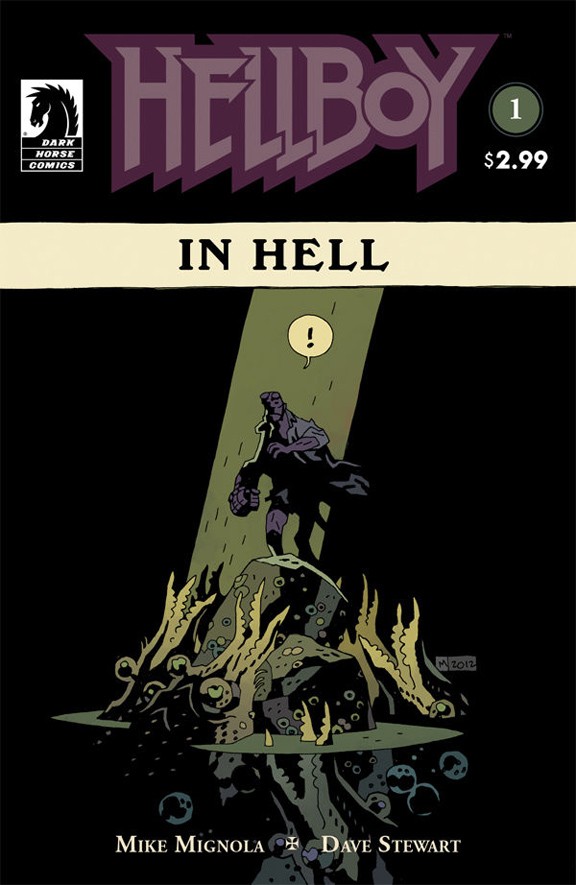
Folklore — Mike Mignola talks about drawing Hellboy again, at ComicsAlliance:
I do have a library. Very little of it is leather-bound. The folklore and mythology library, which is in my studio, is pretty tacky looking since it’s all picked out of used bookstores. I am a book guy but more and more I do use a computer to do certain research things. But there are 30-40, 50, maybe 100 books of folklore in there, most of which haven’t been read. I’ll look at a table of contents and go, “Wow there’s 30 to 40 different Hellboy stories in there.” It’s very comforting to know there’s a million stories to tell that I can pluck off the shelf for those days where it’s like, “Well, I got nothing!”
Suicide Watch — Steve Almond reluctantly reviews Building Stories by Chris Ware for The New Republic:
Ware is essentially a poet of solitude. He uses language and images to capture the private torments of unfulfilled lives. His characters drift in a sea of self-recrimination and unmet desire (not unlike the rest of us). They rarely find love, or resolution.
This bleak approach does yield a curious dividend, though. The occasional moments of grace explode off the page. At one point, we see his heroine cavorting with her daughter on their front lawn. “I remember Lucy landing on top of me, laughing…with the sun shining behind her suddenly life came into perfect focus,” she muses. “This was what it was all about … this very moment … the joyful reality of my daughter.” The girl’s lovely face, nearly life-size, beams at us from the middle of the page.
Of course, this idyll is shattered by the news that one of her friends has committed suicide. If Ware has one flaw, it’s his obvious discomfort with the notion that people—at least his people—might ever find an enduring happiness.
And, while were on the subject of comics…
Hannah Berry, author of the enjoyable Britten & Brülightly, writes about the independent comics scene in the Britain at the New Statesman. Berry’s second graphic novel Adamtine was published earlier this year in the UK by Jonathan Cape.
Also at the New Statesman, Hayley Campbell on the current state of British comics.
Meanwhile, back in the world of big grown-up publishing…
The Telegraph profiles Liz Mohn, “the woman behind media giant Bertelsmann” and, therefore, the monster that is Penguin Random House.
And finally…

Lubricated — Hunter Oatman-Stanford (how’s that for a moniker?) examines the nautical past of popular tattoos at Collectors Weekly:
“Many sailors are extremely superstitious,” says [C.W] Eldridge [founder of the Tattoo Archive], “so they would get specific tattoos to relieve this anxiety over their beliefs. There are stories of guys in the old, wooden-ship days who would get Christ’s head tattooed on their backs so if they got into trouble and had to take lashes, the person wielding the lash would be more sympathetic.”
The variety of designs matched each and every danger aboard a ship. “Sailors would get things like a pig and rooster on their feet to keep them from drowning,” Eldridge says. “They would have ‘Hold Fast’ tattooed on their knuckles so that when they were in the riggings, their hands would stay strong. They would get hinges on their elbows to keep them from having rheumatism and arthritis, and sometimes they would even get a little oil can tattooed above the hinge so that the hinges would stay lubricated.”
Like this:
Like Loading...