In the most recent installment of the Laser Age, the Dissolve’s fascinating history of science fiction films from the 1960s to the 1980s, Keith Phipps turns his attention to Superman, Star Trek, and Flash Gordon — three movies released in the immediate wake of Star Wars. It’s a great read if you are at all interested in this stuff, but it’s also a perfect excuse to revisit Phipps’s earlier — but oh, so timely — essay, ‘Why Star Wars?’:
Why? Of all the science-fiction films released in the long wake of 2001: A Space Odyssey and Planet Of The Apes, why did Star Wars take hold in a way no film before it had? None of the many answers are entirely satisfying. But combining a few of them lets us make some sense of the question.
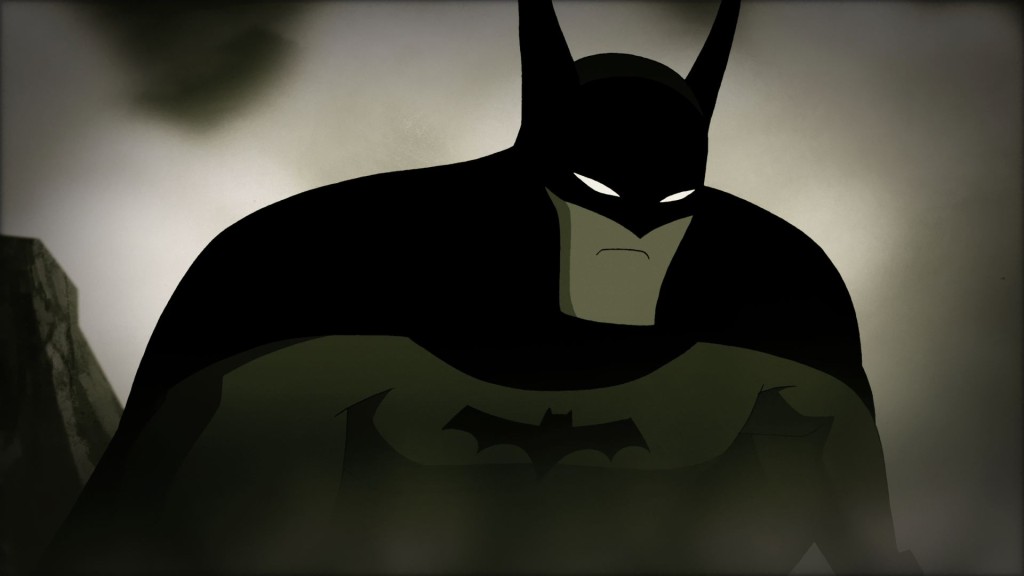
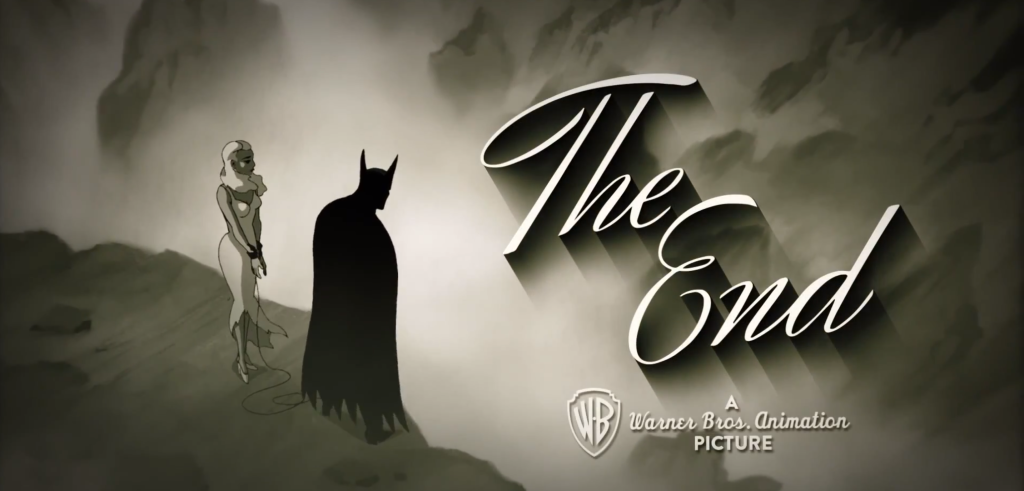
For me, and I suspect plenty of other people of a certain age, the noir-inspired Batman: The Animated Series, is still the most satisfying version of the character to come to screen. The series has long since ended but happily, Bruce Timm, co-creator of the series, has produced a new, wonderfully retro, animated short called Batman: Strange Days to celebrate the Dark Knight’s 75th anniversary:
In a recent interview with Comics Alliance, Timm talked about his work on the original series and the retro look of the new short:
I wanted to make the whole cartoon look as if it was like the cartoon itself was made in 1939, got stuck in a vault somewhere, and nobody has seen it until now. Not that I thought we were going to pull that kind of hoax, but that was the feel I wanted. I wanted it to be so authentically old school. I went back and looked at those early Bob Kane comics and even though they’re really super crude, there’s something really cool about the way Batman looks in those comics. He’s got the really long ears, they kind of stick out in an inverted “A” shape, or a “V” shape, on the top of his head because they kind of stick out on an angle; they’re really tall. He’s got tiny eyes, his trunks are long, his boots are long. He has short little gloves. I tried to incorporate as much of that in there as possible.
No surprise then that like the animated series, it reminds me a lot of the Fleischer Studios Superman cartoons from the early 1940s. The first episode of that series, “The Mad Scientist”, was released September 26th 1941 (before Superman could even fly!):
Personally, I like the episode 2, “The Mechanical Monsters, a lot:
And just as side note, when Batman first battled Hugo Strange’s giant monster men in Batman #1 (Spring 1940), he doesn’t mess about with tear gas — he actually takes them down with a machine gun. It would be the last time Batman killed anyone on purpose.
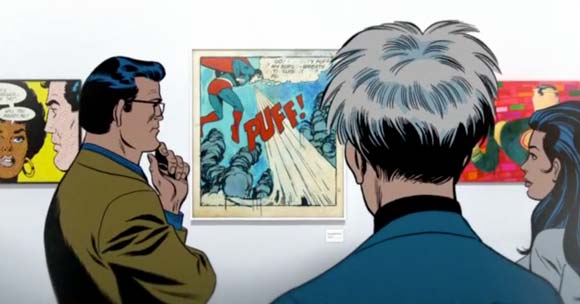
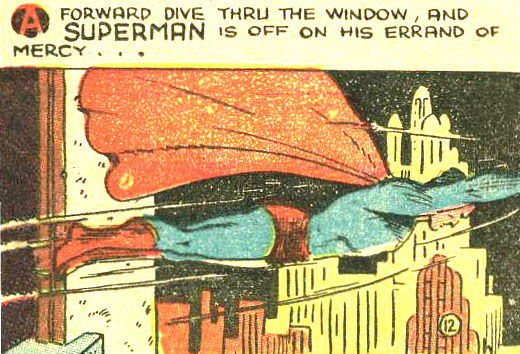
At the Smithsonian Design Decoded blog, Jimmy Stamp provides a brief history of The Daily Planet building in Superman comics:
Whenever disaster strikes Superman’s Metropolis, it seems that the first building damaged in the comic book city is the Daily Planet – home to mild-mannered reporter Clark Kent, his best buddy Jimmy Olsen, and his gal pal and sometimes rival Lois Lane. The enormous globe atop the Daily Planet building is unmistakable on the Metropolis skyline and might as well be a bulls-eye for super villains bent on destroying the city. But pedestrians know that when it falls–and inevitably, it falls–Superman will swoop in at the last minute and save them all (The globe, however, isn’t always so lucky. The sculpture budget for that building must be absolutely astronomical).
I have no idea what I’m doing. All the decisions I appear to have made—about plots and characters and where to start and when to stop—are not decisions at all. They are compromises. A book is whittled down from hope, and when I start to cut my fingers I push it away from me to see what others make of it. And I wait in terror for the judgements of those others—judgements that seem, whether positive or negative, unjust, because they are about something that I didn’t really do. They are about something that happened to me. It’s a little like crawling from a car crash to be greeted by a panel of strangers holding up score cards.
A Dog’s Cock — The history of the exclamation mark:
no one really knows the history of the punctuation mark. The current running theory is that it comes from Latin. In Latin, the exclamation of joy was io, where the i was written above the o. And, since all their letters were written as capitals, an I with an o below it looks a lot like an exclamation point.
But it wasn’t until 1970 that the exclamation point had its own key on the keyboard. Before that, you had to type a period, and then use the backspace to go back and stick an apostrophe above it. When people dictated things to secretaries they would say “bang” to mark the exclamation point. Hence the interobang (?!) – a combination of a question (?) and an exclamation point (!). In the printing world, the exclamation point is called “a screamer, a gasper, a startler or a dog’s cock.”
One more on the late Robert Hughes at The Economist:
As our lives grow increasingly distracted and overstimulated, the critic has become both more and less relevant in the service of cultural sieve, filtering out the good from the bad. Mr Hughes didn’t subscribe to such categorical certainties. In turn he placed as much emphasis on the context of a work as he did on its content. To Mr Hughes, experiencing art wasn’t about passing a few hours in some museum, but what made those few hours meaningful to be alive.
My hobby has two rules: I buy books only on the street. (Uniquely boring books must present themselves willingly; you can’t hunt them down.) And the titles must meet a standard of boring intrigue that I have a hard time putting into words, beyond “I know it when I see it.” This is where — if I may shed any pretense of modesty — taste and connoisseurship come into play.
[Comics] are a unique storytelling medium. They can tell a story in a way that no other medium can. But I’m not evangelical about comics, and I don’t have a problem if they’re a niche interest. There was a time in the eighties when everyone thought comics were going to break through. They were sold in bookshops. “Sequential art”, “post-textual literature” and all kinds of other pretentious terms were bandied about. I don’t think that’s necessary. Comics are their own thing, and work on their own terms, in different ways to novels and films.
Steven Hyden on My Bloody Valentine album Loveless at Grantland:
Listening to Loveless is not unlike the sensation of having just endured a two-hour sonic hurricane, then feeling an intense yet melodic pounding in your eardrums for the next week. And I mean that in the most pleasant way imaginable. What took so long for Shields to find in the studio was the ecstatic pleasure point buried in the suffocating psychic evisceration caused by pure unadulterated volume. On most rock records, the music drowns out the lyrics; on Loveless, the music drowns out the music.