Skip to content

Tag: steven attardo

Monday Miscellany

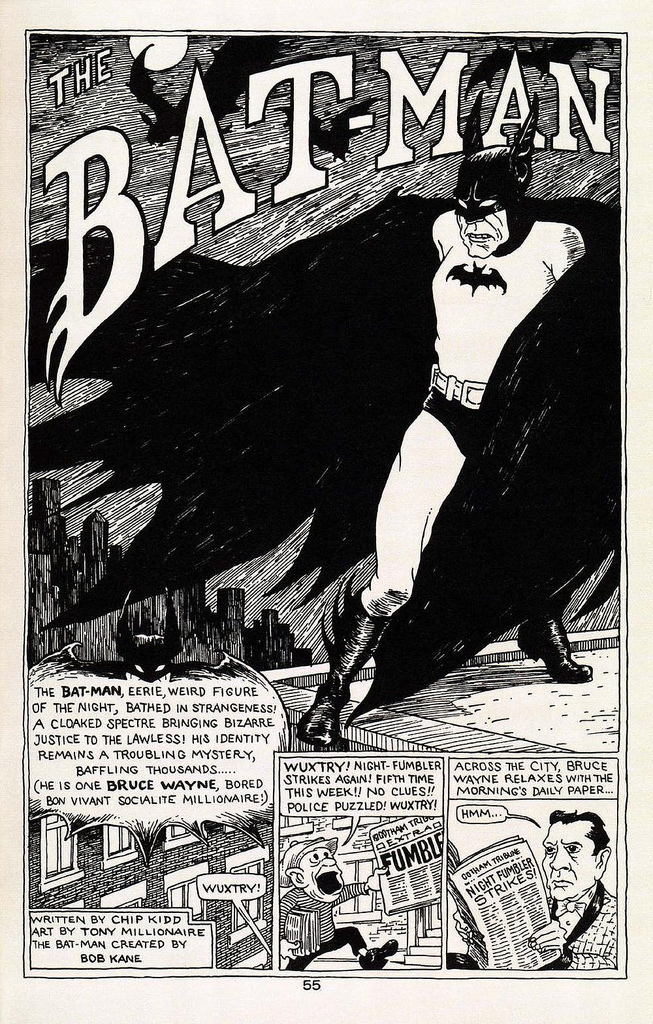
“The Bat-Man” by Chip Kidd and Tony Millionaire from Bizarro Comics #1. I can’t quite believe I haven’t seen this before… (via Martin Klasch)

Could Have Been Something — José da Silva interviews Billy Childish for The White Review:

Critics want you to get in your box and shut up. That’s why they don’t like it that I’m a writer, musician and painter. That’s totally unacceptable to their small minds… I’m looking for freedom from being categorised or identified with aspects of myself. But at the same time I use this very strong biographical information to negotiate a world – a world which I find quite mental, by the way. So I still refuse to identify myself as Billy Childish the artist,  painter, writer or musician, because in my estimation only an idiot would want to be something.

Accommodating the Mess — Tim Martin on B S Johnson,  ‘Britain’s one-man literary avant-garde’, for The Telegraph:

In principle, at least, Johnson’s declared mission echoed the great Modernist cry to make it new. Politically socialist and from a working-class London background, he cultivated pithy distrust for the complacency of his novelist peers, “neo-Dickensian” writers, as he called them, who were using a 19th-century form to gratify the “primitive, vulgar and idle curiosity of the reader to know ‘what happens next’”. A truly modern novel would seek, in Beckett’s phrase, a form to accommodate the mess, stripping readers of their escapist illusions while remaining ruthlessly true to the writer’s experience.

This obsession with so-called narrative truth runs through Johnson’s work, accounting for its most unorthodox experiments as well as its greatest flaws.

See also: Juliet Jacques review of Well Done God! Selected Prose and Drama of B S Johnson for The New Statesman.

And finally…

The mild-mannered Richard Hell in the New York Times:

After running away to New York in 1967, at the age of 17, with dreams of becoming a writer, Mr. Hell collected some good editions of favorite books. Then, in the 1970s, when he became a drug addict, he traded them for cash.

“Those were pretty much my only liquid resource,” he said. “So I sold them all over the years.”

Since getting his health and career back on track in the ’80s, he has replaced most of the ones that got away. Given the number of books now neatly stacked into the East Village apartment where he has lived for the last 38 years, he has more than made up for lost time.

Hell’s memoir, I Dreamed I Was a Very Clean Tramp, is out this week. The cover was designed by Steven Attardo.


Comments closed

Midweek Miscellany

Peter Mendelsund chats with Chip Kidd about his office for the redesigned From The Desk Of:

I’ve always been a ‘nester’, I think most designers are. The difference now between my office and my bedroom as a child is the dearth of KISS posters (I mean NOW, not then).

(Frankly I’m surprised the universe didn’t collapse from all that awesomeness contained in a single room)

And on a related note, Mendelsund is one of many designers who work is included in AIGA’s recently announced 50 Books / 50 Covers list (although several covers appear to be attributed to their art directors rather than the designers themselves, no?).

Math-Lit — Helen DeWitt, author of The Last Samurai and the forthcoming Lightning Rods, interviewed at BookForum:

Chance often plays a big part in fiction, but it is generally not chance as this is mathematically understood, which tends to be counter-intuitive. A while back I discovered Edward Tufte’s brilliant books on information design, The Visual Presentation of Quantitative Information, Envisioning Information, and so on. I read Gerd Gigerenzer’s Reckoning with Risk, about why we have trouble calculating probabilities using percentages, even when it’s a matter of life and death (a doctor working out the likelihood that someone is genuinely HIV-positive, based on a positive test result); I read Peter Bernstein’s Against the Gods on the history of risk; I read Michael Lewis’s Moneyball, on the way sabermetrics had transformed professional baseball. It seemed to me that one could use Tufte’s methods to incorporate this tremendously interesting subject into fiction.

The cover design for Lightning Rods is by Steven Attardo for Rodrigo Corral Design.

And finally…

The legendary George Lois talks about his covers for Esquire  with Gym Class Magazine. There’s no shortage ego, but I love this anecdote about playing a soft ball game against The New Yorker:

So I go over there with my glove and my sneakers, and I could not believe it. I looked at the team. The third baseman was Gay Talese. The second baseman was Gore Vidal. It was not a team of athletes. I said: ‘Oh my god, they’re all literary geeks.’ He said: ‘No, no, we’re going to have fun.’

Now I’m serious about playing softball or basketball. I don’t screw around, I play with great ballplayers, I’m a good athlete. I said: ‘Harold, this side is terrible.’ He said: ‘No no!’

We went over and played THE NEW YORKER, and I think we lost 18–3, and the only reason we got three runs is because I hit three homers. I don’t remember being there for any other reason.

Comments closed