Skip to content

Tag: State of the Industry

Margaret Atwood : The Publishing Pie

Author Margaret Atwood used to come by the bookstore where I worked in Toronto. It was always slightly surreal selling books to her, but certainly no more so than watching her on YouTube (YouTube!) deliver a great keynote speech at O’Reilly’s recent TOC Conference:

Atwood expands on her talk in this interview with Gretchen Giles:

3 Comments

Something for the Weekend

Steven Heller, editor of I Heart Design and author/editor of countless other books about design, at 10 Answers.

And Steven Heller is one of the designers featured in BBC Radio documentary I Heart Milton Glaser about the iconic I (Heart) NY logo and the designer who created it (go listen now because it’s only available for a few more days).

Print and the City –a fascinating look at whether movable type printing presses were the drivers of economic growth in cities by Jeremiah Dittmar (via The Browser):

[C]ities in which printing presses were established 1450-1500 had no prior growth advantage, but subsequently grew far faster than similar cities without printing presses… Cities that adopted print media benefitted from positive spillovers in human capital accumulation and technological change broadly defined. These spillovers exerted an upward pressure on the returns to labour, made cities culturally dynamic, and attracted migrants.

In the pre-industrial era, commerce was a more important source of urban wealth and income than tradable industrial production. Print media played a key role in the development of skills that were valuable to merchants. Following the invention printing, European presses produced a stream of math textbooks used by students preparing for careers in business.

The Savage Marketplace — A really interesting and thoughtful survey of the current state of book editing in the UK by Alex Clark , with contributions from Diana Athill, Blake Morrison, Jeannette Winterson and others, for The Guardian:

[W]hat saps the spirit are the manuscripts that leave you with the question: why did no one sit down with the writer and point out where this isn’t working? Why didn’t a red pen mark the hackneyed phrase, or the stock character, or the creaky dialogue? And, sometimes, why didn’t someone deliver the unfortunate verdict: this simply isn’t ready yet, and may never be?

And finally, if you’re in London… Kemistry Gallery have an exhibition of film posters by Saul Bass from the BFI archive, February 17th to March 17th:

SOME GOOD NEWS FROM THE WORLD OF BOOKS.

Comments closed

Merchants of Culture | The Book Show

Another really interesting interview with John Thompson, author of Merchants of Culture, about the past, present, and future of the book business.  This time he talks with Ramona Koval for The Book Show on ABC Radio National:

ABC Radio National The Book Show: John Thompson Mp3

Comments closed

Midweek Miscellany

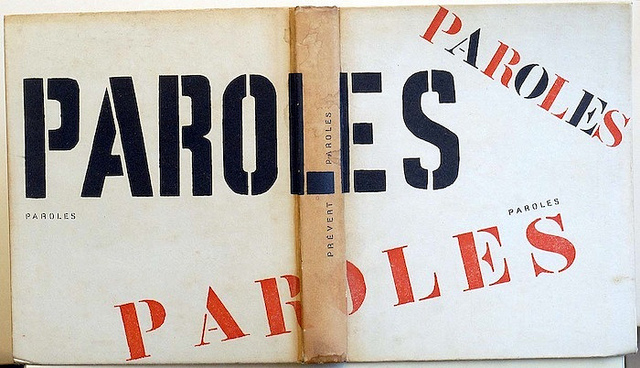
Some lovely vintage French book covers on Flickr, courtesy of Alexis Orloff (via Words & Eggs).

Cultural Change — A really interesting analysis of the current state of publishing by John B. Thompson, author of Merchants of Culture, at The Brooklyn Rail:

Readers and consumers have many different values, and beliefs, and preferences and you will see some be very happy to read on electronic devices of one kind or another. Others will remain wedded to print on paper and will want books in that form. There are deeply embedded cultural practices around writing and reading and these are not going to change quickly and easily. There are people who believe that technology sweeps all before it, and that technology is really the driving force of social change. I don’t take that view. I regard that as a technological fallacy—the view that technology is a driving force of social change. I think technologies are always embedded in social, cultural context and what technologies get taken up depends on a variety of factors that shape people’s practices and beliefs. There are many examples of technologies that went nowhere…

Getting Paid — Cartoonist and illustrator Colleen Doran on the pirating of her comics (via Richard Curtis):

Creators and publishers can’t compete with free and the frightening reality is that even free isn’t good enough.   Pirates aggregate content in ways creators and legit publishers can’t. Why go to dozens of web pages for entertainment when you can go to a pirate and get everything you want? There’s no connection to creators as human beings who work hard and make money from that work, and who need income from past work to finance future work.

Distribution is the only concern. Readers care about the gadget that gives them the goods, and have no connection to the goods at all, or who made them.  But without desirable content, there’s nothing to distribute.

Everyone gets paid — manufacturers of computers, iPads, electricity, bandwidth — everyone except the creators of content.

And finally…

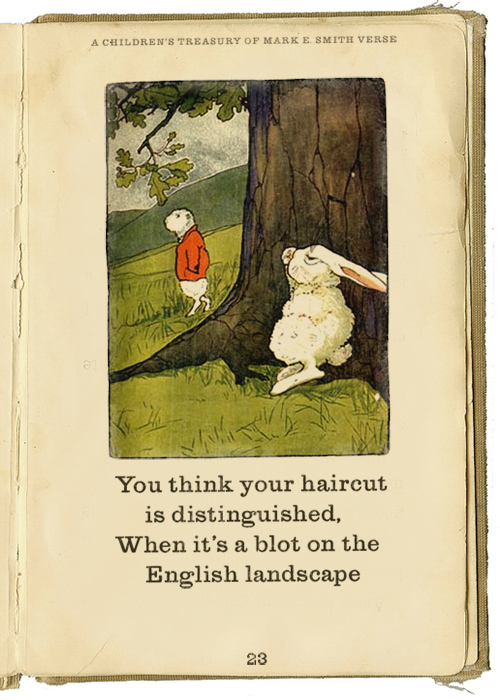
A Children’s Treasury of Mark E. Smith Verse (via the awesome A Journey Round My Skull):

Comments closed

Agents of Change

There’s a great op-ed by Stephen Page, chief executive of Faber & Faber, in today’s Guardian about the iPad and publishing:

It’s clear that publishers must move faster to establish our compelling and useful role in the modern life of reading. While acquiring new expertise, we must assert the best of our traditional strengths; providing capital (in the form of advance payments), offering editorial expertise, and creating a readership by designing, creating, storing, promoting and selling the works of writers. But that’s not enough. Publishers also have to explain what value they are bringing to the relationship between writers and readers, a conversation that is made far more transparent through digital media and digital texts.

Page goes on to list what he sees as guiding principles for publishing going forward. These include retaining print and digital rights, reviewing royalties, flexible pricing, connecting to readers, and excellent metadata. He concludes:

The iPad launch is not the moment, but that’s because the moment has passed. We need to work with authors in new ways, and keep pace with reading’s evolution, or better still become agents of change ourselves.

It’s a must-read. If you work in publishing, send it to your CEO.

1 Comment

Work with a Publisher!

I love Tom Gauld:

Comments closed

#Failure

It probably hasn’t escaped your notice that following the departure of founder and publisher Bob Miller to Workman Publishing last month, HarperCollins imprint HarperStudio is going to close after just 2 years in business.

As a publisher, HarperStudio garnered a remarkable amount of media attention for offering authors lower advances in exchange for a greater share of profits, their plans to sell book to booksellers on a non-returnable basis, and an early and comprehensive embrace of social media.

There was, however, a general feeling — particularly within the industry itself — that despite (or because of) their marketing-savvy, the imprint didn’t quite live up to the hype (even if not everyone felt quite as strongly about it as Dennis Johnson).

In the end they unable to keep author advances down, or their books non-returnable. Yet, as writer Mark Barrett who blogs at Ditchwalk notes, these problems are hardly unique to HarperStudio and, in a sense, their failure is a collective one for publishing.

Perhaps we simply expected (or hoped for) too much?

Nevertheless, I was disappointed by HarperStudio for the more basic reason that their books always seemed to be less innovative than the company itself. When people talked about HarperStudio it was rarely about what they actually published. The books were — for all their audacious marketing — eminently forgettable. They were kind of things that traditional small-to-medium sized trade publishers have a tendency to churn out with alarming regularity (with perhaps the notable exception of Crush It! for which HarperStudio reputedly paid a rather large advance), and it was never clear to me who their core readership was intended to be. Their innovations seemed to do little to improve the kind of books being the published.

In this sense, HarperStudio’s closure has echoes of Quartet Press.

Like many people, I had unrealistically high expectations for Quartet, and I still admire the fact that the people involved put their money where their mouths were (and mostly still are). But my heart sank when it became clear that for all their innovative plans for e-books, they launched with nothing ready to publish. The eventual announcement that they would be publishing romance fiction meant that, unlike HarperStudio, they at least planned to publish to a recognised (and potentially profitable) niche, but somehow this felt like an afterthought. The digital medium was more important than the message.

I was reminded of all this by Brett Sandusky‘s recent announcement that his project Publishr is soliciting for material to publish:

Publishr is proud to announce a new project: Publishr will bring an eBook, which has yet to be created, to market. We will do this in an atmosphere of complete transparency.

Publishr currently seeks proposals from motivated authors (particularly those with works of unpublished fiction and narrative non-fiction) as well as support from contributors who are interested in innovation and building a superior native-digital eBook product or suite of products that will be sold in the real world.

In many ways this is great idea, and there are definitely lessons to be learnt from this kind of experimentation. But Publishr seems to be following in the footsteps of HarperStudio and Quartet (albeit on a smaller scale). Based on the erroneous belief that there is a large reservoir of quality material that can be easily and quickly tapped, the focus is on revolutionizing how to publish rather than what or who to publish.

There is, of course, wisdom to innovating the process rather than the product. Toyota’s success was built on innovative factories, not innovative and original products (at least until the Prius came along). And yet the Toyota process was geared (again until recently) to producing certain kinds of consistently good, inexpensive cars (which, I would guess, was all the consumer actually cared about).

My point is not that we should not stop experimenting with new author contracts, transparency, formats, trade terms, or marketing — we need to try new things and be allowed to fail. But this should not come at the expense of consistently good, interesting (and inexpensive) books.

Perhaps a model for start-ups is to be found in James Bridle’s modestly immodest print-on-demand publishing effort Bookkake. Although Bookkake is not publishing new material (and who knows whether it is making money), it seems a more sustainable kind of venture, not least because James has published books that he cares about. They have an sense of coherence and quality that one might expect from a successful small press.

Another alternative is demonstrated by Toronto small press ChiZine Publications (CZP) who established a ‘dark genre’ webzine long before they moved into print. Founders Brett Alexander Savory and Sandra Kasturi knew what the kind of stories they liked — “weird, subtle, surreal, disturbing dark fiction and fantasy” — and built a community around it. The books (available in multiple formats) came later.

The CZP story in particular seems to be the polar opposite of HarperStudio, Quartet, and Publishr. CZP was launched because they had stories they wanted to publish, not because they wanted to ‘fix’ the system. I’m not saying that improving the process isn’t important, it’s just that we need to find new, interesting, consistently good content as wellmeaningful stuff that matters (if only to us). If we don’t, the new books will just be glowing versions of the old books (with better PR)… Plus ça change…

8 Comments

The Peanut Gallery

Having written a couple of things this week about what publishers should be doing, Don Linn has a timely post at his blog Bait ‘n’ Beer on exactly why such thoughts are usually wide of the mark:

[N]ot all publishers are the same. While there are some commonalities among the hundreds of publishers, there are major differences between trade, academic, educational, reference and other types of publishers and even within those broad categories, there are major differences (even within the same house) between fiction and nonfiction, text and illustrated, genre and general fiction, children’s, YA and adult titles. And I’ve only named a few… The point is it’s dangerous to take individual examples and generalize them to an entire, very diverse industry.

He goes on remind readers that talk is always cheap:

[P]ublishers don’t do everything critics think they should [because] not many publishers are rolling in cash at the moment. I can’t name a single publisher who wouldn’t want to spend more on investments in marketing, quality, workflow improvement and editorial, but the money’s just not there. So we need to temper our expectations with a dose of financial reality.

It’s a great post. And worth reading every time you think a publisher should be doing something they aren’t.

(link)

Comments closed

Too Many Books

“We have reason to fear that the multitude of books which grows every day in a prodigious fashion will make the following centuries fall into a state as barbarous as that of the centuries that followed the fall of the Roman Empire.”

“Too many books” is one old complaint. Historian Adrien Baillet wrote that in 1685. Plummeting book prices is another…

An interesting segment about books on NPR’s On The Media from late November 2009:

(Too bad about the dreadful Moxy Fruvous song)

The transcript is here.

(via Lined & Unlined)

Comments closed

Predictions

I really don’t know why smart people make predictions.

Surely one of the lessons of the last couple of years is that experts are actually very, very bad at making predictions — or rather, they are good at making predictions, just not very good at making accurate ones, which is, perhaps, even worse.

And didn’t we learn that experience doesn’t necessarily tell us much about the future?

In fact, someone even wrote a bestselling (if very irritating) book about it.

Nevertheless, it seems the smart book people — like moths to a flame — are undeterred. Here are some predictions from people in and around the industry:

Book Business Faces ‘Tectonic’ Shift: 2010 and Beyond (Part One) — Gail Roebuck (Random House), Peter Field (Penguin) and Victoria Barnsley (HarperCollins) in The Bookseller. Victoria Barnsley:

I think 50% of books will be read online by 2020. There will be far more variety for consumers across different formats with enhanced e-books for example. The business model will become much more complicated. The day when we sold only hardbacks and paperbacks will be looked backed at with wonder.

‘Decade of the people’: 2010 and Beyond (Part Two) — Tim Godfray (Booksellers Association), Michael Neil (Bertrams), Tim Coates (library campaigner), Roy Clare (Museums, Libraries and Archives Council), George Walkley (Hachette) in The Bookseller. Tim Godfray:

The big booksellers will develop online presence and independent booksellers will get increased offers of support from publishers, but as ever it will be consumer led and the winners will be the ones that please the consumer…

$64,000 question—where will the book be purchased and on which platform will it lie?

Predictions 2010: Cloudy with a Chance of Alarm — Michael Cairns, Information Media Partners and Personanondata:

[T]here have been few bright spots… during 2009, and after having taken the pulse of views on the near-term future in publishing by speaking to a number of senior publishing executives, my belief is we will not see any appreciable improvements during 2010. While some of their collective views can be attributed to ‘hedging,’ external trends support the lack of optimism whether they be reductions in education funding and library budgets or the increasing reliance on “blockbuster” authors or pricing issues.

It Was the Best of Times, It Was the Worst of Times — Bob Miller, president and publisher of HarperStudio:

[F]or every trend there will be a counter trend

Book Publishing 10 Years in the FutureRichard Nash, former publisher, at GalleyCat:

In 2020 we will look back on the last days of publishing and realize that it was not a surfeit of capitalism that killed it, but rather an addiction to a mishmash of Industrial Revolution practices that killed it, including a Fordist any color so long as it is black attitude to packaging the product, a Sloanist hierarchical management approach to decision making, and a GM-esque continual rearranging of divisions like deck chairs on the Titanic based on internal management preferences rather than consumer preferences.

A baker’s dozen predictions for 2010 — Mike Shatzkin, The Idea Logical Company:

By the end of 2010, the experiment with “windowing” ebooks — withholding them from release when the hardcover comes out — will end as increasing evidence persuades publishers and agents that ebook sales (at any price) spur print book sales (at any price), not cannibalize or discourage them and, furthermore, that this withholding effort does nothing to restrain Amazon’s proclivity for discounting.

2010 Predictions — Joe Wikert, general manager and publisher at O’Reilly Media:

Let’s face it. The e-future of this industry is not quick-and-dirty p-to-e conversions.  Pricing pressures and  value propositions mean these will be nothing more than revenue rounding errors for the foreseeable future.  2010 will be the year where we’ll see more investment in richer e-content products.

Ten Things You Can Comfortably Ignore in 2010 — David Worlock, publishing analyst and advisor, Thoughts from the bottom of my garden…:

Anyone who proclaims the arrival of a new age and names it web 3.0 , 4.2 or X marks the spot.  We are working within a new continuum, every technology we will use in the next 15 years has already been invented and patented, and what remains to be seen is only the way in which consumers react to which combinations of hardware/software/content to solve which problems in what contexts. And nothing is lost by experimentation.

OK, for the record, I do genuinely believe these are all smart people who should have some idea what they’re talking about. But I do think it’s important to ask the following questions:

  • Who is writing the prediction?
  • Why are they making predictions about the book industry?
  • What do they have to gain (or lose) from their predictions coming to pass?

And, remember kids, while predictions are fun, they’re really no more reliable than tea leaves…

Book business faces ‘tectonic’ shift: 2010 and beyond, part oneBook business faces ‘tectonic’ shift: 2010 and beyond, (part one)

4 Comments

Something for the Weekend

It’s been a slightly shite week in the book trade this week.

Amidst the plethora of end of year/decade “Best of…” lists and gift guides, it was announced that Kirkus and Editor & Publisher Magazine are going to close (are we surprised? No); B&N’s Nook e-reader turned out to be not be quite as good as it was cracked up to be (are we surprised? No); and Simon & Schuster, Hachette, and HarperCollins upset the usual suspects (for all the usual reasons — only Moby Lives seemed to get that it might be about something else) by announcing their decision to hold back the release of a few e-book editions (are we surprised? No)… Is any of this particularly interesting? No. (Although — for the record — I am grateful to the WSJ‘s Jeffrey A. Trachtenberg  for reporting on the e-book developments, and to indefatigable Largehearted Boy for compiling a comprehensive list of Best of… lists)…

So needless to say, there isn’t much about the book industy in today’s links. Ah well…

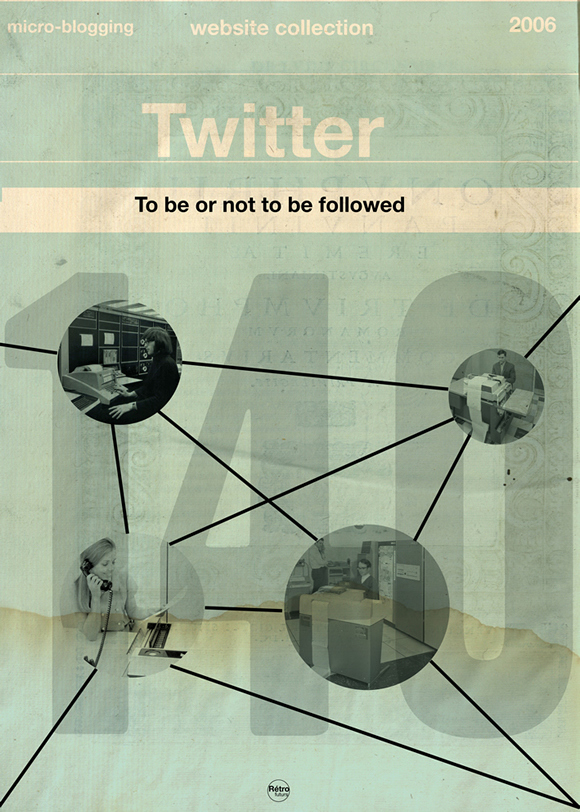
Another addition to the weirdly brilliant (or brilliantly weird?) vintage book/pop culture mash-up phenomenon:  Web Services Book Covers by French illustrator Stéphane Massa-Bidal AKA Hulk4598, or Rétrofuturs. They’re sort of like Olly Moss meets Cristiana Couceiro. (First seen at Design You Trust and then just about everywhere else this morning).

The Sixties — Another fantastic new cover by Henry Sene Yee for Picador’s BIG IDEAS // small books series.

Type for the Tube — an interesting history of Edward Johnston’s typeface for the London Underground from its design to current usage.

And finally…

F is For Fail — A really charming “alphabetical odysessy through the creative process” by Brent Barson (via the lovely Aqua-Velvet):

Can I go home yet?

(Have a great weekend!)

3 Comments

Something for the Weekend, November 13th, 2009

Is this a new cover for J G Ballard’s Crash? HarperCollins Canada have a release date of November 2nd, so I guess so. And I would assume The design/illustration is by the immensely talented David Wardle who did the previous covers in this seriesCan anyone confirm?

In any case, I think the Warhol/Banksy Elizabeth Taylor illustration fits the book pretty well and it’s a nice counterpart to the Marilyn Monroe on the cover of Atrocity Exhibition.

Moving the Needle — Literary agent Nathan Bransford on the challenges facing publishers in the HuffPo:

One of the big recent surprises in the industry… is a newfound difficulty making a splash… with adult nonfiction. Now, to get an idea of what a huge problem… this is, bear in mind that for many years adult nonfiction was the bread and butter workhorse of the industry. Fiction, except for very very established authors, has always been regarded as something of a crapshoot. Nonfiction, on the other hand, was a source of relative stability, and… healthy margins.

Not so much anymore. Everything is difficult to break out.

Artists’ eBooks — a new project from James Bridle and booktwo.org (now, James, if you could only get my bkkeepr badge work properly…)

I Don’t Know WhyUnderConsideration‘s FPO (For Print Only) looks at the quirky and deliciously creepy There Was An Old Lady by Jeremy Holmes, published by Chronicle Books (and — full disclosure alert — distributed by Raincoast in Canada)

And finally…

The (slightly bonkers) illustrator and musician mcbess has a new book (and vinyl record!) called Malevolent Melody coming out from Nobrow:

(If you haven’t seen the insane mcbess/The Dead Pirates Dirty Melody/Wood animated video, you can find that here if you are so inclined).

Update: Thanks to Deanna McFadden of the Tragic Right Hip and HarperCollins Canada for confirming with her UK counterparts that the Ballard cover was designed by David Wardle.

2 Comments